
Dropshipping product research means investigating a customer need, checking demand, comparing competing offers, and deciding whether you can source and deliver a suitable product at a workable cost. Use search, marketplace listings, ads, and customer feedback to build a product hypothesis. Then check the physical sample and test your own offer before increasing your commitment.
The result should be a specific product you know how to evaluate.
- “A popular phone accessory” leaves almost every buying decision open.
- “An adjustable phone stand that works with the cases our customers use” gives you something to investigate, demonstrate, and ask a supplier to provide.
01
Start with a customer and a job the product should do
Choose the destination market and the situation in which someone would use the product. A stand for video calls at a desk may need different features from one carried in a pocket. Those differences affect the competing products, the sample you order, and the promise you can make on the product page.
Useful ideas can come from your existing customer questions, products people buy together, complaints about current options, specialist retailers, marketplace categories, and demonstrations of unfamiliar products. Save the original page or conversation reference with each idea. A screenshot of an attractive object loses much of its value if you cannot recover the model, seller, or use case.
For a new store, start with questions you can investigate:
- What is the buyer trying to do, and what do they use today?
- What is inconvenient about that solution?
- Which feature would make the alternative meaningfully better?
- Can the difference be shown clearly before purchase?
Keep the initial description short. You are choosing an investigation, so several details can remain unresolved. Record those details as questions instead of filling them with optimistic assumptions.
02
Read demand signals according to what they measure
Search activity, marketplace sales rank, and ad engagement describe different behavior. They can help you choose where to investigate, but their numbers do not combine into a reliable “winning product” score.
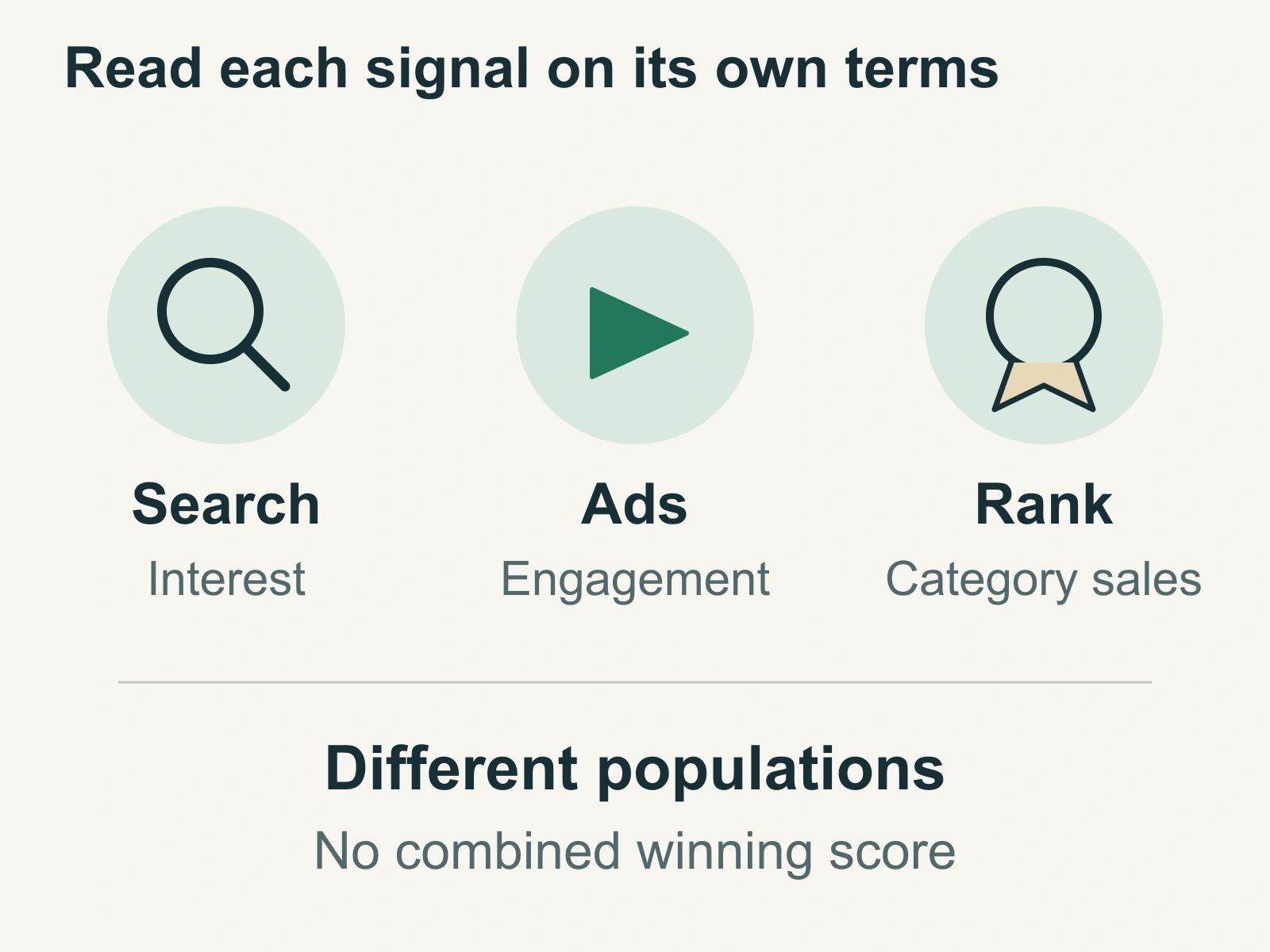
| Research source | Useful question | What the result leaves unanswered |
|---|---|---|
| Google Trends | Is relative search interest persistent, seasonal, or changing in my market? | How many people will buy this particular offer? |
| Google Keyword Planner | What searches occur around this need under my selected settings? | What will my store convert, and at what acquisition cost? |
| TikTok Top Ads | How are selected successful creatives demonstrating the problem or product? | Are those advertisers earning a profit on that product? |
| Amazon Best Sellers Rank | How does a product rank by sales within its Amazon category and store? | Will buyers choose my offer outside that marketplace? |
Google Trends uses sampled search data and scales relative interest from 0 to 100.
- A score of 100 marks the peak within the comparison; it is not a count of purchases. Equal scores in two regions also do not establish equal search volumes.
- Keep the geography, time range, and comparison settings visible when saving a finding. Google Trends data guidance explains these limits.
- Look at enough history to see whether the apparent growth repeats around a holiday or season.
- Then inspect a shorter period for recent changes.
Keep the product term specific enough to describe the intended need: a broad category can rise while a particular product type loses interest.
Keyword Planner adds a different view.
- Its average monthly searches depend on the date range, location, network, and keyword—including close variants.
- The competition column concerns advertisers, so it should not be read as the number of competing stores or suppliers. Google’s historical metrics guidance also distinguishes these search statistics from advertising forecasts.
Use ads to study how an offer is explained.
- TikTok describes Top Ads as a collection of high-performing creatives authorized by advertisers.
- It is a selected collection, so absence from it does not prove a product lacks demand, and inclusion does not reveal the advertiser’s full economics.
- Save the demonstration, objection, or use case worth investigating. TikTok’s Top Ads description defines the collection.
Amazon BSR provides sales-related evidence within its own setting.
- Amazon says the rank uses recent and historical sales, with recent sales carrying more weight, and is relative to a category and Amazon store.
- A rank is therefore useful for comparing appropriately matched listings; it is not an exact monthly-unit figure or a product-quality rating. See Amazon’s explanation of BSR.
When the sources disagree, investigate the difference.
A striking demonstration may attract attention to an unfamiliar product with little established search demand. A frequently searched item may face an offer problem because customers can already buy it locally at a lower delivered price. Write down which explanation fits the available evidence and what would distinguish it from the alternatives.
03
Compare the offer a customer can actually buy
Choose relevant competing listings in the market you intend to serve. Compare the variant, included accessories, stated compatibility, delivered price, delivery promise, return terms, and the evidence supporting the advertised benefit.
A low headline price may exclude shipping or show a smaller variant. A bundle may include an accessory your proposed version lacks. Capture those details together so you do not build a price comparison around different products.
Read competitor promises as claims to examine. A listing that says a stand supports a thick case gives you a compatibility question; it does not establish that the product performs as described. Customer reviews, demonstrations, and your own sample can help investigate that question.
You need a reason for someone to choose your offer.
- That reason might be a verified fit, a useful bundle, clearer instructions, better product information, or a delivery arrangement suited to the customer.
- It must be something you can actually provide. A new product name and another supplier’s photos do little to resolve a buyer’s concern.
If comparable products are readily available with a stronger delivered offer and you cannot identify a meaningful improvement, move on or narrow the use case.
More ad research will not repair an offer you cannot fulfill competitively.
04
Turn customer problems into product requirements
Read reviews and questions for the circumstances behind the complaint. Check the date, variant, intended use, and any supporting detail. Separate a feature problem from damage in transit, a misleading description, or a buyer using the item outside its stated purpose.
Several similar complaints can justify an investigation, but visible reviews are not a representative survey of every buyer. Preserve the actual references and avoid turning a handful of comments into a claimed market-wide failure rate.
The useful step is translating the concern into something you can examine. The following phone-stand example is illustrative; these are hypothetical concerns, not reviews collected from a real listing.
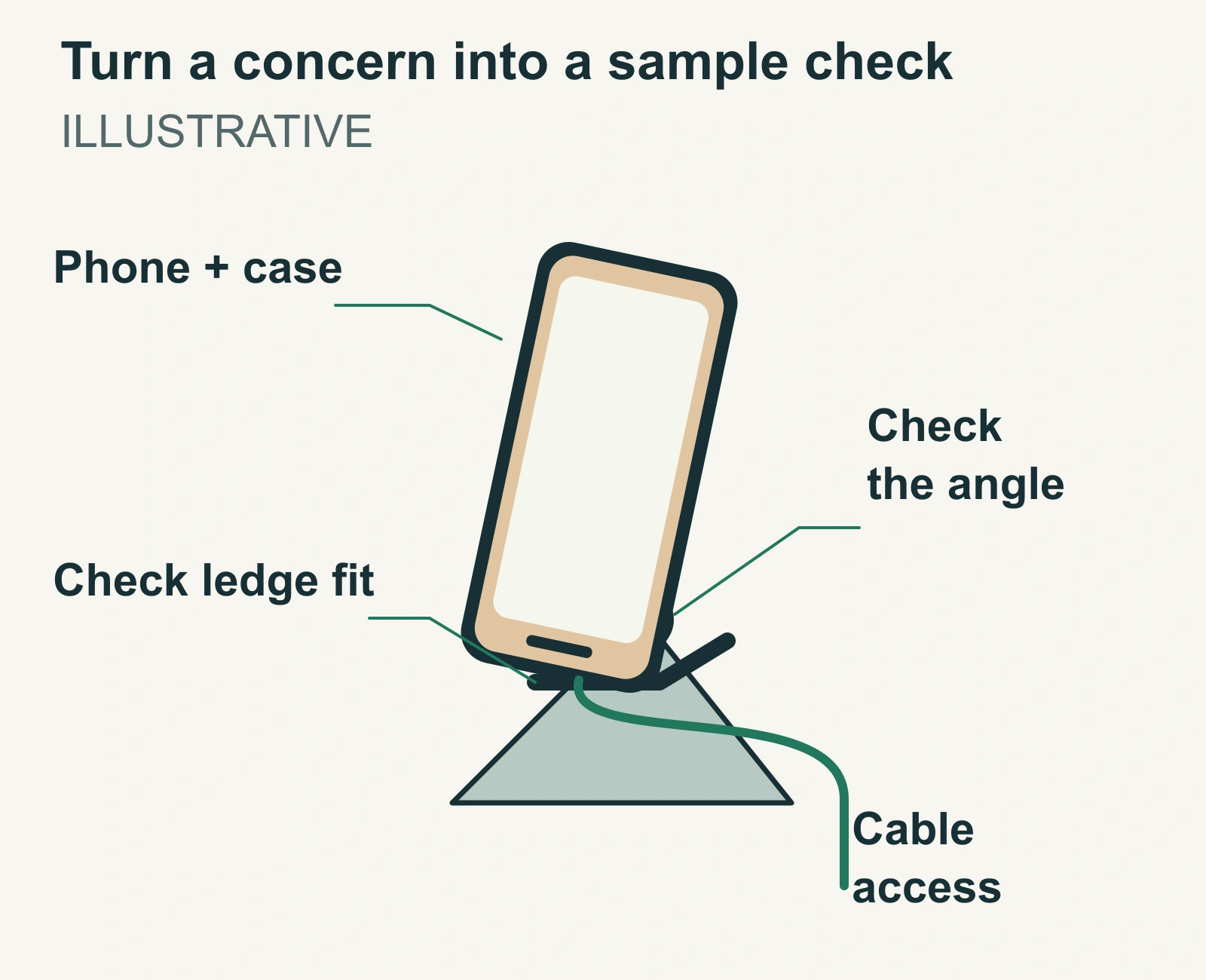
| Possible customer concern | Requirement to investigate | What the sample should show |
|---|---|---|
| The phone does not sit securely with its case on | Fit with the intended phone-and-case combination | The identified phone and case sit correctly on the support ledge in the intended orientation |
| The viewing angle changes during use | Stability for the intended device and activity | The stand maintains the agreed position during the defined use check |
| The charging cable catches on the base | Cable access while the phone is supported | The intended cable connects and routes without forcing the phone out of position |
A supplier can answer a specific fit question more usefully than a request for “premium quality.” Identify the phone, case, orientation, and use conditions. Ask which available model meets the requirement and what evidence supports that answer.
When the sample arrives, repeat the use you intend to demonstrate.
- Photograph the relevant contact points and record the model and variant.
- If the phone only fits after removing its case, either choose another product or change the offer honestly.
- Do not preserve an attractive claim after the sample has contradicted it.
Keep the approved reference and the acceptance requirements together. The dropshipping quality-control guide explains how to turn that reference into checks for later goods. Product research establishes what you want to sell; those checks help ensure subsequent units match it.
05
Check feasibility before paying to test demand
Request a quote for the actual version, destination, packaging, and intended ordering arrangement. A catalog price for a similar item does not establish the cost of the product you have just specified.
Include the product, packing, handling, shipping, payment charges, and an explicit allowance for the post-sale costs you expect. Keep one-time sample or setup spending separate from recurring order costs. The dropshipping profit-margin guide shows how those costs affect contribution and the amount available for customer acquisition.
Record unknown charges as unknown.
If profitability depends on a shipping price that nobody has confirmed, resolve that uncertainty before treating the product as financially viable. Also check whether a bundle changes parcel size or whether an apparently small customization requires purchasing materials in advance.
Product feasibility includes more than cost.
- Identify the documentation, product claims, selling rights, and destination requirements that need verification for the category.
- Products involving batteries, electrical functions, cosmetics, children’s use, or other specialized risks require appropriate product-specific review.
- A supplier’s listing or a successful basic sample check does not complete that work.
For the phone-stand example, a useful early decision is whether an existing model already solves the fit problem. If it requires a new design, tooling, or an unsupported material change, the research has uncovered a different level of commitment. Obtain that scope before treating it as a simple catalog-product test.
06
Test a truthful offer and learn from the whole order
A sample tests the product. An offer test asks whether the intended customer will respond to your product, price, presentation, and delivery promise. Complete the sample and material feasibility work before taking orders for claims you have not checked.
State the question for the test. You might need to know whether buyers understand a compatibility benefit, whether they will purchase at the required price, or whether the promised fulfillment process works. These questions need different observations.
Use the product validation guide to turn that question into a limited test, record what the result supports and decide whether to continue, revise or stop.
An interest page or waitlist can help assess response before accepting payments.
- Make its purpose clear.
- A signup measures willingness to leave contact details; record it separately from a purchase.
- Do not imply that an unavailable item is ready to ship to make the test look stronger.
For a selling test, use accurate product information, the actual price, and a delivery promise the supplier can support.
- Set a spend limit, observation period, and the decisions you will make before launching.
- The appropriate limit depends on the question and your resources; there is no universal amount that validates every product.
Follow the order beyond checkout. Record acquisition spending and paid orders, then track fulfillment, cancellations, customer questions, returns, and the resulting contribution. Recent orders may not yet have had time to reveal delivery or return problems. A short run can answer a narrow question while leaving long-term performance uncertain.
Poor results need diagnosis.
- If people click but leave the product page, inspect the fit between the ad and the offer.
- If buyers abandon after seeing delivery details, investigate that promise.
- If orders arrive but the sample-approved feature fails in normal use, revisit the product requirement.
Avoid changing several major variables at once when you need to understand which one caused the problem.
- Continue when the next commitment is supported by what you observed.
- Pause when an important question remains unanswered.
- Stop when the product cannot meet the customer requirement or the feasible offer leaves inadequate room for costs.
A few encouraging orders justify further learning; they do not establish a stable business.
07
Finish with a brief a supplier can act on
Research becomes useful when the next person can distinguish what you need, what you observed, and what remains uncertain. Assemble the product reference, target customer, destination, required features, intended offer, cost assumptions, and sample questions in one document.
For the illustrative phone stand, a short request could read:
We are evaluating an adjustable stand for customers who use a phone in a thick case at a desk.
- Please propose an existing model and identify its SKU and variant. We will provide the phone, case, cable, and intended use details for the fit check.
- We need to confirm support-ledge fit, position stability, and charging access on a physical sample.
- Please quote the product and normal single-order delivery to our stated market, including packing and handling.
- Identify any feature you cannot verify and any change requiring a minimum purchase or setup cost.
Attach the evidence you actually collected. Label a proposed selling price as an assumption until tested, and keep an observed sample result separate from a feature still promised by a seller. This prevents a tentative idea from becoming an accidental product claim during sourcing or page creation.
Use the guide to finding dropshipping suppliers when the brief is ready for candidate discovery. If you need a coordinated product-sourcing review, bring the same brief and ask which requirements can be met, which need samples, and which change the cost or fulfillment arrangement.
08
Frequently asked questions
Can I do dropshipping product research with free tools?
You can begin with public search results, Google Trends, marketplace listings, reviews, and accessible ad research. Paid tools may make collection easier, but their estimates still need interpretation. Samples, shipping tests, and any paid offer test have separate costs.
How do I know whether a product is too saturated?
Countless similar listings do not answer the question by themselves. Compare the offers your intended customer sees and identify an improvement you can deliver at a viable cost. If your only plausible advantage is a price you cannot sustain, the market is a poor fit for that offer.
How long should product research take?
Continue until the next decision is answerable. You may reject an unsuitable item quickly, while a promising product needs sample delivery, cost confirmation, and an offer test. More browsing has little value once a physical check or customer response is the missing evidence.