
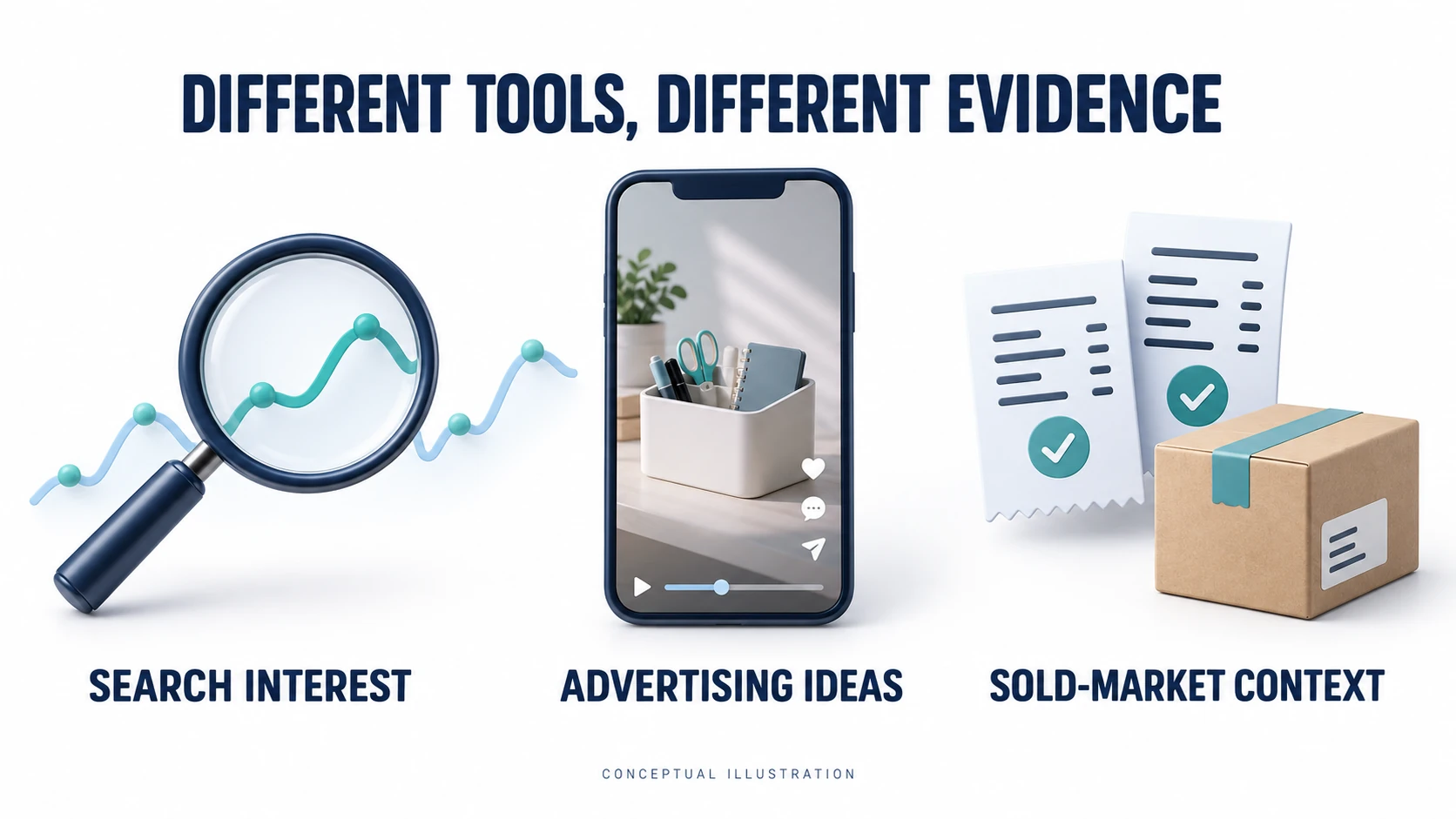
Useful dropshipping product research tools include Google Trends and Keyword Planner for search demand, Meta Ad Library and TikTok Creative Center for advertising ideas, and eBay Product Research for sold-market evidence. Paid platforms such as Minea, Sell The Trend and Dropship can add discovery and monitoring features when their current coverage matches your market.
Choose the data you need before choosing a subscription. A tool that finds interesting advertisements answers a different question from a tool that reports completed marketplace transactions. Neither confirms that your supplier can deliver the product profitably.
The comparisons below describe the providers’ public documentation reviewed on September 15, 2026. They are not hands-on performance rankings. Features, access and plans can change; verify the specific feature you need in the current product before paying.
01
Choose a tool for the decision in front of you
Start with the uncertainty that is blocking your next decision. “I need product ideas” is different from “I need to know whether this variant sells at this price in my target country.” The second question requires more precise evidence.
Search demand: Google Trends helps you examine relative interest over time; Keyword Planner adds search-volume and advertising context for selected targeting.
Creative and offer research: Meta Ad Library and TikTok Creative Center help you inspect how advertisers present products and what their messages emphasize.
Marketplace sales context: eBay Product Research helps you examine sold prices and other transaction information within eBay, using relevant filters.
Broader discovery and monitoring: Paid platforms can organize ads, products and shops in one place. Their value depends on coverage, freshness and the time they save on work you actually perform.
You do not need every category for every decision. A seller with an established audience may already understand the customer problem and need better supplier information. A new store may need to investigate the audience and competing offers before any importer or automation feature becomes useful.
For the complete process from customer need to supplier brief, use the dropshipping product research guide. This article concentrates on choosing and interpreting the tools within that process.
02
Google Trends and Keyword Planner: demand context
Google Trends
Use Google Trends to compare the direction and seasonality of related searches. Keep the country, period, category and search type consistent, and distinguish a search term from a broader topic when choosing what to compare.
Google explains that Trends uses sampled data normalized to relative interest. Equal scores in two regions do not necessarily mean equal search volumes, and very low-volume terms can appear as zero. A spike is a reason to investigate, not proof of commercial success. Google Trends data guidance explains these limits.
For a product idea, compare the specific use case with the broader category. Interest in travel accessories does not tell you which organizer size a customer wants. Keep the exact query and settings in your research note so you can reproduce the comparison later.
Google Keyword Planner
Keyword Planner is useful when you need search terminology and approximate volume within your target settings. Google defines average monthly searches using the selected period, location and Search Network, including close variants. Its competition field describes advertisers, not the number of competing stores or suppliers. See Google’s historical metrics guidance.
Separate historical metrics from forecasts. A forecast depends on campaign assumptions and does not promise the same result for a new advertiser. A term with fewer searches can still describe a precise need; a large broad term can contain many searches irrelevant to your product.
Save the query, geography and date with any figure you use. If you later change the target country, rerun the relevant comparison instead of carrying the old result into a new market.
03
Meta Ad Library and TikTok Creative Center: advertising ideas
Meta Ad Library
The Meta Ad Library is a useful starting point for examining advertisements. Search relevant products and advertisers in the market you are studying, then open the associated offer where available.
Record the product shown, the promise, the format and the landing page. You may find a demonstration that makes the product easier to understand, or a question the advertisement leaves unanswered. Those observations can improve your own research and creative brief.
Visible advertising is not verified profit. Do not infer an advertiser’s conversion rate, acquisition cost or retained margin from an ordinary commercial ad listing. Different ad categories and jurisdictions expose different information; a field available for one type of ad should not be assumed available for all others.
Use the library to study communication, not to copy assets. Make your own demonstration or obtain the necessary rights to material you use. A competitor’s attractive video can also show a different product version from the one you can source.
TikTok Creative Center
TikTok Creative Center offers inspiration tools including Top Ads. TikTok describes Top Ads as a collection of high-performing creatives, with advertiser authorization required for inclusion. That selection is a material limitation when using it for product research. See TikTok’s Creative Center overview.
Look at how the product is demonstrated and where the explanation becomes clear. A useful observation might be that viewers need to see the object’s size against a familiar item. That can guide your own product photography without implying anything about the competitor’s profit.
Check the selected region and objective before comparing examples. Absence from the collection is not proof that no market exists. Inclusion is not permission to reuse the advertiser’s video or a guarantee that your offer will perform similarly.
04
eBay Product Research: compare sold-market evidence
eBay Product Research provides historical transaction information, including sold prices, shipping information and sales trends. Its documentation describes access to the last three years of data and filters such as condition, category and buyer location. It also explains that actual accepted Best Offer prices can be included. See eBay’s Product Research documentation.
This can answer a more specific question than browsing attractive active listings: what did comparable items sell for under the selected conditions?
Build a careful search. Exclude spare parts, bundles or used goods when they do not match your intended offer. Review the results themselves before relying on an average. A low-priced replacement insert and a complete organizer set should not be treated as interchangeable observations.
The evidence remains marketplace-specific. A seller with established feedback, local inventory or a different return arrangement may convert customers at a price that your new store cannot sustain. Use the results to understand the alternatives available to buyers, then test your own offer separately.
Supplier marketplace pages answer another set of questions. They can help you identify possible variants and request quotations, but their visible price may exclude your packaging, destination or order quantity. Confirm the supplier data you need before putting those numbers into a margin calculation.
05
Compare paid platforms by their current scope
Paid tools can be worthwhile when manual research becomes repetitive. Compare the feature that solves your problem rather than the number of features on a landing page. The examples below are possible candidates, not a ranked shortlist of independently tested winners.
Minea: investigate ad and shop research features
Minea’s current plan descriptions list Meta ad, product and shop research, plus brand tracking, notifications and AI analysis or transcription. The plans differ in tracking and usage allowances. This makes it a candidate for a recurring Meta-ad workflow: find an advertiser, save the relevant shop or brand, and monitor new material instead of repeating the same search. Choose the plan around the number of brands and analyses you actually need; the current plan description is stronger evidence of included coverage than an older testimonial mentioning other channels.
Before subscribing, search for products and advertisers you already know. Check whether the relevant country, channel and dates appear. Ask how displayed spend or revenue information is produced and what the provider discloses about estimates, gaps and update frequency.
A large database claim does not tell you whether your particular niche is represented well. Nor does a displayed revenue figure tell you the merchant’s refunds, cost of goods or advertising profitability. Treat those as separate questions.
Sell The Trend: investigate discovery plus workflow
Sell The Trend’s current feature list names NEXUS product research, TikTok Viral Ads Explorer, TikTok Shop Explorer and Facebook Ads Explorer. It therefore deserves a trial when your investigation crosses product discovery, advertising examples and TikTok Shop offers. Start with one candidate and see whether those views help you answer different questions about it. The named features establish advertised scope; they do not establish independent sales accuracy, and you still need to verify which features your chosen plan includes.
Evaluate the research on its own merits before giving value to the additional automation. A convenient import step does not improve the source data. Check the actual product version, supplier link, destination options and rights to the images or copy before publishing an imported listing.
If a product card displays potential revenue or a margin figure, identify its assumptions. Your selling price, traffic costs and fulfillment arrangement may be different. Recalculate with your own inputs rather than using the displayed value as your budget.
Dropship: verify which platform a feature covers
The current Dropship site describes its Sales Tracker around TikTok shops and products. Its public feature descriptions also include advertising research and product and shop libraries. This matters because older comparisons may describe a different platform focus.
Confirm the current tracking scope before buying for Shopify research. A feature name such as Sales Tracker does not establish that it tracks the store type, region or product you intend to analyze. Ask the provider to demonstrate the exact use case within the plan under consideration.
The provider’s page establishes what it currently advertises, not an independent accuracy result. Inspect definitions, source coverage, refresh timing and export options. Where a commercial result is inferred rather than directly observed, retain that distinction in your own notes.
06
Build a small stack and test it before expanding
A practical starting stack can be one search-demand tool, one advertising library and relevant marketplace or supplier research. Add a paid service when you can name the missing capability: a useful filter, coverage of a particular channel, saved monitoring or an export that reduces recurring manual work.
For the paid candidates above, start the comparison with Minea when repeated Meta advertiser research and brand monitoring are the bottleneck; include Sell The Trend when you need named Facebook, TikTok-ad and TikTok-Shop discovery tools in one workflow; and test Dropship when following identified TikTok shops or products over time is the priority. These are task-based trial choices from the providers’ current descriptions, not an accuracy ranking. For search seasonality or eBay sold-price evidence, the free tools already discussed answer the more relevant question.
There is no universal spending level at which paid tools become necessary. Compare the subscription cost with the work it replaces and the evidence it adds. Paying for a second dashboard that repeats the first dashboard’s sources may provide little additional confidence.
Before starting a trial, prepare a small evaluation set:
- A familiar product or advertiser you expect the tool to find.
- A narrowly defined product in your target market.
- A candidate you previously rejected, with the reason recorded.
- A question that your current tools cannot answer efficiently.
Run the same evaluation across the services you are considering. Record useful results, missing coverage, irrelevant matches and the time needed to reach a decision. This is your own purchasing test; avoid turning a handful of examples into a universal accuracy ranking.
Check the terms before entering payment details. Distinguish a permanent free tier, limited preview, trial and refund policy. Review renewal timing, billing period, cancellation method and any usage caps that affect the feature you need. Follow the current provider terms rather than a price copied from an older roundup.
Review access requests too. A research-only task may not need permission to edit your store. Understand requested permissions and use the narrowest suitable access. Remove access when you stop using a service.
07
Make conflicting results useful
When two tools disagree, first check whether they describe the same thing. Match product version, country, date range, sales channel and metric definition. A global trend score and a local sold-price history can both be correct while answering different questions.
Next, inspect the source. Two paid platforms may depend on the same public advertisement or marketplace listing. Agreement between them can reflect shared input rather than independent confirmation.
Keep three kinds of evidence separate: observed information, estimated information and your own interpretation. An observed advertisement establishes that the displayed creative was present in the source you checked. An estimated revenue value depends on the provider’s method. Your conclusion about whether to order a sample is a judgment using those inputs.
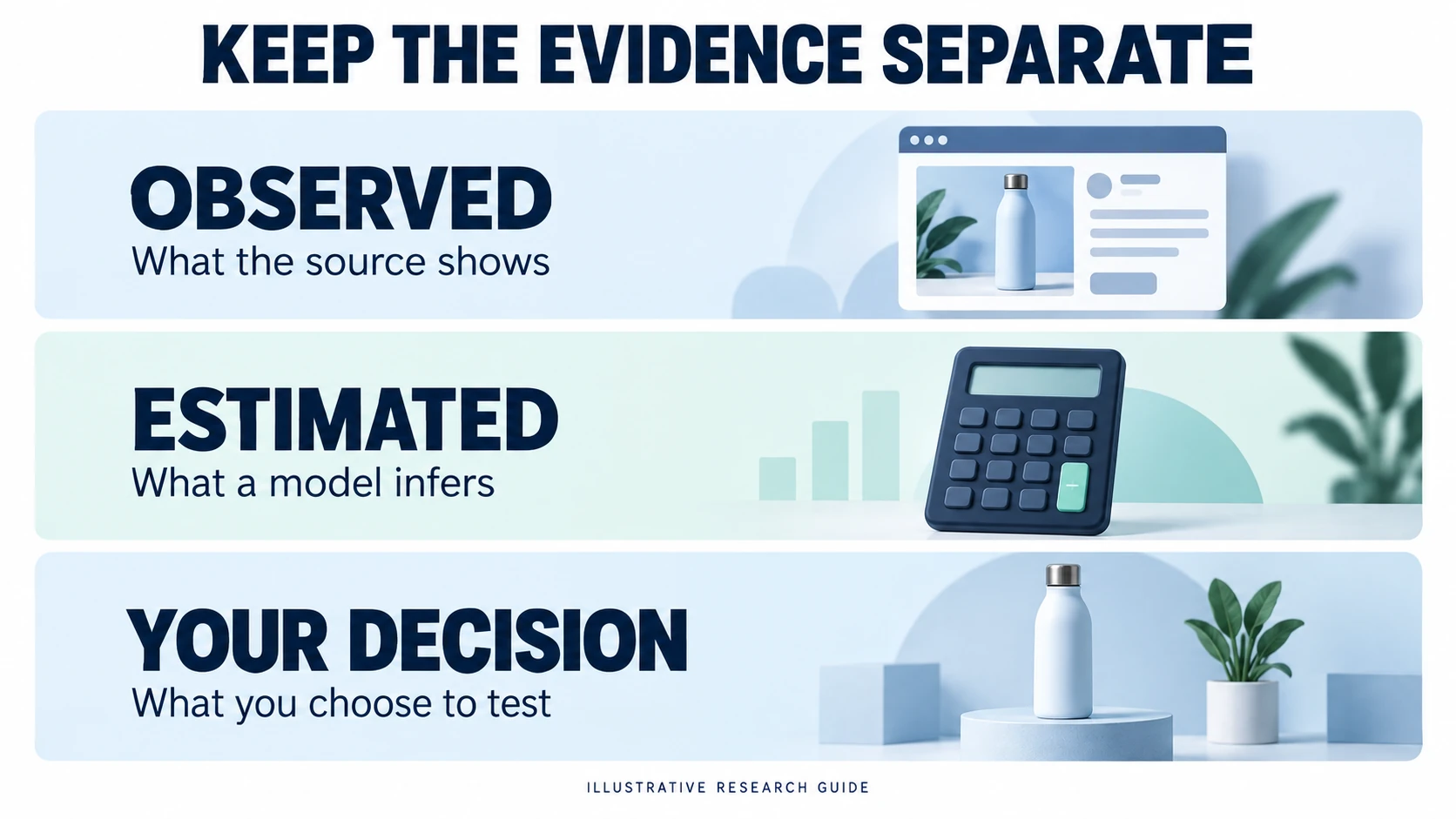
This separation makes it easier to update the decision. If the shipping quote later changes, you can revise the cost calculation without pretending that search interest has changed too.
08
Turn a research session into a usable next step
Suppose you are investigating a compact cable organizer for commuters. Start by checking the terms people use and whether interest is seasonal in your target country. Then inspect advertising examples for the tasks sellers demonstrate.
Review comparable offers and, where relevant, sold-market evidence. Match dimensions, included items and condition. Record the delivered offer rather than a product thumbnail or a headline price alone.
Now write down what remains unanswered. The charger may not fit the supplier’s version. The quoted shipping service may not support your intended promise. A paid research dashboard cannot resolve either issue without new product or fulfillment evidence. A properly specified sample can answer the physical fit question.
The output should be a short decision note: the customer, exact candidate, supporting observations, unresolved questions and the next action. That action might be requesting a sample, obtaining a complete quote or rejecting an unsuitable variant. A folder of screenshots with no conclusion leaves the work unfinished.
As your own orders accumulate, use store and fulfillment records to review the assumptions. Customer questions, cancellations and replacement costs can reveal something the discovery tools never showed. Research becomes more valuable when it helps you revise an actual offer.
09
Frequently asked questions
Which free tool should a beginner use first?
Start with the question you need to answer. Google Trends is useful for relative search interest; an ad library helps with creative and offer research; eBay Product Research can provide sold-market context where comparable transactions exist. One source alone does not complete product validation.
Can a research tool tell me a competitor’s profit?
A displayed sales or revenue figure does not establish profit. You would also need reliable cost, discount, refund and other expense information. Read each metric’s definition and treat estimates as estimates.
Are AI product scores enough to choose a product?
No. Check the inputs, coverage and explanation behind the score. Use it to prioritize investigation if it helps, then verify customer fit, the actual product and your own costs. A score with unclear inputs is a weak basis for a purchasing commitment.
Should I buy an all-in-one tool or several specialist tools?
Choose the combination that covers your actual tasks with the least unnecessary duplication. An all-in-one service may simplify handoff, while a specialist may offer a filter or source you need. Test the required use case and access terms before committing.