
You can dropship sunglasses by selling a confirmed frame and lens combination through a supplier that ships individual customer orders. Choose a particular buyer, describe the fit and lens properties accurately, and confirm the complete parcel price, destination service and return arrangements before listing the pair.
Your customer cannot try the frames on through a product photograph. A stylish pair can still pinch at the bridge, feel too wide or arrive without the case they expected. Measurements, included contents and clear photographs make the offer more useful.
Start with a narrow adult fashion range you can explain. Prescription lenses, therapeutic claims, eclipse glasses and protective sports eyewear involve different questions; they should not be added to an ordinary sunglass offer simply because a supplier groups them together.
Explore the broader topic: Clothing Dropshipping: Sizes, Variants, Samples and Returns.
01
Choose a frame and lens for a particular buyer
Begin with the situation in which someone will wear the pair. A customer wanting an everyday rectangular frame has a different preference from someone looking for a large aviator or a pointed cat-eye shape. A style name helps navigation; it does not tell the buyer how the frame will fit.
Compare the features that actually differ:
- Frame shape and coverage: rectangle, round, aviator or cat-eye, with photographs from the front and side.
- Frame material and construction: the specified plastic or metal, hinge type, nose pads and finish. “Lightweight” needs a measured weight or another sound basis.
- Lens description: color, any supported UV statement and whether the selected version is polarized.
- Included items: the pair alone, or the pair with a hard case, cloth and box.
Polarized lenses can reduce certain reflected glare. That is a separate property from UV protection, and a dark tint does not prove either one. Confirm what the actual lens version supports before writing the description.
Give the buyer useful measurements
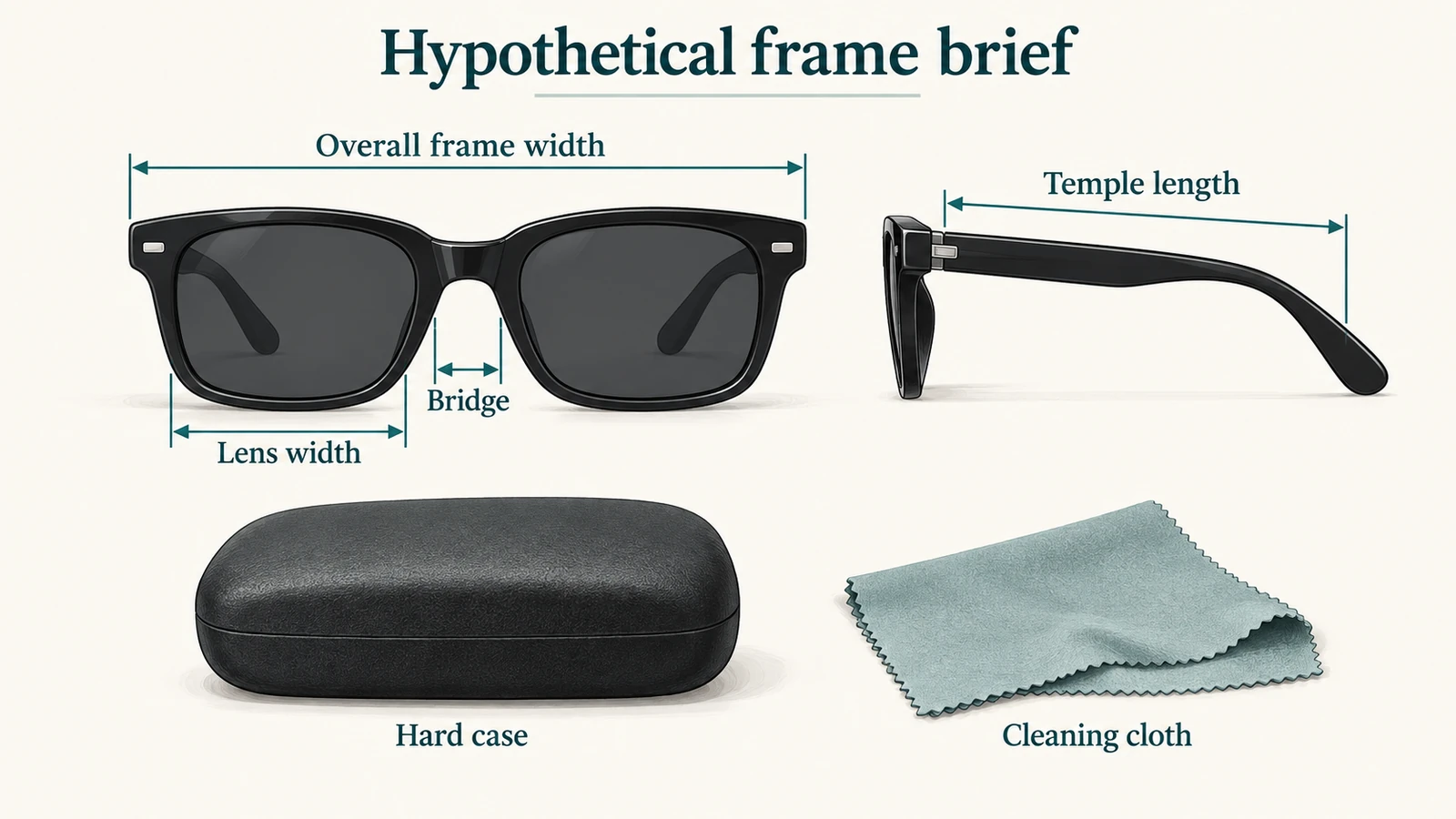
Show overall frame width, lens width, bridge width and temple-arm length. The bridge sits between the lenses; the temple arms run toward the ears. Overall width includes more than two lens widths plus the bridge, so do not substitute that sum for a measured frame width.
Our hypothetical offer is an adult black rectangular pair with a proposed 140-millimeter overall frame width, 52-millimeter lens width, 18-millimeter bridge and 140-millimeter temple arms, supplied with one hard case and one cloth. These numbers define a supplier request, not a measured product or a guarantee of comfortable fit.
Ask customers to compare the actual measurements with a pair they already wear comfortably. Provide a measurement drawing and model photographs you have permission to use. One customer’s fit does not justify a “one size fits everyone” statement.
Ask for the frame, lens and parcel together
Send an inquiry such as: “Please quote one adult rectangular pair in black, with the attached target measurements, one hard case and one cloth, for individual US customer dispatch. Identify the exact frame material and lens version, actual dimensions and weight, support for the proposed UV and polarization statements, packaging, current stock, sample cost, processing time, shipping price and return procedure.”
If you want two frame colors or both polarized and non-polarized versions, request separate product codes and documentation for each. A manufacturer replacing the lens or coating can change more than the appearance. The product selection guide helps compare this focused offer with other categories.
02
Choose an actual order route
There are several ways to source the offer, and they require different amounts of work. A manual supplier can be usable for a small store; a software connection may become more useful when order volume increases. Neither route establishes lens performance or customer demand.
| Real source | Published route | Confirm before using it |
|---|---|---|
| Superhot Eyewear | Manual customer-address orders with a dropshipping note; its page states no minimum order or application | Exact model and destination charge; cases and other accessories cost extra; standard packing is neutral with no invoice or retail prices |
| Hertwill’s SU.VI offer | Branded eyewear announced for its Shopify/WooCommerce supplier service | Current eligible products, store and destination access, stock, selling permissions and returns |
| Karuson | Stock sourcing and private-label/OEM manufacturing options | Actual model availability, minimum quantity, customization cost and whether individual customer dispatch is included |
On a phone, swipe the table sideways to compare every column.
A custom-frame batch is a different purchase
OEM means manufacturing a product to an agreed business specification. A factory’s custom-frame offer may require a batch purchase, tooling or artwork approval. It should not be assumed to work like a single-pair dropshipping order.
Superhot’s dropshipping page, rechecked October 11, states 24–48 calendar hours for processing, with public-holiday delays possible. Another public page gives 24–72 hours. Confirm the current estimate for your order. Processing is the time before dispatch; the parcel still needs its shipping journey.
A CSV service needs agreement
Its CSV arrangement requires an agreed ongoing relationship and assessment; the page discusses roughly ten daily orders as a condition for considering that service. A CSV is a structured order file, not proof of automatic inventory or payment synchronization. Standard self-service Shopify integration and an automatic prepaid-balance setup are not currently presented as generally available services.
If you choose branded stock, obtain permission for the products, images and branding you intend to sell. A catalog displaying a designer-looking name or logo does not establish that the stock is authentic or that you may use those assets.
Compare the complete service: pair, case, packing, order submission, shipping, return address and problem handling. Do not rank suppliers on a cheap frame price while leaving the rest of the parcel unpriced.
03
Check the sample and support the lens description
Order the exact frame, lens color and included case before publishing. Check measured dimensions, hinge movement, loose screws, finish, scratches and packing. Wear or fit observations should be described honestly and should not be turned into a promise that the pair suits every face.
A dark lens cannot prove UV protection
A physical inspection can catch a crooked hinge or a missing cloth. It cannot establish UV protection by looking at a dark lens. The quality-control guide explains how an agreed sample helps check later goods; optical performance still needs appropriate product-specific support.
Separate three different lens properties
What UV protection describes
UV protection concerns ultraviolet light. FDA’s consumer advice explains UV400 and 100% UV-protection labeling in terms of blocking more than 99% of UVA and UVB radiation. Obtain support for the exact product before using those claims. Lens darkness and selling price do not establish that performance.
What polarization describes
Polarization concerns certain reflected glare. A supplier may offer the same frame with different lenses, so a polarized version’s information cannot automatically be applied to a cheaper non-polarized version.
What impact resistance describes
Impact resistance is another question. FDA’s lens guidance addresses testing and certification under 21 CFR 801.410, including representative production-batch sampling where applicable. Ask for the relevant manufacturer and lens-batch information. Impact-resistant does not mean unbreakable or shatterproof, and plastic lenses are not automatically exempt from the question.
Keep the frame model, lens version, color/coating, report scope and supplied batch connected. A generic report showing a different lens is not enough to establish the advertised pair’s properties. No lens test or supplier report has been independently reviewed for this article.

Establish your US role
For a US offer, first establish who manufactures the exact pair and who imports it. Ordinary nonprescription sunglasses fall under FDA’s Class I HQY classification. The record says 510(k) exempt, subject to limits, but not GMP exempt. FDA’s QMSR took effect February 2, 2026. A premarket-submission exemption is not a blanket manufacturing exemption. It also does not mean every retail store must buy an ISO certificate.
The next step depends on your role, as FDA’s registration table shows:
- Domestic distributor that does not import: This role does not register, list or pay the establishment fee. Check the source and product records you rely on.
- Initial importer: This role registers and pays the applicable fee, identifies the manufacturers and does not itself perform device listing as an initial importer. Coordinate entry information, labels and the applicable impact-resistance certificate with the manufacturer and broker.
- Manufacturer, foreign establishment, relabeler or repackager: Different entries apply. Identify the actual business doing each job instead of assigning every duty to a store address.
Registration is not product approval
Registration is not FDA product approval, and FDA does not issue establishment-registration certificates. Do not turn a supplier registration screenshot into an “FDA approved” badge. The US role check does not clear the pair for other countries.
04
Work out the whole order cost
A case changes the quote. So do tracked shipping, payment fees and the money spent to attract the customer. Ask for a packed-pair price and destination delivery charge before deciding that a cheap frame leaves a large margin.
This hypothetical order uses invented USD amounts to show the calculation. It is not a Superhot, Hertwill or Karuson quote.
| One fictional order | Amount |
|---|---|
| Customer revenue, excluding collected sales tax | $42.00 |
| Sunglasses | −$7.00 |
| Hard case, cloth and packing | −$2.00 |
| Customer shipping | −$7.00 |
| Payment processing | −$1.50 |
| Advertising attributed to the order | −$10.00 |
| Contribution after the listed variable costs | $14.50 |
On a phone, swipe the table sideways to compare every column.
Include the case before setting the price
The $14.50 left after those costs still has to pay the store’s fixed expenses. If the included hard case and cloth push delivery $3 above the assumed quote, the order leaves $11.50 before those expenses. Price the actual packed pair, not a frame alone.
Include actual duties, destination taxes, product evaluation, insurance, registration and other applicable expenses in the budget. A public unit price rarely includes every one of those items. Use actual fees from your payment and sales channels, and avoid counting a fee again if you have already entered it separately from the net payout.
Ten orders need supplier cash
For our fictional order, the supplier-side pair, case/packing and shipping total $16. Ten orders need $160 for those bills if supplier payment comes before your customer-payment payout. Advertising and overhead may need additional funding. Keep accessible money for customer remedies as well; a supplier’s possible future credit does not pay today’s bill.
05
Keep the correct variant moving
Give every frame, color, size and lens version a clear product code in the store and supplier order. “Black sunglasses” is too vague when the same photograph appears beside several options.
Before paying a Superhot order
Enter the actual customer’s delivery address. Add the selected frame and lens variant, then add the hard case and cloth as separate paid items if that is your promised offer. Its documented route asks you to write dropshipping in the order notes. Check the item counts and complete address before paying.
After the supplier accepts it
Match the accepted supplier order to the store order: same frame, lens, color, one case and one cloth. Retain its reference and check dispatch and tracking separately. The note requests the dropshipping packing arrangement; it does not select accessories or prove that the parcel contains them.
Use a short routine for each paid order:
- Check the address and the exact frame/lens code.
- Confirm current stock and included case and cloth.
- Confirm acceptance and the supplier’s dispatch estimate.
- Check packing and carrier acceptance, not just creation of a shipping label.
- Give the customer tracking and act on missing scans or delivery exceptions.
Keep lens surfaces protected and avoid a loose pair rattling around with a hard accessory. Agree the packing with the supplier and review a sample parcel. Do not describe accessories as included unless the selected order actually contains them.
Hold an unavailable lens version
If a variant runs out, hold the order and explain the options. A replacement lens color can also have different properties. Do not silently change the pair or its promised arrival; obtain the customer’s appropriate choice and follow the applicable sale and refund requirements.
06
Give a useful answer when the pair does not work
A pair that feels too wide, a scratched lens and a supplier sending the wrong version are different problems. Ask for the order code and a clear description, with photos where useful and safe. Then explain the available remedy under the customer’s rights and the store’s terms.
For poor fit, give the return address and applicable timing and condition requirements. Your supplier’s business return policy does not automatically determine what your customer is entitled to. Record the reason: repeated bridge complaints may show that the listing needs clearer measurements or that this frame does not serve the intended buyer.
For a wrong pair, missing case or damaged hinge, compare the actual contents with the accepted order. Arrange an appropriate replacement, missing item or refund; do not make the customer wait for your supplier’s reimbursement decision.
Budget the remedy before requesting credit
In our fictional order, another complete $16 parcel reduces the original $14.50 contribution to a $1.50 loss if no other costs change. A full $42 refund instead produces a $27.50 loss when all original costs have been spent and cannot be recovered. These are alternative outcomes, not two expenses to add to every complaint.
A supplier claim is not available cash
If the store requests a $7 credit for the pair, record it as a separate supplier claim until the outcome is known. It is not money already available for a refund. Keep the customer order, supplier order, photos, product version and correspondence connected.
Pause a lens claim that lacks support
A concern that the advertised UV information does not cover the supplied lens needs more than a cosmetic exchange. Pause the affected offer and dispatch, establish the actual version and supporting information, and handle the customer’s remedy and any relevant reporting with the responsible parties. Do not restock a doubtful pair as verified UV protection merely because its frame looks undamaged.
07
Turn the frame brief into a supplier conversation
Have the buyer, measurements, lens version, contents and destination ready before asking for a price. You should be able to show what will arrive, what supports the description, how an order reaches the supplier and how a customer problem is handled.
For a China-side sourcing route, AIDrop’s product-sourcing service can help coordinate supplier options, the agreed frame and lens specification, sample and packing review, and shipment arrangements. Contact AIDrop with a product link, frame measurements, lens requirements, case/cloth requirements and destination. Confirm the actual operating scope separately from optical testing, product claims and manufacturer/importer legal responsibilities.
08
Frequently asked questions
Can I dropship one pair without buying a batch?
Some suppliers support individual customer orders; the Superhot route described above is one example. Confirm the exact pair, destination and accessory charges. A private-label factory offer can still require a batch, even when it uses the word dropshipping.
Do polarized lenses automatically have UV protection?
No. Polarization reduces certain reflected glare; UV protection is a separate property. Obtain support for the actual lens version you will sell. A dark tint or a polarized option alone does not establish a UV400 claim.
Does FDA registration mean the sunglasses are FDA approved?
No. Registration identifies an establishment and does not approve the product. Check the actual manufacturer/importer role and the applicable lens requirements; do not turn a registration screenshot into an approval badge.

Clothing Dropshipping: Sizes, Variants, Samples and Returns
Verify apparel sizes, variants, samples, labels and returns before launch. Build a clothing dropshipping offer around accurate
Clothing Dropshipping Suppliers: 5 Options for Different Stores
Compare Trendsi, Printful, Printify, Apliiq and BrandsGateway by clothing model, fit information, stock, shipping and return costs.
Shoe Dropshipping: Sizing Evidence, Variants and Return Exposure
A shoe listing needs model-specific fit evidence, exact size-color stock and a workable exchange route. Compare one
