
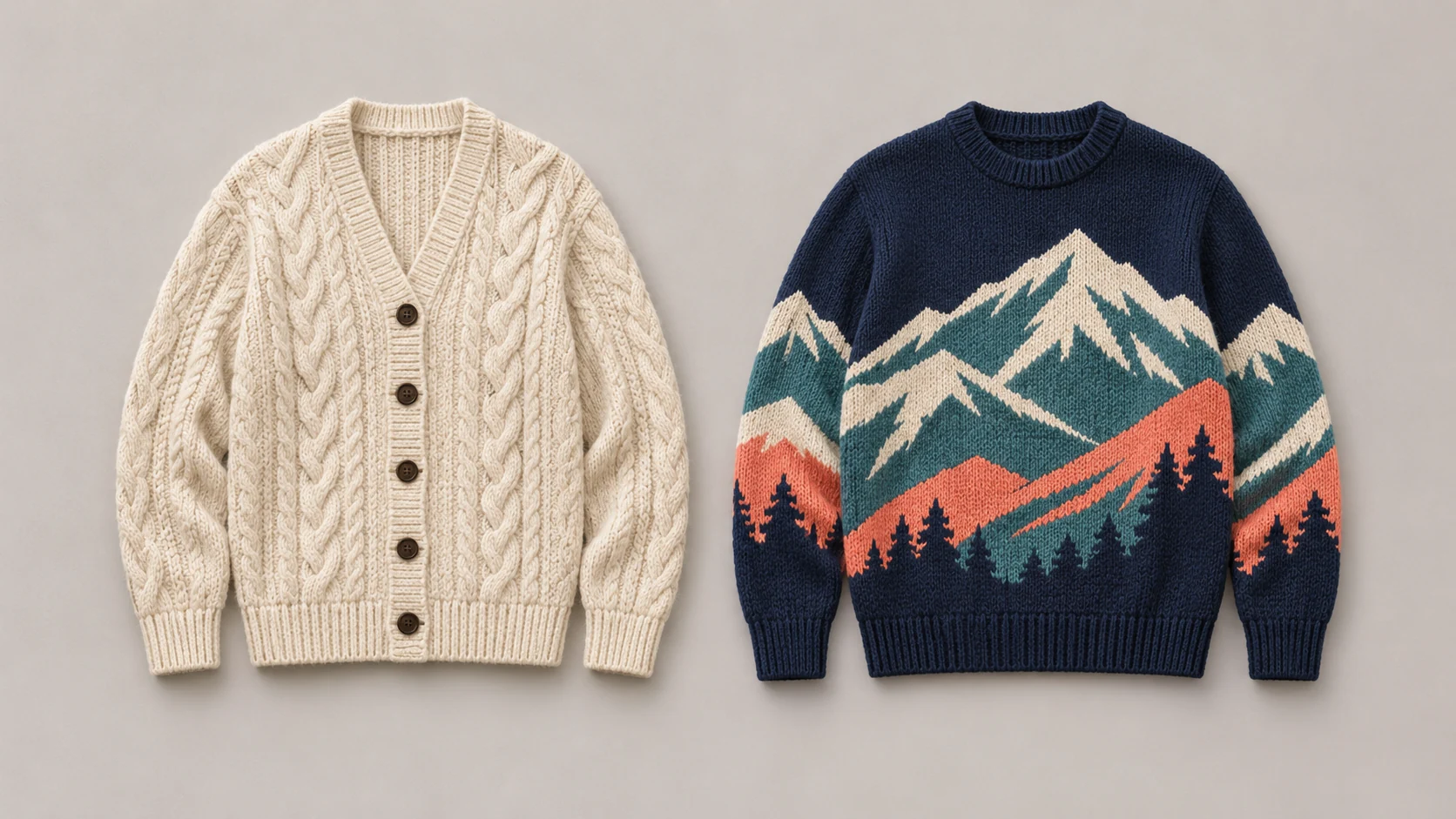
For sweater dropshipping, compare Trendsi for ready-made styles, Knitwise for knit-on-demand designs, and Knitup for its different knitwear-production programs. Start with the garment you want to sell: an existing sweater, an original motif knitted into an available shape, or a more extensively developed garment.
You pick a sweater for its soft, woolly look and plan a holiday campaign around it. Later, the material list reveals no wool, and the custom design still needs approval before knitting begins. The garment and timetable may differ from the offer you pictured.
Check the material and production schedule for one sweater before importing a winter collection. Use the confirmed details in its description, price and delivery estimate.
Public information checked November 5, 2026. Supplier records and stated prices are references, not our private quotations or results from garments we have ordered, washed or worn.
01
Two ways to source sweaters, plus a custom-development option
| Source or program | What you start with | What needs confirming |
|---|---|---|
| Trendsi | An existing sweater in its clothing catalog | Exact material, variant, available stock, dispatch route and destination |
| Knitwise | A knit-on-demand base with your design | Yarn palette, artwork conversion, selected garment, seller price and production terms |
| Knitup | Essentials or its more extensive Atelier service | Which program supports the changes you want, and its quantity and fulfillment conditions |
Ready-made clothing
Trendsi is a source to investigate when you want to select an existing cardigan, pullover or sweater dress. The item record matters more than a general “fast shipping” headline: material, sizing and dispatch details can differ between styles.
The clothing supplier comparison puts this model beside other apparel arrangements. Choosing a ready-made sweater does not commission a different yarn, cut or knitted motif.
Your design in the yarn
Knitwise’s business program advertises production from one piece and connections including Shopify, Fourthwall and Order Desk. Its designs use jacquard knitting: the motif is made with the yarn as the garment is knitted.
Knitup’s Shopify workflow also describes designing, sampling, selling and fulfilling knitwear. Its Essentials and Atelier offerings have different scope. Do not apply a “no minimum” headline to every development or branding service; the quantity details matter when you request a quote.
These are published options to investigate, not a ranking based on our delivery or quality tests. Select the production model before comparing one provider’s finished service with another’s starting garment price.
02
Read the fiber label and the actual garment chart
A cable pattern, fluffy surface or “knit” category does not establish that a sweater contains wool. Knit describes a construction; the fiber list tells you what yarn material is stated.
For example, Trendsi’s Textured Knit Round Neck Sweater, style 10010079773, lists:
- 50% viscose.
- 28% polyester.
- 22% polyamide.
- Slight stretch.
There is no wool in that published composition. Describe it as the stated blend, rather than adding “wool sweater” because the photo looks warm. Its care record specifies cold machine washing and low tumble drying; that instruction belongs to this item, not every sweater you might sell.
Choose the chart that belongs to the garment
Check whether measurements refer to the finished sweater laid flat, its full circumference or the intended wearer’s body. Record the measurement method with the selected style.
A flat chest width of 50 cm and a full garment chest circumference of 50 cm describe very different sizes. Doubling a flat width gives a nominal circumference; it does not tell you how much room a particular wearer needs or how the knit will feel.
Keep men’s, women’s and youth labels tied to the supplier’s actual chart. Do not move a size conversion from one crewneck onto another cardigan because both selectors say M. For the wider process of managing clothing sizes and variants, see the clothing dropshipping guide.
03
A knitted design is different from a print
With a surface print, a design is applied to an existing fabric. In jacquard knitting, different yarns form the design through the knitted loops. A printed picture of a cable texture does not turn a sweatshirt into a cable-knit sweater.

That difference becomes important with tiny lettering, a detailed photograph or a smooth gradient. A screen can display many colors and very small details. The chosen knitting template has a finite number of loops and available yarn colors.
Knitwise’s design guide explains that one pixel in its production template represents one knitted loop. An uploaded photograph is scaled and converted first; each original photo pixel does not automatically become its own loop in the garment.
Think of the converted template as the version the knitting process can actually make. Inspect the face, lettering or symbol there. More pixels in the original upload cannot guarantee that a tiny word remains readable after conversion.
Plan four yarn colors, including the background
Knitwise’s Design Maker instructions specify a maximum of four yarn colors, including the base and trim. That means four total—not four colors in the graphic plus a separate background, collar and cuffs.
Here is an original planning example for a simple mountain motif:
| Yarn | Job in this example |
|---|---|
| Navy | Body background, collar, cuffs and hem |
| Cream | Snowcap and a large contrasting symbol |
| Teal | Main mountain shape |
| Coral | Small sun |
If the first sketch also contains a yellow sunburst, it has five colors. One workable revision is to use coral for that sunburst too. You have simplified the design without asking the process to produce a fifth yarn.
This is a teaching palette, not a saved Knitwise design or a promise about the exact yarn shades. Use the chosen provider’s available colors and product limits. Check whether its preview retains the important detail, then assess the physical sample.

The artwork can also sit differently across sizes. Review the selected base’s front, back, sleeves and trim areas; a good-looking medium mockup does not establish that a motif near the hem will work on every size.
04
Approve what the shopper will actually wear
Order the finished version you intend to list. A generic plain sample can help you feel a yarn, but it cannot show whether your converted lettering is legible or whether the colors work together.
| Sample check | Compare with | What to do if it fails |
|---|---|---|
| Readable artwork | Approved converted design and actual viewing distance | Simplify or enlarge the motif, then review the revision |
| Agreed style and size | Supplier reference, chart and agreed measurement tolerance | Resolve the garment or listing mismatch |
| Matching panels and trim | The approved front, back, sleeve and trim version | Identify the incorrect area rather than requesting a vague quality fix |
| Condition and measurements after care | Its own instructions and recorded before/after observations | Investigate the change before continuing sales |
These are proposed checks. We have not performed them on a supplier’s garment. A screen preview cannot establish hand feel, actual yarn shade, inside construction or how the piece sits on a wearer.
Keep one approved version
Save the garment code, size, chosen yarns, final artwork, placement and sample photographs together. If the supplier used an earlier file, the correction concerns the file sent to production. If the approved design itself is unreadable, you need to revise the design.
For a care trial, follow the actual item’s instructions and use the same measurement method before and after. Do not assume every knit should be tumble-dried because one catalog item permits it. Equally, one successful care trial does not prove every future batch will behave identically.
If you want store photos showing texture or fit, photograph the real approved garment. Generated images can explain a design concept, but they do not document your actual sweater or its performance.
05
Compare the seller quote, not a custom-gift headline
Knitwise’s business page gives an indicative knitwear range of $27–$49, depending on the product. Its designed-for-you sweater page showed $98 when checked, including design work and preview revisions. Those are different service descriptions, not conflicting wholesale quotations for the same order.
The latter product also lists a 55% cotton, 45% polyester composition. It should not be used to fill the material field of every knit-on-demand base without checking that base’s record.
Request the price applicable to your seller arrangement and completed design. Keep these charges visible:
- The chosen garment, size and customization.
- Any design preparation or additional development.
- Labels, hangtags and packing actually included.
- Production and delivery to the selected destination.
- Taxes, duties or other charges outside the quoted total.
A minimum belongs to a particular service
Knitup’s FAQ distinguishes its programs: Atelier development has a minimum of 100 pieces per design, while custom label development typically has a separate 1,000-piece minimum. Do not interpret that label minimum as a requirement to buy 1,000 sweaters.
Ask which Essentials features already fit your idea and which changes move it into development. A new silhouette, specialty yarn or custom label can change the commitment even when the platform also offers one-piece ordering.
For the overall business model, our print-on-demand guide explains why production payments and customer payments are separate. Free access to a design tool does not make the finished sweater, sample or shipment free.
06
Put approval, knitting and transport on the same calendar
Start with the date the buyer needs the sweater, then identify every stage that happens before arrival. This is particularly useful for event merchandise or a holiday design that loses its purpose if delivered late.
| Stage | Detail to record |
|---|---|
| Artwork preparation and approval | The approver and the date the final artwork is ready. |
| Production | The knitting start and production window for this order. |
| Dispatch and transit | The selected shipping service and destination. |
| Delivery uncertainty | The agreed response if a delay makes the intended use impractical. |
Knitwise’s business page describes a typical 7–14-day production period, followed by transit. Its shipping policy describes roughly 2–4 weeks from approval to delivery by Air Economy and 2–3 weeks by Air Express. The second description already runs through delivery; adding the full production period to it again would double-count a stage.
Use the current arrangement for your actual order. A general seven-day headline is not a seven-day doorstep commitment. Delayed approval, a changed design or a different destination can alter the plan.
Write the buyer’s estimate from the confirmed route
Keep the start event visible: “after design approval” is different from “after checkout.” For an existing ready-made sweater, get that item’s availability and dispatch estimate instead of applying a custom-knitting schedule.
Do not promise an event date from a promotional cutoff alone. Confirm the design, quantity, destination and current production position. If the supplier cannot support the required date, change the offer or decline that deadline before taking payment.
Also check address exclusions and duty handling. Knitwise’s shipping policy excludes PO boxes and APO/FPO addresses and places destination duties or taxes with the recipient. Those conditions matter alongside the transit estimate.
07
Separate a wrong sweater from a change of mind
A production partner’s remedy depends on what went wrong. An incorrect garment, an approved design that the buyer dislikes and a damaged delivery are different situations.
Made-to-order cancellation and quality issues
Knitwise’s refund policy allows cancellation before knitting begins and limits returns once its made-to-order product has been knitted. It directs quality issues to support. Do not rewrite that as either “all custom sweaters are refundable” or “we never need to address a faulty garment.”
Ready-made clothing returns
Trendsi’s ordinary return policy describes eligible unworn clothing returns for US customer orders, with original tags and labeled packaging. It specifies a seven-day request window and a further seven days to send the return, with conditions. It does not offer exchanges, and shipping and handling charges are non-refundable.
Check the applicable item, destination and policy before making a store promise. Your retail-customer obligations are separate from the supplier reimbursement you may receive.
Keep the order tied to the design
Record the customer’s garment, size, design version and destination beside the actual supplier order, payment and production status. If a design changes after payment, establish whether production can still be stopped before treating the edit as accepted.
For a mixed basket, find which items the provider actually fulfills. Knitup’s connection guidance distinguishes its synced items from other products in the order. One sweater’s tracking update does not mean an unrelated accessory has shipped too.
When a complaint arrives, identify the cause before ordering again:
- Wrong artwork: compare the approved file with the version sent to production.
- Missing supplier payment: locate the matched order and resolve its payment state.
- Changed preference: apply the relevant customer policy and supplier remedy terms.
A second purchase does not repair the first record automatically.
08
Sweater dropshipping questions
Does knit-on-demand mean I can choose any garment shape?
An available base gives you its supported customization choices. A different silhouette or construction may require separate development, sampling and quantities. A free design editor does not mean the provider will make a new garment shape for you.
Can I turn any photograph into a knitted sweater?
Providers may accept a photo, but its detail must work with the chosen template, yarn palette and conversion. Review what survives: a recognizable face, readable word or important symbol can matter more than retaining every color. Get permission for artwork and images you intend to sell.
Do I need stock or money before customers order?
Individual production can avoid buying a finished batch upfront. You still need samples and funds for production, shipping and customer support. Some branding or development arrangements require commitments separate from the individual garment order.
If an existing catalog does not supply the sweater you want, send AIDrop a product sourcing request with the reference shape, fiber requirements, garment measurements, intended artwork, label and packing needs, quantity and destinations. We can use those details to review sourcing options and request a quote. Agree on sample work, quantities and production charges before ordering. A Knitwise or Knitup account is a separate arrangement.

Clothing Dropshipping: Sizes, Variants, Samples and Returns
Verify apparel sizes, variants, samples, labels and returns before launch. Build a clothing dropshipping offer around accurate
Clothing Dropshipping Suppliers: 5 Options for Different Stores
Compare Trendsi, Printful, Printify, Apliiq and BrandsGateway by clothing model, fit information, stock, shipping and return costs.
Shoe Dropshipping: Sizing Evidence, Variants and Return Exposure
A shoe listing needs model-specific fit evidence, exact size-color stock and a workable exchange route. Compare one
