

You can dropship bicycles and cycling products through a supplier that accepts your business, chosen models and customer destinations. Whole bikes need a clear assembly and repair arrangement as well as freight. Parts need exact compatibility, and e-bikes add battery, electrical-system and transport requirements. Choose the range around what you can support after delivery.
Plan for the work that remains after the customer opens the box: checking fit, completing the required assembly and getting help with a wheel or brake problem. Agree who provides that help and who pays before listing the bike.
This guide compares actual published supplier routes and works through fit, assembly, delivery costs and after-sales. The ordinary-bike example is an adult, non-electric commuter; any model identifiers and commercial figures used for teaching are hypothetical.
01
Choose between whole bikes, parts and accessories
A high selling price makes a complete bicycle look attractive beside a small accessory. It also creates a different service business. A bicycle retailer may need to help with sizing, assembly arrangements, spare parts, damage and workshop labor long after the first parcel arrives.
| Range | What makes the sale work | What can make it expensive to support |
|---|---|---|
| Complete adult bicycles | Correct model and size, clear arrival condition and a usable assembly/service route | Large cartons, wrong fit, shipping damage and local labor |
| Frames, wheels and replacement components | Precise compatibility with the customer’s bicycle and intended use | Wrong axle, brake, tire, drivetrain or other interface |
| Convenience accessories | Clear dimensions, mounting method, included parts and use limits | “Universal fit” claims, missing mounts or an unsuitable parcel |
| E-bikes and electrical parts | The above, plus a supported electrical system, battery and transport arrangement | Battery/charger mismatch, local restrictions and difficult reverse shipping |
For a seller without cycling expertise or local service contacts, a narrow accessory range with understandable mounting and use may be a more practical first project than complete bikes. That does not make every accessory uncomplicated. A protective helmet, for example, has its own product requirements; it is not just another small add-on.
If you already run a bike shop or have qualified support available, whole bicycles or technical parts may fit your business. Choose a specific customer and use—such as an adult commuting on the manufacturer’s stated surfaces—rather than selling one “mountain bike” for every rider and activity.
The outdoor gear dropshipping guide helps compare wider product categories. For cycling products, also arrange the assembly and ongoing service the customer will need after delivery.
02
Find a bicycle supplier that supports your sales model
These examples come from current public pages checked on October 26, 2026. Program descriptions establish possible routes, not approved accounts, tested quality, live stock or your private wholesale price.
| Provider or route | Published arrangement | Decision before listing |
|---|---|---|
| ICAN Cycling | Application-based dropshipping with eligible inventory and brand pricing conditions | Confirm the exact approved frame, wheel or other product; do not assume the whole catalogue qualifies |
| Coastal Cruiser Bikes | Dealer wholesale/drop shipping, including a Shopify Collective connection | Confirm retailer eligibility, accepted products, territory, payment, freight and support terms |
| CYSUM | Authorized dropshipping described from a European warehouse, alongside wholesale and OEM routes | Confirm the actual country/model; an EU program does not establish US fulfillment |
| FavoriteBikes | Dealer application explicitly says new dropshipping accounts are not being opened | Its stated dealer route requires inventory and a physical location; it is not a no-stock option for a new online-only seller |
| Workstand supplier fulfillment | The platform lists fulfillment-capable distributors separately from inventory-sync integrations | Establish your dealer account, eligible items and actual dispatch connection |
Use the application and terms for the actual program
ICAN’s dropshipping page asks applicants for business/contact details, sales channels and expected sales. Approved partners receive their own code and pricing. The page also sets a floor at its official retail price and limits available products; the checked list includes frames and wheels. Request the current eligible range instead of treating the page title as a complete-bike stock list.
Its published order method uses the partner’s account/email, customer delivery address and approved code at checkout. Its stated dispatch window is within seven working days. Dispatch time is not the delivery time to your customer. Get current processing, stock and carrier information for the particular order.
Compare the direct Coastal Cruiser dealer route, CYSUM partnership options and FavoriteBikes conditions before applying. Do not send applications or accept paid orders on the assumption that a dealer discount automatically includes direct customer dispatch.
A stock feed is not a fulfillment connection
Workstand’s current integration list distinguishes Supplier Sync, which displays warehouse inventory, from Supplier Fulfillment, which can dispatch online orders. It names different country and partner scopes. Showing a distributor’s quantity on your site does not establish that it will receive, accept and ship your orders.
Ask the chosen supplier how an order is accepted, when payment is taken, what happens if stock changes and where tracking returns. Also settle permitted channels, price conditions, image use, warranty and return handling. A working catalogue import is only one part of that arrangement.
03
Define the handoff from a shipping carton to a usable bike
For a fictional adult commuter called BIKE-DEMO-C, the finished product photograph does not describe the delivered condition. The box could contain a partly assembled bike, and the customer may need an agreed assembly service. Obtain the actual maker’s information before deciding what to promise.
| Information for the real model | Why the buyer needs it |
|---|---|
| Exact model, version, frame size and geometry | To assess fit using the maker’s guidance rather than a generic size label |
| Assembly state on arrival | To understand what work remains after opening the carton |
| Correct instructions and required tools | To know the manufacturer’s procedure and whether appropriate help is needed |
| Included components and accessories | To distinguish the purchased bicycle from optional pedals, racks, lights or other pictured items |
| Assembly/service arrangement and cost | To know who performs the work, where it happens and who pays |
| Model/serial identification and support contact | To obtain the right replacement part, warranty decision or safety follow-up |
Put the actual assembly promise on the page
“Mostly assembled” is not enough to tell a customer what they must do. Obtain the real arrival checklist and instructions. State which work remains and whether your sale includes a workshop appointment, reimbursement, a separate paid service or no assembly service. Confirm a workshop actually accepts that model before promising its help.
For US bicycles within its scope, CPSC’s bicycle guidance addresses assembly, brakes, structural integrity and reflectors. It requires instructions and model-identifying markings. For a bicycle sold less than fully assembled or adjusted, its guidance also describes required tool and rider-leg-length information on promotional material and the carton. Have the actual model’s information reviewed; a generic unboxing video cannot supply it.
Delivery, assembly and readiness to ride are different milestones. This article does not supply a universal torque value, brake adjustment or safe-assembly procedure. Use the exact manufacturer’s instructions and appropriate qualified service rather than asking a buyer to improvise.
Separate frame fit from wheel size
“29-inch bike” describes a wheel-related size, not a complete rider-fit recommendation. Obtain the maker’s frame geometry and sizing method, ask for the measurements that method needs and explain its limits. A generic medium or a single height range borrowed from another brand is not enough.
For US general-use bicycles, CPSC lists bicycles under 16 CFR part 1512 in its rules requiring a General Certificate of Conformity. Obtain the applicable model-specific documentation and establish the manufacturer/importer role. Children’s products and current import filing requirements need their own review; a supplier sending directly to the buyer does not settle those responsibilities.
04
Write parts compatibility with the real measurements
A replacement part can look right and still be wrong. “Fits mountain bikes” leaves out the interfaces that determine whether a wheel, tire, cassette or brake component belongs on a particular bicycle.
Read a tire code before using the inch label
Schwalbe’s tube finder explains that 40-622 means a nominal tire width of 40 mm and an inner diameter of 622 mm. Those numbers describe different dimensions. They are not a rider height, a frame size or the tire’s approximate outside diameter.
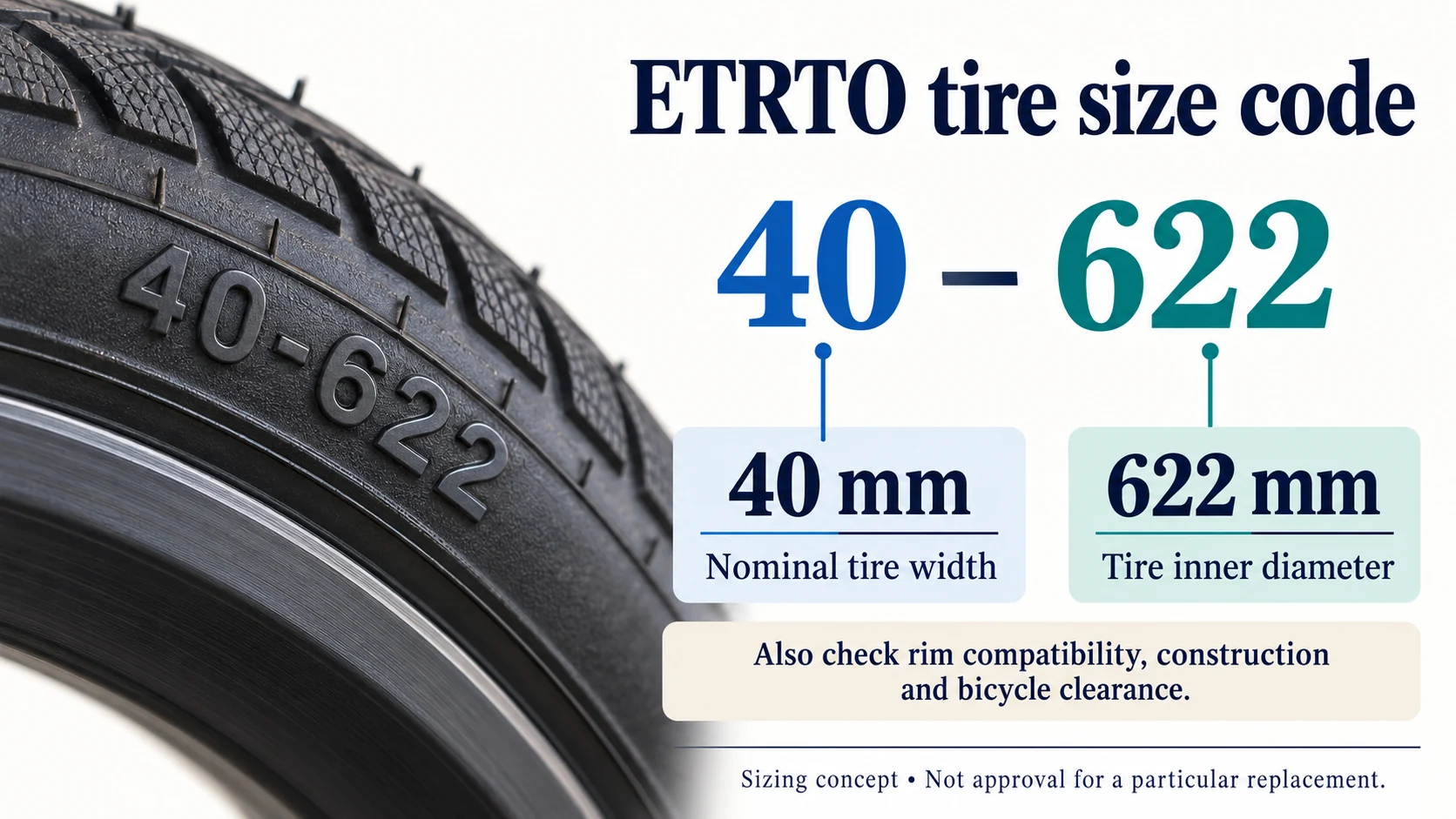
| What you see | What it tells you | What it does not establish |
|---|---|---|
| 40-622 | Width and tire inner diameter in millimeters | Compatibility with every rim, frame and brake clearance |
| A 584 mm diameter designation | A different diameter from 622 mm | An interchangeable substitute because both listings say “bike tire” |
| 28-inch or 29-inch marketing wording | An approximate size convention | The complete dimensional and construction requirements |
Schwalbe’s 28-inch versus 29-inch explanation shows why inch labels can mislead: those descriptions can share a 622 mm inner diameter. That still does not make every width or tire suitable for every bicycle using that diameter.
For a real sale, obtain the exact tire and rim information, permitted width and construction, and the bicycle maker’s clearance requirements. If an inner tube is involved, match its specified size range and valve requirements too. Hold the recommendation if the relevant model information is missing; do not tell the customer to force an apparently close size into place.
Record the interface for the component you sell
A wheel inquiry can need axle/end-cap, brake interface and freehub/cassette information as well as diameter. A frame inquiry can involve the exact fork, headset, bottom bracket and other maker-specified interfaces. Ask for the actual bicycle/model and part identifier, then use the relevant manufacturers’ compatibility information.
Use the fit information relevant to the component. For a frame bag, record dimensions and mounting clearance; for a replacement wheel, record the required technical interfaces. Refuse substitutions the manufacturer has not approved.
05
Compare the full delivery and return cost
Get the packed dimensions, gross weight, parcel count, dispatch origin and actual destination ZIP code. Ask which carrier/service accepts the carton and whether the quote includes handling, protective packing, residential or remote delivery, oversize charges and any customs-related costs. Do not assume the product’s weight determines the invoice.
The shipping-cost guide explains how to give providers the same parcel and service request. For a bicycle, add the arrival state and assembly arrangement. A cheaper freight quote may leave the buyer paying separately for work your other offer includes.
Work through a complete return, not only the selling spread
Assume a fictional ordinary bicycle sells for $600. The supplier charges $420 for the bike, outbound freight costs $95 and an agreed assembly expense costs $30. That leaves $55 before payment fees, advertising, overhead, tax and other costs. These are illustrative inputs, not a quotation or expected margin.
Now suppose the sale is fully refunded and the return costs another $90. For this teaching case, assume the supplier later accepts the return and credits the entire $420 goods cost, while freight and the paid assembly expense are not recovered.
| Item in this fully refunded example | Result |
|---|---|
| Customer revenue retained after refund | $0 |
| Original bike, outbound freight and assembly costs | $545 |
| Additional reverse freight | $90 |
| Assumed supplier goods credit actually received | −$420 |
| Unrecovered cost before other fees | $215 |
The loss is $545 + $90 − $420 = $215. Subtracting just the return freight from the original $55 spread would overlook the customer’s refunded payment. If the supplier offers less credit, or requires a different return service, the result changes again.
Settle where an opened bike can go
Ask whether the return destination can receive an assembled or partly disassembled bicycle, whether the original carton is needed, who arranges collection and who pays for an approved inspection or labor. A warehouse that ships bikes is not automatically the correct place for every opened return.
Keep the supplier’s commercial return terms separate from the remedy your customer is entitled to. The dropshipping returns guide explains that distinction. Price the practical reverse route before taking orders, rather than giving the customer an overseas address after a problem occurs.
06
Treat e-bikes as a separate product and transport review
An e-bike is not an ordinary bicycle with a generic battery added. Obtain the exact model, motor/control configuration, battery and matched charger information, instructions and relevant product/market documentation. Establish service and replacement support for that system; similar connectors do not establish interchangeability.
Product-safety classification, permitted road use and shipping acceptance are separate questions. CPSC’s bicycle scope does not answer every state or local riding restriction, and a European warehouse does not prove the model is suitable for every European or US destination.
Battery documents do not replace a route decision
PHMSA’s lithium-battery transport guidance explains commercial transport requirements and UN 38.3 test summaries. Get the documents for the actual battery design and have the shipper confirm acceptance of the real configuration and transport mode. A transport test summary does not certify the entire bicycle’s electrical system or establish permission to ride it on a particular road.
Agree the return process for a damaged, defective or recalled battery before selling. Do not tell a customer to put it on an ordinary parcel return label or substitute a charger while waiting for support. Obtain instructions from the manufacturer and appropriately qualified transport/service providers.
An October 2026 Federal Register notice concerns comments on a proposed micromobility battery/electrical-system safety rule. That notice is not a final standard. Check the current applicable federal, state and local requirements for the actual model and destination; do not promote a proposal as product approval.
07
Follow one delivery and make the repair promise real
Use an authorized first order to verify the operating arrangement. For BIKE-DEMO-C, replace the teaching name with the real manufacturer model, version, frame size, color and included equipment. Confirm stock at the actual dispatch location before making the shipment promise.
- Match the accepted order. Retain the store and supplier references, exact variant, address, charges and actual order acceptance. An imported product and paid retail order do not prove the supplier accepted that bike.
- Follow the shipment. Record the parcel count and carrier receipt, then delivery. Keep processing time separate from transit and any assembly appointment. A tracking label does not confirm a workshop booking.
- Complete the agreed handoff. Make the correct instructions and arranged service available. Record the supplied model/serial and any delivered damage, missing item or mismatch. The real first-order result decides what needs correction before promotion expands.
We have not carried out this order or assembly test. Keep the actual order and service records before describing your own setup as tested.
Ask who pays the mechanic, not only who sends the part
Suppose the buyer reports a wheel problem after opening the carton. Do not diagnose a bent, misadjusted or defective component from a brief message. Ask for the order and exact model/serial, record the description and relevant photos, and obtain the manufacturer’s appropriate inspection/service route. Advise against riding a bike with a suspected safety fault until it has been appropriately assessed.
A supplier agreeing to send a warranty part does not automatically cover removal, installation, inspection or another freight charge. Establish the approved part, qualified service, labor authorization, payer and likely timing before promising the buyer a free local repair. If a safe supported remedy cannot be provided, deal with the applicable return/refund or other remedy rather than leaving the customer to arrange an improvised repair.
Update the customer on the actual next step and pursue eligible supplier reimbursement separately. Repeated fit questions call for better product information; repeated assembly confusion calls for a clearer delivery promise. A genuine product fault needs the relevant supplier and safety response, not just a rewritten FAQ.
For China-side sourcing or fulfillment coordination, send AIDrop Agent the exact bicycle product, destination and proposed assembly/service arrangement . Include the component specification or the packed-carton dimensions, weight and quoted freight so the team can assess the requested work. Technical suitability, product compliance and qualified repair still require the appropriate evidence and parties.
08
Frequently asked questions
Can a beginner dropship complete bicycles?
Only if the supplier and retailer arrangement can support the actual model, fit, assembly, freight and customer remedy. Without cycling expertise or service contacts, a narrower range of understandable accessories may be a more practical start. A high ticket price alone does not make complete bikes a good first range.
Does every bicycle dealer offer dropshipping?
No. FavoriteBikes currently states it is not opening new dropshipping accounts and requires inventory and a physical dealer location. Other published programs have their own approvals, eligible products and territories. Check the actual arrangement rather than a supplier list’s label.
Can I describe a boxed bike as ready to ride?
Only when the actual delivered condition and any included service support that promise. Obtain the maker’s arrival checklist, instructions and required work. A finished product photograph or an assembly percentage does not establish that the customer can ride straight out of the carton.
Do the same inch labels guarantee replacement-tire fit?
No. Read the actual ETRTO and manufacturer information. Diameter, width, rim/construction compatibility and bicycle clearance matter; an inch label alone does not settle them. The worked 40-622 explanation is a way to read dimensions, not an approval for a particular replacement.
Is a supplier’s seven-day dispatch promise seven-day delivery?
No. Dispatch is the supplier handing off the order; carrier transit and any agreed assembly appointment follow. Use the current model, origin, destination and service information to make a supported customer promise.
Does a warranty replacement include local labor?
Not automatically. Ask which part is authorized, who performs the work and who pays inspection, installation and transport. Keep the supplier claim separate from the buyer’s applicable remedy.
Can I use the same delivery and returns for e-bikes?
Do not assume so. The actual battery, configuration, condition and route affect transport acceptance. Product, electrical-system and local-use requirements also need review. A damaged battery in particular needs an appropriate approved process, not an ordinary return label.
Sources and scope
Sources checked October 26, 2026: linked supplier and platform pages establish published program scopes; CPSC, Schwalbe, PHMSA and the Federal Register support the specified technical and regulatory distinctions. BIKE-DEMO-C and commercial figures are hypothetical. No application approval, private quote, physical inspection, assembly, test ride, shipment or actual customer outcome is claimed.

Pet Supplies Dropshipping: Fit, Materials and Product-Use Boundaries
Start with a narrow non-ingestible pet accessory. Verify intended use, fit, materials, sample version and recovery path

Fitness Products Dropshipping: Load, Fit and Support Requirements
A roller, band and doorway bar need different evidence. Check the exact model, use claim, package and

Outdoor Gear Dropshipping: Product Use, Durability and Shipping Fit
A picnic blanket, dry bag and camp chair call for different use evidence and parcels. Check model,
