
Use Minea to discover product candidates and study how ads and shops present them. Then decide what the exact product still needs to prove before you sell it. An active ad, a popularity label or a shop’s estimated revenue does not establish that one product will sell profitably through your store.
You may find a convincing demonstration, open the shop and see an impressive revenue estimate. It is tempting to import a similar item immediately. The missing step is connecting that evidence to the exact version you can supply, the buyer you want to reach and the offer you can honestly make.
This guide uses Minea’s current public research views and a fictional pet-hair-roller example. No paid account, private search results, sample or advertising test was used.
01
Start with a buyer question in Products or Ads
“Find a winning product” gives you almost no way to judge a result. “Find a reusable tool that helps pet owners remove hair from their car upholstery” gives you a buyer, a job and a surface the product must work on.
Minea’s public Products view searches by product name, shop name or domain. Its Meta Ads view searches keywords, brands or websites. Use Products when investigating an item and Ads when investigating how it is promoted.
Try a scoped research setup
The following is a proposed setup, not a search we executed or a proven winning filter:
| Research choice | Example |
|---|---|
| Buyer question | Removing pet hair from car upholstery |
| Search terms to try separately | pet hair roller; pet hair remover; reusable lint roller |
| Intended market and language | United States and English, using applicable available controls |
| Initial investigation window | September 26–October 26, 2026, then a wider window if useful |
| Result to retain | Exact item/ad/shop link, observation date, filter settings and the question it helps answer |
The public Meta view labels include Countries, Languages, Publication date, Duration, Status and Product categories. The Products view has its own product, shop and engagement filters. Controls and access can differ by plan; public labels do not establish that every function is available on your account.
In Products, the shop’s Traffic by country field is not a sales-by-country report for the selected product. Keep the country field and its scope with the source record; an ad’s country label is not a report of who bought your future offer.
A date window narrows the investigation; it does not make a recent item better than an older one. If the exact phrase returns little useful material, try a sensible related term or a wider period. An empty search is not proof that nobody needs the product.
Filter to make comparisons useful
Keep the market, language and question consistent while comparing candidates. A demonstration for a different use or country may be interesting without answering your original question.
Avoid starting with an arbitrary rule such as “over 700 likes means test it.” That selects an engagement level, not a product that fits your customer or costs. Record the available engagement, but keep the selection reason tied to the buyer’s job.
For choosing a broader research stack, the product research tools guide explains the different jobs performed by search-demand, ad and transaction tools. This page concentrates on making a Minea research session produce a useful decision.
02
Keep ad, shop and product evidence separate
The most important question about a number is what it describes. An ad, a shop and one product are different units of evidence.
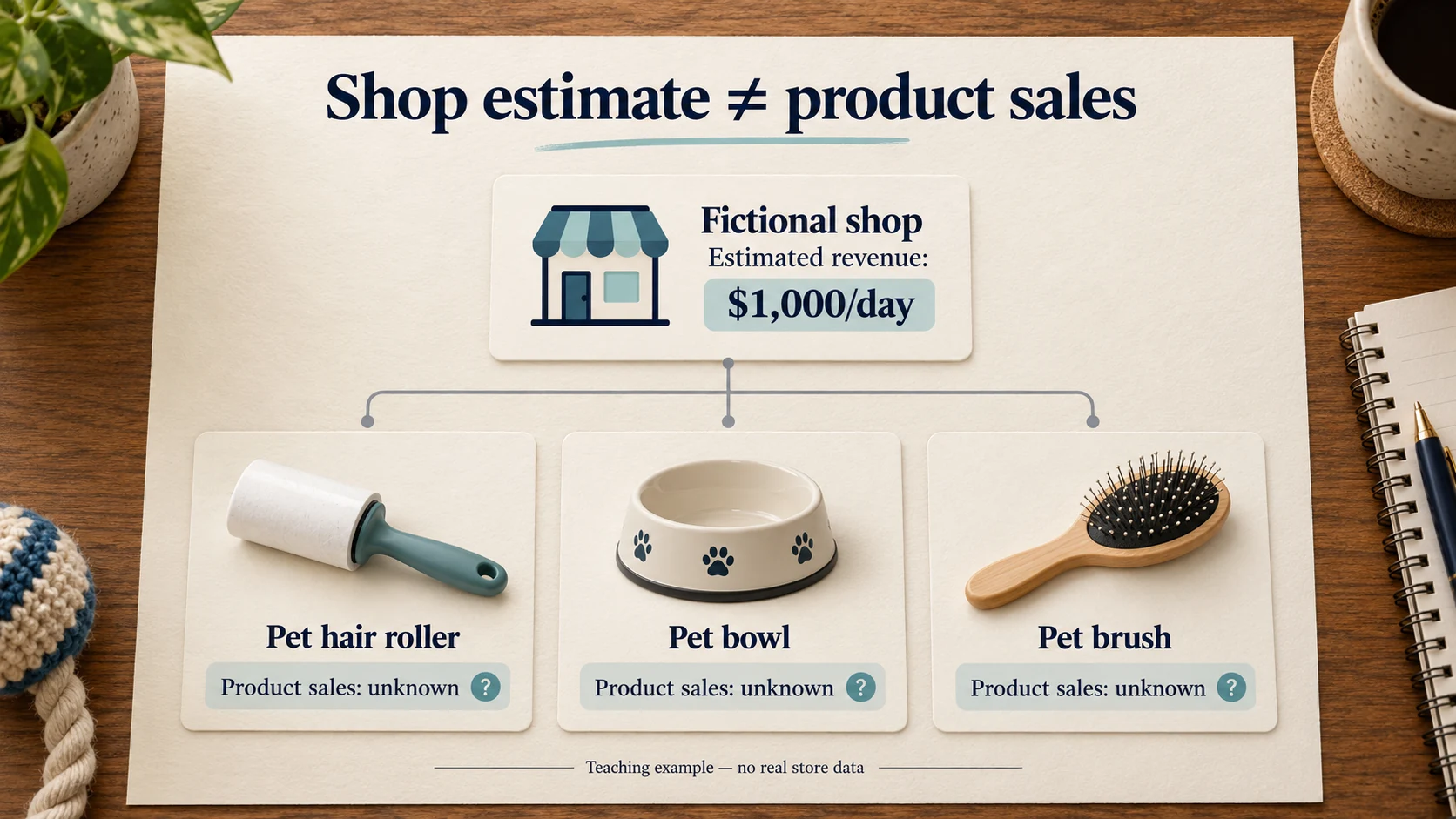
Minea’s Products interface labels one shop field Estimated daily revenue. Suppose, purely as an illustration, a shop selling a roller, pet bowls and brushes has a $1,000 daily estimate. That does not tell you how much came from the roller. It also does not give that roller’s advertising cost, refunds or retained profit.
A shop estimate cannot become product sales
Writing “this roller makes $1,000 a day” would add a product-level conclusion that the hypothetical shop-level figure does not support. Keep the estimate attached to the shop and the actual inspection date; mark the product’s share as unknown.
| Signal | What it can help you investigate | What it does not establish by itself |
|---|---|---|
| Ad creative and landing page | How the item is demonstrated and what the offer promises | Whether your supplier’s version performs the same way |
| Ad duration or active status | Whether the advertisement merits closer inspection | Acquisition cost, retained margin or profitable continuous spending |
| Engagement and ad counts | Reactions, recurring messages and additional creatives to inspect | A count of independent buyers or profitable businesses |
| Estimated shop revenue | A shop-level research lead | Verified sales or profit for the selected product |
A useful technical word is proxy: an indirect signal used to investigate something else. Likes can be a proxy for interest, but your decision concerns whether people will buy and keep the exact offer you can fulfill. The proxy is useful only when you retain that distinction.
Respect the field’s geography and limits
The public Meta view groups certain reach and spend fields under EU Only. Do not treat a field available for that scope as a verified US advertiser’s spend or acquisition cost.
Multiple ads can also repeat one offer or creative. Save the actual advertiser and destination rather than counting every result as a separate business proving demand. The purpose is to understand the offer and its evidence, not accumulate a reassuring number of screenshots.
03
Work one candidate through the missing facts
Now follow the pet-hair-roller idea. The record below is explicitly fictional; it is not a Minea result, a customer testimonial or a supplier assessment.
| Part of the fictional candidate | Research record | Consequence |
|---|---|---|
| Buyer need | Pet owners want to lift hair from car upholstery | The intended surface matters; a clothing-only demonstration is incomplete evidence |
| Ad idea | A roller is shown collecting visible hair from upholstery | Investigate the exact mechanism and conditions, rather than copy the performance claim |
| Shop context | The imagined shop sells several products and has a shop-level revenue estimate | The roller’s sales and profit remain unknown |
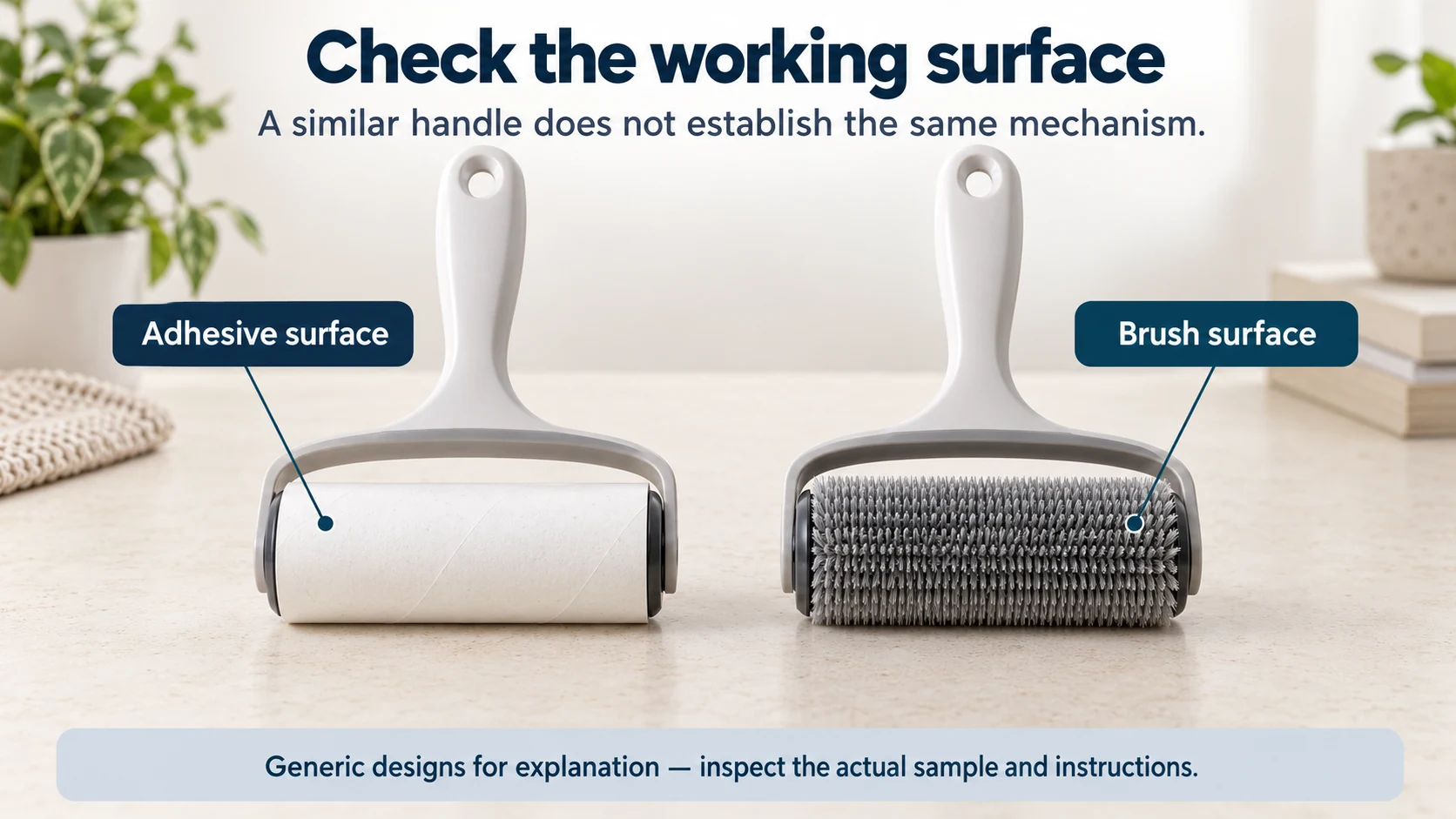
| Proposed supplier item | A photograph shows a similar outer shape | Matching appearance does not establish the same working surface or cleaning method |
| Product promise | Reusable upholstery hair removal is proposed | Fabric limits, operation, cleaning and repeat-use behavior still need product evidence |
| Next decision | Request the exact version and its instructions as a sample | Hold the retail offer until the sample and claims can be assessed |
Follow the gap to a specific next action
The research has produced a plausible problem to solve, but it has not produced a product ready for sale. The immediate next step is a matching sample and its intended-use information, rather than a larger advertising budget.
Ask for the exact item shown in the supplier offer, including its working surface and cleaning method. Keep the source reference and version with the sample. If the delivered sample differs, resolve that difference before filming a demonstration or promising the original result.
This is a useful outcome even if you later reject the candidate. You have identified a concrete reason to stop: the version you can obtain may not support the use that made the advertisement attractive.
04
Move from research to an honest selling test
Assess the sample against the proposed buyer job, using the product’s applicable instructions and permitted surfaces. Record what it actually does, how it is cleaned and any relevant limits. Check the received components and packing as well as its appearance.
Create your own demonstration or obtain the necessary rights to material you use. Generated teaching images, a competitor’s video and your own sample evidence have different roles. An illustration cannot prove the real roller’s result.
Put the delivered cost beside the offer
Suppose a fictional offer leaves $29 in revenue after applicable sales tax, with $11 for the goods and delivery, $1 in payment expense and a $3 working allowance for customer remedies. These are invented planning inputs, not Minea data, supplier rates or a measured return rate.
The remaining amount is $29 − $11 − $1 − $3 = $14 before advertising and overhead. Spending all $14 to acquire an order would leave nothing from that amount for overhead or operating profit. Your actual allowable acquisition cost must follow your own costs and required remainder.
The sample can change this calculation. A different package, cleaning requirement, delivery service or remedy cost may make the original offer unattractive even though the advertisement remains interesting. Recalculate the offer you can actually supply.
Decide what a limited test should answer
Once the item and claim are supportable, define the exact variant, audience, price and delivery promise. Set an affordable spending and order limit before starting, and verify that the visit-to-order measurement works.
Then follow paid orders through fulfillment and the customer outcome. Purchases tell you something that ad engagement cannot, but a few purchases still do not establish reliable demand, profit or repeatable delivery.
The product validation guide develops that test and its stopping rules. The result of Minea research should be a reasoned candidate and a testable offer, not permission to skip this work.
If you need help assessing a China-side version of the item, send AIDrop Agent the supplier reference, intended use and destination. We can discuss the sample and packing checks the proposed offer needs. We do not verify a competitor’s private sales or guarantee that a research-tool ranking will become a successful product.
05
Pay for the research work you actually use
Minea’s dedicated pricing page, checked October 26, 2026, displays these USD monthly prices:
| Plan | Displayed monthly price |
|---|---|
| Starter | $49 |
| Premium | $99 |
| Business | $199 |
Other billing periods are offered. A monthly equivalent advertised for a longer billing period is not necessarily a month-to-month charge. Check the selected currency, period and total before paying.
Some older official landing pages still show different Business pricing and credit-based tables. Use the current dedicated pricing and your actual checkout terms rather than combining benefits from one version with the price from another.
Match the plan to the blocked task
Identify what you need next: product searches, particular ad coverage, shop analysis, saved collections or monitoring. Check that function and its limits on the current plan. Seeing a filter label publicly does not prove that its full result set is included at every tier.
Paying more makes sense only if the additional function resolves a real research gap or saves worthwhile work. It does not fix an unknown product mechanism, a weak delivery offer or a revenue figure assigned to the wrong item.
Subscription cost also sits outside the product, sample, creative, advertising and fulfillment budgets. A research tool can organize the investigation; it does not fund the test or absorb the customer remedy.
06
Frequently asked questions
Can Minea tell me which dropshipping product is guaranteed to sell?
The public research features and rankings do not establish that guarantee. Use them to find candidates and inspect offers, then evaluate the exact product and your own costs. A competitor’s shop estimate is not your future sales result.
What are the best Minea filters for a beginner?
There is no useful universal likes threshold. Start with a specific buyer problem and the market you intend to serve, use the appropriate product or ad search, and retain the dates and settings. Broaden deliberately when the result does not answer the question.
Does a supplier-finder result prove it is the same product?
A source link or similar photograph is a lead. Compare the exact version, materials, mechanism, contents and intended use, then inspect an appropriate sample. In the roller example, a similar handle does not establish the same working surface.
Can I copy a successful advertiser’s video or reviews?
Visible material is not permission to reuse it. Study the question it answers, obtain rights where needed and create truthful evidence for your actual offer. Do not present someone else’s reviews or a generated result as your own customer’s experience.
What should I save at the end of a research session?
Save the specific item/ad/shop references, inspection date and filters, what each signal actually describes, the unanswered product and cost questions, and the next decision. Use the available collection or your own research record. “Request this version as a sample” is a clearer output than another folder labeled winners.
Sources and scope
Sources checked October 26, 2026: linked current public Minea Products/Meta views and dedicated pricing, with older official content used only to identify discrepancies. Public labels were inspected; private filter execution, returned products and revenue accuracy were not tested. The roller, shop estimate and cost inputs are fictional teaching examples. No actual sample, subscription, ad campaign or profitable product result is claimed.

Dropshipping Product Research: Decide What Deserves a Test
Research dropshipping products with demand signals, offer comparisons and sample checks, then turn the findings into a
Best Dropshipping Niches: 7 Focused Ideas and Who They Suit
Compare seven dropshipping niches with product examples, customer needs, content angles and sourcing risks. Learn how to

Best Products to Dropship: 12 Practical Ideas to Test
Explore 12 practical products to dropship, with customer uses, sample checks, demand validation and a shipping-cost example
