

A dropshipping virtual assistant (VA) can take over repeatable store work: checking order status, following up with suppliers, preparing customer replies and spotting listing errors. Start with one defined queue and a short paid trial. Keep decisions about refunds, price changes, supplier changes and new delivery promises with the store owner or another named approver. A VA can move an order forward without being given permission to rewrite what the store owes the buyer.
Picture a store with 25 open customer messages. Ten ask where a parcel is, six need a product detail, and the rest need judgment. The first 16 may be good VA work once the answers and escalation rules are documented. The last nine are where an impressive “I can handle everything” job description becomes risky. The question is not how many tasks a person will accept; it is which decisions you can safely hand over.
Explore the broader topic: Is Dropshipping Worth It? Work Through Profit, Cash, and Time.
01
Give the first assistant a real queue, not your entire store
For a first hire, choose a narrow job such as order-status and supplier follow-up. The VA starts with an order number, checks what the store and supplier actually know, logs the next action and sends or drafts a reply under your approved language. This is more testable than asking for “customer service, marketing, products and operations” at once.
| Work in the queue | VA may do with an approved playbook | Merchant or named approver decides |
|---|---|---|
| Where-is-my-order message | Match order, supplier dispatch and carrier event; explain the verified status | New delivery guarantee or compensation outside policy |
| Missing or wrong item | Request order and parcel evidence; open a supplier investigation | Replacement, refund and who pays the loss |
| Product listing check | Flag a price, variant, image or stock mismatch with evidence | Change price, claims or supplier if not preapproved |
| Supplier follow-up | Ask for a dispatch date, stock confirmation or missing tracking | Accept new terms or redirect paid orders to another supplier |
On a phone, swipe the table sideways to compare every column.
This table is a starting assignment, not a universal job description. An experienced team with written refund limits might authorize more routine actions. A new store with unclear supplier terms should authorize less. In either case, say what proof the VA needs and when an exception leaves the queue. The order-release checklist helps define what must be confirmed before a supplier is told to ship.
Give the assistant a source for each product fact
Product uploads can be delegated too, but only after the store has an approved source of product facts. A VA should not infer that a supplier’s red variant has the same material, contents or compliance documents as the black one. Give them a field-by-field source and ask them to flag missing facts. The same principle applies to customer replies: a polished sentence cannot repair an unknown shipment status.
If your bottleneck is mainly delayed parcels and unclear supplier answers, hire for that work first. If your bottleneck is choosing products or buying ads, an order-support VA may be busy without solving the actual constraint. The scaling guide covers the wider operational sequence; the VA role should fit the current weak handoff.
02
Check whether the queue is ready for a hire
A VA helps when a repeatable task already has a reliable source of facts and a clear next action. Count a week of tickets before opening a role. Separate simple order-status lookups, supplier follow-ups, product-fact checks and judgment calls such as refunds.
Note the actual minutes spent and how often the supplier or store data was missing. A backlog caused by missing tracking events will still be a backlog with another person reading it.
Measure a known task before adding a person
Make the first role small enough to train and measure. If ten daily tracking questions each take five minutes and the answers are in the order system, that is roughly 50 minutes of repeatable work a day. If eight of those questions require an unknown supplier handoff, the first investment should be a better status feed or escalation agreement. Those numbers are a workload illustration, not a staffing rule or wage estimate.
Give the assistant evidence and an approver
Before hiring, produce three things: a sample ticket with the correct evidence and reply, an escalation rule for facts that cannot be verified, and a named person who approves buyer remedies. This gives a candidate something to practice and gives you a pass/fail standard. Then price the paid trial against time saved and mistakes caught; an hourly rate alone cannot tell whether the buyer gets a truthful answer.
03
Match access to the job you wrote down
Use a named account with access matched to the task. Shopify’s current plan rules do not allow ordinary staff users on Basic or Starter; Grow, Advanced and Plus have different limits. Check the plan before promising a VA an admin login.
If the plan cannot add staff, keep the trial in an appropriate helpdesk with only the order information the task needs, or choose an eligible access arrangement. Do not solve the limitation by sharing the owner password or assuming every VA qualifies as a Partner collaborator.
Check access in three places:
Store
use current role options and dependencies. Shopify’s examples are a guide, not a ready-made VA role.
Other tools
scope helpdesk and supplier-portal accounts separately. A limited Shopify role cannot secure a shared supplier password.
Sign-in and exit
use two-step authentication, test one harmless order lookup, then remove access when the trial ends.
If the VA needs more access later, add the specific permission for a documented task and test the boundary again.
Configure the first role from the ticket, not from a job title
For an order-status trial, list the minimum actions first: view the relevant order, read fulfillment and tracking, draft a support note, and contact the supplier through a separately scoped account if needed.
Save the task-specific role
For an eligible Shopify plan, create a task-specific store role through Settings → Users → Roles → Add role. Name the role, select its actual required permissions and apps, and Save. Leave money movement and offer changes outside this first trial’s scope.
Save the invitation and check acceptance
To invite the user, use Settings → Users → Add users, enter the email, assign the intended role, inspect the combined permission summary and Save. Keep secure sign-in enabled. A Pending invitation is not a completed account; reopen it after acceptance and test the saved access.
Test one permitted task and one forbidden action
Test both sides of that boundary. Give the trial user a non-sensitive order: can they find the carrier event and draft a reply? Under the same role, confirm they cannot refund an order or change a price. Test the helpdesk separately if its access differs from Shopify.
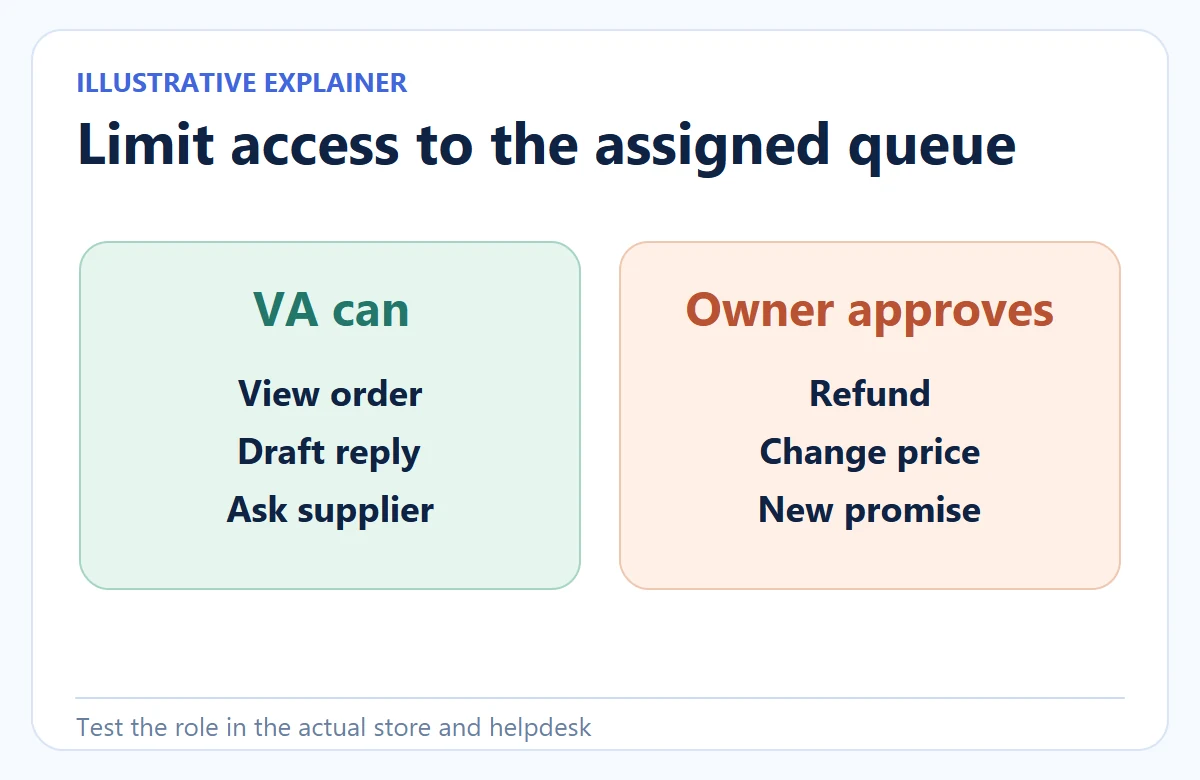
Record the result as can view order and draft reply; cannot move money or change offer. Fix any failed boundary before real tickets. Add two-step authentication and an offboarding date to the access record.
Instructions must match saved permissions
The paper workflow and the software role should agree. If your instructions say “escalate refunds,” but the account can issue refunds, the boundary exists only in a document. If your instructions say “reply to a tracking question,” but the VA cannot see the supplier’s latest answer, the reply may be guesswork. Fix the mismatch before asking someone to work faster.
04
Work one delayed-parcel ticket from evidence to reply
Here is an illustrative order, not a customer case. Order #1842 was placed on Monday. A shipping label appeared Tuesday, but by Thursday there is no carrier acceptance scan. The buyer asks, “Will this arrive by Friday?”
The VA has four things to record before replying:
Store record
order number, promised shipping window and the exact item paid for.
Supplier record
whether the parcel was packed, handed over, held or still waiting for stock.
Carrier record
the latest actual tracking event and its timestamp. A created label is not a carrier scan.
Customer next step
what can be said now, when another update is due, and who approves a remedy if the original promise cannot be met.
A plain reply while pickup is unconfirmed
With no confirmed carrier handoff, do not promise Friday delivery. A proposed reply is: “I can see a shipping label, but I cannot yet confirm a carrier pickup. I have asked our fulfillment team to verify the handoff and will update you by tomorrow at 12:00.”
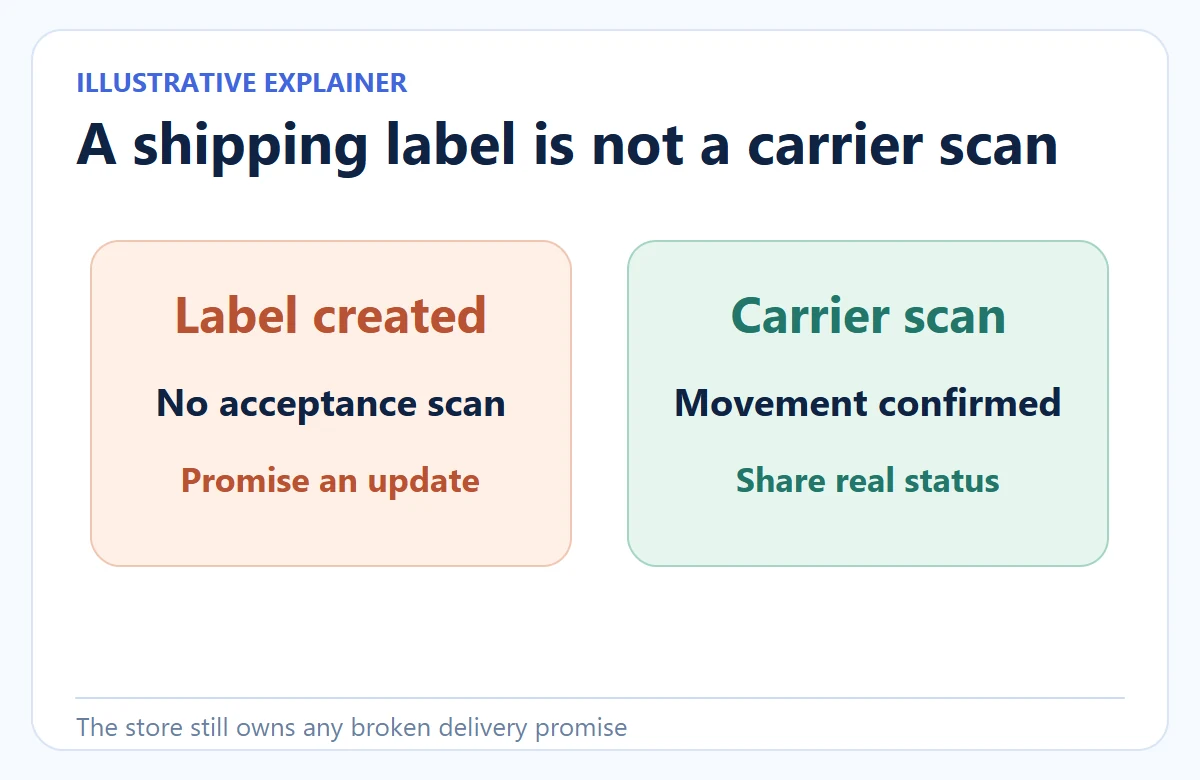
The example deadline promises an update, not delivery. Use a response window your store can meet. Record what is still unknown and send the merchant a decision request if the original delivery promise cannot be met.
The merchant’s ticket should be short enough to decide from: order #1842; blue basket; paid Monday; label Tuesday; no acceptance scan Thursday 10:00; supplier asked for handoff proof; buyer update due Friday 12:00; VA gathers evidence; merchant owns remedy.
An answered task can leave the buyer’s case open
The VA may close the information task when the supplier fact is found or escalated. A label alone does not close the buyer’s case. If a real scan arrives, update the ticket and buyer. If it does not, send the merchant the unresolved promise and a decision deadline.
The VA then follows up with the supplier and puts the evidence in the ticket. If Friday delivery was promised on the product page, if the item has become unavailable, or if the buyer asks for a refund, the case goes to the named approver with the facts.
The approver decides the replacement, refund or changed customer promise under the store’s policy and applicable rules. The customer-service guide covers the wider reply process; the returns guide is the next reference when the issue becomes a return.
This is the useful division of labor. The assistant can eliminate waiting, missing notes and vague replies. They cannot turn an absent parcel into a confirmed shipment. A well-run queue makes the merchant’s decision quicker because the evidence is already attached.
05
Run a paid trial that measures judgment, not message count
Prepare a one-page trial brief: queue hours and channels, systems, representative sample tickets, reply templates, required evidence, escalation triggers and the named approver. Use the cases below to test the actual first job, rather than asking for a fixed number of copied replies.
State whether replies are drafts for review or may be sent directly within a narrow policy. Give the candidate a paid trial with a mix of easy and awkward cases; do not test them only on questions with answers copied from a template.
Define the unanswered-supplier escalation
The brief should say what the assistant does when nobody answers a supplier message. For example, first request a dispatch update against the order ID, follow up through the agreed channel after the stated response window, and escalate a missed customer promise to the merchant with the unanswered questions attached.
If the VA merely sends another “any update?” every day, the inbox may look active while the buyer gets no decision. A next-action owner and deadline are more useful than a long activity log.
| Trial observation | What good work looks like | Warning sign |
|---|---|---|
| Order facts | Correct SKU, status and latest timestamp are captured | Old or unrelated tracking copied into the reply |
| Customer wording | Plain update with a real next contact time | “On its way” inferred from label creation |
| Escalation | Refund, lost parcel and broken promise reach the approver promptly | VA offers an unapproved remedy or closes the ticket |
| Closure | Supplier response and buyer update are linked to the same order | Inbox count falls while unresolved cases disappear |
On a phone, swipe the table sideways to compare every column.
Review accuracy and unresolved cases
You can count tickets processed, but speed by itself is a poor pass mark. Review a small sample of the actual replies and ticket notes. Did the VA separate a supplier’s estimate from a carrier event? Did they ask the missing question early? Did the buyer get a useful next step? Did the merchant receive enough information to decide without reopening the whole order?
Use tickets that test different decisions
Score the paid trial on four observable decisions rather than a message total:
Verified tracking
A routine tracking ticket: did the candidate cite a real carrier event and send a clear answer?
Label without acceptance
A label-without-scan ticket: did they avoid calling the parcel shipped and set an update time?
Wrong item
A wrong-item complaint: did they match the paid variant to evidence and escalate the remedy?
Refund request
A refund request outside policy: did they send it to the approver without promising money back?
For each, check the order/variant match, evidence used, buyer wording and handoff. Review the notes with the candidate and show a corrected example. A trial that handles 40 easy tickets but invents one delivery scan has not passed an order-support role.
Fix the data problem before widening the queue
If those answers are consistently good, extend the queue or add a second bounded job, such as listing-fact checks. If the assistant repeatedly needs to guess because suppliers do not report dispatch clearly, hiring another person will not fix the source of the problem. The store needs a better supplier and fulfillment handoff first.
Decide the paid trial from observed work:
Continue
when the VA identifies the right order and variant, reports accurate status and escalates exceptions with usable context.
Retrain or narrow scope
when facts are right but reply tone or ticket notes need work.
Stop or withhold access
when the VA invents dispatch, shares data outside approved tools or makes an unauthorized financial promise.
“Felt helpful” is a weak hiring decision once a customer has paid.
For China-side sourcing, quality checks, packaging or fulfillment exceptions, AIDrop Agent’s services can help define who supplies the facts your support queue needs. We are not offering a VA recruitment service here. If your assistant spends each day chasing missing dispatch or product evidence, tell us where that handoff breaks and what a confirmed answer should contain. A clear upstream record makes both a human assistant and the customer experience better.
06
Frequently asked questions
Which task should my first VA own?
Choose one repeatable queue with facts they can verify, such as order-status lookup and supplier follow-up. Give a sample ticket, reply standard and escalation deadline. Do not combine refunds, product sourcing, ads and customer support into an untestable first assignment.
Should the VA get the store-owner login to work faster?
No. Use a named account with only the first task’s permissions and secure sign-in. Check the actual plan: Shopify Basic and Starter cannot add ordinary staff users. If staff access is unavailable, use an appropriate scoped helpdesk arrangement rather than sharing the owner password. Test the permitted and blocked actions in each tool.
How do I know a paid trial worked?
Review actual tickets for correct order and variant, verified tracking, clear buyer update and timely escalation. Count errors and unresolved cases as well as speed. If the assistant repeatedly lacks supplier facts, fix the upstream handoff before treating more messages as a hiring success.
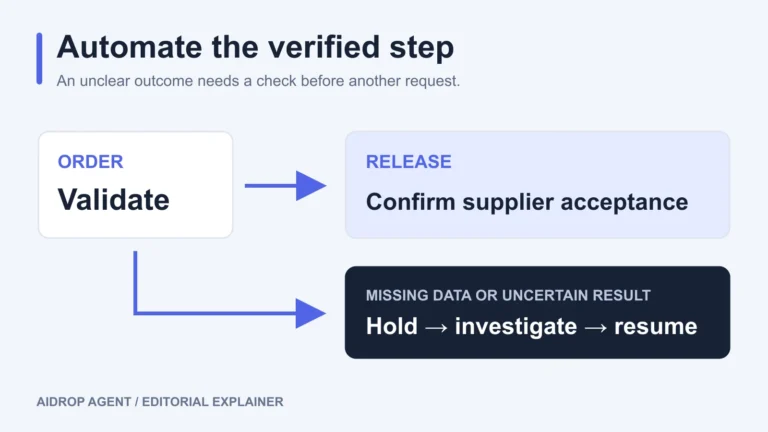
Automated Dropshipping Fulfillment: Setup, Holds, and Recovery
Set up automated dropshipping fulfillment with product mapping, release rules, supplier acknowledgments, holds and safe recovery after
Dropshipping Order Release Checklist: From Hold to Supplier Acceptance
Release a dropshipping order only after its payment terms, risk review, exact items, delivery details, stock, supplier
Dropshipping SKU Mapping: Make Every Store Variant Reach the Right Item
A variant-level mapping and controlled order stop the wrong color, size or pack from reaching buyers.
