
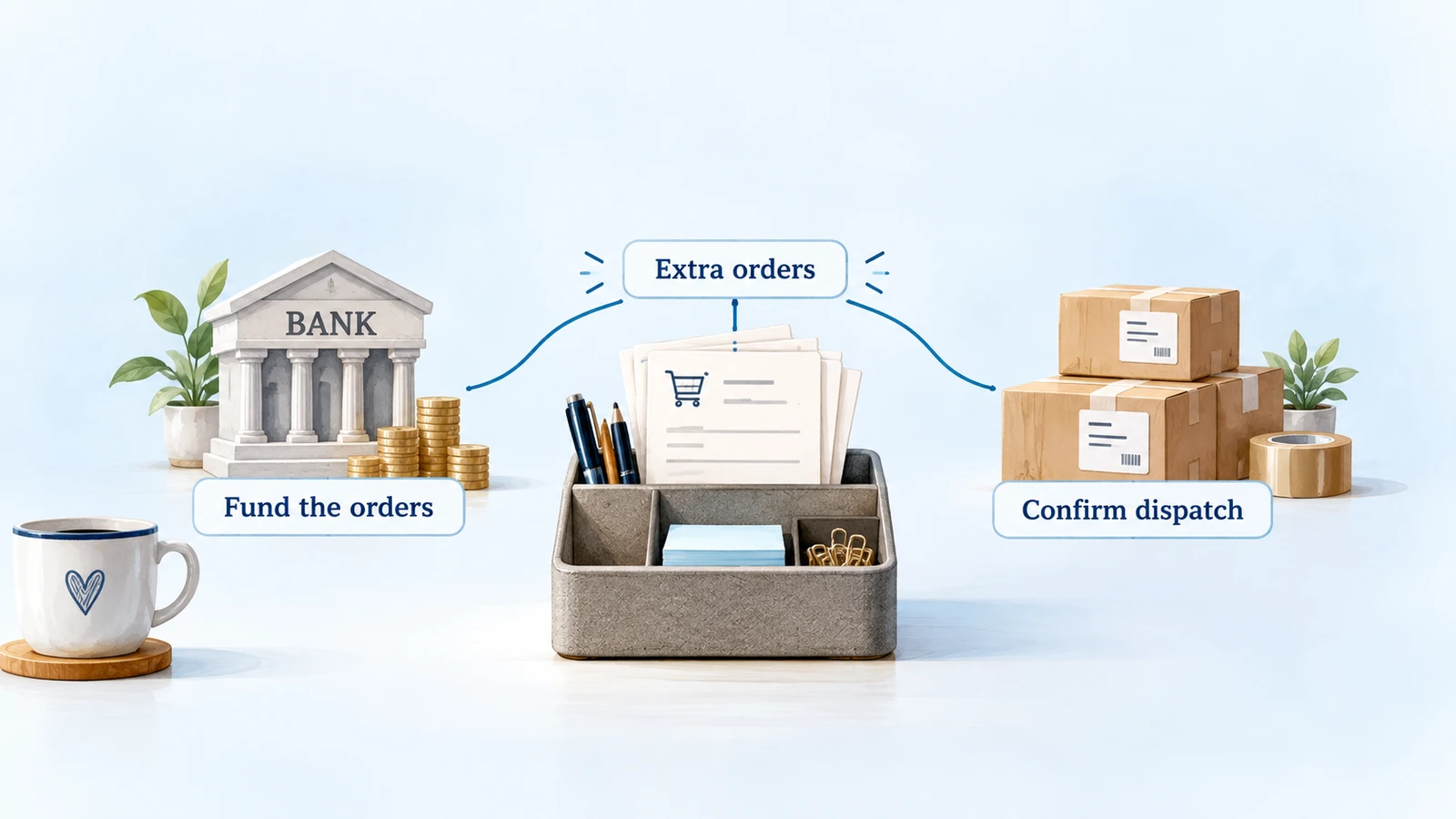
To scale a dropshipping business that already makes sales, improve the part that stops more orders from becoming profitable, paid-for, delivered orders. Find the constraint, calculate what the next orders leave after their costs, make sure you can pay the supplier before payouts arrive, and test only a volume your supplier can dispatch. Then keep, repair or stop the increase based on completed orders.
Can twenty daily orders become thirty?
Suppose your store already sells twenty desk organizers a day. You want to reach thirty. More ads may bring those customers, but the extra orders help only if they leave enough money, your bank can fund the parcels and the chosen color actually reaches the carrier. The figures in this article are hypothetical, not AIDrop quotes or a store performance claim.
The dropshipping marketing guide covers channel selection. Here, the store already trades; the question is which part to grow next.
01
Find the constraint before buying more traffic
Take a recent group of delivered orders and compare it with an earlier group selling the same item to a similar destination. Note the source of each order, the price paid, product and delivery cost, any refund, and whether the promised shipment happened. A sale from yesterday can show interest, but its final cost is still developing; keep unresolved orders visible.
| What the store shows | First move | Sign that it helped |
|---|---|---|
| Suitable visitors buy, but there are too few | Test more of the source that brings those buyers | Extra kept orders still leave contribution after acquisition cost |
| Visitors ask about size or price and leave | Show the organizer beside a laptop, its dimensions and delivered price | More comparable visitors complete and keep orders |
| Buyers want a related item after delivery | Try one priced companion or appropriate follow-up | The complete second order adds contribution |
| A popular color sells out or parcels wait | Repair that variant’s stock or daily picking limit | More exact items reach the carrier on time |
| Orders earn money on paper but supplier invoices come first | Fix the payment gap | Usable cash covers the bills before payouts |
On a phone, swipe the table sideways to compare every column.
Choose the problem the orders reveal
Choose one row for the first increase. If buyers hesitate over the organizer’s footprint, buying more of the same traffic makes the page problem more expensive. The conversion-rate guide helps locate that buying-path issue. If the page converts but the blue variant repeatedly stalls, the first call is to the supplier.
02
Compare the money from twenty and thirty orders
Contribution is the part of an order’s net sale that remains after its variable costs. It still has to cover fixed business bills and, eventually, profit. For the illustrative organizer, the store receives $50 after discounts, excluding tax collected for the authorities.
- Customer receipt: Current plan: $50; Thirty-order ad plan: $50
- Product and outbound shipping: Current plan: −$22; Thirty-order ad plan: −$22
- Payment fee: Current plan: −$2; Thirty-order ad plan: −$2
- Customer acquisition: Current plan: −$12; Thirty-order ad plan: −$18
- Planning allowance for order remedies: Current plan: −$3; Thirty-order ad plan: −$3
- Contribution: Current plan: $11; Thirty-order ad plan: $5
Revenue rises while contribution falls
Twenty orders a day for seven days leave 20 × 7 × $11 = $1,540 toward overhead and tax. Now suppose acquiring the extra volume raises the average advertising cost to $18 across all thirty daily orders. Thirty orders a day then leave 30 × 7 × $5 = $1,050. Weekly revenue rises from $7,000 to $10,500, yet contribution falls by $490.
More orders would leave less money for the business in this example. If only the extra ten orders cost $18 to acquire, calculate those ten separately; do not raise the assumed cost of the original twenty without evidence. The $3 remedy allowance is a forecast, not a bill paid on every sale. When the order group matures, replace it with actual losses rather than subtracting both.
What if only the extra orders cost more?
There are two different scenarios. The earlier $1,050 result assumes all thirty daily orders cost $18 each to acquire. If only the extra ten cost $18 and the first twenty genuinely stay at $12, calculate them separately:
The first twenty each day
20 × 7 × $11 = $1,540 contribution for the week, using the original stated costs.
The extra ten each day
10 × 7 × $5 = $350 more contribution. Combined contribution would be $1,890 before overhead and tax—not the earlier $1,050 scenario.
Both are teaching calculations, not ad-test results. For your actual period, keep acquired orders, acquisition spending and other variable costs together. If the increased campaign affects the original traffic too, use that changed cost. A revenue chart alone cannot tell you which scenario occurred.
Enter variant costs before the sale
Shopify’s profit-report guidance says the basic product cost captured at sale does not include shipping, taxes and other costs. Add parcel, acquisition, payment and remedy records before using that report to choose a bigger ad budget.
03
Make sure you can pay for the extra parcels
The customer may pay today while the supplier and ad platform require payment before that sale becomes spendable bank cash. Put four dates beside the proposed volume: supplier payment, ad billing, usable payout and other bills. Use your processor’s actual account terms. Shopify’s payout guidance says settlement varies by region and risk; weekends, holds and bank processing can move the usable date.
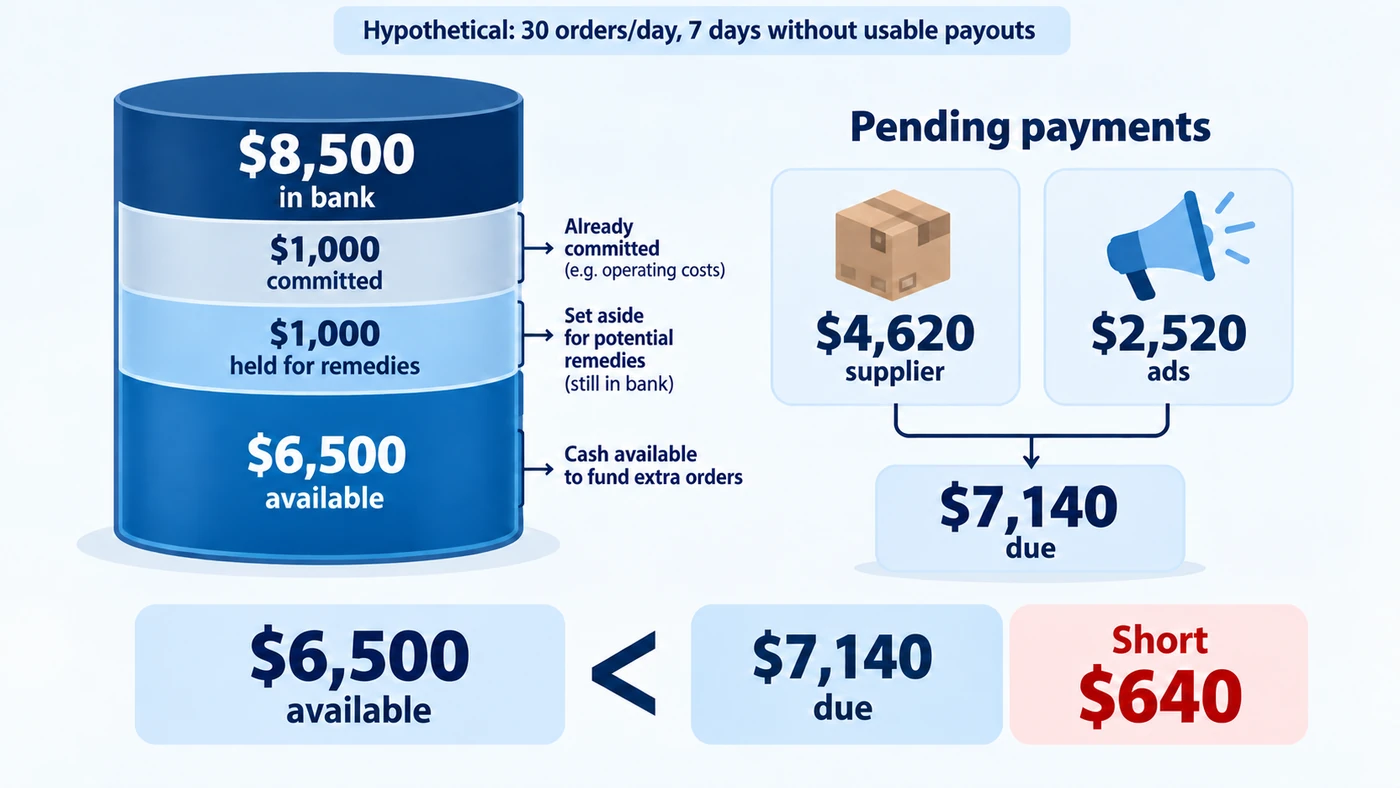
Even if the earlier $12 acquisition cost holds, the thirty-order increase must be funded before its payouts arrive. Assume, for this example only, that no new customer proceeds become usable for seven days. Product and shipping cost $22 per order:
30 × 7 × ($22 + $12) = $7,140 needed before usable payouts.
The bank holds $8,500. Of that, $1,000 is already committed to other bills and $1,000 is being held for possible customer remedies. Only $6,500 is available for this week’s product, shipping and ads. The thirty-order plan is $640 short. The held $1,000 is still cash reserved for another purpose; it is not another expense in the contribution calculation.
At twenty daily orders, the same seven days need $4,760. A proposed twenty-five-order day needs 25 × 7 × $34 = $5,950 and fits the $6,500 available under these assumptions, with $550 left for variation. That is a funding test, not proof that twenty-five orders can be won or dispatched.
Check whether the account has a real payout reserve; Shopify describes reserved funds as inaccessible until release. If fees are deducted from payouts, lower the expected receipt. If a supplier has confirmed credit terms, move that actual due date. Neither a pending payout nor hoped-for credit pays an invoice today.
04
Test one growth lever on the proven offer
Choose the change that matches the problem you found. If qualified visitors buy the organizer and their orders remain profitable, try a capped increase in the current traffic source or one relevant audience. State the maximum spend, destination and acquisition cost that would still make the additional orders worthwhile. There is no safe ad-budget percentage that applies to every store.
Repair the offer before expanding traffic
If visitors hesitate, make the product easier to buy before expanding traffic. Add a photo showing the organizer beside a laptop, the actual dimensions and the delivered price. Keep a comparable audience while you test the page, so you can tell whether the change helped. The point is not to add more copy; it is to answer the buyer’s missing question.
Price the full bundle and parcels
A companion item or bundle can raise the basket total. Price both items, picking, packaging, shipping and any discount before calling it a win; two items may need another parcel. For a repeat offer, wait until the first order has arrived and address any open support problem. The customer-retention guide covers the follow-up choice and recipient eligibility.
Set a review date for the one change. Compare kept orders, not clicks or checkout starts alone. Forecast repeat purchases can inform a longer plan, but they cannot fund this week’s supplier invoice.
05
Ask whether the exact organizer can leave the warehouse
Send the supplier the item code and colors you intend to sell, the destination mix and the proposed daily quantity. Ask for the physically available units of each variant, the replenishment date, the picking cutoff, packing capacity and the carrier-handoff record. “We handle hundreds of orders” does not answer whether the blue organizer can leave tomorrow.
Observed capacity is twenty-five
For this example, suppose the store has observed correct picking and carrier acceptance at twenty-five orders a day. Thirty remains unproved. Run the smaller, funded volume before promising the larger one. Track order-to-carrier acceptance, not just a generated shipping label or an app’s “fulfilled” status.
Incoming stock is not available stock
Shopify’s inventory states separate available stock from committed and incoming quantities. Its order-routing rules can allocate orders among supported locations; they do not inspect the shelf. If another location or supplier would make a second parcel, recalculate cost and tell the customer what will ship. Do not silently substitute another color to keep the order count up.
For covered US merchandise orders, the FTC’s shipping rule requires a sound basis for the shipment promise and the prescribed delay-consent or cancellation/refund response if it cannot be met. A supplier’s missed cutoff does not erase the store’s customer obligation. The rule is about shipment; it does not grant a universal thirty-day delivery allowance.
06
Buy stock, software or help for a proven bottleneck
Do not add all three because revenue went up. Spend on the problem that keeps recurring:
| Repeated problem | Possible change | Cost or failure to price first |
|---|---|---|
| The same approved color sells out | Hold a modest quantity of that variant | Purchase, storage, handling, cash tied up and unsold units |
| Staff retype the same correct order fields | Automate that transfer | App cost, duplicate or missing orders and someone to handle failed responses |
| Tracking questions wait while the owner finds parcels | Assign a trained support person | Hours, access permissions, escalation and contribution to fund the role |
On a phone, swipe the table sideways to compare every column.
Fund the replenishment commitment
Before prebuying the organizer, compare demand during the supplier’s replenishment time with the variant’s uncertainty. A discount on unwanted colors does not repair stockouts of the one buyers want. Before automating, test cancellation, missing variant and duplicate requests. Software passing an order along does not establish physical carrier handoff.
If China-side picking, packing or handoff is the actual limit, AIDrop’s fulfillment service can review the operating arrangement. Send the product link, destination mix, intended volume and anonymized delay examples through contact. Confirm connection scope, physical work and quote before budgeting for it; the service does not supply working capital.
07
Write the next-volume decision for one week
For the organizer store, the decision now has numbers and a specific next test:
Hold twenty orders a day for now. Do not buy a direct jump to thirty: the proposed ad economics lower weekly contribution, the seven-day cash requirement is $640 above spendable funds even at the original $12 ad cost, and thirty daily carrier handoffs are unproved. If the next traffic test keeps acquisition cost within a profitable range and the supplier commits the exact variant, try a capped twenty-five-order day. Under the stated seven-day assumptions, it needs $5,950, leaving $550 of the $6,500 available.
At the review date, put the tested orders into three groups: kept and delivered, canceled or refunded, and still open. Compare actual receipts, acquisition, parcel and remedy costs with the earlier comparable group. Add spendable bank cash, upcoming invoices, variant stock and carrier-handoff delays. Do not treat open orders as successful deliveries.
Keep the money, supply and outcome records together
For the proposed twenty-five-per-day test, write the dates and chosen change at the top of one record. The example’s figures are a plan to check, not a sales forecast:
Money before the orders
Available cash: $6,500 after the stated commitments and held buffer. At $22 goods/shipping plus $12 advertising for 25 × 7 orders, the planned outlay is $5,950, leaving $550. Replace these costs and payout assumptions when the actual plan differs.
Capacity before the promise
List the exact organizer variants, intended destinations, required daily quantity, cutoff and handoff dates. Keep the supplier’s actual confirmation and the responsible person. Incoming stock or a routing setting cannot stand in for available units and picking capacity.
Outcome at the review
Record paid orders and spend for the same period, then identify delivered/kept, canceled/refunded and still-open orders. Match supplier invoices and actual remedies. Keep open parcels provisional and review later returns before calling the result final.
If the trial changes from $12 to $18 average acquisition cost, its seven-day cash need becomes 25 × 7 × ($22 + $18) = $7,000. That exceeds $6,500 by $500 even before extra costs. Recheck funding when a cost changes; do not leave the old $550 headroom in the plan.
Increase when the observed extra orders contribute enough, funds cover their payment dates and fulfillment works at the tested volume. Repair if a specific page, price, stock or dispatch issue limits otherwise suitable orders. Hold when the extra orders cannot be funded or shipped as promised. Change one constraint and review again; a bigger top-line number is not itself the decision.
08
Frequently asked questions
How many orders should I have before scaling?
There is no universal threshold. You need enough completed orders to understand acquisition, product, delivery and customer-remedy costs. Start with the next volume your cash and supplier can actually support.
Do I need more products?
No. A clearer offer, more suitable buyers or a relevant companion purchase can grow the existing item. Add a product only when you understand its customer need, full cost and fulfillment.
When should I hold inventory?
Consider it for a variant with repeated real demand when the stockout or picking delay costs more than purchasing and holding it. Price tied-up cash and slow-selling units. Other items can stay supplier-held.
Can I scale without paid ads?
Yes. Search content, a suitable creator or eligible customer follow-up can bring orders. Include samples, commissions, labor and fulfillment in the decision even when no ad invoice appears.

Dropshipping Marketing: A Plan from First Visit to Repeat Order
Plan dropshipping acquisition, product-page conversion and repeat sales around realistic margins. Compare channels and measure costs and

Dropshipping SEO: Build Search Pages Customers Can Trust
A practical SEO plan for dropshipping stores: map searches to the right pages, verify supplier claims, link

Dropshipping Customer Retention: Earn the Next Order After the First Delivery
A practical retention plan for dropshipping stores: meet the first-order promise, choose a relevant follow-up, and measure
