
Handbag dropshipping means selling a selected bag while a supplier stores it and dispatches the customer’s order. You choose the product and price, explain what the bag is like, and handle the customer if it arrives late, damaged or unsuitable. The arrangement works best when you can describe the exact bag, obtain a delivered order cost and offer a practical return or fault remedy.
Start with a use you can explain. For this guide, imagine a small store selling an everyday crossbody bag to US buyers who carry a phone, wallet and keys. That is a hypothetical product story, not a bag we have tested. The first useful question is whether those objects fit through the opening and sit comfortably inside. A fashionable photograph cannot answer it.
An ordinary ready-made bag is a sensible first product if the supplier accepts individual orders and you can buy a sample. Customizing the construction, buying branded luxury stock and printing a design on a tote introduce different supply arrangements. Our dropshipping product guide covers choosing a category; here, we will work through the measurements, supplier order, protected parcel and customer return for a ready-made handbag.
Explore the broader topic: Clothing Dropshipping: Sizes, Variants, Samples and Returns.
01
Choose a bag around what the customer carries
Match the shape to the job before choosing colors. A crossbody frees the hands for errands; a shoulder bag needs a comfortable strap and convenient opening; a work bag needs verified room for the buyer’s intended equipment. Calling any of them “medium” tells the customer very little.
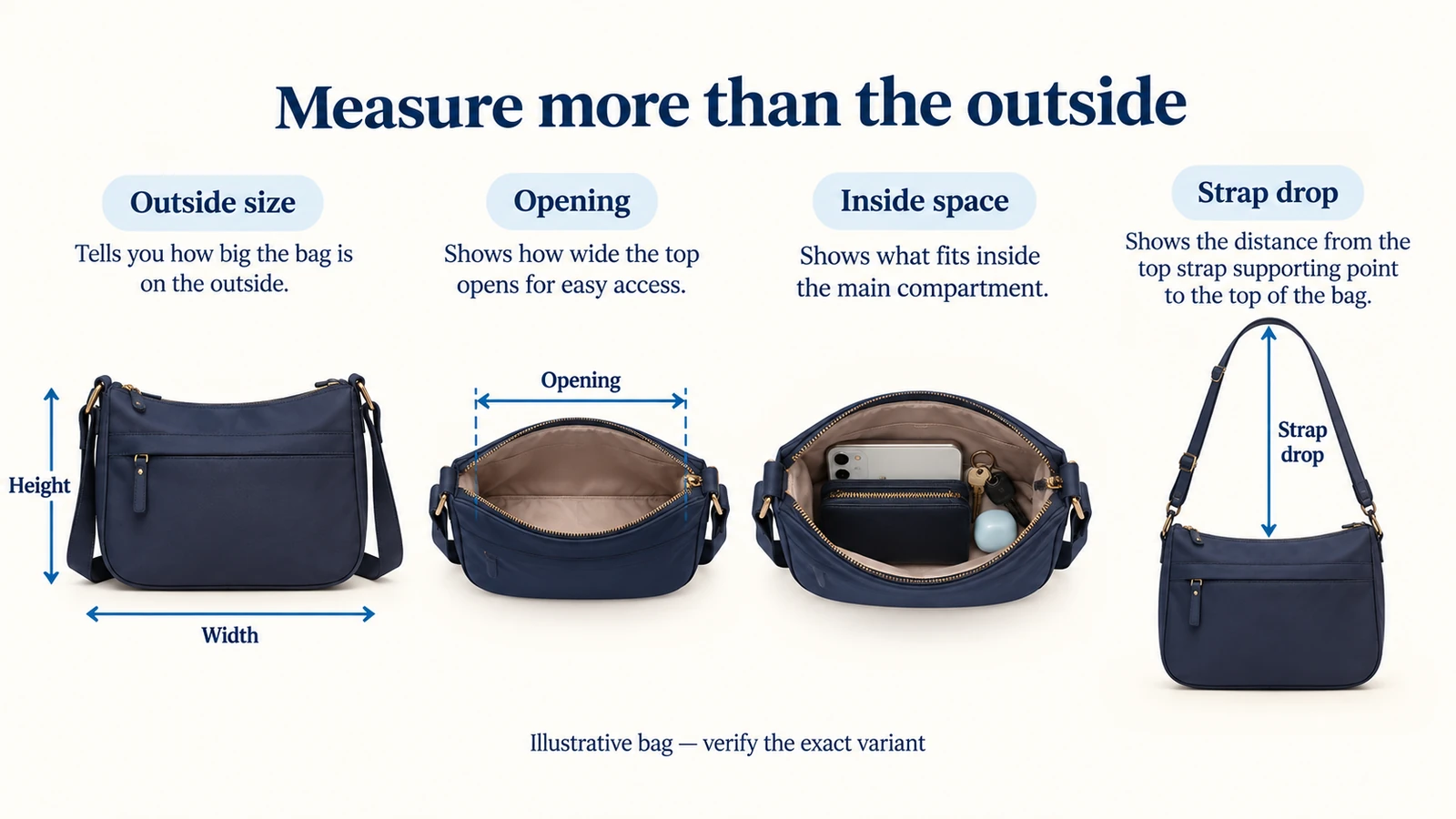
Outside dimensions
Obtain a labeled photograph of the measured height, width and depth. These describe the silhouette, not the space available for a phone or wallet.
Opening and inside space
Request the opening width, usable internal dimensions and a photograph with the intended objects. A wallet may fit inside but still be awkward to pass through a narrow opening.
Strap length and drop
Obtain adjustable strap length and the minimum and maximum drop. Length follows the strap; drop is the distance from its supporting point down to the top of the bag.
Pockets and closure
Request pocket measurements, a view of the lining and the zipper or clasp. Check whether the phone is accessible and the bag closes with the intended belongings inside.
Materials
Identify the outer, lining, handles and any different trim. A leather-like finish does not prove animal leather.
EPROLO’s detachable-strap crossbody lists a PU outer, polyester lining, zipper and adjustable strap. Its published dimensions are height 21.5 cm, width 32 cm and thickness 18 cm. A separate shoulder bag lists H18/W9/L29 cm. Keep those labels when asking for measurement photographs; do not silently turn the supplier’s width into depth. Neither listing establishes the exact opening or usable strap drop for our buyer.
Describe PU as PU
PU means polyurethane. For these products, use a clear description such as “PU outer with polyester lining” rather than “genuine leather.” The current US leather and imitation-leather guides specifically cover handbags and shoulder bags, including disclosure when a non-leather material appears to be leather. Textiles used in handbags are excluded from the Textile and Wool Acts labeling requirements described in the FTC’s textile guidance; that exclusion does not make a misleading material claim acceptable.
Send a short request: “For the black variant, please show the opening, inside dimensions and strap drop. Photograph a phone, wallet and keys inside with the zipper closed, and identify the outer, lining and trim materials.” Add the actual dimensions of your intended objects. “Vegan,” “waterproof” and “sustainable” are separate claims requiring their own support; a PU description does not establish them.
02
Find a supplier route you can actually order through
Choose between catalogue and committed stock
The following are documented routes to investigate, not a ranking of bag quality. Supplier details were checked on September 28, 2026. The next step is a quote for the exact variant and destination, followed by a sample.
EPROLO: verify the selected offer
The inspected PU crossbody and shoulder-bag listings give materials and some dimensions. Select the color and destination in your account. Unfilled public stock and shipping fields do not establish an available quantity or delivered price.
Doba / Linx Deals: check the channel
Product D0102HGAB9W lists Black and White variants, PU/polyester and a 60–113.5 cm adjustable strap. Obtain selected price, stock and return terms. The inspected listing prohibits Walmart; confirm that your intended channel is permitted.
YANYAN: fund the initial stock
Its terms distinguish ready stock, logo work and custom manufacture. Individual customer dispatch follows an initial 100-piece stock commitment. You still need to fund that inventory even though later orders are sent separately.
Material fields can contradict the title
The Doba Linx Deals satchel is a useful example of why the detail fields matter more than the headline. Its title includes “leather,” but the material fields say PU and polyester. It lists item dimensions of 30.5 × 13.5 × 34.5 cm and an item weight of 608 g. The package is separately listed as 31.5 × 15.5 × 23 cm and 827 g. Ask for labeled measurement photographs rather than assigning your own height, width and depth to the numbers.
Processing happens before transit
That selected page shows a US route, estimated three-business-day processing and five-to-seven-day DHL delivery. Processing happens before the parcel’s delivery journey; these are supplier estimates for that listing, not a delivery promise for every bag or address. The public price and account-level quantity are gated.
Five wholesale bags are not one customer order
YANYAN’s quantity terms start ready stock at five pieces per style, logo work at 100 per style, and customized manufacture at 100 per color and 300 per style. Custom retail packaging has a separate 300-piece threshold. Its introductory and detailed ready-stock timing ranges differ, so obtain an agreed dispatch date with the quote. A five-piece wholesale minimum does not establish a one-bag dropshipping service.
Make the first bag order testable
To turn either catalogue route into a first order:
- Open the supplier account and select the exact product, color and selling destination. Retain the supplier product and variant code.
- Request the bag price, packed shipping cost, payment charge, allowed marketplace and return address. For committed stock, also request storage and individual-dispatch charges.
- Buy a sample using the intended packing and shipping route. Correct the product page from what arrives.
- List the approved variant, then submit each paid customer order with its address. Confirm supplier acceptance and stock before treating it as ready to ship.
A paid sale may still need purchase cash
Fund supplier orders separately from customer payouts. A store can have a paid sale while the payment provider has not yet released the money needed to purchase its bag.
03
Use the sample to build a believable product page
Have the sample delivered as a customer would receive it. Photograph the unopened parcel, then the bag immediately after unpacking. Creased panels, scratched hardware and a persistent packaging odor are questions to raise with the supplier before buying more, not details to hide behind catalogue photographs.
For our crossbody, try the intended phone, wallet and keys, open and close the zipper with them inside, and check whether the phone pocket remains accessible. Adjust the strap to its limits and measure the drop in both positions. Inspect the attachment points, stitching, lining and clasp. These are proposed sample checks; we have not tested the listed products or established a safe load rating.
Take photographs that answer a buying question:
- A front and side view for the shape, plus a view of the back.
- An open-bag photograph showing the lining and pockets.
- The intended contents alongside the bag and inside it with the closure shut.
- Labeled opening, exterior and strap measurements.
- A close view of the actual surface, stitching and hardware finish.
Use this material to replace vague “spacious” or “premium leather” copy. A useful description would say what the sample held, identify the confirmed materials, show the adjustment range and explain the closure. Keep centimeters and any converted inches consistent. If you show the bag worn, explain the measurements without promising the same position on every body.
Permission for a photo and for a design differ
Obtain permission for supplier photographs or make your own. The US Copyright Office’s photographer guidance explains why an image found online is not automatically available for reuse. Removing a logo also does not establish that a copied bag design is cleared for sale; trademark, patent and copyright protect different things.
Finish the page with the exact color and material, verified measurements, dispatch and delivery estimates, and your customer return and fault policy. Do not add an untested “waterproof,” heavy-load or stadium-approval promise because it appears in a supplier headline.
04
Price the protected parcel, not the empty bag
A bag may be light and still expensive to ship because its protective box occupies space. Obtain the packed dimensions and packed weight, including filler, dust bag, hardware protection and outer packaging. The Doba example’s 608 g item and 827 g package show why those are different fields; they are supplier-listed figures, not our measurements.
Agree packing for the exact shape. A structured handbag may need support inside to retain its shape. A soft bag may tolerate a flatter pack, but confirm the fold does not leave damaging creases. Keep chains, buckles and other metal parts from rubbing against the surface. Ask for a photograph of the bag inside the final pack, and approve the reference packing before individual customer dispatch.
When a light bag is billed as a heavier parcel
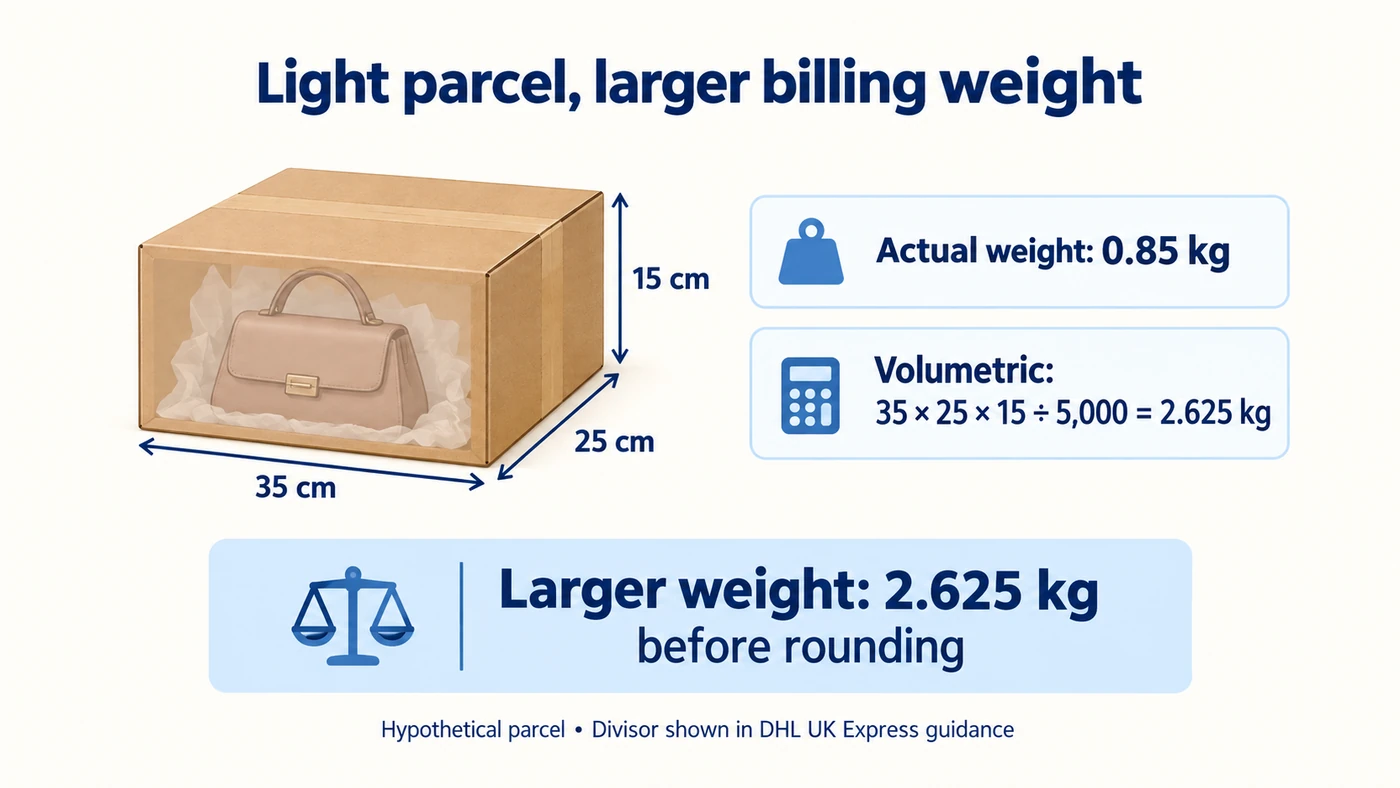
DHL’s UK Express weight guidance compares actual weight with volumetric weight and uses the larger. Volumetric weight converts a parcel’s occupied space into a billing weight. For that guidance, the calculation uses dimensions in centimeters divided by 5,000.
Consider this hypothetical parcel, unrelated to the Doba package above:
- Box dimensions: 35 × 25 × 15 cm
- Actual packed weight: 0.85 kg
- Volumetric weight using the stated divisor: 35 × 25 × 15 ÷ 5,000 = 2.625 kg
- Larger weight before the service’s rounding: 2.625 kg
This explains why a quote based only on 0.85 kg can be misleading. It does not establish an AIDrop freight rate or a universal carrier divisor. The selected service’s rounding, charges and destination terms still determine the payable quote.
Send the supplier or shipping partner the destination postal code, packed length, width, height and weight, a packing photograph, and the bag quantity. Compare quotes using the same protected pack. A smaller box is useful only if the bag arrives in the condition your page promises.
05
Work out what one sale leaves you
Use the selected supplier’s complete order quote, then add the costs of making the sale. A wholesale price alone is not a profit calculation. The following is an entirely hypothetical US-dollar example, not supplier or AIDrop pricing.
- Customer payment: $49.00
- Bag: −$18.00
- Freight: −$7.00
- Protective packing: −$2.00
- Payment charge: −$1.50
- Advertising allocated to this sale: −$8.00
- Share of already-paid store costs: −$1.00
- Total allocated costs: $37.50
- Amount left after listed costs: $11.50
The $11.50 is what remains after these listed costs, including the $1 allocated store expense. It is not final profit: other expenses, unsuccessful advertising, duties and destination surcharges may still apply. Keep sales tax collected for the government separate from the $49 sale.
If the bag comes back
Suppose you refund the full $49 and pay $6 return postage. Assume all $37.50 of allocated costs remain spent, with no refunded payment charge, supplier reimbursement or value recovered from the returned bag yet. The result is $49 − $49 − $37.50 − $6 = −$43.50. You also need $49 available to send the customer’s money back, plus the $6 postage payment; the $11.50 original remainder is not a sufficient refund reserve.
A reusable returned bag or an approved supplier credit can improve the eventual result, but record that recovery when it actually happens. An unusable item, a credit that can only fund later orders and money returned to your bank have different effects on your cash.
Before raising an advertising budget, ask what causes returns. If your opening photographs prevent a predictable size mistake, that may be more useful than trying to earn an extra dollar from each bag. Review actual return reasons and replacement spending as orders accumulate, then revise the price, page or product accordingly.
06
Fulfill the promised variant and make returns workable
Send each order with the agreed product and color code, customer address, packing and service. Check the supplier accepts it, then follow the dispatch and tracking events. If black sells out, pause that option and ask affected buyers about a confirmed wait, an agreed alternative or cancellation. Do not ship white, change the lining or downgrade the hardware without their agreement.
For US sales, the FTC’s shipment rule guidance explains when a seller must obtain consent to a shipping delay or provide a refund. Another company dispatching your bags does not remove your responsibility to the customer. Keep the evidence supporting your advertised shipment time and act on delays promptly.
Choose the remedy from what happened:
The wallet does not fit
Compare the opening and inside measurements with your page and the buyer’s intended wallet. Correct inaccurate copy and explain the applicable return address, timing and postage before asking the buyer to send the bag.
The zipper or surface is damaged
Keep the order and variant codes, and request useful photographs of the fault, item and packing. Arrange the customer’s applicable remedy, then submit the documented supplier claim.
The color or hardware is wrong
Compare the received bag with the actual ordered variant and approved description. Explain correction or refund options and obtain the applicable return instructions. A supplier substitute is not the customer’s choice.
Agree the return address, authorization process, evidence, deadline and responsibility for postage before listing. Doba’s return policy makes selected supplier terms relevant to non-defect returns, including possible freight and restocking conditions. Your buyer’s rights and your published policy are separate from the reimbursement you can obtain upstream.
EPROLO’s seven-day policy is expressly for apparel, with unworn-clothing conditions. It is not evidence of a seven-day handbag return entitlement. Its older public general policies and homepage promotions also differ; get current written terms for the selected bag rather than copying a site-wide promise.
For a China-sourced bag, AIDrop’s product-sourcing service can help clarify samples, variant details and packing. Send the product or supplier link, destination and the capacity or packaging issue through contact. Confirm the agreed work for that product; material authentication, live freight and customer return arrangements still need their own evidence and terms.
07
Frequently asked questions
Can I dropship handbags without buying inventory?
Some catalogue routes let you order an available variant for an individual customer. Confirm that for the selected product. YANYAN’s documented individual-dispatch arrangement requires an initial 100-piece commitment, so it does not remove inventory funding.
Can I call a PU bag leather?
Describe the confirmed material clearly. PU is not genuine animal leather, even if the supplier’s title uses “leather.” Obtain evidence for any separately claimed leather trim or lining, and apply the relevant material disclosures for the destination.
Are custom printed totes the same business?
They involve artwork, printing and production choices that this ready-made handbag guide does not cover. If you want a changed construction or customized product, use our custom-product dropshipping guide to plan that different order.
Can I sell designer-looking or branded bags from a catalogue?
A catalogue listing does not establish authenticity, resale permission or clearance of a copied design. Obtain the evidence for the actual brand and supply route before offering branded stock. For an ordinary unbranded bag, accurate capacity, material and delivery information can provide a useful offer without implying a luxury affiliation.

Clothing Dropshipping: Sizes, Variants, Samples and Returns
Verify apparel sizes, variants, samples, labels and returns before launch. Build a clothing dropshipping offer around accurate
Clothing Dropshipping Suppliers: 5 Options for Different Stores
Compare Trendsi, Printful, Printify, Apliiq and BrandsGateway by clothing model, fit information, stock, shipping and return costs.
Shoe Dropshipping: Sizing Evidence, Variants and Return Exposure
A shoe listing needs model-specific fit evidence, exact size-color stock and a workable exchange route. Compare one
