
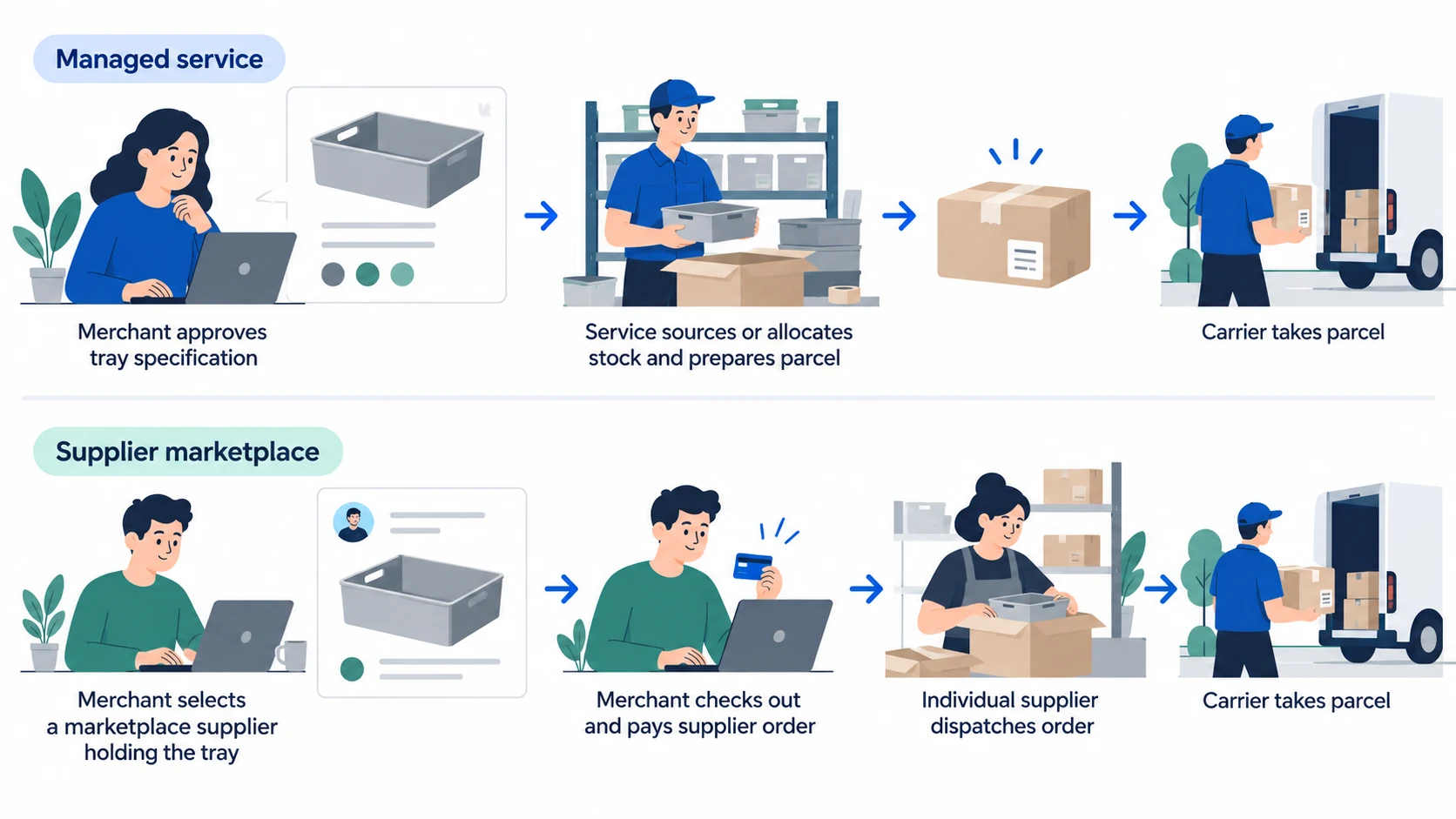
CJdropshipping can source, hold and fulfill products; Spocket connects your store to individual suppliers who dispatch their own goods. Compare the same approved variant and destination. CJ’s free core account and Spocket’s paid plans are only one part of complete delivered cost.
This comparison uses both providers’ public documents checked September 23, 2026. It is a decision framework, not a matched shipment test or a promise about any supplier’s speed. Confirm live plan terms and the chosen SKU’s route before selling it.
01
Compare the job each service performs
CJ — managed physical work: It can source, receive stock, apply approved packaging and ship through its service arrangement. A merchant can use a catalog route or arrange private inventory; membership and warehouse services have different cost rules.
Spocket — supplier marketplace: The selected supplier holds or makes the item and ships it. Spocket’s supplier requirements place inventory and dispatch with that supplier. A synced store order still needs retailer checkout and payment before the supplier is alerted, according to its order guide.
For a wrong-color order, find who held the variant, who mapped it and who accepted the paid order. Software synchronization alone is not a shipment. The automation guide explains these handoffs; our CJ review examines CJ on its own.
02
Which products can you actually source?
Spocket’s origin and destination filters help find a supplier near a target market. A US supplier filter does not prove that every variant is held in the US, that a particular address is served, or that the supplier can alter a material.
CJ sourcing can help when a listing does not match the item you approved. Give a sourcing request dimensions, material, included pieces, target market and package requirements. Then compare its offered variant and sample with your specification. A CJ catalog listing does not itself prove stock in the warehouse you want.
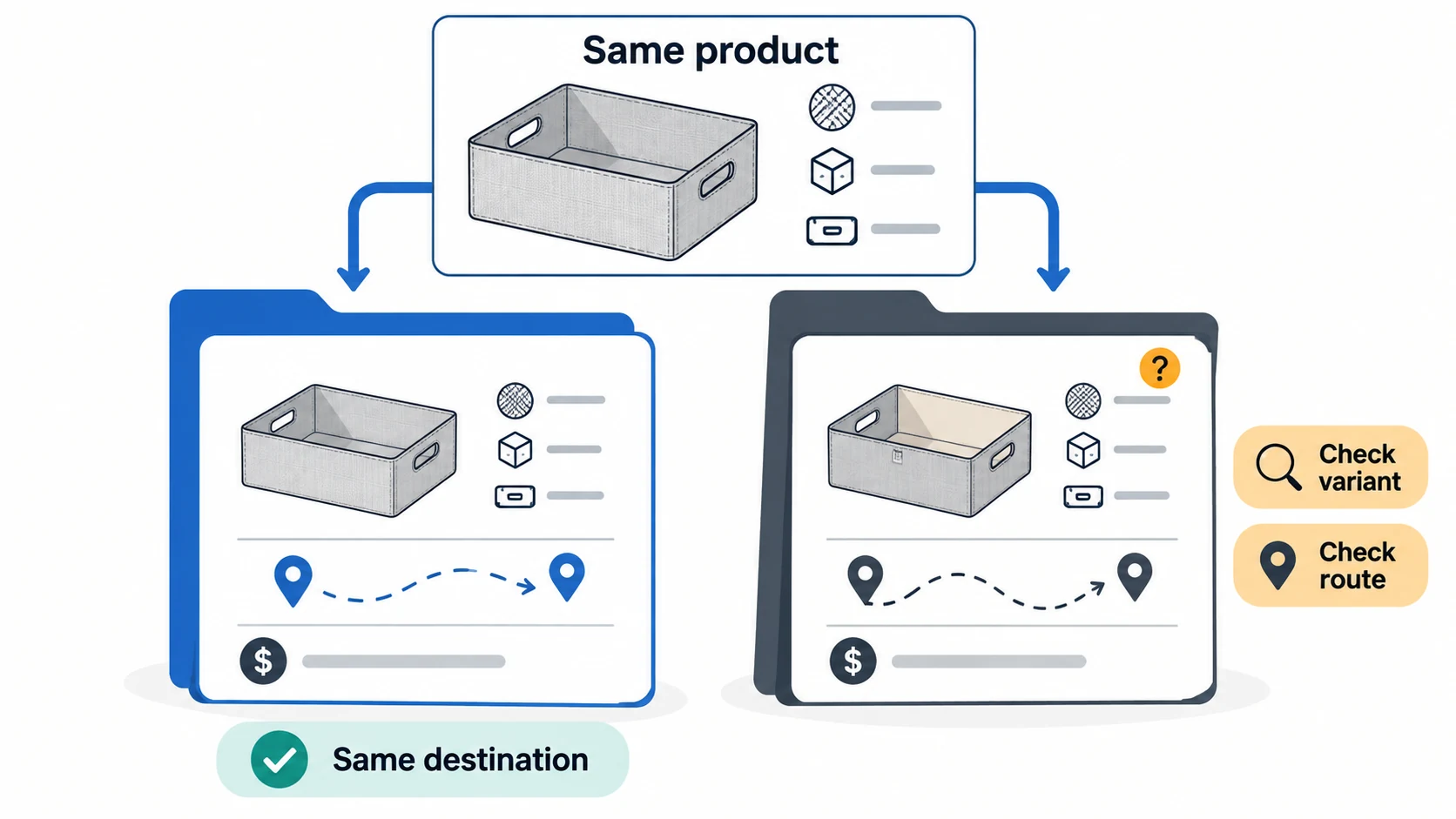
Consider a foldable storage tray in two materials. A Spocket supplier might list fabric in Ohio, while a CJ offer is plastic from China. They are not interchangeable because the photographs look alike. Reject a “cheaper” quote until material, size, included pieces and destination match. The supplier-selection guide gives the sample questions.
03
Shipping location is a fact to check per variant
Spocket suppliers set product- and destination-specific rates and estimated times, as its shipping configuration guide explains. A US or EU origin filter finds candidates; it does not locate every color or guarantee service to your customer’s address.
CJ’s shipping FAQ likewise says weight, item attributes, value and destination can restrict methods. A warehouse selector does not prove stock. If private inventory first needs inbound transfer and receiving, that time sits before the final-mile estimate.
For each candidate variant, record five facts before promising delivery:
- Physical stock location and available quantity.
- Processing time before dispatch.
- Eligible route and full charge to one postal code.
- Quoted delivery range and what starts that clock.
- First carrier-acceptance event in a trial shipment.
If the route fails the promise, change the offer or the source; a general “fast shipping” claim cannot repair that gap.
04
Compare the complete order cost
CJ’s membership page shows a $0 core plan and optional Plus $15.99, Prime $19.99 and Advanced $59.99 monthly plans. Product and freight remain payable; private stock or special work may add charges. The CJ pricing guide shows which lines belong to each arrangement.
Spocket’s pricing page currently lists monthly Starter $39.99, Professional $59.99, Empire $99.99 and Unicorn $299.99 after its trial, with different annual billing rates. The supplier item and shipping are extra: its listing-versus-retail explanation excludes shipping from both displayed prices, and its checkout guide says address-specific shipping and transaction charges appear at order checkout.
On a phone, swipe sideways to compare all columns.
| Fulfillment path | Put these amounts side by side for the same SKU and address |
|---|---|
| CJ catalog order | Variant price + eligible shipping + any chosen packaging or service. |
| CJ with your stock | Unit acquisition + allocated inbound/receiving/storage/outbound + final shipping. |
| Spocket supplier | Supplier checkout price + shipping/transaction charge + paid-plan allocation, if applicable. |
At 40 completed orders, a $39.99 plan contributes about $1.00 per order; at 200, about $0.20. This is subscription allocation only, not Spocket’s delivered price. Your acquisition, payment, refund and replacement costs remain outside both providers’ headline prices. A supplier discount from its reference retail price, even if required by Spocket’s supplier rules, is not your profit. Use your own sale price and an eligible route.
A matched quote, filled in: assume one approved organizer and the same destination. Every unit price below is invented; the $39.99 plan is the dated monthly figure discussed above, not a new provider quote.
The common order
- Sale before tax: $42.
- Customer payment processing: $2.
- Customer acquisition: $7.
That leaves $33 for the provider and contribution. Both examples exclude the same import amounts, remedy costs and overhead; neither remainder is net profit.
Illustrative CJ catalog path
- Approved product: $17.
- Eligible freight: $8.
- Chosen per-order service: $1.
- Total: $26.
$42 − $2 − $7 − $26 leaves $7 before the named exclusions. This assumes no private-stock purchase or paid membership. Add those if your actual arrangement requires them.
Illustrative Spocket supplier path
- Approved product: $20.
- Eligible freight: $5.
- Supplier-checkout transaction charge: $2.
- Monthly plan over 40 completed orders: $39.99 ÷ 40 ≈ $1 per order.
The modeled provider cost is about $28, leaving $5. With only five completed orders, plan allocation is about $8, so provider cost becomes about $35 and the remainder −$2.
The CJ case has more contribution under these inputs. A verified Spocket supplier may still be the viable choice if the CJ route misses the customer’s requirement. Confirm actual stock, dispatch and complete charges before deciding; neither catalog name settles delivery.
05
Branding: invoice, package and product are separate
CJ offers custom packaging services, subject to availability and purchase of the required materials. Approve the finished pack and check where packaging stock is held. If the box must be purchased before orders, include that cash and any effect on parcel dimensions in the comparison. The packaging guide explains the production and approval steps.
Spocket describes a branded invoice, but its help center warns that this feature is not available for every supplier. Its supplier rules require neutral outer shipping packages and a Spocket-generated invoice. That is not equivalent to a custom-printed product, approved retail box or your own fulfillment packaging. Verify what the chosen supplier can include before advertising an unboxing experience.
If branding is the commercial reason for choosing a provider, request a physical sample. Check item, box fit, printed details, damage protection and invoice content. A mockup cannot settle the comparison.
06
Who pays and who updates the store order?
In Spocket, a customer order appears in the connected retailer store, then the merchant checks out and pays for the supplier order through Spocket. The supplier fulfills and returns tracking. The Spocket guide specifically cautions against marking the Shopify order fulfilled before Spocket’s flow is complete, because that can disrupt synchronization.
In CJ, product linkage and store authorization can sync incoming orders, but payment and available stock still matter. CJ’s fee and workflow explanation says synced orders are paid before its processing and shipment. For either service, trace customer order → supplier order → supplier acceptance → carrier handoff → store tracking. Write down who investigates when one arrow fails.
Use a test item with two variants. Deliberately check whether the store’s blue variant maps to blue at the provider. If the product goes out of stock or the supplier changes its SKU, pause automatic order release until the mapping is repaired. The inventory management guide goes further on avoiding oversells.
07
Returns and customer support still belong to the store
Your storefront refund promise may be broader than what a supplier reimburses. Before listing, check the evidence deadline, return address, original-freight treatment and who pays for a replacement in four cases: damage, wrong variant, non-delivery and change of mind.
Spocket: the physical supplier may need to inspect or accept the return; marketplace support is a different participant. CJ: the route depends on whether CJ sourced the goods or you supplied or reserved them. The returns guide helps map that responsibility into a storefront policy.
Keep one case record. For a lost parcel, attach the store and provider order IDs, accepted carrier events and customer messages. For a defect, add photographs against the approved specification. That evidence lets support act within the supplier’s window instead of rebuilding the order history after it closes.
08
Make the choice with one controlled trial
Use one approved item, two variants and one destination. Keep the result in a short comparison record:
- Approve the item specification and sample; list dimensions, material, included pieces and packaging.
- Confirm the Spocket supplier’s variant stock, origin, checkout total, processing time and return terms for the destination.
- Request the same information from CJ for a matching product or sourced version and an eligible route.
- Buy samples through the intended paths. Compare actual item, pack and first carrier acceptance, not just catalog images or route labels.
- Test one store SKU at a time. Do not let both services automatically buy the same customer order.
Choose Spocket if a specific supplier already holds the right variant where it needs to dispatch and its checkout plus plan cost fits your offer. Choose CJ when its sourcing, controlled stock or packaging solves a real requirement and the delivered quote passes the same test. If neither passes the product and route check, do not list the item yet.
09
Frequently asked questions
Is CJ free while Spocket charges for every order?
CJ’s free core account does not include products or freight. A Spocket subscription also sits beside the selected supplier’s product, shipping and applicable checkout charges. Compare the same variant, address and included work, then allocate any monthly plan over the orders you actually expect.
Does a US supplier filter prove faster Spocket delivery?
It finds candidates. Confirm the exact variant’s stock location, processing time and service to the buyer’s address. Compare that complete wait with the eligible CJ route; a country filter alone does not prove a delivery date.
Can I use CJ and Spocket in one store?
You can assign different products to different approved paths, with one fulfillment owner per SKU. Decide how mixed-cart parcels are explained and how open orders and returns are handled. Prevent both services from independently buying the same customer order.
Dropshipping Automation Software: Compare Tools, Costs and Workflows
Compare dropshipping software by supplier fit, pricing, stock updates and order handling. Build a workable setup with
CJdropshipping Review: Costs, Warehouses, Quality and Fulfillment Fit
CJdropshipping is a practical option for sellers who want sourcing, store connections, packaging and fulfillment in one

CJdropshipping vs DSers: Who Sources, Pays and Ships the Order?
CJdropshipping can source and physically fulfill an order; DSers maps a store product to supported external suppliers
