
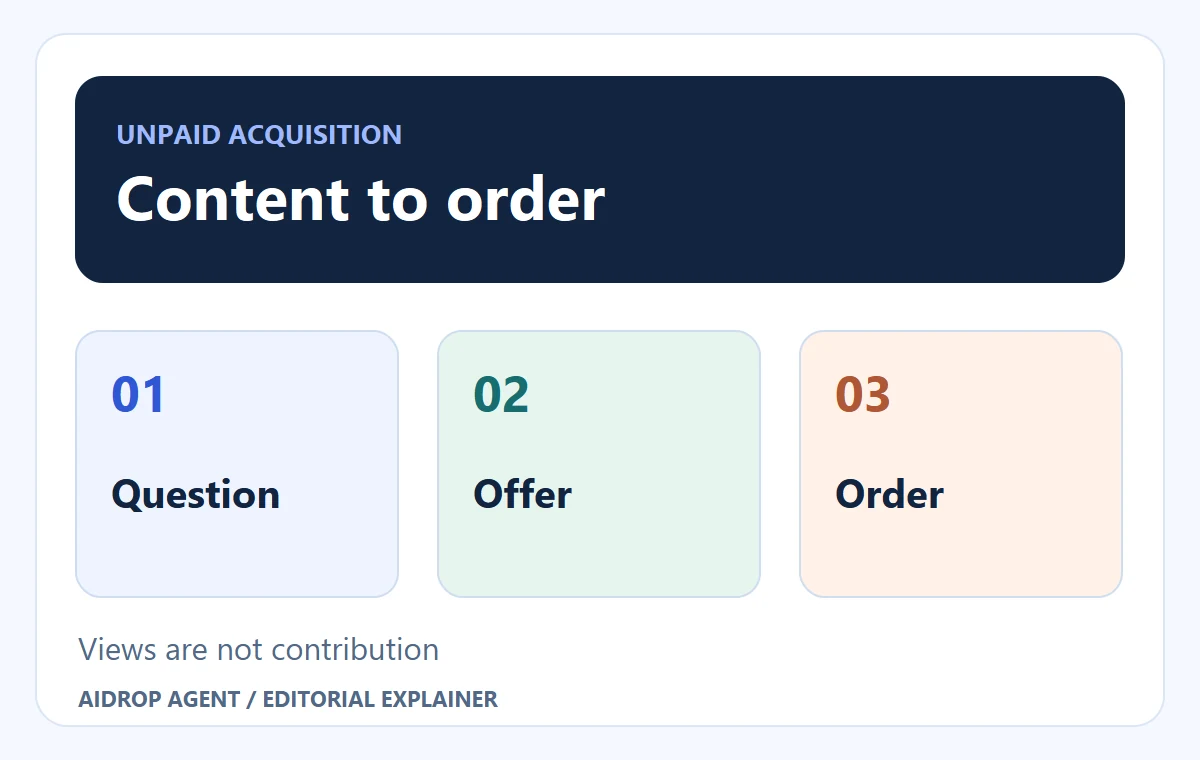
Organic dropshipping uses unpaid search, social or other content to attract buyers, while a supplier fulfills the orders. Start with one product, one buying question and one channel. Count the time, samples and fulfilled-order costs before calling the traffic profitable.
“No ads” does not mean “no cost.” Writing, filming, sampling a product and answering questions take time; a creator or editor may need to be paid. The practical question is whether that work brings qualified orders at a cost your product can support. Choose one channel you can sustain, rather than opening five accounts and measuring only views.
Explore the broader topic: How to Get Dropshipping Sales Without Paid Ads.
01
Match the channel to the question a buyer already has
Match the evidence to the buying question
A person searching “lamp for a narrow bedside table” is trying to solve a specific fit problem. A short video viewer may have no plan to buy until they see how a lamp works in that space. Those audiences need different evidence. Search pages should give dimensions, light output where verified, plug details and clear photos. A demonstration should show the actual item, not a supplier render pretending to be a test.
Shopify’s organic dropshipping guide includes search, social and email as possible unpaid channels. Google’s SEO starter guide emphasizes useful, understandable content for real searchers. Neither source promises that publishing a page or video will produce sales. Your first channel choice should follow the product’s buying question and your ability to make credible content.
If buyers need…: A comparison of size, compatibility or use
Start with…: Search-oriented product and guide pages
Evidence the content should show: Measurements, variants, included parts and who should not buy
If buyers need…: To see an unfamiliar product work
Start with…: A short original demonstration
Evidence the content should show: The actual sample, setup, result and limits of the demonstration
If buyers need…: Inspiration for a project or room
Start with…: Useful visual posts tied to a landing page
Evidence the content should show: The product in context, dimensions and a direct path to the exact variant
If buyers need…: A reminder after visiting your site
Start with…: Permission-based email
Evidence the content should show: The product they viewed, genuine availability and the current delivery promise
The TikTok organic guide handles that channel in detail; Pinterest marketing has a different discovery pattern. This page is for choosing a first channel and connecting it to orders, not repeating every platform tactic.
02
Build the offer before making thirty pieces of content
Use one product that you can explain honestly. A narrow-table lamp is a useful running example: choose an exact model, test the width and switch, check the power specification for your target market, and obtain a quote to a typical destination. If the supplier changes the model after your sample, the content no longer describes what customers receive. Resolve that before posting more demonstrations.
Keep the post and offer about the same item
Write a small offer sheet: buyer problem, product version, price, delivery range, return route and the one claim your content can prove. The sheet protects you from a common organic-growth failure: the video shows a clever feature, but the product page has no dimensions, the shipped version differs, or the supplier cannot serve the viewers’ country. The product-validation guide covers deciding whether a product deserves the test at all.
Make the landing page answer the hook
An organic post should take people to a page that answers the same question. If the video demonstrates that a lamp fits a 20-centimeter shelf, the page needs that exact dimension and the same model. If the measurement is uncertain, do not build the hook around it. A high click-through rate into a confusing page is still a failed handoff.
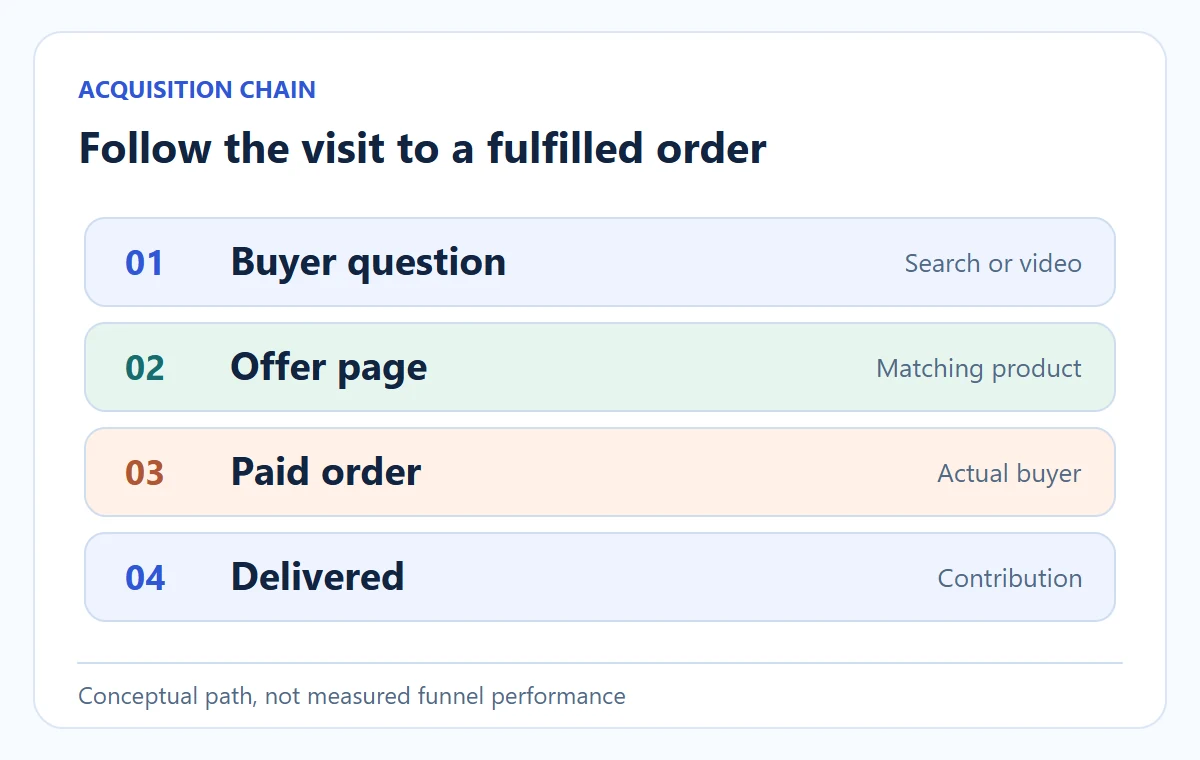
Make content from real questions, not a posting quota
Choose a question you can prove
Collect the questions shoppers ask before buying: Will it fit? What arrives in the box? Does it need an adapter? How long does delivery take? Can I return it if the light is too bright? A separate post can answer each, but only after you have the evidence. The product page should retain the complete answers so a visitor does not have to watch five videos to understand the offer.
Give each page a distinct job
For search, map one distinct query to the page that can best answer it. A comparison page can explain two use cases; a product page must tell the truth about the product you sell. Avoid making ten near-identical articles targeting slight keyword variations. For social, show the result first, then the condition under which the result was achieved. Original footage of a sample can be persuasive because it lets the viewer see what marketing copy usually hides.
Turn buyer questions into a four-week test
Make one verifiable demonstration
Do not begin with a quota such as “post every day.” For the lamp, choose one question that the product can answer with evidence: whether it fits a 20-centimeter shelf. Measure the actual base, photograph the sample beside a ruler, and make the product page state which version was measured. A second piece can address the power plug or the light’s use in a small room; it should not repeat the first headline with different synonyms.
Week: 1
Work that produces evidence: Verify the sample, quote, destination and product page; record baseline visits and buyer questions
Question to answer before continuing: Can this exact item be sold and delivered to the audience the content will reach?
Week: 2
Work that produces evidence: Publish one detailed search answer or one original demonstration and connect it to the matching product variant
Question to answer before continuing: Did relevant people reach the offer, and did the page answer the question raised by the content?
Week: 3
Work that produces evidence: Answer the strongest new objection with a different piece; repair any page or shipping mismatch first
Question to answer before continuing: Are visitors asking a buying question or merely reacting to an entertaining clip?
Week: 4
Work that produces evidence: Review orders, contribution, returns and content time; update the offer or test one adjacent question
Question to answer before continuing: What single change has the clearest evidence behind it?
This is a sequence of decisions, not a promise that four weeks is enough for search rankings. A search page may take longer to be discovered; a video can receive immediate views from people outside the deliverable market. Record the landing page and destination country so those two situations do not look like the same “traffic.”
03
Use a 30-day test that records work and orders
Set a weekly time budget before you start. Six hours a week might cover one useful search answer or a few demonstrations of the same sample; it does not oblige you to publish every day. Follow the work plan above, then review the result at the end of each week.
At the end of each week, record:
- Work: hours spent or money paid for content.
- Relevant visits: people reaching this offer in a market you can serve.
- Orders: completed purchases, separated from questions and abandoned checkouts.
- Contribution: what remains after product, shipping, fees and actual or estimated remedy costs.
Keep buyer questions beside the numbers. They help explain why a visit did not become a purchase.
Work out what the two orders actually earned
Suppose twelve hours of work produce 600 views, 60 visits and two orders. If each retained order leaves $18 after variable non-marketing costs, they contribute $36 before content labor. At an illustrative $15 an hour, the work costs $180.
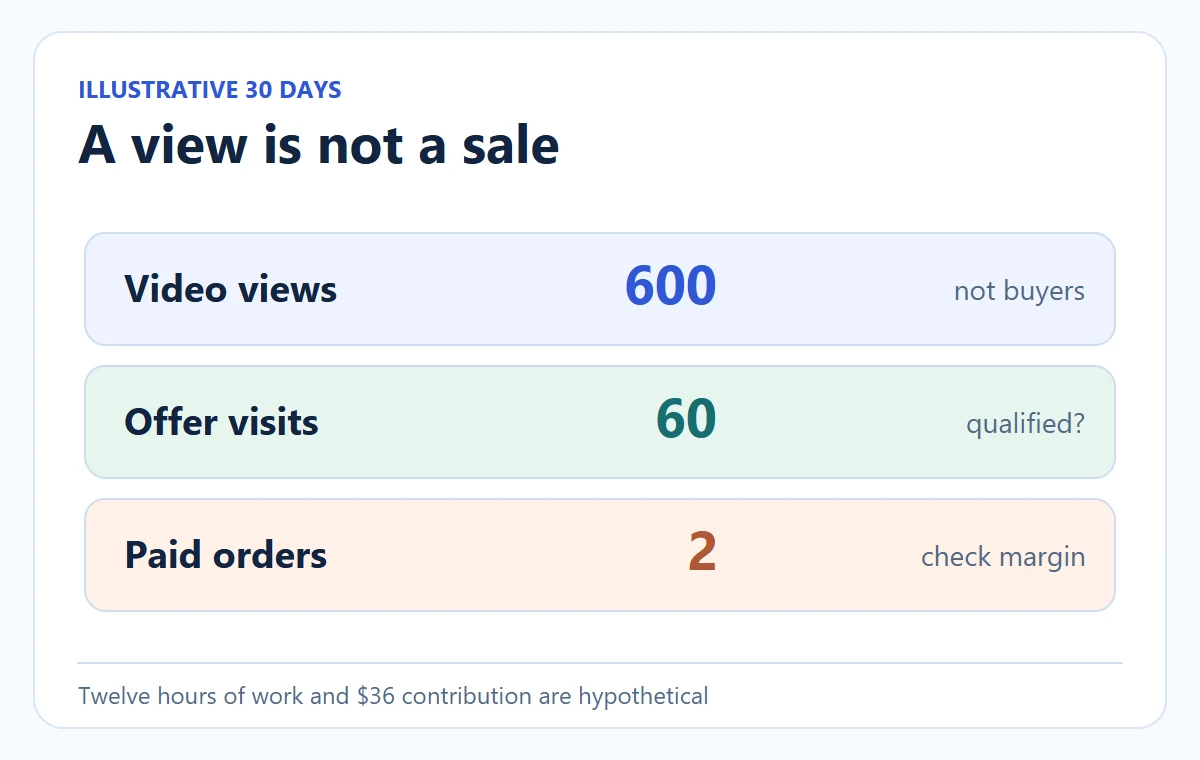
This test is $144 short of covering its content labor. Ten retained orders at the same $18 contribution would cover that one $180 cost. Neither calculation includes other fixed costs or predicts the next month’s sales.
If an order is refunded, replace its expected $18 with the actual revenue kept minus unrecovered item, freight, fees and remedy costs. Do not retain the forecast profit and then count the same refund twice. The profit-margin guide explains the order arithmetic.
These are fictional inputs. For your store, match the numbers to paid orders and their final remedies; views and pending checkouts are not retained sales. A useful guide may bring later orders, but spread its cost only over results you can reasonably attribute to it—not a promised future ranking.
Tag one post so you can inspect the visits
For a fictional Instagram demonstration of the lamp, add these campaign parameters to the real product URL:
utm_source=instagramutm_medium=socialutm_campaign=lamp_shelf_testutm_content=base_measure_v1
Open the final link from the published placement on a phone. It should reach the measured lamp version with the same offer. Preserve an existing variant parameter: append with & if the URL already contains ?. Use campaign tags on external promotional links, not links between your own pages.
In Shopify, open Analytics → Reports, filter Category → Marketing, and inspect Performance by marketing channel and the campaign for the same dates and attribution setting. Shopify’s report instructions describe the September 2026 change that added organic and referring traffic. A pre-change report is not an identical comparison.
A dash in spending means the value is unavailable, not that your labor was free. Campaign metrics also do not account for returns. Keep actual hours and remedy costs beside the report, and use the analytics guide when reconciling orders. Consent settings, device changes and lost tags can leave a visit unattributed.
Choose the next change from the weak step
What you see: Views, but few relevant visits
Check next: Does the content show a buying use and reach a country you serve?
Useful next experiment: Show the lamp fitting the narrow shelf sooner; link the same model
What you see: Visits, but few orders
Check next: Does the page answer the hook, with dimensions, price and a usable shipping method?
Useful next experiment: Fix the strongest buyer objection or checkout mismatch
What you see: Orders, but little contribution
Check next: What remains after freight, fees, remedies and content work?
Useful next experiment: Revisit price, fulfillment cost or production time before publishing more
What you see: One useful post, several weak ones
Check next: Which specific buyer question did the useful post answer?
Useful next experiment: Answer one related question instead of repeating its headline
A buyer may watch the video, search for dimensions and buy after an email. Treat last-click credit as one view of that path, not proof that one post caused the sale. Record the landing page, available campaign data and actual order outcome. That is enough to choose a better next test without inventing certainty.
04
Keep the product and the channel honest as you grow
Use footage and claims you can support
An organic strategy can tempt a store to copy a viral product demonstration, use supplier images without rights, or imply a result the actual item cannot achieve. Request usage rights for footage and take your own sample images where practical. If a feature varies by model or batch, name the version shown. If a post reaches a country the supplier cannot serve, do not quietly accept those orders.
Search also changes slowly and unevenly. Google may crawl a page without ranking it; a social feed can stop showing a post even when it was useful last week. Do not build a business case on a promised algorithm outcome. Build reusable product answers and record the actual orders they help create. When the product data changes, update both the content and the offer.
If you add email, collect permission appropriately and send messages that relate to the customer’s real stage. A shopper who has not ordered needs product answers; a customer waiting for a parcel needs accurate tracking. The email lifecycle article explains that distinction. Recycling a generic sales message to both groups usually makes support harder.
05
Decide whether to continue, change the offer or change the channel
Choose one evidence-based next experiment
After thirty days, keep the channel if it brings qualified visits and the product economics can plausibly support the work as the content improves. Change the offer first if people ask for a different size, reject the delivery time or cannot find what they saw in the post. Change the channel if the product requires a type of proof you cannot reasonably create there. Pause promotion if the supplier cannot fulfill the exact version shown.
The outcome is a one-page record: product and supplier SKU, channel, content hours, page visits, first orders, contribution per order, common buyer objection and next experiment. That record is more useful than a follower count when deciding what to publish next.
AIDrop Agent can help verify the China-side part of an offer before you send traffic to it: sample, product version, packaging, fulfillment route and the quote for the market you want to reach. Share the SKU, sample questions and destination through the review form. Content performance remains your store’s measurement, and no supplier review can guarantee organic reach.
06
Frequently asked questions
Is organic dropshipping free?
It avoids paying for each click or impression, but content, product samples, software and your time still cost something. Measure those inputs against completed orders and their contribution.
Should I start with SEO or social video?
Start where you can answer a real buying question well. A specific product with fit or compatibility questions may suit search; a product whose value appears only in use may need an honest demonstration. You can add a second channel after the first produces useful buyer evidence.
How long until organic traffic produces sales?
There is no reliable universal timetable. Search visibility and social distribution vary by query, competition, audience and content. Use a bounded 30-day learning test to check visits, objections and orders, then decide what to change; do not promise a sale by a fixed date.
Dropshipping Marketing: A Plan from First Visit to Repeat Order
Plan dropshipping acquisition, product-page conversion and repeat sales around realistic margins. Compare channels and measure costs and

Dropshipping SEO: Build Search Pages Customers Can Trust
A practical SEO plan for dropshipping stores: map searches to the right pages, verify supplier claims, link

Dropshipping Customer Retention: Earn the Next Order After the First Delivery
A practical retention plan for dropshipping stores: meet the first-order promise, choose a relevant follow-up, and measure
