

Use Pinterest to show a product answering something a shopper is planning, then link the Pin to the store page that delivers that answer. Make useful, different content around the product and measure visits and orders. Pinterest can help people discover a dropshipping offer, but checkout happens on the merchant’s website; views and saves alone are not sales.
Three questions from one small desk
For example, someone arranging a small desk may want to know whether an organizer fits beside a laptop, what it holds and how it looks in a working setup. Those are three useful Pin topics for one product. A generic “buy now” image gives that shopper much less help.
This guide follows a hypothetical organizer and organic, or unpaid, Pinterest publishing. The example dimensions and results are invented for teaching, not an inspected product or observed account. The dropshipping marketing guide covers the wider choice of channels and budget.
Explore the broader topic: How to Get Dropshipping Sales Without Paid Ads.
01
Find the shopping question your product can answer
Start with the buyer’s situation. “Small desk organization” is more useful for our organizer than “winning dropshipping product.” Try relevant phrases in Pinterest search and note the suggestions and types of content you see. Look for a question your actual item can answer, such as fitting stationery into a limited space or keeping a frequently used item within reach.
Pinterest Trends can help compare interest where the tool supports the relevant region. Its 0–100 scores are relative, not counts of searches or orders. A rise in “desk setup” does not establish demand for this organizer at your price. Use it to investigate wording and timing, then compare that idea with the actual product and offer.
Check the real product before making the Pin
For our hypothetical item, assume a 24 cm width and 12 cm depth. Those are teaching dimensions. Before using measurements in a real Pin, verify the actual variant and check a sample where needed. A buyer arriving for “fits a narrow desk” should find enough information to decide whether it fits their desk.
Use media you have permission to publish, and make product, stock and delivery claims you can support. Pinterest’s Community Guidelines address rights, deceptive links and spam. Shopping features have separate merchant requirements, including accurate offers and usable store information.
Write one sentence before creating content: “This organizer helps a small-desk shopper decide whether the footprint and storage suit their setup.” If the product cannot deliver that answer, choose a better-supported topic or offer.
02
Make three genuinely useful Pins for the same organizer
Give each Pin a different reason to visit. Changing the background color on the same product photo does not answer another buyer question. Pinterest’s distribution guidance favors fresh, original, relevant content and a clear match between the image, Pin information and destination.
Here is a worked content plan, using our hypothetical organizer:
| Shopper question | What the Pin would show | Where the link should go |
|---|---|---|
| Will it fit beside my laptop? | The organizer’s footprint beside a laptop, with a clear width/depth view and an invitation to measure the available space | The exact product page with dimensions and the same variant |
| What can I put in it? | A real demonstration of the compartments with ordinary stationery; show what fits without hiding awkward items | The product page showing capacity, compartments and included pieces |
| How can I arrange a small working desk? | A wider desk arrangement explaining where the organizer belongs and how the area is used | A useful desk-planning page with a visible route to this organizer |
On a phone, swipe the table sideways to compare every column.
For the first idea, photograph the actual product with a ruler or another trustworthy size reference. For the second, fill the sample and show the result; do not infer capacity from a supplier’s decorative image. For the third, explain the arrangement so the reader gains something before the product link.
You can make a short video when movement helps—for example, placing items into the compartments. A clear image can be enough for the footprint comparison. Use the format that explains the answer rather than making a video simply because the platform accepts it.
Keep important text readable on a phone. Pinterest recommends vertical images with a 2:3 ratio; give the product room and avoid crowding it with claims. Include the real item, useful context and a short clear message.
A size claim needs an actual measurement
Supplier media may describe an offer if you have permission to use it. For a fit or capacity Pin, photograph or measure the actual organizer before making that claim; an illustration cannot prove its dimensions.
03
Fill the publishing fields with one clear promise
First set up a free Pinterest business account so you can use Pinterest Analytics. On desktop, choose Sign up → Create a business account, enter the requested details and complete the profile. If you want to convert an existing personal account, use Settings → Account management → Convert to a business account. Business accounts are public; check that choice before converting a private profile.
With your store page and profile ready, use Create Pin. Upload the image or video, enter a title and description, add the destination link and choose a relevant board. A board is the collection in which the Pin is saved; choose one that matches the buyer’s topic.
For the footprint Pin, the fields could look like this. The measurements belong to our hypothetical item and must be replaced with verified product details for a real post.
Title
Small desk organizer: check the 24 cm footprint
Description
Planning a narrow desk? This organizer is 24 cm wide and 12 cm deep in our example. Measure the space beside your laptop, then compare the footprint and compartments on the product page. Choose the variant that fits your setup.
Board
Small Desk Ideas, if that is the relevant board you maintain
Link
Your ordinary public product-page URL for this exact organizer
Media
A clear view of the footprint and usable desk space, matching the description
The organic Pin specifications, rechecked October 11, 2026, allow titles up to 100 characters and descriptions up to 800. A description may not appear in home or search feeds, though Pinterest uses it to understand relevance. Keep the main idea clear in the image and title; do not hide essential product qualifications only in the description.
Before publishing
Review the media and link. Open the destination on a phone: it should be the exact organizer or promised desk-planning page, not a homepage, missing page or different variant.
After publishing
Open the actual Pin and follow its link again. Confirm the expected product or article appears. On a product page, check that the promised variant is available and can be selected. Correct the link or offer when this route fails; a successful upload has not verified the buying journey.
If you use Publish later, Pinterest’s scheduler help currently allows up to 30 days ahead and ten queued Pins on a business account. Check the limits shown in your account; these three topics need only a small schedule.
04
Make the destination deliver the Pin's answer
Match the organizer and variant
The footprint Pin should open a page where the shopper can immediately find the same organizer, its dimensions and variant. If the Pin shows a compact blue model but the page opens a larger white one, the shopper has to work out whether they have landed in the wrong place.
Give the buyer the missing decision information
Put the relevant photograph and measurements near the product choice. Explain what is included, price, destination-specific delivery and the return route before checkout. A clear size drawing is more helpful to this visitor than a long opening paragraph about your brand.
A planning page should deliver the arrangement
The desk-arrangement Pin can lead to a useful planning article instead. That page should actually show the arrangement and a clear link to the organizer used. Do not promise a desk-planning tutorial and quietly redirect the reader to an unrelated checkout. Test the ordinary mobile route from Pin to page to product selection, including what happens when the advertised variant is unavailable.
Add shopping features after the basic route works
Pinterest’s shopping explanation places checkout on the merchant’s website or app. Additional shopping features are optional and have requirements. Its shopping help distinguishes catalog-created Product Pins from product Rich Pins that use website information. Catalog-created Product Pins can be used for shopping ads; product Rich Pins are not interchangeable with that ad format.
A domain claim is not merchant approval
Claiming a website establishes a connection to a site you control. It requires access to the relevant website setup, and most marketplace seller pages cannot be claimed as your own domain. A claimed domain does not by itself grant merchant approval.
You do not need to turn this first organic test into a complete catalog or advertising project. Finish the useful Pin and matching buying route first, then add a shopping feature when it solves a real need and your account and offer meet its current conditions.
Use the policy version that is in force
At our October 11 check, Pinterest’s current merchant guidelines link to an update due to take effect on November 12, 2026. The preview is a future version, not the rule already in force. Review the relevant version before applying for shopping features. An ordinary Pin, a website claim and merchant eligibility remain different steps.
05
Use visits and orders to decide what to change
On desktop, log into your business account and open Analytics → Overview. Set a date range and choose the Organic content filter in Pinterest Analytics before comparing the Pins. Impressions show displays, saves show saved content and outbound clicks measure clicks that lead away from Pinterest. For store traffic, use outbound clicks rather than treating every interaction as a visit.
Keep the statistics’ scope visible
You can also open a Pin’s statistics. Keep the metric definitions in view: some figures combine the same image and destination across saved Pins. A report is not necessarily a count of unique people responding to your individual upload.
Then compare your store’s Pinterest-sourced sessions and orders for the relevant period. A session is a visit recorded by the site’s analytics. Keep paid and organic activity separate where the tools allow it, and note different reporting windows, time zones and tracking limitations.
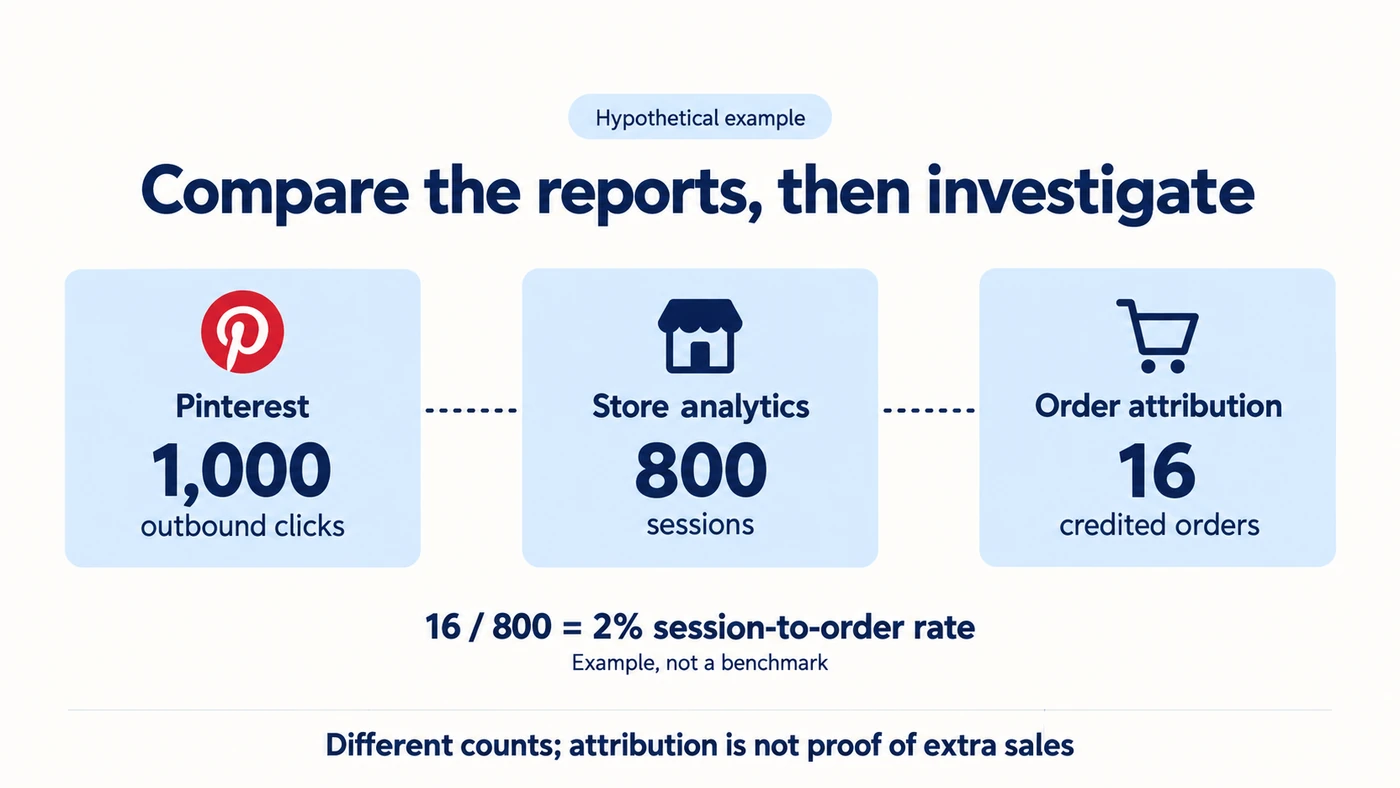
In a hypothetical review, Pinterest reports 1,000 outbound clicks, the store records 800 Pinterest-sourced sessions, and sixteen orders receive credit under the store’s chosen attribution method. Sixteen divided by 800 gives a 2% session-to-order rate. It is an example, not a good-or-bad benchmark for your store.
Two counters do not identify 200 lost people
The 200-count difference does not prove 200 separate buyers abandoned the page. Repeated clicks, reporting methods, loading and measurement conditions can contribute. Use the counts to choose a check, not to invent a precise customer journey.
| What you observe | What to investigate | What to change or recheck |
|---|---|---|
| Little relevant reach | Topic, words, image clarity and whether the Pin answers a real planning question | Make a clearer original explanation; give it time without assuming a fixed discovery deadline |
| Views but few outbound clicks | Whether the image/title gives a useful reason to open the destination | Improve the promise and show what the reader will learn or choose there |
| Outbound clicks but little recorded store activity | Broken link, mobile loading, wrong destination and analytics collection | Open the ordinary link on a phone and check measurement before blaming the offer |
| Store visits but few purchases | Product match, variant availability, price, delivery, buyer questions and checkout | Repair the specific obstacle you find, then compare the same stages again |
On a phone, swipe the table sideways to compare every column.
Repair the missing size answer
For example, visitors may arrive to compare size but find no dimensions near the product choice. Add the verified footprint and a useful image, then recheck visitor questions and the buying route. Merely increasing posting volume would leave that problem in place.
Conversion Insights has account and tracking conditions; it is not available to every organic beginner. Whatever report you use, attributed orders are orders given credit by its rules. They are not proof that all those sales would disappear without Pinterest.
06
Count the work behind organic traffic
Organic publishing avoids buying the placement, but photographs, editing and your time still have a cost. Compare that work with what the attributed orders contribute. Contribution is the money left from an order toward content and other business costs.
Here is a hypothetical organizer sale. These are teaching figures, not supplier rates or observed results; customer taxes collected for remittance are outside the calculation.
- Selling price: $40
- Product: −$16
- Delivery: −$7
- Payment/platform fees: −$2
- Expected remedy allowance: −$3
- Contribution before content and overhead: $12
Suppose the three Pins cost $120 to produce. The sixteen attributed orders from our example contribute $192 before that cost. $192 − $120 = $72 remains before other overhead and tax. If there are only four orders, $48 − $120 leaves a $72 shortfall on the same limited calculation.
Attributed orders do not prove incremental profit
This helps you evaluate the work; it does not prove an incremental $72 gain caused by Pinterest. Attribution can credit a sale influenced by other activity too. Include owner hours and any recurring content expense in your own assessment, and avoid treating an expected $3 remedy allowance as the most a particular customer can cost.
If the obstacle is the physical offer—unclear organizer dimensions, inconsistent variants or packing and delivery costs—AIDrop’s product-sourcing service can help clarify China-side supplier and sample requirements. Send the product link, destination and unresolved detail through contact. Accurate product information gives the Pin and store something useful to explain; the service does not guarantee traffic or conversion.
07
Continue the questions that help buyers choose
After the first three Pins, look for the next useful question. If visitors ask whether the organizer holds a particular item, measure and demonstrate that item. If they ask about a different desk shape, create an arrangement that genuinely addresses it. Reuse what you have learned, while producing a distinct explanation.
Keep publishing original answers to real buyer questions at a pace you can maintain. Pinterest does not promise a fixed time to reach shoppers, and posting near-duplicates every day will not repair a poor product-page match.
Old Pins need current offer information
Keep the old buying routes accurate too. When the model, price, variant or availability changes, check the Pin’s promise and destination. Do not let a popular image keep sending buyers to a product that no longer matches it. Check current policy and account conditions before adopting a new shopping or advertising feature.
Decide the next action from the evidence you have. Keep useful content that brings suitable visits and orders, improve a specific weak promise or page, and pause spending time on an approach whose costs you cannot justify. With only a handful of impressions, you may lack enough relevant visits to judge the offer; fix clear faults and continue a limited test without calling it a proven success or failure.
08
FAQ
Does Pinterest take the customer’s checkout payment?
For the shopping route described here, the customer completes the purchase on the merchant’s website or app. The destination still needs an accurate offer, workable checkout and customer support.
How many Pins should I post every day?
There is no daily number that guarantees sales. Start with original content you can make and maintain, then review whether it brings useful visits. Three different buyer questions are a stronger starting point than many cosmetic duplicates.
Do I need Product Pins before posting useful content?
You can begin with ordinary image or video Pins linked to a matching page. Catalog-created Product Pins and product Rich Pins have different features and conditions; neither removes the need for a truthful offer.
Why are there views but no orders?
First check outbound clicks. If people leave Pinterest but the store receives little measured activity, check the link, loading and analytics. If suitable visitors reach the page, investigate product match, buying information, availability and checkout. Views alone cannot identify the fault.
Does claiming my website approve my store for shopping features?
No. A website claim connects a domain you control. Merchant eligibility and product conditions are separate checks.
How to Get Dropshipping Sales Without Paid Ads
Build dropshipping traffic with useful videos, search, free product listings, communities and email. Follow a plan that
Dropshipping Marketing: A Plan from First Visit to Repeat Order
Plan dropshipping acquisition, product-page conversion and repeat sales around realistic margins. Compare channels and measure costs and
Dropshipping SEO: Build Search Pages Customers Can Trust
A practical SEO plan for dropshipping stores: map searches to the right pages, verify supplier claims, link
