

Matterhorn is a fashion wholesaler that offers dropshipping directly to your customer. Its documented routes include manual website orders, a Shopify app and a REST API. Importing products is only the start: the supplier order still needs the correct size, delivery details and payment before processing begins.
The practical way to assess the service is to follow one garment through those stages. A dress appearing in your store proves that product information arrived. It does not prove that a paid medium dress will be accepted, funded and dispatched correctly.
01
Choose how your store will send Matterhorn orders
Choose the connection according to what it actually does. Product import, stock updates, order requests and payment are separate functions, even when one app brings several of them together.
| Route | What to establish | What to verify separately |
|---|---|---|
| Manual website order | Exact product, customer delivery address and supplier checkout | Payment, acceptance and tracking |
| Matterhorn Shopify app | Current app settings for products, variants, stock and fulfillment requests | Which event sends the request and how the supplier order is funded |
| Product files | Supported XML/CSV/XLS format and import/update process | Order creation, payment and shipment information |
| REST API or partner integration | Actual supported operations and identifiers | Your implementation’s failure handling and financial workflow |
The Shopify app listing is useful for checking current app availability and its stated functions. Reviews can suggest questions to investigate; they cannot establish the outcome your store will experience. Do not turn one review into a universal service-quality verdict.
For another platform, ask which work your connector performs. If it only imports a product file, assign someone or a supported tool to place supplier orders. A beautifully populated storefront with no order route cannot complete a sale.
The wholesaler’s job and your store’s job
Matterhorn’s dropshipping help describes preparing and shipping goods to the end customer. Your store chooses the assortment, sets the retail offer, takes payment and answers the buyer.
Its documented manual route treats an order with a customer delivery address different from billing as a dropship order and describes unmarked packaging without a sales invoice inside. Confirm the parcel and communication behavior for the actual route you use; unmarked outer packaging does not mean a garment has no manufacturer branding.
Begin with a small, coherent clothing range. Check actual destination coverage, garment sizes, product information and brand/channel restrictions. A wholesale catalog may contain products that are unsuitable for your audience or marketplace even when they can technically be imported.
Register accurate billing details and establish the account’s tax and payment arrangements. The supplier transaction and your retail sale are separate. A tax field or invoice setting should not be guessed from a catalog currency.
For comparisons with other apparel routes, use the clothing supplier guide. This article follows Matterhorn’s own order and data responsibilities.
02
Start with the right size and net wholesale price
Matterhorn’s Shopify file documentation lists fields including size, variant SKU, inventory quantity and a variant price described as the net wholesale price. That last detail deserves attention before an import publishes products.
Use the documented format supplied for your route. These field names describe a particular product file; they should not be copied into an invented API request or assumed to match every current app screen.
A proposed mapping might contain:
| Store variant | Supplier variant | Size | Selling-price decision |
|---|---|---|---|
DRESS-NAVY-M |
Actual medium pick reference | M | Retail price calculated from the completed order |
DRESS-NAVY-L |
Actual large pick reference | L | Check the actual product and delivery charges |
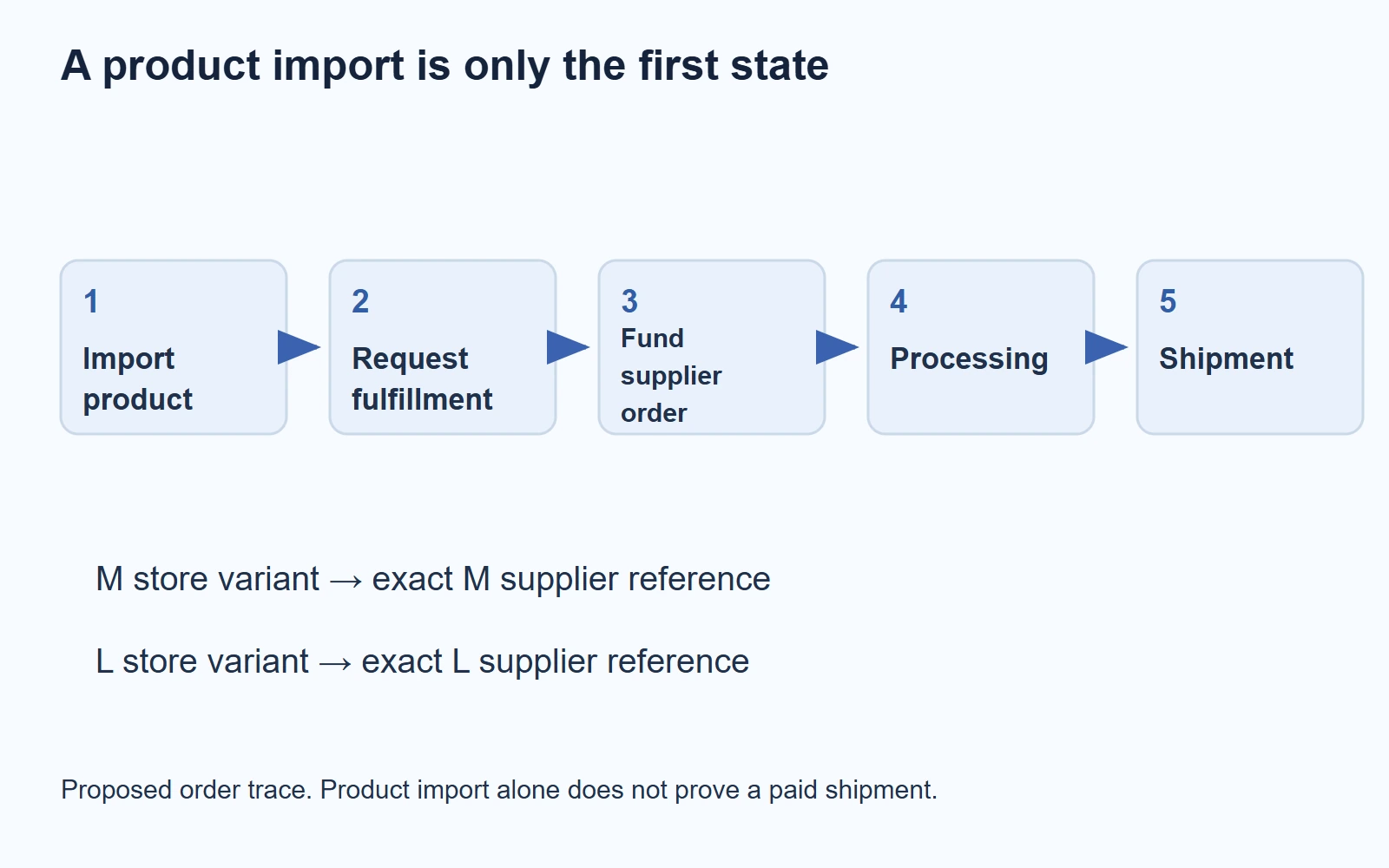
Keep the real supplier identifiers, not the placeholder text in this example. Import medium and large as separate variants and inspect both. Linking both choices to one supplier reference can send the wrong size even when the product title looks correct.
Preview the selling price, currency and tax settings before making the product available. Importing a net wholesale price directly as a consumer retail price can produce an offer that cannot cover delivery and operating costs. Set a deliberate pricing rule and verify its actual result on the product page and in the cart.
03
The buyer has paid. Has Matterhorn been paid?
For the Shopify route, Matterhorn’s help describes using Request fulfillment and beginning processing after the wholesaler is paid. Confirm the current app and account behavior before relying on automation.
Use one specific test case, such as the medium navy dress above. This is a proposed control sequence, not a private app installation or order we performed:
- Select the medium variant and confirm the store order preserves it.
- Confirm customer payment and inspect the fulfillment destination.
- Submit the request through the supported route and obtain the supplier order reference.
- Match product, size, quantity, address and supplier charge.
- Verify supplier payment and acceptance before treating the order as processing.
- Match shipment and tracking to that order, then inspect the delivered garment.
The customer payment and supplier payment can occur at different times. If the buyer has paid but the supplier order is unfunded, the store needs a funding action rather than another catalog import.
Also check a neighboring size. A medium test cannot establish that every large variant is mapped correctly. Keep the SKU mapping guide available for a larger catalog or a connector change.
04
If the order stops, find the missing step
Locate the last confirmed supplier state before taking action. “Paid in Shopify” describes your store payment; “supplier order accepted and paid” describes a later event.
| Last confirmed event | First thing to check |
|---|---|
| Store order exists, no supplier reference | Whether a fulfillment request was actually submitted |
| Supplier order exists, payment uncertain | The wholesaler’s payment record and any hold |
| Paid request rejected | Stock, variant, address or other stated reason |
| Processing, no shipment | Actual processing estimate and supplier update |
| Shipped, tracking absent in store | The supported tracking-transfer route |
If an existing order may already be accepted, do not submit another manual order simply because the app looks slow. Ask about the original reference first. A duplicate purchase can create two dresses and two charges for one customer.
For a wrong-size delivery, compare the store choice, mapped supplier reference and garment label. Correct the relevant map or supplier pick problem, pause the affected variant and verify the corrected route before reopening it.
05
A €49 dress has more than a €21 product cost
Use the account’s actual tax and charge basis. Matterhorn’s public help describes net merchandise and shipping prices. Your own payable amount and retail tax treatment need to be established for the transaction.
Here is an illustrative euro calculation with clearly assumed inputs:
| Item | Amount |
|---|---|
| Retail payment | €49.00 |
| Goods cost used in this example | −€21.00 |
| Delivery | −€7.00 |
| Payment fee | −€1.80 |
| Acquisition | −€8.00 |
| Remedy allowance | −€2.00 |
| Contribution before other costs and applicable tax | €9.20 |
Do not use €21 as your full payable amount if the actual quote adds tax or another charge. Rebuild the calculation using the real invoice and payment total.
The supplier’s dropship help also lists a €5 charge for a parcel returned by the courier because of an incorrect address or failure to collect. Re-shipping is charged according to the destination price list. That is not a statement that every merchandise return costs €5; goods-return commissions and conditions are a separate issue.
Keep those cases separate in your model. A normal completed order, a failed delivery and an authorized garment return can produce different costs. Confirm whether any supplier recovery is a cash refund or account credit and when it becomes available.
06
Delivery promises and the clothes that come back
The public help describes lead time from recorded payment, including completion and destination delivery. A product imported at 9 a.m. has not necessarily started that clock. Build your customer estimate around the actual acceptance and payment route.
For clothing, correct product information can prevent avoidable disappointment. Publish the actual garment chart, fabric and care information. If a size chart uses body measurements, label it accordingly; do not silently replace it with the measurements of another supplier’s dress.
Before offering returns, confirm whether the relevant goods-return option is active on your account, which products qualify, the authorization process, destination, fees and deadlines. Your consumer obligations can differ from the commercial terms the wholesaler grants you.
Give the buyer one clear process. A sizing-preference request, an incorrect size and a faulty garment should reach the appropriate remedy without requiring the buyer to work out your wholesaler relationship.
Keep the actual paid order, supplier reference, garment label and any approval or return number together. Those records make it easier to distinguish a chart problem, a wrong pick and an ordinary change of preference.
Check that an ordinary goods return is enabled
Matterhorn’s published help describes non-claim merchandise returns as an additional service that must be activated for the account. It also says goods sent back without that service can be shipped onward again at the account holder’s expense. Settle the actual return arrangement before publishing a return address for your customers.
For an illustrative medium dress, keep two possible cases separate. If the store correctly described and supplied medium but the buyer prefers large, check your customer policy and the enabled commercial return terms. If large was supplied against a medium order, investigate the order map and fulfillment evidence instead of categorizing it automatically as a preference return.

The record should show the customer remedy, any authorized goods movement, supplier return or claim reference, fees and the financial result. If the supplier issues credit rather than cash, mark it as credit until it is used. A customer refund can leave your bank account before supplier recovery becomes available.
Check the returned garment before adding it back to available inventory. Receiving a parcel does not establish that it contains the expected size in saleable condition. Incorrectly reopening the stock can pass the first customer’s problem to the next buyer.
If you need a different apparel sourcing arrangement, send AIDrop the garment, size and destination brief. We can review that separate sourcing and fulfillment scope; we do not administer Matterhorn accounts or promise to change its app behavior.
07
Matterhorn setup and order questions
Is importing the CSV enough to start selling?
It provides product information, not proof of a complete order route. Verify prices, variants, available stock, supplier ordering, payment and tracking before accepting customer orders.
Are the catalog prices tax-inclusive retail prices?
The cited file documentation describes net wholesale prices. Check the current account, invoice, currency and tax basis, then set the actual retail offer deliberately.
Will the parcel include my supplier invoice?
Matterhorn’s documented manual dropship route describes no sales invoice inside. Confirm the actual route and parcel contents you will use; do not assume all branding or communications are identical across methods.
Can I sell every brand on every marketplace?
Check the specific brand and channel. Matterhorn’s help lists brand-related marketplace conditions, and the marketplace’s own rules remain applicable.
Sources and scope
Public sources were checked on October 15, 2026. Order references, costs and testing steps are illustrative. No private account transaction or independent delivery-quality test is claimed.
CJdropshipping Review: Costs, Warehouses, Quality and Fulfillment Fit
CJdropshipping is a practical option for sellers who want sourcing, store connections, packaging and fulfillment in one

CJdropshipping vs DSers: Who Sources, Pays and Ships the Order?
CJdropshipping can source and physically fulfill an order; DSers maps a store product to supported external suppliers

AutoDS Review: Evaluate the Automation You Would Actually Use
AutoDS can reduce listing and order work, but its value depends on your sales channel, tier, add-ons
