

Your supplier has just raised the delivered price of a product you already sell. The note says “tariffs,” but it does not say whether the new charge is included in shipping, billed separately, or collected from your customer at delivery. That is the first thing to settle. Tariffs can increase the cost of an imported dropshipping order, but no headline percentage tells you the charge for your particular item and parcel. Get a dated, itemized quote for the exact product and route before you change the store price.
A tariff is a government charge on an imported good. The difference matters on small orders: an extra amount on a parcel may come from that charge, a carrier’s brokerage service, a different shipping method, or several of those together. The buyer will judge the total price and delivery experience you promised, regardless of which company sends the box.
Explore the broader topic: Dropshipping Shipping Times: What to Promise Your Customers.
01
Start with the product and the parcel, not the headline
Manufacturing origin differs from dispatch location
Suppose you sell a desk organizer to customers in the United States. The store is registered in one country, your supplier is based in another, and the parcel leaves a third location. Which country matters for a tariff is the origin of the goods, not merely the address on your website or where the supplier keeps a warehouse. Product classification, customs value, destination and the rules in force when the goods enter also matter. Shopify’s tariff explanation lays out those inputs.
Give the broker the full product description
Ask the supplier for the product’s materials, function, manufacturing origin and proposed tariff classification. A description such as “home accessory” may be fine on a storefront, but it is too vague to verify a customs treatment. If the supplier gives you an export-country HS code, do not assume it is the completed US import code. USITC explains that the first six digits are internationally harmonized while the later digits can differ by country. The HTS also contains notes and additional-duty provisions beyond a simple product-name lookup.
Give the broker the product’s real inputs
That is why the question to a carrier or broker is not “What’s the tariff on organizers?” Give them the actual product specification, origin, destination, customs-value basis and proposed route. Ask which classification and measures the quote uses, and what they still need to verify. For an uncertain US classification, the USITC FAQ points to CBP’s ruling process. A blog chart or a supplier’s old invoice cannot make that determination. For the broader duty, tax and document handoff, see our dropshipping customs-duties guide.
The date belongs on your cost sheet. At our October 11, 2026 check, the USITC page listed 2026 HTS Revision 21, published October 9. Recheck a quote based on the earlier edition; the publication of a revision does not mean every product’s duty changed.
Ask for the entry treatment, not a search result
For the organizer, give the broker its actual material, use, manufacture origin and entry destination. Do not copy a code from another product merely because both listings say “organizer.”
Classification evidence
Proposed complete US HTS number ___; product specification ___; relevant notes/ruling or other basis ___; version/date used ___. Ask the authorized party to explain any additional applicable measures, not just the ordinary-rate column.
Quote and entry evidence
Valuation basis and amount ___; actual importer ___; entry/shipping route ___; expected entry date ___; duty/tax and broker fees included ___; quote expiry ___. A warehouse move alone does not establish a new manufacturing origin.
The USITC FAQ explains legal notes, CROSS research and the difference between informal help and a binding CBP ruling. This worksheet requests an answer; it is not a product classification or customs filing.
02
Find out who receives the import bill
“Shipping included” and “duty paid” answer different questions. A supplier may include the transport charge while the carrier later asks the recipient for duty and a collection fee. A DDP arrangement is intended to put import-cost responsibility on the seller side; under DAP, the customer can be asked to pay import costs to the carrier. Shopify’s carrier and shipping-terms guide describes those differences and notes that brokerage or disbursement can be separate from government charges.
Name the importer and invoice recipient
Do not infer your exact arrangement from the three letters on a chat message. Request the named destination, the party who acts as importer, the party the carrier will invoice, and which charges the quoted DDP amount covers. If the quote says DAP, check that the product page and checkout do not promise a final all-in price while the buyer will face a delivery bill. Our DDP dropshipping guide goes deeper into the seller–supplier–carrier handoff.
Read a revised quote line by line:
| Line on the order | What it may mean | What to ask |
|---|---|---|
| Product cost | Supplier’s price for the item | Is this the same specification and quantity as before? |
| Transport | Shipping to the named destination | Did weight, service or route change? |
| Import duty or tariff | Government charge based on the entry | What classification, origin and effective rule support the estimate? |
| Tax | A separate destination charge where applicable | Is it included, collected at checkout or due on arrival? |
| Brokerage or advance | Carrier or broker service charge | Is it additional to the duty, and who will be billed? |
Do not add a tariff twice
One supplier can fold a tariff allowance into its shipping price; another can show it on a separate line. Zendrop’s own help page, for example, says its US China-route tariff amount is built into its displayed shipping cost. That statement describes Zendrop’s current billing, not your supplier’s contract. Adding a second “tariff” line to a quote that already includes it would overstate your cost. Assuming every supplier includes it would create the opposite error.
03
Compare two dated quotes for one SKU
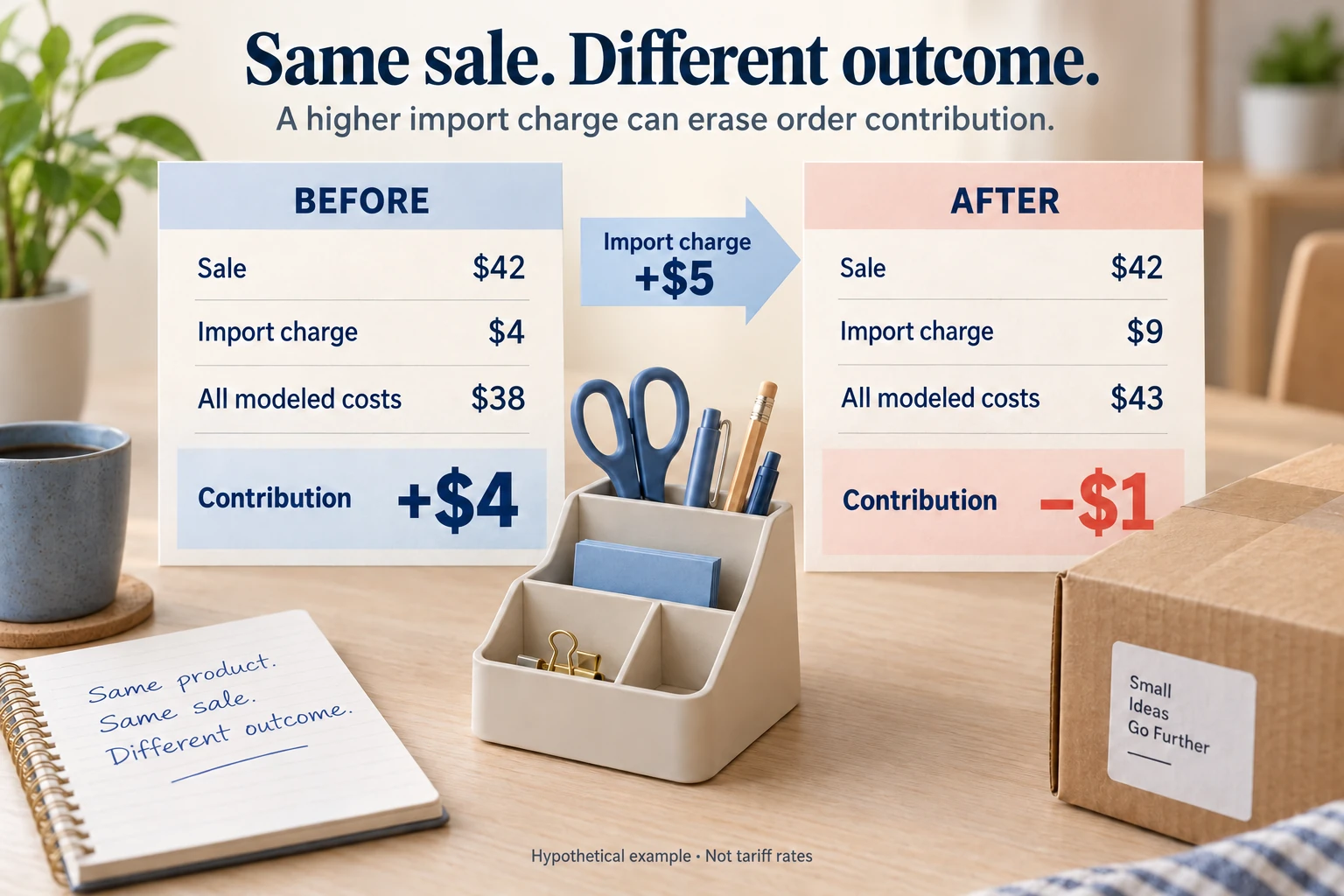
Here is a hypothetical desk-organizer order. The numbers are invented to show the method; they are not AIDrop prices, carrier quotes or tariff rates. The retail price is $42. The previous provider bill and other assumed order costs look like this:
| Cost per order | Previous quote | Revised quote |
|---|---|---|
| Product | $13 | $13 |
| Delivery | $6 | $6 |
| Billed import charge | $4 | $9 |
| Carrier brokerage | $1 | $1 |
| Payment cost | $3 | $3 |
| Customer acquisition | $9 | $9 |
| Expected returns allowance | $2 | $2 |
| Total modeled variable cost | $38 | $43 |
| Contribution at $42 retail | $4 | −$1 |
Compare like-for-like written quotes
The new quote appears to erase $5 of contribution. But before changing the product page, the seller still has to ask whether the $9 replaces the earlier $4, whether both quotes cover the same parcel and destination, and whether the new amount is a firm DDP charge or an estimate that may be reconciled later. A higher carrier shipping price could also hide the import charge; the rows must come from an itemized written answer, not a guess.
A higher price can change acquisition cost
If every other hypothetical cost stayed fixed, a $47 selling price would restore $4 contribution per order. That does not guarantee the week’s profit. As an illustration, suppose the same $90 weekly ad spend previously brought ten orders ($9 per order) but a higher price brought eight ($11.25 per order). With that acquisition cost, the $47 sale contributes only $1.75 after the revised import charge and the other modeled costs.
Retest the changed offer
Those order counts are assumptions, not a conversion test or AIDrop result. Verify the dated duty quote first, then test whether the new price actually preserves contribution after changed ad efficiency, payment cost and returns. $47 is a sensitivity input, not a recommended price. The profit-margin guide covers the wider economics.
For the quote request, copy this into a supplier or carrier email and fill in the blanks:
Please quote SKU [product/specification] from [ship-from] to [destination/postcode], parcel weight and dimensions [details], quantity one. Show product, transport, estimated import duty/tax, brokerage or disbursement, and every other billed fee separately. State the goods’ manufacturing origin, proposed classification and valuation basis, whether the route is DDP or DAP, who is importer and who receives each invoice. Include the quote date, validity, service and likely delivery window. Tell us which amounts are estimates and which are included in the total.
That request does not replace customs advice. It makes the gap visible before you promise a price to a customer.
04
Decide what to do with the live offer
The next action depends on the whole order, not the news headline:
| What the new evidence shows | Sensible next move |
|---|---|
| Itemized landed cost and payer are unchanged | Keep the offer, save the dated quote and review again when a rule or route changes. |
| Cost rose but the same route and delivery promise remain workable | Test a new retail price or shipping charge against contribution and checkout conversion; update customer wording before new orders. |
| A second supplier or route looks cheaper | Compare the same SKU, destination, importer, duty coverage and delivery standard; test an actual parcel before switching. |
| Charge, classification, origin or payer is still unclear | Pause the affected SKU or destination until the carrier, supplier or broker resolves it. Do not sell an “all duties included” promise you cannot support. |
Keep the earlier customer promise separate
Already accepted orders need separate handling. A price change on your website does not rewrite what an earlier customer paid or what you promised that customer. Check which party will pay the carrier on those orders, document any extra cost, and communicate a real delay or payment request promptly. Do not silently push an unexpected import bill onto the customer because a supplier quote changed after checkout.
Checkout collection must match the parcel route
If you collect an estimated duty amount at checkout, match that setup to the actual shipping arrangement. Shopify notes that checkout collection is an estimate and its carrier-label support has conditions. A checkout estimate is not proof that the supplier’s parcel will travel DDP or that a carrier will never invoice an additional service fee.
Verify the price change on a real order
After the carrier or broker resolves the quote, check the actual customer route before reopening the affected SKU. The $42/$47 examples above are planning inputs, not a completed pricing test.
At the storefront
Open the exact organizer and destination on a phone. Check item price, shipping, tax/duty wording and checkout total. If duty is already included in the provider bill, remove any duplicate modeled duty line; if the buyer will owe charges, make the real arrangement clear before payment.
At shipment reconciliation
Compare the completed parcel’s invoice and any recipient charge with the saved quote. Match the same SKU, service, origin and entry date. A brokerage line is not automatically a new tariff. Take a genuine mismatch to the carrier/broker and correct the next offer without silently shifting old-order costs to the buyer.
Keep the quote date and actual invoice together. Successful checkout proves what your store charged; it does not prove customs accepted the classification or that the carrier collected nothing else.
05
Keep the cost sheet current without chasing every headline
Review the exact SKU and route when the supplier revises terms, a carrier changes its billed service, a shipment returns with a different entry charge, or an official tariff measure changes. Save the dated quote and the invoice from a completed shipment side by side. A recurring difference is useful evidence to take back to the supplier or broker.
Do not “solve” a cost increase by asking a supplier to use a cheaper but inaccurate product description, country of origin or declared value. The right response to uncertainty is a better product record and an authorized classification answer.
AIDrop Agent can help coordinate the China-side product, packing and fulfillment facts needed for a clean carrier quote. Send the exact SKU, destination and current supplier bill with your inquiry. We can help identify missing operational details before you decide how to price the order; the applicable tariff and import entry still need to be confirmed by the authorized carrier, broker or customs source. Tell us what you are shipping.
Questions about tariffs and a dropshipped order
Do tariffs apply to every dropshipping business?
Tariffs concern imported goods, not the business-model label. A domestic dispatch and a newly imported customer parcel have different cost paths. Existing local stock may already carry import costs in the supplier’s price; it is not proof that importing the same item has become duty-free.
Is a US parcel under $800 automatically duty-free?
Do not assume that old exemption. CBP’s current public guidance describes suspended low-value duty-free treatment. Its recent proposed-rule background also describes that suspension; the proposal’s future entry procedures are not current rules. Confirm the exact entry route, applicable treatment and any exception with the authorized carrier or broker.
Does DDP mean there can never be an extra charge?
Confirm the named destination, importer, invoice recipient and included charges in your actual agreement. The three letters alone do not show which estimates will be reconciled, which carrier services are extra or how an incorrect declaration is handled.
Should I raise my price by the headline tariff percentage?
Start with the itemized landed quote. In the fictional example, cost rises by $5, but a $47 price only restores $4 contribution if other costs stay fixed. If acquisition rises from $9 to $11.25, that result falls to $1.75. Use actual costs and observed orders.
How often should I check the quote again?
When the supplier, route, product origin, applicable official measure or actual invoice changes, and before a quote expires. There is no useful universal interval for every SKU. Save the version and relevant entry date rather than refreshing an unrelated headline daily.
Dropshipping Shipping Times: What to Promise Your Customers
Use product-specific processing and transit estimates to set a delivery promise. Named route examples and a worked
Dropshipping Shipping Costs: Compare the Whole Parcel Quote
Calculate dropshipping shipping costs from packed dimensions, billed weight and fees. Compare a worked parcel quote, import
Dropshipping Tracking: Set It Up and Handle Missing Updates
Set up parcel-level tracking, interpret carrier events, and investigate missing updates without mistaking a shipping label for
