
Dropshipping customs duties depend on where the parcel enters the country, what it contains, where the goods originate and their customs value. The store, supplier or customer may pay, depending on the delivery agreement. Before quoting a delivered price, confirm both who pays and who can act as importer.
A customer who has paid an all-inclusive price should not be surprised by a courier’s payment request. Yet that is what happens when the checkout promise and the supplier’s shipping instructions disagree. Clearance can also stall over a less visible problem: an invoice with the wrong material, an unsupported origin or an unexplained value.
The following checks connect the price you advertise to the shipment your supplier sends. Destination examples were checked on September 16, 2026; the rate for an individual shipment still requires current classification and jurisdiction advice.
01
Separate duty, tax and clearance charges
Customs duty is a charge associated with importing goods. Import VAT or GST is a separate tax. A courier or broker may also charge for clearance, advancing funds, storage or another service. A quote that covers one item does not necessarily cover the others.
An itemized quote makes these costs easier to compare. A single line labeled “customs” could mean government charges, a carrier fee or an estimate to be reconciled later. Until the provider separates those amounts, the cheapest quote may simply have the most omissions.
Duty: check the classification, origin, value and applicable treatment for the destination. A zero ordinary tariff rate does not establish that every other charge is zero.
Import tax: confirm who accounts for it, where it is collected and whether the transaction qualifies for the mechanism being used. Checkout collection and import collection are different events.
Service charges: ask the carrier or broker which fees apply to the selected route, who is billed and what happens if information is missing. These costs belong in the delivery calculation even when the duty itself is small.
The customer-facing explanation can be short once these arrangements are clear: which charges the price includes and which, if any, the customer will pay later.
02
Give each customs field an owner
Customs information comes from several places. The supplier has the materials and manufacturing details; the store has the customer’s order and payment; the carrier or customs representative specifies the filing data. An unknown field needs to go back to the party that can substantiate it.
Build a product record before the first shipment:
- Description: a specific product name, use and material where relevant. “Accessories” may tell the broker too little to classify the goods.
- Classification: the proposed tariff code and the basis for it. Have the appropriate customs professional confirm uncertain classifications for the destination.
- Origin: where the goods originate under the applicable rules. The country dispatching the parcel is not automatically the country of origin.
- Value and currency: the transaction information and other elements needed for the applicable valuation method. Keep invoices and payment records that explain the declared amount.
- Quantity and contents: every item actually in the parcel, including bundles and replacements where relevant.
- Parties and identifiers: seller, recipient, importer and required tax or customs identifiers, transmitted through the approved channel.
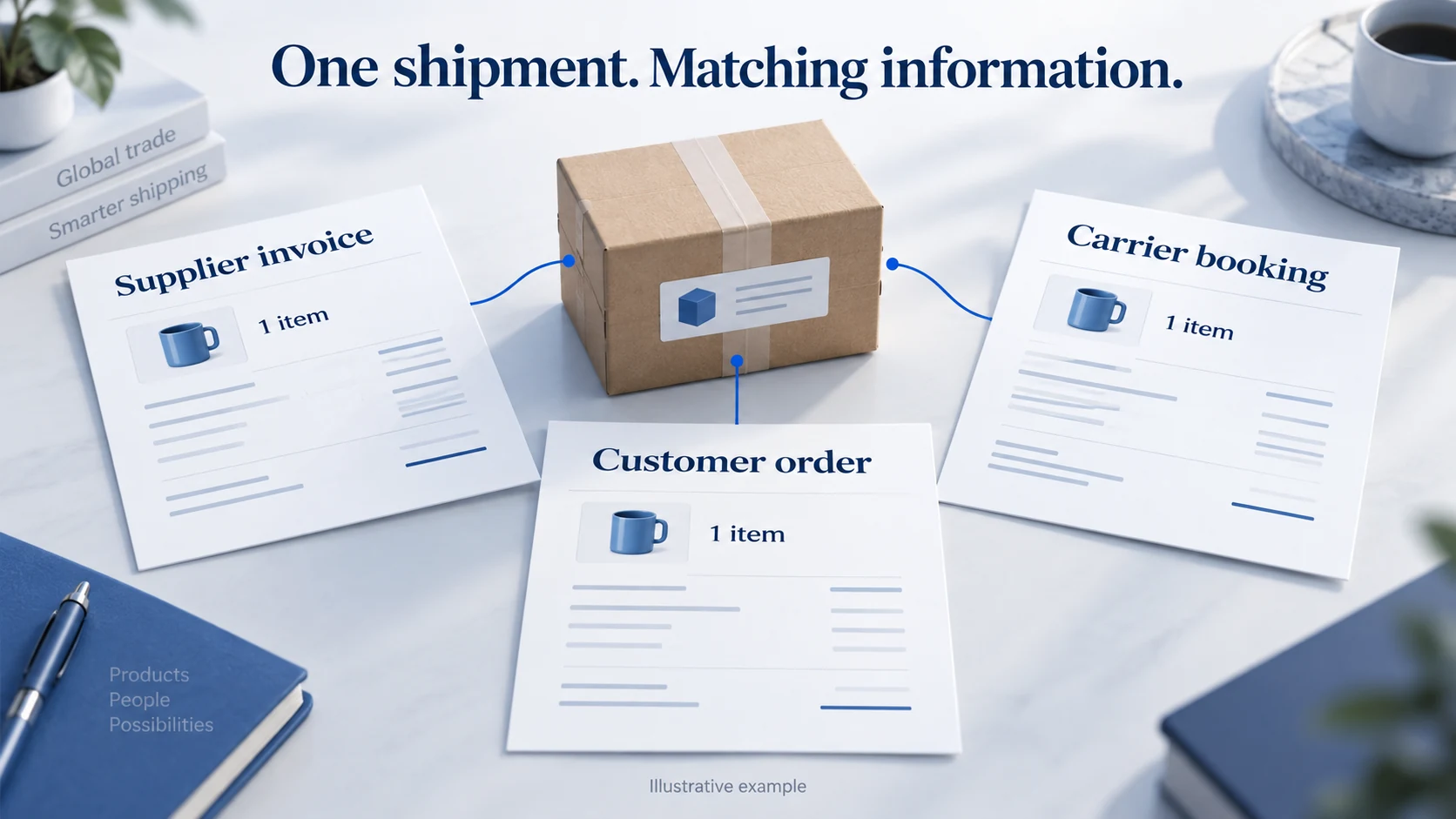
A supplier invoice, customer order and carrier booking should describe the same shipment. They can legitimately serve different commercial relationships, but unexplained differences in contents, currency or value need resolution before dispatch.
For example, describing a desk lamp as a “plastic accessory” leaves out its function and electrical nature. An accurate description helps the broker classify it. Choosing a cheaper code simply to reduce the bill creates a declaration problem.
Keep sensitive tax identifiers out of public packing inserts and customer-facing screenshots. Share only what the authorized filing process requires. If a supplier changes the manufacturing country or product material, review the customs record instead of copying the old SKU’s settings.
03
Name the importer and the payer separately
Three names may appear in the paperwork: the party that agreed to bear import charges, the eligible importer and the carrier’s billing customer. Confirm each one. A supplier’s promise to cover a bill does not, by itself, establish the import arrangement.
With a duty-paid customer offer, the merchant needs a route that can clear the goods and charge the agreed business account. With a customer-paid arrangement, the store needs clear pre-purchase disclosure and a lawful, workable procedure for the destination. Disclosure does not solve an arrangement that the carrier cannot perform.
The phrase “DDP shipping” deserves a follow-up question: DDP between which parties, to which named destination, and covering which costs? The supplier’s quote may describe its sale to the merchant, while the merchant has made a separate promise to the consumer. Our DDP dropshipping guide explains that distinction in more detail.
Ask the provider to confirm these points in writing:
- Who acts as importer or makes the required import arrangements?
- Which duties, taxes and carrier fees are included?
- Which account receives an adjustment or unexpected assessment?
- What information must the merchant supply before dispatch?
- Who takes action when a parcel is held or the customer receives a bill?
“Our line handles it” leaves all five points unanswered. An all-inclusive price needs a more specific commitment from the provider.
04
Check the destination, not an old threshold chart
Low-value import rules differ by destination and have changed substantially. The examples below show why old threshold charts are a poor basis for pricing, and why VAT collection and duty treatment need separate checks.
United States
CBP’s February 2026 guidance confirms the continued suspension of the specified duty-free de minimis treatment, with limited statutory exceptions. Do not use the former $800 threshold as a blanket duty-free promise. Postal and non-postal entry processes differ, and the relevant route and applicable charges still need verification for the shipment. See CBP’s continuing-suspension guidance.
For a new US route, ask the carrier or broker for its current entry and billing requirements. Do not turn a tariff rate from a past invoice into a permanent percentage in your store pricing: product classification, origin and measures applying at entry can change the result.
European Union
The Commission’s implementation guidance describes a temporary €3 duty from July 1, 2026 for each tariff-classification category in covered distance-sale consignments up to €150. Its current FAQ covers different VAT schemes, with an exception for qualifying preferential-trade or Customs Union goods declared through H1 without IOSS VAT collection. The declarant generally handles payment; this is separate from the proposed Union handling fee. Commission guidance and current FAQ.
For a mixed parcel, classification can therefore affect the bill as well as total value. The route provider should explain how it collects and passes through duty and VAT, including any charges outside its IOSS-related VAT process.
Great Britain
For non-excise goods, GOV.UK distinguishes consignments worth £135 or less from higher-value imports. Its consumer guidance says customs duty is not charged on non-excise goods at or below that level; VAT can still apply. Northern Ireland has different rules and should be reviewed separately. GOV.UK tax and duty guidance.
HMRC’s direct-sales guidance applies the £135 test to the total consignment, not each item. In an illustrative order, two goods with intrinsic values of £80 and £70 shipped together total £150. Checking each product separately would miss the threshold. The valuation conditions and channel-specific rules still matter. HMRC guidance for overseas direct sellers.

Include bundled carts and multi-item orders in testing. Keep the shipment description and value accurate; the example does not justify artificial splitting or misdescription to avoid charges.
05
Build the estimate around a real order
A landed-cost estimate is useful when it names the SKU, destination, contents and shipping service. It should also say how long the quote is valid and what may trigger an adjustment. “Shipping to Europe” is too broad to price a particular order.
For illustration, take an order with these assumed costs:
- Product: $18
- Transport: $7
- Duty: $3
- Import tax: $5
- Carrier handling: $2
The cash outlay is $35, before other store expenses. These are invented amounts for comparison, not tax rates or a country-specific quote.
If the supplier’s $25 price includes only product and transport, the remaining $10 needs an owner. If a second supplier quotes $34 with the same five items included, that offer is $1 lower on these assumptions. Compare identical scope before concluding that the first supplier is cheaper.
Also distinguish cash paid from final expense. A recoverable tax, if your business is eligible and has the required evidence, may receive different accounting treatment from an unrecoverable cost. Do not assume recovery or subtract it from your margin calculation without confirming that position.
For checkout collection, test the fulfillment connection. Shopify warns that estimates can change with inaccurate product data and requires compatible duty-paid shipping arrangements when collecting import charges through the relevant setup. Shopify’s checkout collection guidance.
A test order should reach invoice reconciliation, not stop at checkout. Compare the product data, customer charge, supplier instruction and carrier booking with the eventual bill. That is where a missing payment instruction becomes visible.
06
Resolve holds and unexpected bills with the shipment record
A customs hold may concern a missing document, unpaid charges or a product restriction. Start with the actual request: shipment number, requesting party, missing information and response deadline. That record tells the team whom to contact and what to send.
For a document request, send the accurate supporting information through the authorized carrier or broker channel. If the supplier cannot substantiate the declared material or origin, escalate that gap; repeating the same unsupported declaration will not fix it.
For an unexpected customer bill, compare the customer invoice, supplier terms and carrier booking. Find out whether the charge is duty, tax or a service fee, whether it was already collected and which party was instructed to pay. Ask the carrier how to correct an erroneous billing instruction rather than telling the customer to ignore a genuine notice.
A refund to the customer does not automatically recover money from customs or the carrier. Keep reimbursement and any official repayment application as separate tasks. Record who will submit the claim and which evidence is needed; do not promise recovery before eligibility is established.
If clearance threatens the delivery promise, update the customer with the known status and next action. Do not invent a clearance date. Build these exceptions into the wider dropshipping shipping-time plan so the estimate covers more than transit between airports.
07
Keep the customer promise aligned with the route
Before launch, compare the shipment data, import and billing arrangement, and customer-facing price side by side. They should describe the same service.
For a supplier switch, check whether the origin, parcel structure, carrier or payment account changes. For a new market, confirm the rules and service before enabling checkout. For an unexpected charge, correct the underlying configuration as well as handling the individual complaint.
Keep the confirmed billing instructions with the supplier’s dispatch instructions so a routine booking does not undo the price agreed at checkout.
08
Frequently asked questions
Does the customer always pay customs duties in dropshipping?
No. The commercial arrangement may place the cost with a business before delivery or with the recipient. Confirm the applicable import responsibilities and carrier billing instead of assuming that the recipient automatically pays.
Can the supplier declare a lower value to reduce the charge?
Do not instruct a supplier to undervalue or misdescribe goods. Supply accurate transaction and product information and have the appropriate customs professional determine the required declaration.
Does collecting VAT mean duty is paid?
No. VAT and customs duty are different charges. Confirm the relevant collection mechanism, data transmission and carrier instructions for each.
What should I do before adding a new destination?
Verify the product’s eligibility, classification and origin; obtain a shipment-specific cost and importer arrangement; test the billing instruction; and make the checkout promise match the confirmed route.