
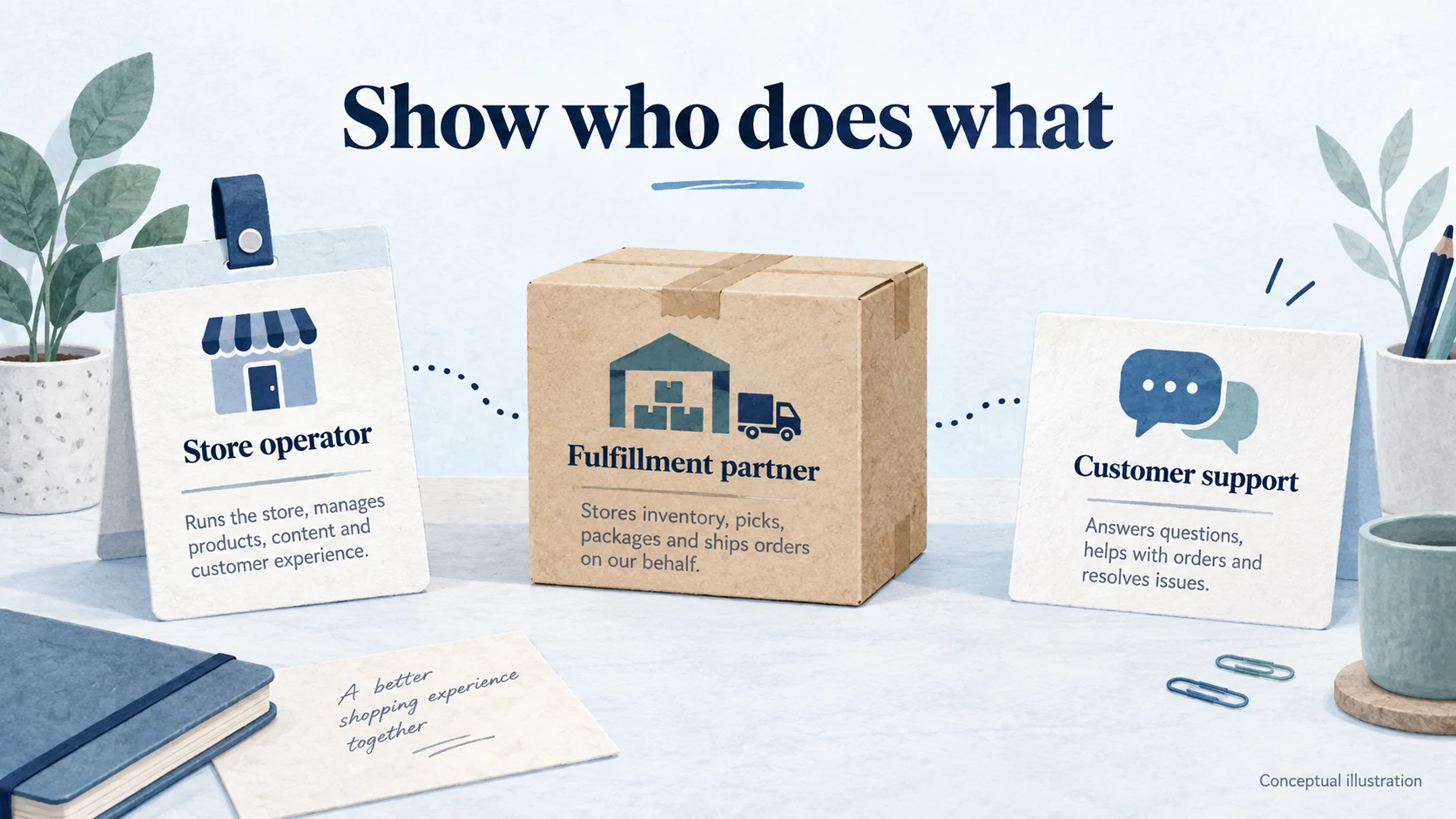
A dropshipping About Us page should explain who operates the store, why its products were chosen, how fulfillment works and who will help after purchase. Give customers a short, genuine introduction supported by details they can check. A new store can do this without inventing a long history, a warehouse or thousands of satisfied buyers.
The visitor has usually already seen a product. Now they are checking the business behind it. “Will someone answer if this does not arrive?” may matter more to them than a polished mission statement. Your page should make that answer easy to find.
01
Start with the business customers are buying from
Write the first paragraph as if you were introducing the store to someone who has never heard its name. State what you sell, who it is useful for and the practical reason you chose that range. Then identify the person or business responsible for running the store.
“We sell storage accessories for people furnishing small rented homes” gives a reader something to understand. “We deliver exceptional lifestyle solutions to customers worldwide” does not explain a product, an audience or a service.
An origin story can follow, but it does not need a dramatic turning point. Perhaps you found that product dimensions were poorly explained, or that buyers could not tell which accessories fitted together. If that is the real reason you started, describe what you changed in the shopping experience. If it is not, choose the actual reason instead.
Nielsen Norman Group’s research on About Us information found that people wanted clear company explanations and compared them with information elsewhere. Treat the page as part of that wider inspection: its names, location descriptions and contact details should agree with your policies, order emails and public profiles.
02
Gather the facts before writing the story
Start with a small set of facts you can substantiate. This makes writing easier and reveals promises the operation cannot yet support.
| Information | A useful detail to collect | What it supports on the page |
|---|---|---|
| Business identity | The actual operator and its relationship to the store name | Who the customer is dealing with |
| Product selection | Your selection criteria and any checks actually performed | Why this particular range exists |
| Fulfillment | Who packs orders, dispatch countries and whether parcels can be split | What happens after checkout |
| Customer support | A monitored contact route, working hours and an achievable response target | How customers can reach someone |
| Returns | The current policy, contact process and appropriate return destination | What customers should do if something is wrong |
| Experience | Genuine background, dated milestones or attributable feedback | Evidence behind claims about the business |
The registered address, operating location, dispatch warehouse and return address can all be different. Label them accurately. A company based in one country does not make every parcel a domestic shipment, and a warehouse used by a fulfillment partner does not become your owned facility.
Use the correct legal or trading identity where appropriate, and check the business-information disclosures required for your market. Do not change an entity’s legal type in copy to make it sound larger. You can explain a brand name in friendly language while keeping the responsible operator accurate in your contact and legal information.
For the broader relationship between product selection, customer promises and supplier execution, the branded dropshipping guide shows how those decisions need to work together. The About page should describe the operation you have built, rather than make up one you hope to have later.
03
Explain fulfillment in language a customer can use
Customers do not need a sourcing lecture. They need to know where an order may come from, what timing applies and whom to contact. A practical explanation might say that selected suppliers prepare and dispatch orders, while your store handles product questions and order support.
Using a fulfillment partner does not remove your responsibility to the buyer. Avoid language that tells customers to resolve problems with an unnamed factory. If you take the order, your support process should explain the next step and coordinate any supplier investigation behind it.
The word “dropshipping” can be included when it helps, followed by an explanation. Omitting that industry term is different from falsely claiming that you manufacture, stock or personally pack every item. Describe the actual arrangement without creating a misleading impression.
Keep detailed delivery tables on the shipping page, with a clear link from About. If product routes vary, do not copy the fastest route into a sitewide promise. For covered US merchandise orders, the FTC’s shipping rule guidance requires a reasonable basis for shipment representations and specifically addresses sellers using dropshippers. A friendly brand story does not override those obligations.
04
A complete example for a new store
The following is an invented example, written for a fictional storage-accessory store called Small Room Supply. The business, founder, sample checks and support arrangements are all illustrative. It demonstrates finished prose; none of its operational statements should be copied unless they are true for your store.
Small Room Supply: useful storage for smaller homes
Small Room Supply is an independent online store for people making the most of a rented room or a small apartment. We focus on drawer dividers, cable organizers and compact storage accessories that help you use the space you already have.
I started the store after finding that shopping for small-space storage involved a lot of guessing. A photograph could make a box look roomy, but finding its usable dimensions or understanding how it opened was much harder. I wanted a smaller selection with clearer explanations of what each item could fit.
Today, I manage the store and answer product questions. Our product pages show dimensions, materials and the items included, so you can compare them with your own space before ordering. When a product has an important limitation, such as a fixed compartment size, we include that too.
For our first collection, we ordered samples and checked their measurements, closures and included parts. These checks helped us write the listings and photograph the products. They are not a claim that every future item has been individually tested by us. If a supplied product changes, we review the listing before continuing to offer that version.
Selected supplier partners prepare and ship orders directly. Dispatch locations and estimated delivery windows are shown on the relevant product and shipping pages; a mixed order can arrive in separate parcels. We do not operate a public shop or collection counter.
If you need help choosing an organizer or following up on an order, use our Contact page. I read messages Monday to Friday and aim to send an initial reply within two business days. Please include your order number when asking about a purchase, so I can locate it quickly.
For a damaged, incorrect or unwanted item, start with the Returns page and contact us before sending anything back. That page explains the available options, applicable time limits and where an authorized return should go.
Browse the storage collection when you are ready, or send us the measurements of the space you are trying to organize. We will tell you if we have something suitable—and if we do not.
What makes this example useful
The introduction identifies the range and audience. The founder explains a specific shopping problem. The sample paragraph describes the work and its limit. Fulfillment and support are concrete enough for a customer to act on, and the closing invitation fits the products.
It contains no invented review score, annual sales figure or claim to own the supply chain. It would still need real contact and policy links, the actual business disclosures, and photographs of the actual products before use by a real store.
You can make your version shorter. Keep the information that resolves your customers’ doubts, and remove sections for which you have nothing meaningful to say. An empty “Our amazing team” module is unnecessary for a solo operator.
05
Replace broad claims with evidence customers can understand
The most useful edit is often replacing an adjective with a specific practice. The replacement must still be true: a detailed false claim is worse than a vague one.
| Draft claim | A more useful approach | Evidence needed before publishing |
|---|---|---|
| “Premium quality, guaranteed” | Explain the particular material, measurement or function you check | Current product records and the checks actually performed |
| “Fast worldwide shipping” | State the destinations served and link to their delivery information | Available routes and a reasonable basis for the displayed timing |
| “Our expert team” | Name the real role and relevant experience | Genuine experience, not an invented credential |
| “Thousands of happy customers” | Use a dated, accurate milestone if one exists; otherwise omit it | Records matching the number and what it measures |
| “Eco-friendly products” | Describe a specific supported material or packaging feature | Evidence that supports the exact environmental statement |
A new store can use useful product information as evidence of care without pretending it has customer feedback. Show a clear measurement photograph, explain a compatibility limit, or describe a selection decision you actually made.
When reviews become available, use genuine feedback with appropriate permission and disclose relevant relationships. Do not turn supplier marketplace reviews into testimonials about service customers never received from your store. The FTC’s reviews and testimonials guidance explains the distinction between merely hosting reviews and using testimonials in advertising, including the risks of fake or false endorsements.
06
Use images that represent the real business
A simple photograph of an actual sample can be more informative than a large stock image of a warehouse. Show the detail you discuss: a divider measured inside a drawer, the parts included in an order, or the real person answering product questions.
If a supplier permits use of its facility photographs, describe them as that supplier’s or partner’s facilities. Check that permission covers website use and that the caption accurately describes the relationship. Do not label a shared photograph “our warehouse” because its appearance suits the page.
Illustrations are useful for explaining a fulfillment process. They should look and read as illustrations. Generated people, certificates, inspection scenes and buildings should not stand in for evidence that your business has employees, qualifications or facilities it does not have.
No photograph is required for every paragraph. One relevant image with an honest caption, followed by readable text, often communicates more than a gallery of unrelated offices and shipping containers.
07
Make the page easy to read and easy to find
Give the page a straightforward name such as “About Us” or “Our Story.” Put its link where customers expect company information, typically the footer, and consider a main navigation link when your story is an important part of choosing the product.
Start with the introduction, then add only the sections the story needs. Keep the operator, fulfillment explanation and contact route visible in ordinary text. Avoid placing essential facts inside an image or hiding the entire page behind accordions.
On a phone, check that headings do not overwhelm the page, paragraphs remain comfortable to scan and contact links are easy to tap. Use one main next step, such as browsing the relevant collection. Shipping, returns and contact links can remain available as practical supporting routes.
On Shopify, the current About Us page instructions describe creating a page under Online Store → Pages and adding it to the store’s menus. Preview the result in your actual theme; saving a page alone does not guarantee customers can find it.
08
Review the page against a real customer journey
Ask someone unfamiliar with the store to read it and answer five questions: What does this business sell? Who runs it? Why were these products chosen? Where can I find delivery and return information? How would I get help with an order?
If the answers require guesses, revise the relevant passage. Then follow the links yourself, send a test support message and compare the page with an order confirmation. A promise of daily support is a problem if the contact channel is only monitored twice a week.
Track whether visitors can reach the collection or contact route, and read the questions that still arrive. About-page visitors may already be unusually cautious or engaged, so a higher purchase rate among them does not by itself prove that the page caused the difference. Use that information to identify doubts; test material changes separately when the traffic allows it.
09
Frequently asked questions
Do I need to tell customers I use dropshipping?
Explain material facts about fulfillment, delivery, returns and who is responsible. Whether a specific disclosure is required depends on your market and sales channel. Do not imply that you manufacture or own stock when you do not. The industry label alone tells a customer less than a clear explanation of the actual service.
Can a one-person store use “we”?
Choose a voice that accurately represents the business. “I” can work well for a founder-led store. If you use “we” for the store, avoid adding fictional departments, employees or team photographs to support it.
What if I have no founder story or customer reviews?
Explain your range, selection criteria and service plainly. A useful business introduction does not require a dramatic personal story or a testimonial. Add genuine history and feedback as they become available.
Can AI write the About Us page?
It can help organize your verified facts or shorten a draft. Give it the facts first, then remove invented experiences, generic superlatives and promises you cannot meet. Read the final page aloud: it should sound like someone who actually runs the store.
How often should I update the page?
Update it when the operator, range, fulfillment arrangement or support process changes. Check it during major launches and policy updates so an old story does not contradict the service customers now receive.