
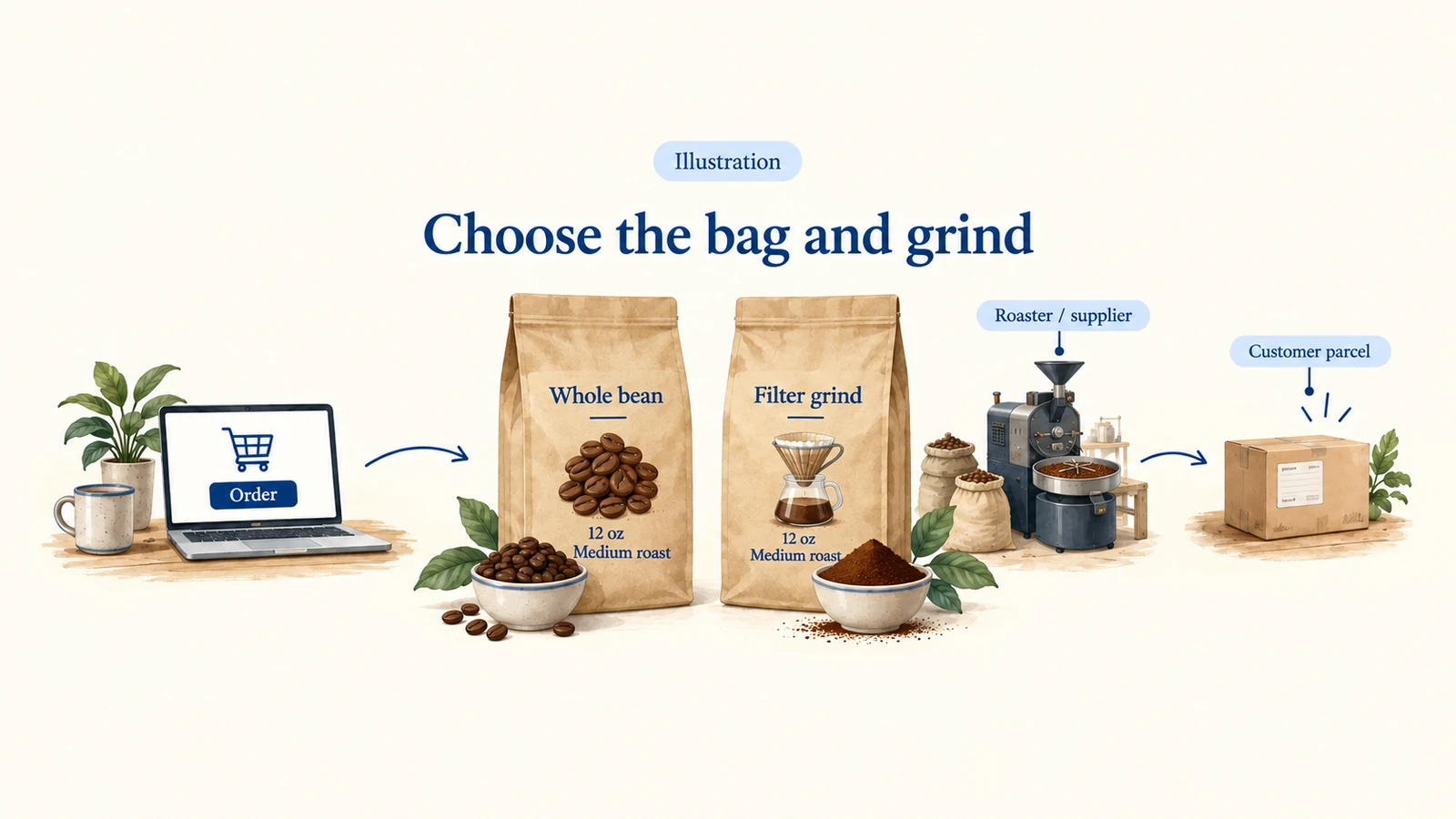
Coffee dropshipping lets you sell coffee while an agreed roaster or supplier packs and ships each customer’s order. You run the store, set the price and answer the customer. The supplier handles the coffee and dispatch under the terms you agree.
Imagine a filter-coffee buyer opening your product page. They need a bag weight, a grind that works with their machine and a believable delivery window. You need the named coffee, a packed shipping quote and an agreement about who sends that bag. Start with that single offer; a broad promise of “fresh coffee” does not answer the order.
The steps below turn that offer into an order a roaster can actually fulfill. The food-rule examples concern US sales. We rechecked Path’s program and selected FDA guidance on October 11, 2026; the other supplier comparisons keep their stated September 28 scope. No coffee, label or shipment was tested for this article.
01
Start with a coffee someone knows how to order
A customer with a grinder can buy whole beans. Someone using a filter machine may want the coffee ground before shipping. An espresso buyer needs a more specific answer than a dropdown that simply says “ground.” Ask the roaster which grind choices it actually supplies and how they are described.
Start with one bag and two supported grinds
For an illustrative first offer, choose a 12-ounce bag of plain, medium-roast coffee with whole-bean and filter-grind options. Give the buyer the bag weight, coffee or blend identity, roast description and available grind choices. Add the roaster’s supported flavor description without inventing tasting results or promising that everyone will enjoy the same cup.
You can resell an existing brand under an authorized supply arrangement, put your label on an existing coffee, or commission a custom blend. The last option can involve different quantities, development work and lead times. An on-demand label service does not automatically include custom coffee development. The private-label and white-label guide explains that broader choice.
These supplier examples show different ways to arrange the work. Their pages were checked on September 28, 2026; they describe their own programs, rather than coffee we have tasted or suppliers we have approved.
| Program | What the provider describes | What to settle before choosing it |
|---|---|---|
| Path Coffee Roasters | Finished private-label bags, on-demand or merchant-supplied labels, store connection and separate shipping charges | Exact coffee/grind, delivered price, setup option and supported destination |
| Liberty Beans Coffee | Roast-to-order private-label coffee and direct shipment with the merchant’s branding | The chosen bag, label approval, order handoff and dispatch promise |
| EZPZ Coffee | Montreal roasting and private-label fulfillment for Canada and the US | Destination quote, border arrangements and the difference between roast location and bean origin |
| Dripshipper | A branded coffee catalog and app-based ordering route | Actual catalog item, app costs, shipment coverage and recurring-order support |
On a phone, swipe the table sideways to compare every column.
Read the actual Path program, Liberty Beans offer, EZPZ coverage and Dripshipper catalog route. Get a written quote for your bag and delivery address. A supplier’s general program page cannot tell you the landed price of every order.
Start with the one coffee and two grinds in this example. If the roaster cannot provide both, remove the unsupported option before a buyer selects it. Add another blend or bag size after the first route has shown that it can dispatch the correct order. If coffee is a poor fit for your buyers or destination, the dropshipping products guide compares other categories.
02
Choose a coffee dropshipping supplier for your offer
Send a request that the supplier can price and fulfill. For the illustrative offer above, it could say:
Please quote one 12-ounce bag of your named medium-roast coffee, in whole-bean and filter-grind versions, with our approved label, delivered to this US ZIP code. Confirm the ingredients, bag and seal, roast-date information, lot identification, order-to-dispatch time, tracking and replacement terms. Tell us what happens if that coffee or grind is unavailable.
Origin, roasting and dispatch answer different questions
Also ask where the beans come from, where they are roasted and where the parcel leaves. Those are three different facts. A Brazilian coffee can be roasted and dispatched in the US. A Canadian roaster shipping to a US buyer creates a different route from a US domestic shipment.
Do not confuse the roast date with the lot
Three dates or codes deserve separate answers. A roast date tells you when roasting occurred. A best-by date gives the supplier’s stated product-life information under its conditions. A lot code identifies a production group so a complaint can be traced. Do not turn one of these into a substitute for the others, or assume a decorative label mockup shows the code used on shipped bags.
Order the exact coffee, grind and packaging you intend to sell. Check the received item against the offer: correct grind, net weight statement, readable label, intact seal and the dates the supplier promised. Taste it using a consistent brewing method to decide whether you want to sell it. This is a proposed sample check, not a taste test we performed; one sample does not establish food safety or the condition of every future batch.
Give storage instructions for the actual bag
Freshness also depends on what happens after roasting. The National Coffee Association’s storage guidance explains why air, moisture, heat and light matter. Give buyers the actual bag’s storage directions and identify whether it contains beans or ground coffee. Avoid a universal “fresh for 30 days” promise unless the particular product and conditions support it.
Ask for the time from order acceptance to roasting, packing and carrier collection. A recent roast date does not guarantee fast delivery. If a blend runs out, decide with the roaster whether the buyer will wait, receive a refund or be offered a clearly approved alternative. A silent switch to flavored coffee could change the ingredients and the order the buyer thought they placed.
Check the preparation time and the coffee itself
Path’s program page, checked October 11, gives a typical 3–4 business days from order to dispatch. Carrier transit comes afterwards. Confirm the exact coffee and destination rather than using that estimate as an arrival promise.
The shipping promise
Obtain the accepted preparation time, parcel service and destination estimate. If preparation slips, the customer needs an updated shipment expectation; a fresh roast date alone cannot fix a missed delivery promise.
The repeat-coffee promise
Ask what happens when a seasonal origin changes. Path describes changing single-origin availability and blending seasonal coffees toward a similar flavor. Confirm any change affecting the product description or supported origin claim before selling the next bag.
This is provider-specific guidance, not proof every roaster follows that timing or formulation. Keep the final coffee description and label consistent with the supplier’s actual current offering.
03
Know who handles the food and its label
Check the artwork for this exact bag
For US sales, ask for the final artwork for the exact bag, not a logo mockup. Check the food name, net weight, ingredients, applicable allergen statement, and business name and address. Agree who reviews it before printing. FDA’s food-business guidance explains why the manufacturer’s, packer’s, retailer’s and state or local duties may differ.
The next label question depends on the coffee you chose:
- Plain beans or ground coffee: a limited Nutrition Facts exception may apply under 21 CFR 101.9(j)(4) if the listed nutrients are insignificant and no disqualifying nutrition claim is made. Other label and food-safety duties still apply.
- Flavored coffee or a drink mix: request the actual ingredients and allergen information. The flavor name alone cannot rule out milk, nuts or sesame. Any “allergen-free” claim needs product-specific support; check FDA’s allergen guidance.
If a US buyer receives coffee from abroad
A bag roasted and dispatched in the US has a different route from a bag mailed to the buyer from abroad. For the imported bag, name each party before taking orders:
- Foreign end: who roasted and packed it, whether that facility must register, and who arranges FDA prior notice?
- US entry: who is the importer, who handles the border work, and who meets any Foreign Supplier Verification Program (FSVP) duties? Its importer is generally the US owner or consignee at entry, or a designated US representative when neither exists.
Those duties and any exemptions depend on the actual transaction. One commercial parcel is not personal consumption merely because it is small, and a facility number is not product approval. Check FDA’s food-import guidance and FSVP explanation with the importer before offering that route.
04
Price the delivered order, then check the cash
Path’s checked program page publishes an average $11 cost for a finished 12-ounce bag, separate shipping charges and one-time setup options of $400 when it prints labels or $350 when you supply them. Its suggested retail markup is not a calculation of your profit. Ask for the actual SKU price and what the finished-bag charge includes.
Here is a hypothetical comparison. The coffee cost uses that public average as a starting assumption; the selling prices, freight, processing fees, advertising and remedy allowances are invented. They are not Path quotations or observed store results.
| One paid order | One 12-ounce bag | Two 12-ounce bags |
|---|---|---|
| Customer payment, with shipping included | $26.00 | $44.00 |
| Coffee and printed bags | $11.00 | $22.00 |
| Parcel shipping | $5.00 | $6.00 |
| Payment processing | $1.08 | $1.62 |
| Cost to acquire this buyer | $4.00 | $4.00 |
| Expected replacements/refunds allowance | $1.20 | $2.40 |
| Total planned order costs | $22.28 | $36.02 |
| Amount left toward monthly bills | $3.72 | $7.98 |
On a phone, swipe the table sideways to compare every column.
The last line is contribution: money left after these order costs, before the business’s monthly bills and other costs. The two-bag offer leaves more per order under these assumptions because shipping and acquisition do not double. A buyer still needs a reason to want two bags, and the actual packed shipping quote may change the result.

A good order margin still has monthly and launch costs
At 100 single-bag orders, the planned contribution is $372. Subtract an illustrative $60 monthly software bill and $312 remains before owner pay, tax and launch costs. If you count the entire $400 setup cost in this first period, the remainder becomes minus $88. Accounting treatment can differ; the setup cash still has to be paid. The unit-economics guide goes further into cost and price decisions.
Fund the bags before waiting for payouts
Cash timing creates another limit. Start with an illustrative $800. Pay $400 setup and $60 software, then fund ten single-bag orders: $160 for coffee and shipping, plus $40 advertising. Before customer payouts arrive, $140 remains. Holding $100 for refunds or surprises leaves just $40 otherwise uncommitted. The first ten customer payments would total $260, or $249.20 after the assumed processing fees, when that money becomes available. Do not spend it merely because checkout says “paid.”
Keep an allowance separate from held cash
The $1.20 allowance estimates possible order costs; the $100 buffer is cash you keep available. It is not another $100 expense. Replace all assumptions with the quote, fees and payout conditions you actually receive. When a real refund or replacement happens, record its actual cost instead of charging both that cost and the planning allowance to the same completed order.
05
Walk one paid order from checkout to tracking
Before live sales, follow an order through the actual setup. Path, for example, describes connecting the merchant’s website to its ShipStation account and checking test orders before selling. That is its program’s process, not proof that every coffee supplier supports your store or has accepted your order.
Your own routine should connect the customer’s order to the supplier’s acknowledgment:
- Confirm the coffee, grind, quantity, address and payment status.
- Send the supplier order once, using a reference you can match to the store order.
- Confirm acceptance and the planned roast, packing and dispatch timing.
- Check the returned tracking number and send the customer an accurate shipment update.
- Match the supplier bill to the coffee and shipping actually supplied.
Path states that it bills the merchant’s card weekly for bags and actual shipping, with itemized invoices and reports. Another supplier may charge immediately or use a prepaid balance. Put that payment timing into your cash plan rather than borrowing another program’s terms.
If the store shows a paid order but the supplier shows none, check the order reference and connection before resending it. Two supplier orders can create two parcels and two bills. If acceptance exists but dispatch is late, obtain the actual status and communicate the revised timing or customer remedy. A label created in a carrier system does not by itself show that the carrier has the parcel.
A missing bag should be traceable to the right order
Keep a short record for the first real order. For this teaching example, the store order is CF1001 and the filter-grind SKU is COF-MED-FILTER. Those are invented labels; enter the actual roaster and shipment references as you receive them.
Before it goes to the roaster
Store order CF1001: one 12-ounce bag, the agreed medium-roast coffee, filter grind and the actual delivery address. Attach the approved retail-label version. The whole-bean SKU must remain a different selection; a general “coffee” line cannot distinguish them.
After the roaster accepts
Save the roaster’s actual order reference and accepted item. Ask how it will identify the lot and roast date on this order. Leave those entries unresolved until the actual supplier provides them. If the grind or artwork differs, hold the job and correct it before packing.
After dispatch and billing
Match the parcel’s tracking and actual handoff date to that same order. Compare the invoice’s bag and shipping charges with the agreed quote. If a buyer reports the wrong grind or a broken seal, this record identifies which order and lot to investigate.
When a paid order appears missing, first search for its store and roaster references. Resending blindly can buy two bags for one customer. The record helps follow the job; it does not establish that the coffee is safe or that a required food record has been completed.
06
Make the subscription dates visible
A subscriber expects the same agreed coffee to arrive again without placing another order. Show the bag count, grind and frequency, plus the date of the next charge and the last moment to change an address, skip or cancel. Your billing tool and roaster must both support those actions; an automatically repeated checkout alone is not enough.
Write the renewal promise before taking subscriptions
For a hypothetical plan, send one 12-ounce bag every 30 days and allow changes until three days before renewal. Those are invented offer terms, not a provider policy or a legal deadline. If a customer skips within that window, the billing record and supplier order both need to show the skip. If the roaster has already accepted the next order, your stated policy must explain the available options; follow the laws that apply to that customer’s subscription.
Decide what happens when a renewal payment fails or a blend runs out. Do not ship an unpaid renewal by accident or silently replace a plain coffee with a flavored blend. Let the buyer know whether you will retry payment, pause the shipment or offer a permitted alternative, and keep the charge and order status aligned.
Press Coffee’s subscription offer illustrates provider-specific coffee choices and shipment frequencies. It does not establish that a different dropshipping app gives your customers the same controls. Confirm the whole renewal routine, including emails and refunds, with the actual tools you select.
07
Put a customer remedy ahead of supplier reimbursement
Match the remedy to the buyer’s actual problem:
- Wrong grind or bag: compare the store order with the supplier order and delivered item. Give the remedy your terms and applicable law require; include the original variant in any replacement instruction.
- Broken seal or ingredient concern: tell the buyer not to consume the coffee while the issue is checked. Record the bag, lot, label and report, and alert the supplier and appropriate food-safety contact. A suspected reaction calls for stopping consumption and appropriate medical help; a complaint alone does not establish its cause.
- Late parcel: confirm actual dispatch and tracking, explain the buyer’s available next step and respond promptly. Pursue any supplier or carrier reimbursement separately; its claim review does not resolve the buyer’s order.
You are ready for a controlled first launch when you have a defined coffee offer, an exact delivered quote, readable label information, a funded order routine and a clear way to handle exceptions. Keep the first menu and order volume within what that arrangement can deliver, then expand with actual order and customer information.
If the plan involves China-side packaging or related product sourcing, AIDrop’s product-sourcing service can help discuss supplier options, sample requirements and packaging details. Send the product or supplier link, destination and the decision you need to make through contact. Confirm whether the food-handling and shipping scope is supported before proceeding; this inquiry is not a roasting service or food-safety approval.
08
Frequently asked questions
Can I dropship coffee with my own label?
Some suppliers offer private-label bags, while a custom blend is a separate service. Ask for the exact coffee, grind, bag weight, approved label artwork, setup cost and destination quote. Confirm the service for that item before listing it.
Is coffee dropshipping profitable?
It depends on the delivered order cost and the customers you can reach. In the hypothetical example above, one bag leaves $3.72 after the listed order costs, before monthly bills and other costs. That is not net profit; setup costs, owner pay, tax and unexpected remedies can absorb it.
Dropshipping Products: Practical Ideas and How They Compare
Compare concrete dropshipping product ideas, from pouches and phone stands to apparel and wall art, with shipping,
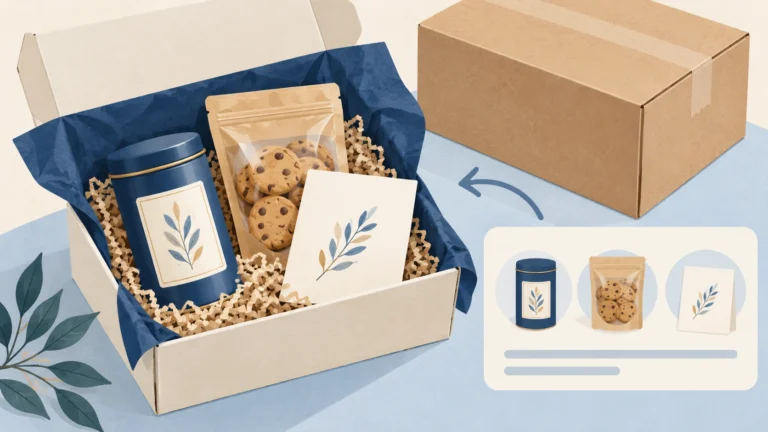
Gift Basket Dropshipping: Choose a Supplier and Keep the Gift Promise
A gift basket can be dropshipped, but the recipient must get the contents, message and delivery experience

Wedding Favor Dropshipping: Get the Count and Event Date Right
Wedding favors can ship directly to a host or venue, but the sold unit, guest count and
