
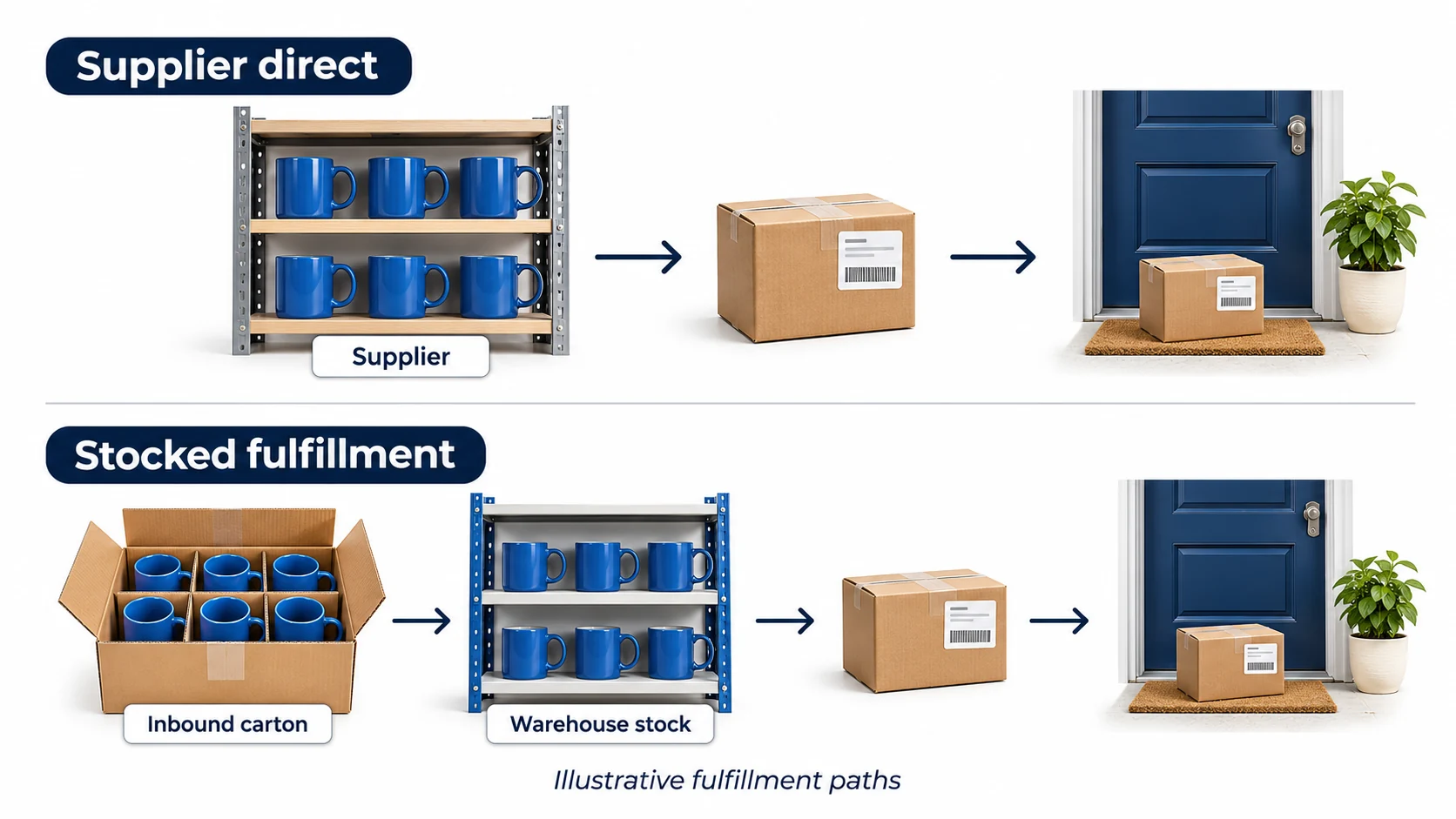
For Chicago-area dropshipping fulfillment, start by comparing ShipBob, Shipfusion and ITL against the work your store needs. They advertise local fulfillment services, but the suitable account, receiving location and inventory arrangement still need confirming. A warehouse usually expects stock to arrive before it can send customer orders.
That matters if you are looking for faster US delivery while your supplier still ships each purchase from overseas. Moving the packing job to Chicago can help once products are stocked there. It also means buying, replenishing and paying to keep those products available.
01
Decide whether you need stock in Chicago
Start with the product that is already selling. If a supplier owns the goods, accepts each customer order and sends it from its own US inventory, you are looking for a domestic dropshipping supplier. Confirm that the chosen item is actually available locally and that the supplier supports your destination and individual-order quantity.
If you buy a batch and send it to a warehouse that picks and ships your orders, you are buying stocked fulfillment, often called a 3PL service. The warehouse handles the goods; you still have money tied up in them. Slow-selling colors and returned units remain part of that commitment.
Consider two ordinary situations:
| Your situation | The service to ask for | What must happen first |
|---|---|---|
| You want to test a new mug without buying a carton | Supplier-owned local stock with individual-order dispatch | The supplier accepts that exact mug and delivery address |
| You sell the same mug regularly and can buy a batch | Receiving, storage and order fulfillment | Your batch is delivered, counted and made available for orders |
A shipping app can pass orders and tracking between systems. It cannot put mugs in a Chicago warehouse. If there is no saleable stock there, a local dispatch promise is premature.
The broader fulfillment-company comparison explains these service arrangements in more detail. For a Chicago shortlist, the next useful distinction is the actual facility and the kind of merchant it serves.
02
Three Chicago-area fulfillment providers to compare
These are service leads, checked against their official pages on November 4, 2026. Their published capabilities help you make a shortlist; they do not establish your account price or measured delivery performance.
| Provider | Public details relevant to your shortlist | Clarify for your account |
|---|---|---|
| ShipBob | Its regional network includes Aurora, Bolingbrook and other Illinois facilities. The locations page lists an Aurora receiving hub. | The receiving and dispatch facilities assigned to your stock, plus the supported store connection and order types. |
| Shipfusion | Its contact page lists the Chicago facility in Carol Stream. Its Chicago service page covers DTC orders, kitting and returns. | Eligibility for your product and order volume, with the packing and returns work included in the quote. |
| ITL | Its fulfillment page lists consumer pick-and-pack, small-parcel shipping, kitting, ecommerce integrations and drop shipping. | The facility handling your work and the connection supporting your storefront and order pattern. |
ShipBob: confirm the assigned receiving address
The official locations page lists a Midwest receiving hub at 1998 Melissa Lane, Aurora, IL 60506, and directs merchants to their dashboard for exact fulfillment-center addresses. Use the address assigned to your inbound shipment. A corporate office address or a facility found in an old article is a poor substitute for receiving instructions.
A network also gives you a placement choice. Keeping stock in one regional location may be simpler initially; splitting it can bring parcels closer to more customers while adding separate stock balances to replenish. Make that choice from your orders, rather than from the number of warehouses on a map.
Shipfusion: check volume and product fit early
Shipfusion lists 365 North Avenue, Carol Stream, IL 60188 on its contact page. Its Chicago service page describes DTC fulfillment alongside services such as kitting and returns, with ground-transit estimates qualified by carrier and service.
Its pricing FAQ says it typically works with brands shipping 2,000 or more orders per month and specializes in small, lightweight items. A store shipping 80 orders should establish account eligibility before spending time on detailed onboarding. The stated focus is useful screening information, rather than a promise that every larger account or smaller account will be accepted.
ITL: specify both the sales channel and the facility
ITL’s fulfillment page describes consumer, store and retail distribution, plus EDI/API capabilities and customized labels. It lists locations in Tinley Park, Bedford Park and Wilmington.
Tell the team whether you need individual ecommerce parcels, retail replenishment or both. Then confirm where those jobs would run. A company offering several services across several locations does not necessarily perform every job at every site.
03
Use your customer ZIP codes to compare delivery
A central location can be convenient while still being a poor choice for a store whose customers mostly live elsewhere. Export an anonymized sample of actual orders with destination ZIP code, item count, packed weight and dimensions. Keep customer names and street addresses out of an initial rate comparison.
Ask each candidate to price the same parcels going to the same destinations. Include the required service, address types and any special handling. ShipBob’s outsourced-fulfillment guide identifies customer ZIP codes and common item combinations among the inputs for a fulfillment discussion.
Weight each price by how often you use it
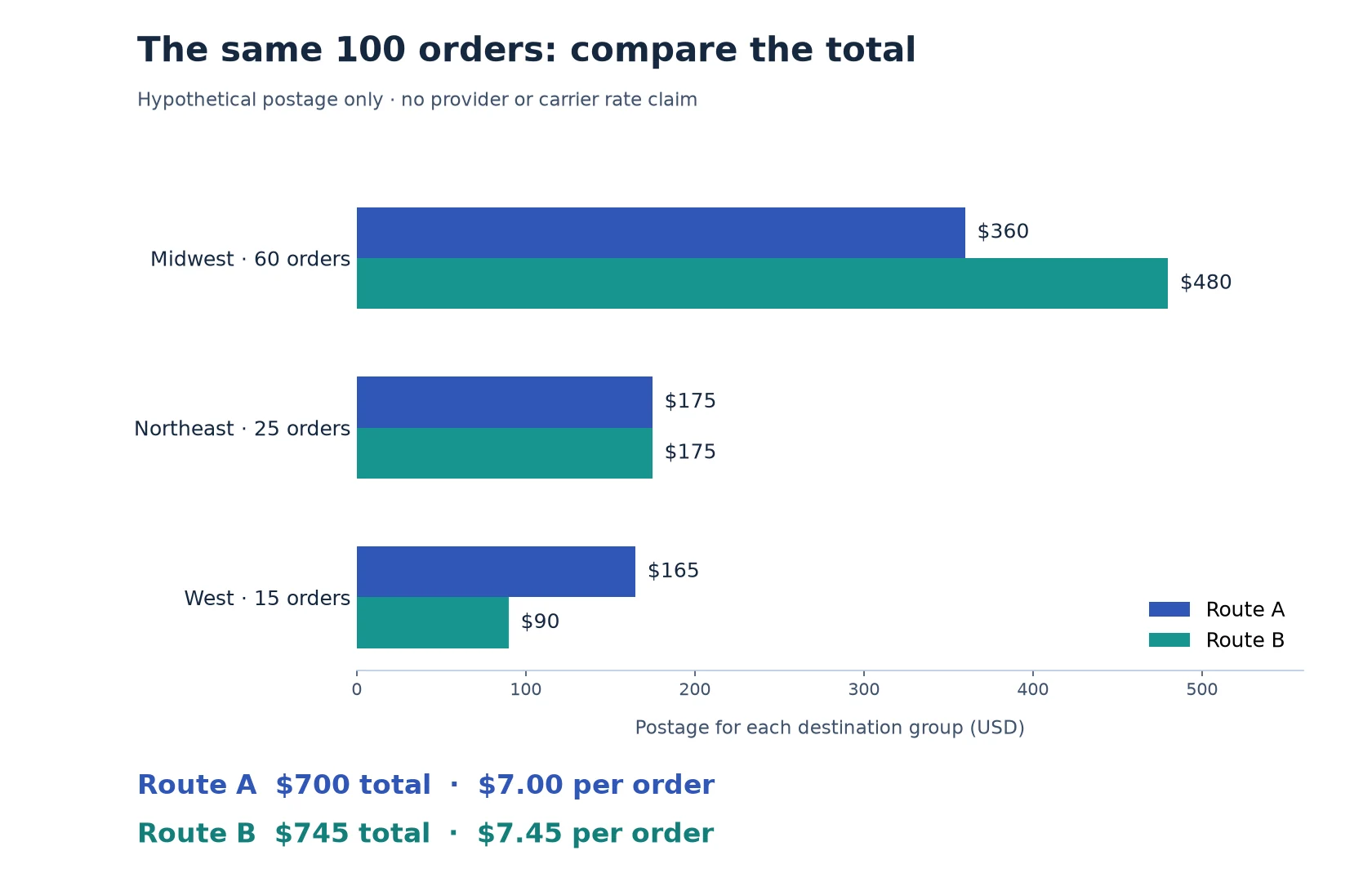
Suppose a store has 100 orders split across three destination groups. The following figures are invented postage examples, not carrier rates or quotes from the providers above.
| Destination group | Orders | Route A postage per parcel | Route B postage per parcel |
|---|---|---|---|
| Midwest | 60 | $6 | $8 |
| Northeast | 25 | $7 | $7 |
| West | 15 | $11 | $6 |
Route A costs 60 × $6 + 25 × $7 + 15 × $11 = $700 in postage. Route B costs 60 × $8 + 25 × $7 + 15 × $6 = $745.
A simple average of the three quoted rates would show $8 for A and $7 for B. That would favor B, even though A costs less for this store’s actual mix. Multiplying each rate by the number of parcels using it gives the useful average: $7.00 versus $7.45 per order.
Now add the warehouse charges to that comparison. A postage saving can disappear if the stock arrangement adds more receiving, storage or account fees than it saves on labels. If you have no order history, use a clearly labeled forecast and repeat the calculation when actual destinations become available.
Put packing time beside transit time
Keep the order cutoff, working calendar, receiving time and carrier transit window separate. A two-day carrier service starts after the parcel enters that service. Goods waiting to be counted, an order held for an address correction or a missed collection can add time before that point.
For the offer on your store, obtain the expected order-to-dispatch time and dispatch-to-delivery window for your eligible parcels. That lets you describe an attainable delivery experience instead of turning a regional coverage map into a blanket two-day promise.
04
Check the cost of keeping inventory there
Local inventory brings a monthly commitment even when sales slow. Some charges follow parcels; others follow pallet spaces, inbound work, time or an account minimum. Ask which units the proposal uses and what the bundled price includes.
For a simple illustration, suppose a month has $120 of receiving work and $100 of storage. Allocating that $220 across 300 orders adds about $0.73 per order, before picking and postage. At 50 orders, the same $220 adds $4.40 per order. These are hypothetical inputs, not published Chicago rates.
The difference explains why a warehouse proposal can suit a repeat seller and feel expensive for an occasional-order store. Buying more stock to qualify for a service can make the commitment larger without creating more customers.
Send a quote request the provider can price
Use one representative product and a realistic month. Include:
- Product and stock: SKU count, unit size, packed parcel size, any battery/liquid/fragile handling, and the quantity you plan to send in.
- Orders: monthly parcels, destination ZIP mix, items per order and common bundles.
- Inbound goods: cartons or pallets, units per carton, SKU labeling and expected replenishment frequency.
- Packing and returns: mailer or box, inserts, assembly, return inspection and restocking work.
Ask for receiving, storage, first and additional picks, packaging, postage, returns and any applicable account charges to be shown clearly. If a minimum applies, find out which fees count toward it before adding a shortfall to the total. Otherwise the comparison may count the same expense twice.
Keep inventory purchases and inbound transport beside the monthly warehouse estimate. A $1 saving on a customer parcel does not tell you how much cash is needed to buy and place the first batch. Use the actual agreed inbound plan, including any import or delivery work needed for your goods; an outbound fulfillment quote may leave that work elsewhere.
Finally, run a slower-month version. Retain the stock and fee assumptions that would genuinely remain, reduce orders and see whether the commitment is still manageable. This is more useful than spreading every cost across an optimistic launch forecast.
05
Get one stocked SKU through the store and warehouse
An advertised store integration is a starting point. Before offering local dispatch, follow an agreed test order from available stock through physical carrier handoff. The walkthrough below is a proposed check, rather than a test performed on any provider’s account.
Use a single product with an easy-to-recognize variant. For example, let MUG-BL mean one blue mug; a supplier carton contains 24 mugs. Confirm that the warehouse receives 24 individual saleable units, and that a store quantity of one requests one mug. A carton code mapped as a retail item could otherwise create a very expensive first parcel.
| Stage | Check with the warehouse or store | Useful result |
|---|---|---|
| Receiving | Expected SKU and quantity match the counted goods; damaged units are separated | You know how many mugs can actually be sold |
| Order import | One paid store order points to the blue-mug SKU and correct address | The warehouse receives the intended item and quantity |
| Reservation and packing | Stock is allocated once and the agreed protection is used | One customer purchase produces one complete parcel |
| Carrier handoff | Tracking matches the parcel and a physical acceptance event appears | Dispatch is supported by more than a created label |
| Receipt | The correct mug and agreed packing arrive | The whole path works for this product and order type |
Keep the store order ID, warehouse order reference and tracking number together. If an import times out, look up the existing result before manually sending another request. The first request may have succeeded even though its confirmation did not reach you.
Also agree when an order can still be canceled or have its address corrected. Once packing or handoff has happened, the available remedy changes. A customer-support reply needs to reflect that stage rather than promise a cancellation the warehouse can no longer perform.
Make stock availability match your promise
Separate goods on the way to the warehouse from goods available for orders. Receiving can take time, and damaged or reserved units may be unavailable. Store availability should follow the saleable quantity used by the agreed fulfillment connection.
Try a multi-item order or another variant before expanding those offers. One successful blue-mug parcel establishes little about a three-piece gift bundle with an insert. Each added physical job needs to appear in both the packing instructions and the quote.
06
Plan returns and your first stock transfer
A US return address helps customers only when someone is expecting the parcel and knows what to do with it. Obtain the authorized address, return reference and inspection instructions for your account. Avoid publishing a corporate office or an unassigned warehouse address as your store’s return destination.
For the mug example, a sealed, correct item may be eligible to return to saleable stock after the agreed check. A cracked mug should be separated, and a different item needs investigation. Agree who makes those decisions, what photographs or records are produced, and which receiving or inspection charges apply. Restocking every parcel automatically can put a damaged product into the next customer’s order.
Move the product you understand first
Start with an agreed batch of an eligible, repeat-selling SKU. Keep the receiving count, store routing and old fulfillment arrangement aligned during the transfer. Your store needs to know which location should fill each accepted order; allowing two operators to act on it can create duplicate parcels.
Watch the first replenishment as well as the first sale. Local stock may be working well until the popular color runs out and a new batch is still overseas. Choose a reorder point from actual demand, replenishment time and the uncertainty you can afford. An attractive domestic transit window cannot compensate for an empty shelf.
If you are comparing Chicago stock with a China-side arrangement, send AIDrop Agent the product, monthly order pattern, packed measurements and main destinations. Our product-sourcing service can help define the sourcing, checking and preparation work for a matched proposal. Keep the US warehouse’s receiving, storage and domestic-delivery charges in the comparison as separate agreed work.
07
Chicago dropshipping fulfillment questions
Does the warehouse have to be in downtown Chicago?
No. Providers often use facilities elsewhere in the metropolitan area or regional network. Confirm the assigned receiving and dispatch addresses. A Chicago office address alone says little about where your particular inventory will be handled.
Do I have to buy products before using a Chicago fulfillment center?
For a stocked-inventory arrangement, goods normally need to be purchased and received before customer orders can ship. A supplier that owns stock and bills you per customer order offers a different commercial arrangement. Establish which service the proposal actually includes.
Does Chicago stock guarantee two-day delivery?
No. Product availability, order cutoff, processing, destination, carrier and service all affect the result. Ask for the applicable dispatch time and transit window for the parcels you sell before publishing a delivery promise.
Can a very small store use local fulfillment?
Possibly, if a provider accepts the product and order volume on terms the store can support. Obtain its receiving requirements, minimum charges and realistic monthly cost. Shipfusion’s published 2,000-plus monthly-order focus is an example of why suitability should be checked early, rather than assumed from a service list.
Dropshipping Suppliers: Compare Channels, Costs, and Fit
Compare dropshipping supplier channels, including Shopify Collective, directories, marketplaces and print on demand, with costs and practical

How to Find Dropshipping Suppliers You Can Actually Work With
Find dropshipping suppliers through directories, marketplaces and manufacturers, then verify quotes, samples and the delivery process before
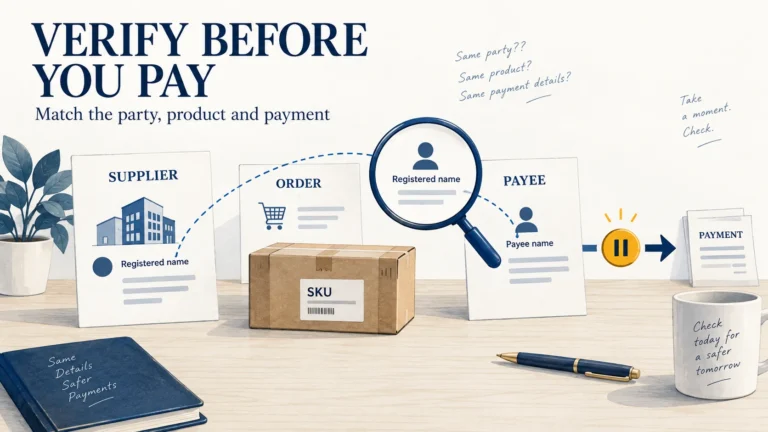
Dropshipping Supplier Red Flags: What to Verify Before You Pay
Pause a supplier payment when the payee, product, stock location or order terms cannot be reconciled with
