

Two fulfillment quotes can cover very different jobs. One company may supply the goods and ship each order; another expects you to buy inventory and send it to its warehouse. Start by matching the work you need, then compare costs, written service terms and a representative trial. The trial should include the parcels still unresolved when you review the results.
The most useful comparison follows the order through three stages: the software receives it, someone physically packs it, and a carrier delivers it. Knowing who handles each stage makes pricing differences and service promises easier to evaluate.
01
Compare companies doing the same job
The term “fulfillment company” covers suppliers, sourcing operators and warehouses, often with overlapping services. Shipping software may connect them without handling the goods itself. The distinction matters because it changes what you must purchase and organize before the first order ships.
Use the proposed service for your account as the basis of comparison. The dropshipping fulfillment guide explains the wider order process if you need to decide which parts to outsource.
| Service model | Work to confirm | Main commitment to examine |
|---|---|---|
| Supplier direct shipping | Product availability, packing and dispatch from the supplier | Product terms and visibility into fulfillment |
| Sourcing plus fulfillment | Purchasing coordination, checks, storage and outbound orders | Who owns each responsibility and any prepaid stock |
| Stocked-inventory 3PL | Receiving, storage, picking, packing and shipping | Inventory placement, receiving costs and replenishment |
| Shipping or order software | Imports, routing, labels, tracking and system updates | Which separate operator physically handles the goods |
Use named providers as starting points, not a ranking
CJ’s fulfillment service description includes receiving products from an outside supplier and shipping them from its warehouses. That is a different arrangement from buying a catalog item and having it shipped. Confirm the product, warehouse and service terms you would actually use.
ShipBob’s pricing page describes receiving inventory, storage and order fulfillment, with customized pricing. ShipMonk’s pricing page describes fulfillment, storage, special projects and shipping, including a monthly-minimum calculation. Those pages are useful inputs for a proposal; they do not establish your final fees or measured service quality.
ShipStation describes itself as shipping software. Its tools can connect to fulfillment providers, but a software subscription alone should not be compared with a warehouse quote as though both include the same labor, space and inventory responsibilities.
These service descriptions were checked in September 2026. They help distinguish the offers; they are not independent performance audits or a ranking.
02
Build a shortlist from your product and markets
Your product can rule out an otherwise promising provider. Packed weight and dimensions affect handling; fragile goods, batteries and liquids can bring further restrictions. Get acceptance for the exact item and destinations. “We handle electronics” leaves too much unresolved if the product contains a battery.
Branded packing also needs a precise description: applying a sticker, adding an insert, assembling a kit and using a prepaid box are different jobs. Agree who buys the materials, who owns them and how stock is tracked. If an insert runs out, the team needs an agreed response rather than an improvised substitute.
Map your current or intended customers by destination and order profile. A nearby warehouse helps only if the correct stock is available there and the service covers those addresses. Consider the cost and time of moving stock into that warehouse, not just the final domestic label.
A candidate belongs on the shortlist only after you can confirm:
- Product: The item, packaging and required handling are accepted.
- Markets: The service covers your destinations, with the required tracking and address types.
- Operations: Minimums, order patterns, integration and support coverage suit the business.
Treat these as requirements before scoring optional features. A dashboard or a price discount cannot make up for the inability to handle your goods. An unclear essential capability remains a question for the provider before shortlisting.
03
Request a quote for an ordinary month and a difficult one
Send the same product data and anonymized order sample to each candidate. Include single-item and multi-item orders, representative postal codes, packed dimensions, expected stock and the services you need. Ask for an itemized invoice simulation or a clear statement of what the bundled price includes.
Price the whole month
Include inbound transport where relevant, receiving, storage, picking, packing, delivery, account charges, applicable minimums and extra work. Keep implementation costs separate from recurring charges. Stock and packaging purchases also need their own upfront cash figure.
Change the assumption most likely to cause trouble
For the second quote, use a plausible difficult month: fewer orders, a two-day promotion, more bundles or slow-moving stock. This shows how sensitive the proposal is to your forecast. Include the relevant peak, aged-storage or special-handling charges rather than assuming the ordinary-month price still applies.
Do not add a monthly minimum twice. Determine which charges count toward it and what shortfall, if any, remains payable. For example, ShipMonk publicly describes a minimum tied to forecast order volume and the first-item pick fee; the details of your proposal need direct confirmation rather than a generic estimate.
CJ’s service-fee schedule also distinguishes warehouse and service categories. That is a reason to specify the chosen warehouse and work, not to assume a headline offer applies to every location. Keep quote validity and variable transport charges visible in your comparison.
04
Make service promises measurable
For a “same-day dispatch” promise, start with a practical question: which orders qualify? The answer should specify the cutoff and time zone, working calendar, stock conditions and required payment or address data. It should also identify the evidence of physical handoff.
Processing: Measure from accepted order to physical handoff. This helps assess work before the parcel enters transport.
Delivery: Measure from handoff to the recipient. The customer also experiences the time before handoff, so retain the full order-to-delivery time alongside these two measures.
For each commitment, request the following:
- The starting and ending event, including its timestamp source.
- The orders included in the measurement and every permitted exclusion.
- The time window and the treatment of weekends, holidays and peak periods.
- The response when the commitment is missed, including notification, investigation and remedy.
Check what an accuracy claim measures
An order-accuracy percentage might concern correct item selection, quantity, packaging or the entire shipment. Ask which errors count, who identifies them and whether customer-reported errors are included. A warehouse’s pick accuracy does not by itself measure supplier product defects or damage later in transport.
Treat a service credit as a remedy with limits. Confirm whether it covers the fulfillment fee, product value, shipping or another amount, and how a claim is submitted. A credit that excludes the largest part of your loss can still have value, but it should not be interpreted as complete reimbursement.
05
Test the integration and the exception process
A supported integration still needs testing with your store’s orders. Variants, bundles, notes and partial shipments can expose differences that a simple import will miss. Check what the displayed status means: an order visible in the system may not yet be accepted, have stock reserved or be released for packing.
Use a controlled test environment or clearly agreed test orders where possible. Check a normal order, a cancellation before release, an unavailable SKU, a corrected address and a split shipment if your business uses them. Avoid deliberately sending invalid or problematic goods through a live carrier just to create a test case.
Check a timeout before retrying
A request can time out even though the provider has created the order. The team needs a way to check that result before sending it again, or one customer purchase could become two parcels and two charges. The order record should connect the store ID, provider ID and tracking number.
A useful exception process identifies the affected order, the person investigating it and the next update. A quick automated acknowledgment alone does not show that the physical problem is being resolved.
Support arrangements need operating hours, escalation contacts and a definition of urgent incidents. A compromised account may need a different response from a missing parcel. Ask what updates your customer-support team will receive and when, so it can give customers an accurate answer.
06
Run a pilot with every accepted order visible
Choose trial orders that cover the variants, destinations, packing work and order types you expect to use. Decide what to record before they ship. A small pilot can expose a mismatch or a broken process; it cannot establish a precise long-term failure rate.
Keep every accepted order in the review, including late, canceled, damaged and still-open orders. Record why each exception occurred. You may separately analyze orders that met the agreed eligibility rules, but do not make excluded orders disappear from the merchant’s overall result.
Consider a hypothetical 30-order pilot evaluated at a fixed reporting cutoff, after the promised delivery window for every order has ended. Twenty-four orders reached the customer within the agreed window, three arrived late and three were still undelivered. The share delivered on time is 24 ÷ 30 = 80% for all accepted orders.
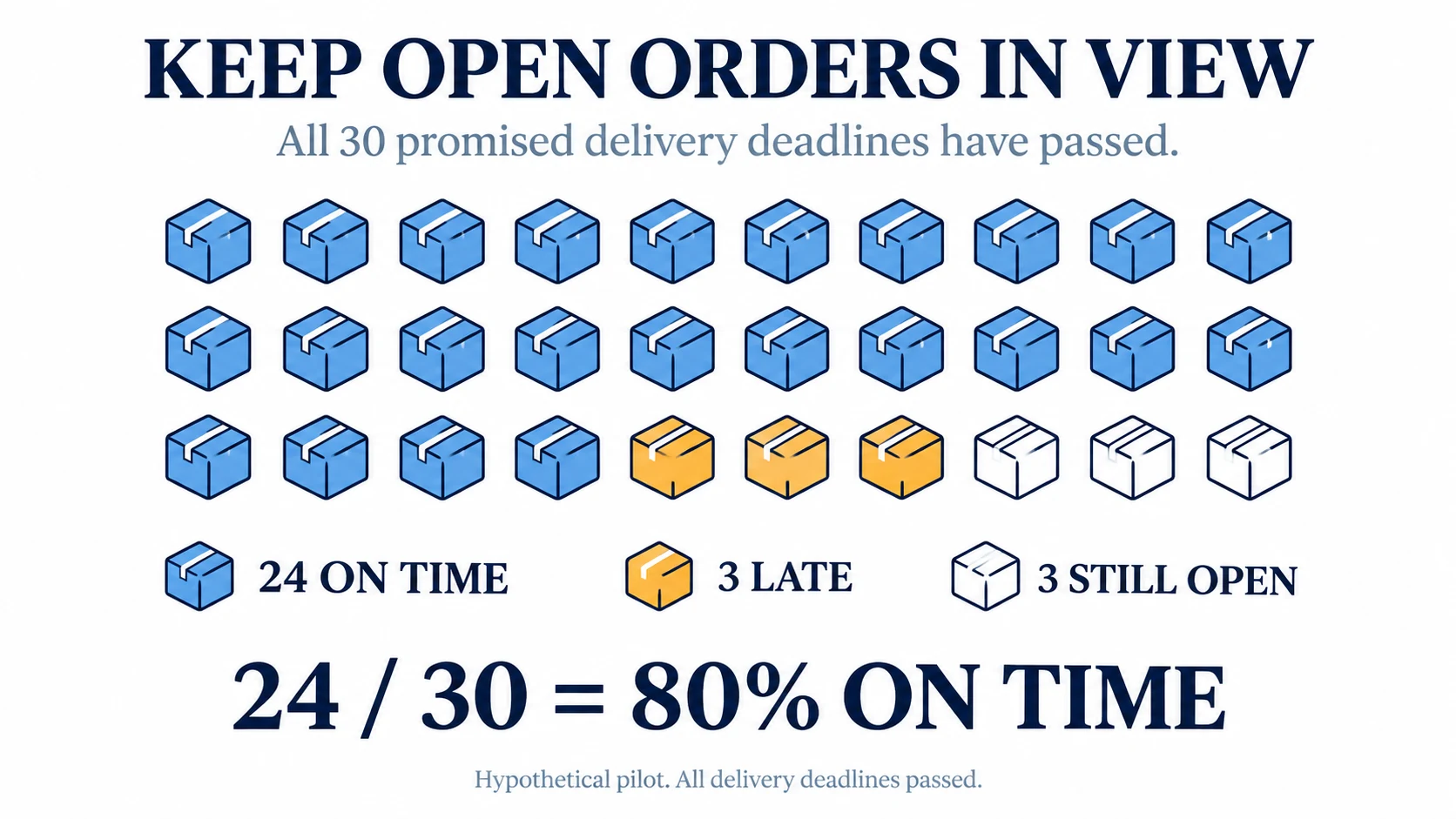
If you remove the three open orders and calculate only among delivered orders, the number becomes 24 ÷ 27 = 88.9%. That second figure answers a narrower question. It must not be reported as though 88.9% of all 30 orders arrived on time. Keep the three unresolved shipments visible until their outcomes are known.
Read the timestamps alongside the percentage
Suppose 28 of those 30 orders were handed to the carrier by the dispatch deadline. The on-time handoff measure would be 28 ÷ 30 = 93.3%, while the on-time delivery measure remains 80% at that cutoff. The figures can both be correct because they measure different events.
Inspect the delayed orders to find the responsible stage. Was stock unavailable, was packing late, did collection fail, or did the parcel stop moving after acceptance? Compare evidence before attributing every delay to the warehouse or every delay to the carrier.
Record the actual invoice as well. Reconcile each unexpected charge with the rate card and order data. A trial that looks operationally successful may still expose a packaging fee or shipping assumption missing from the original quote.
Finish the trial report with the remaining decisions. For this kind of pilot, they might be:
- Correct a variant mapping before releasing more orders.
- Clarify the second-item charge on the invoice.
- Obtain an update on the three undelivered shipments.
These issues still need answers even if the provider earns a good overall score.
07
Check stock, claims and exit terms
Ask who owns prepaid goods and packing materials, how available and reserved stock are reported, and what evidence supports inventory adjustments. Agree the treatment of damaged, missing or quarantined units. If several facilities may hold your stock, confirm how transfers affect availability and charges.
What happens to returned goods?
Identify the return address, authorization procedure and inspection offered. Receiving a parcel may be the full service; testing, refurbishment or preparing it for resale may cost extra or be unavailable. Name who decides what happens to the item and price the work you need.
Clarify claims evidence, deadlines, reimbursement form and exclusions. Ask about liability and insurance for the actual goods and locations rather than relying on a badge or a broad claim of coverage. Have consequential contractual terms reviewed for your situation.
What will leaving cost?
Before stock moves in, obtain the notice period, removal fees and collection requirements. Agree how the final stock count and balance will be reconciled, and how you will retrieve order and tracking records. Accepted orders and open claims also need an owner during the transition.
08
Choose the smallest commitment the evidence supports
A provider may be ready for some work before it is ready for all of it. If product and market requirements are met but branded packing is untested, a limited packing trial may be the next step. Unclear inventory ownership or an essential unpriced service needs an answer before a larger payment.
Summarize each candidate on one decision record: confirmed work, modeled cost, trial results, unresolved issues and the proposed next commitment. If you use weighted scores, show your priorities explicitly. The weights will differ with the business.
For a low-volume catalog test, you may prioritize modest commitment and product availability. For a repeat seller with branded packaging, packing consistency and stock control can become more important. For goods already purchased and stored near customers, a 3PL comparison should focus on the receiving-to-delivery operation and replenishment costs.
After a successful single-item trial, the next useful test might be a bundle or a new destination. Record what changes and review the results before expanding again. That preserves what you learned from the first trial without assuming it applies everywhere.
09
Frequently asked questions
What is the best dropshipping fulfillment company?
The best fit depends on the work required, product eligibility, destinations, stock arrangement and volume. Start with companies that can confirm those requirements, compare matched proposals and review a representative trial. Public feature lists alone cannot establish a universal winner.
Is a dropshipping supplier the same as a 3PL?
They can perform overlapping work, but the commercial arrangement may differ. A supplier sells the goods; a 3PL may receive goods you purchased elsewhere and handle storage and orders. Confirm whether sourcing and inventory purchasing are included in the service being quoted.
How large should a pilot be?
Large enough to exercise the material product, destination and workflow differences without creating an excessive first commitment. Set the scope according to those risks, not an arbitrary order count. A small pilot can expose failures but cannot establish a precise long-term reliability rate.
Should I move all my inventory at once?
A staged transfer can make discrepancies easier to identify when the operating setup allows it. Agree SKU mapping, stock counts, order routing and responsibility during the overlap. Avoid a split arrangement that lets both providers fulfill the same order or leaves neither responsible.