
All case studies / Inventory decisions
Inventory risk before a bulk order
A seller expects 120 orders in 30 days. The supplier offers a batch of 300 units. The example assumes $8 per unit, including the product and its share of inbound freight. Buying 300 units ties up $2,400 before the first sale.
Still tied up in 180 unsold units after 120 orders.
The 30-day inventory ledger
Both options use the same $8 so you can see how purchase timing changes the cash you commit. For your own comparison, use the supplier and freight quote for each route. Add storage, any outbound handling and postage, returns, and any import charges your quote leaves out.
Cash decision
Buy 300 units now
Buy against orders
At the start
300 × $8 = $2,400
$0 committed to a batch if the supplier accepts single-unit orders
Units purchased by day 30
300 units, paid up front
120 × $8 = $960 spent as orders arrive
Cash held in unsold units
(300 − 120) × $8 = $1,440
$0 held in unsold units if you only buy against paid orders
Supplier payment can still come before the platform pays out. Count the paid orders you expect to source before the next payout reaches your bank. At $8 each, 20 such orders need $160 for the goods and modeled inbound share. Then add postage, handling or refunds you pay from the same cash. Use your payout dates and expected orders to work out the float you need.
For personalized items, the inventory choice can be about blank garments by size. The final print can wait for a paid order. See the PawMomento workflow.
Set a stock budget before accepting the minimum
Set aside cash for postage and other bills before budgeting for stock. Suppose that leaves $1,500 for the goods and inbound freight. At $8 per unit for the goods and inbound freight, divide $1,500 by $8 and round down. You can buy 187 units for $1,496.
The 300-unit minimum at $8 would need $2,400 up front, $900 over budget. To buy 300 within $1,500, the landed price would need to be $5 per unit or less ($1,500 ÷ 300). Ask for a smaller batch of your best-selling variant or a quote for buying against paid orders. Recalculate if the supplier charges a different price for the smaller run.
Suppose a supplier offers a smaller run of 150 at $9 per unit, including its share of inbound freight. That uses $1,350 of the $1,500 budget. If 120 sell, the 30 left hold $270, compared with $1,440 in stock from the 300-unit run. Check whether the smaller batch meets the same delivery promise before choosing the higher unit price.
Test a slower month before buying. If you sell only 60 of the 300 units, 240 are still in stock. At the modeled $8 landed cost, $1,920 stays in that stock before storage or other costs. Check whether you would still have enough cash to pay for the next orders.
Check when the stock can go on sale before promising a dispatch date.
If a batch fits your budget, calculate when to reorder using recent sales for that item and the date the next shipment can be picked.
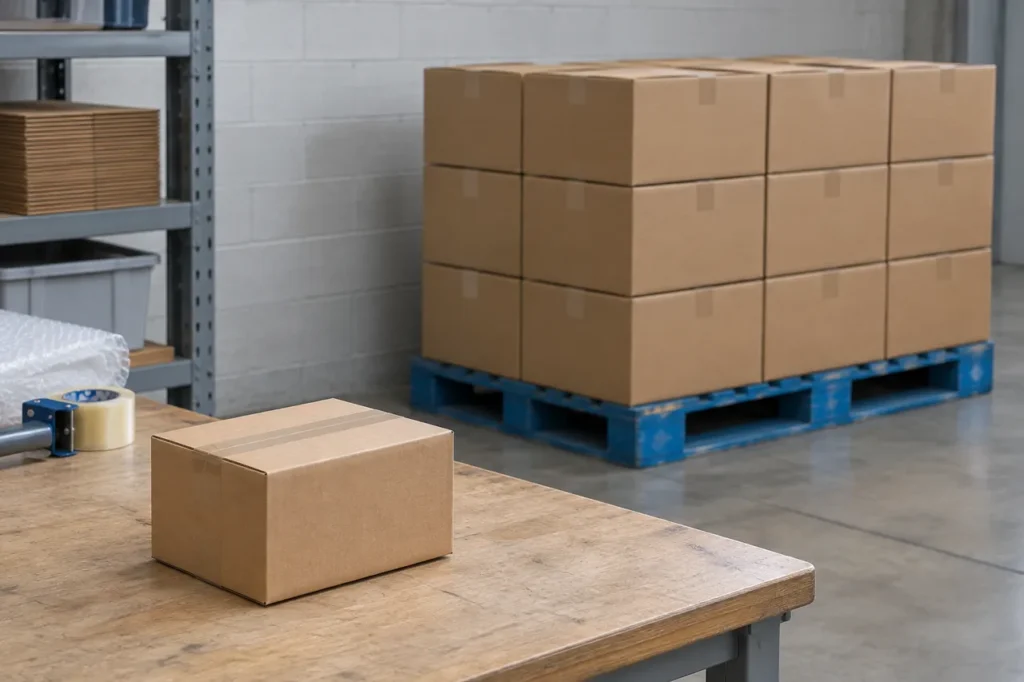
Use actual shipping costs before moving stock
Check which sizes or colors keep selling and where buyers live. Then price the batch you’d buy next. Give the warehouse and carrier the actual carton size and order quantities.
Work out how long the stock ties up cash
At $8 per unit, 180 unsold units tie up $1,440, including inbound freight. If sales hold at 60 units a month, clearing those 180 units takes three more months. Count the storage bills for that period and any markdowns or disposal costs.
Check your records for faster delivery on test orders, a confirmed unit discount or repeat stockouts on the same variant. Then use actual sales and supplier lead time to decide how much to reorder.
For a separate 30,000-order example, U.S. self-fulfillment matches standard China direct when the average UPS invoice is about $11.95 per parcel, including surcharges. The calculation subtracts $103,443.50 of U.S. costs before postage from the $461,839.18 direct estimate, then divides by 30,000.
This threshold uses the larger scenario’s freight, rent and labor inputs. See the carrier, rent and labor sources in the full 30-day example.