Case studies / Warehouse receiving

WAREHOUSE FIELD NOTE

A carton can arrive before its contents are ready to sell

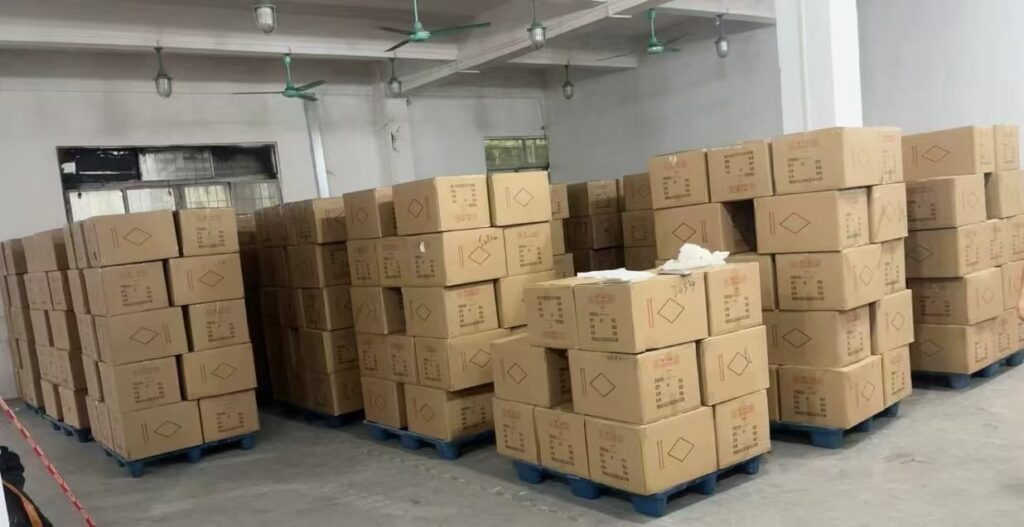
The labels face out so the warehouse team can match each box to the supplier’s packing list. Counting boxes is the first step. Before the store offers the stock for sale, it still needs to know how many of each size or color are inside.

See a worked receiving record

Cardboard cartons with printed marks stacked on blue pallets
Warehouse photograph. Carton marks face the aisle, where receiving staff can compare them with the packing list.

What the photos can tell a store

Wide warehouse aisle with stacked cartons and tall pallet racks
Warehouse photograph. Pallet racks and the aisle show how stock can be identified by storage location.

Read the mark, then check the contents

Use the visible carton mark to find the matching shipment line. A carton can contain several sizes or colors. If the mark is unclear or the carton is damaged, verify the contents and keep the affected units off the available count until someone clears them.

Record where the stock went

The photo shows where cartons are stored. To see what’s ready to sell, check the warehouse record for the product code, the shelf and the number of units available.

A receiving record that separates 40 available from 20 on hold

The photographs show boxes and storage. The following 60-unit example shows how to record a different delivery when two cartons match and one needs opening.

For each carton, record shipment reference, outer mark, expected item and quantity, actual count, storage or hold location, and who checks or releases it.

INBOUND

Expected and received

The supplier lists three cartons at 20 units each. Three arrive. Match each mark to the packing list and note the affected carton when the label is unclear.

RELEASE

40 units available

Two cartons match the approved variant and count. If no units are reserved, the store can make 40 units available. Record the SKU, counted quantity and storage location.

HOLD

20 units need verification

Set the third carton aside and record its markings, the 20 units on hold and who will check them. If all 20 match the item code and count on the packing list, record who approved them and update the available count to 60, assuming none are reserved. If 16 match and four are a different color, only add the 16 matching units to that item. With no reservations, its available count goes from 40 to 56. Record the four separately and keep them off sale until their item code and condition are verified.

Use the same shipment reference on the packing list, count sheet and release record. In the worked shipment, the delivery total is 60 expected in the ordered color and 56 counted in that color. For the mixed carton, log 20 expected, 16 matching and four of another color on hold. Save a photo of the mark and contents with its carton number.

Share the discrepancy with the supplier and record any agreed replacement, credit or revised packing list. If you agree to keep the four, check their item code and condition before stocking them under the correct color. The ordered color stays at 56 available before any reservations.

Check how many of those 56 are already promised to paid orders before updating the storefront. If eight are reserved, publish at most 48 more for sale from that location. The four held units stay separate while the warehouse verifies their color and condition. Use the stock reconciliation guide if the store and warehouse still disagree.

Before sending inventory

Send the product variants, carton marks and supplier packing list to the receiving team. Agree whether to open every box or only ones with missing labels, damage or a count that doesn’t match. Ask for separate prices for receiving, checks, storage and any work to fix a problem.

See the warehousing service · See published fees and what needs a quote · Set a budget for your next stock order