
Qikink lets an India-focused store sell its own printed designs without stocking the finished products. Check its fit on a complete order: the selected blank, print, delivery, taxes and payment route. For cash on delivery, you still fund fulfillment before the buyer pays. A free account does not remove that cash requirement.
That is the first thing to understand before connecting a store. You need a product you can describe accurately, an order quote you can fund, and a way to follow the order through delivery and any COD payout.
01
What Qikink does—and when it fits
Qikink suits merchants investigating custom printed products such as T-shirts, hoodies and mugs, particularly for an India-focused store. It is a different service from a general marketplace where you import unrelated ready-made products.
Its documented workflow covers creating products from your designs, connecting a store, checking orders and having Qikink print and ship them. Shopify and WooCommerce are among its supported integration routes. Confirm the particular product, destination and account arrangement you need.
- A good match: your own design on a supported catalogue product, with funding and customer support ready.
- A separate production question: a different garment construction, custom stocked goods or products outside the catalogue. Confirm that scope before assuming the POD connection covers it.
The POD supplier comparison guide explains the wider production and fulfillment choices. This page focuses on Qikink’s order, money and exception handling rather than treating its marketing claims as independently verified performance.
02
Price the product, print and delivery separately
Qikink’s 2026 price list lists the UC21 Unisex Classic Crew T-Shirt at ₹190 for S–2XL, with its stated product GST rate. That is a published base-product price, not the delivered price of your printed customer order.
The complete quote needs the selected garment and size, printing method and area, delivery destination/weight, payment method, packaging or branding additions, and applicable taxes. Use the actual order calculation before setting the retail price.
A small print can still meet a minimum charge
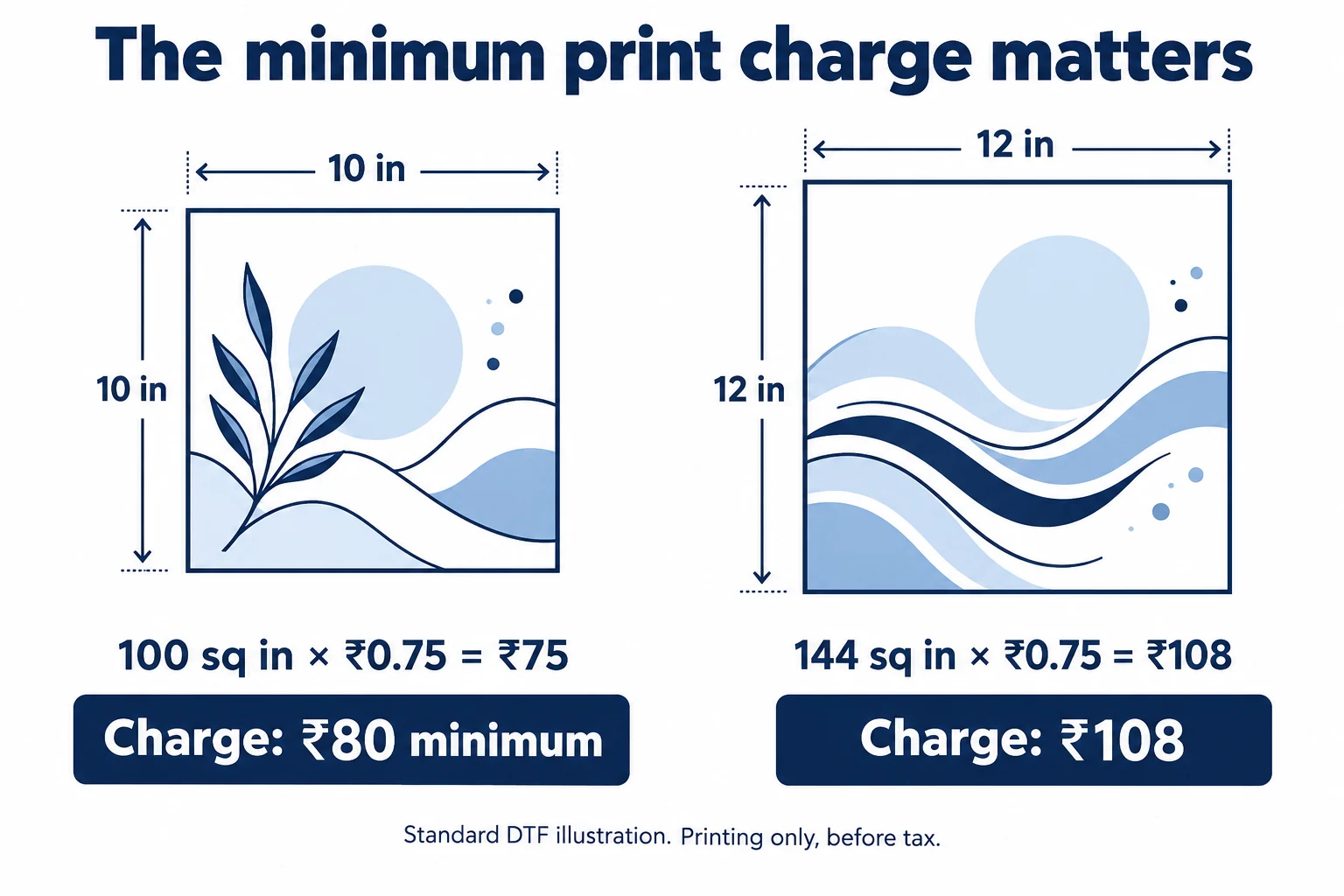
The standard DTF printing table lists ₹0.75 per square inch with an ₹80 minimum, before its stated tax. DTF means direct-to-film printing. Using that published schedule for a simple illustrative comparison:
| Print area | Calculation before tax |
|---|---|
| 10 × 10 inches | 100 sq in × ₹0.75 = ₹75; the ₹80 minimum applies |
| 12 × 12 inches | 144 sq in × ₹0.75 = ₹108 |
These are print-charge illustrations, not complete shirt quotes. Special placements, methods and current product options need their own calculation. Do not assume that shrinking a design always reduces the charge below the method’s minimum.
Qikink’s shipping help directs merchants to the Create Order calculation for the exact shipping cost. Compare the same garment, print, destination and payment method. A COD order and a prepaid order can have different charges even when the printed item is identical.
Keep advertising, store fees and the customer-remedy allowance outside the supplier-only quote. The difference between retail price and blank-garment price is not your profit.
03
You fund a COD order before the customer pays
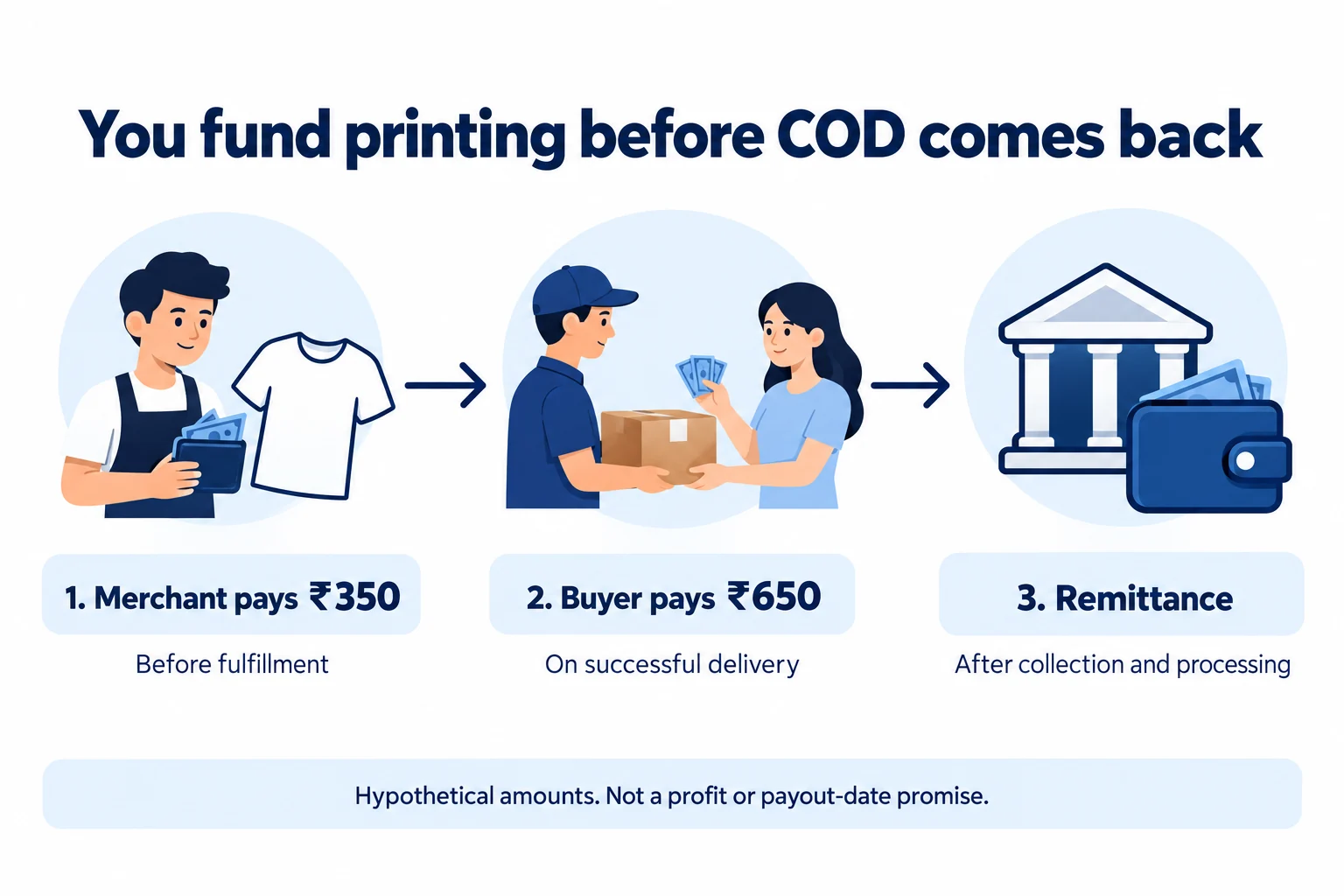
Cash on delivery (COD) means the buyer pays the courier at delivery. It does not mean Qikink waits until then to collect the merchant’s fulfillment payment. Its COD help states that merchants pay upfront to process the order.
This creates a working-capital gap: money goes out for production and delivery before the customer’s collection reaches your usable balance or bank. More orders can increase the gap even when the retail price looks attractive.
Three orders do not fund themselves
Suppose, purely for illustration, the complete Qikink charge is ₹350 per order and your COD selling price is ₹650. These are invented all-in figures, not Qikink’s quotation for UC21 or any other product. Assume no further payout deduction in this simplified example.
| What happens | Cash consequence before other business costs |
|---|---|
| You release three orders | You first need 3 × ₹350 = ₹1,050 |
| All three are delivered and collected | Collections total ₹1,950; the difference from that initial outflow is ₹900 |
| Only two are delivered and collected | Collections total ₹1,300; the difference from the same initial outflow is ₹250 |
Those differences are not profit figures. Advertising, store costs, customer remedies, taxes outside the assumed supplier charge and the treatment of any reusable returned product still matter. The point is timing and collection: an undelivered third order does not produce its expected ₹650.
Estimate the cash needed for the orders you must fund before previous collections become available. Use your real quoted cost and observed settlement timing, with room for failed delivery and support cases. Do not budget using a guaranteed margin or return rate from a landing page.
Check the payout route, not just the delivery badge
Qikink lets merchants choose wallet or bank COD remittance; bank remittance requires verified details. Its COD help says processing is within five working days after delivery, while its benefits page describes different wallet/bank timelines. Confirm the current mode and terms for your account rather than promising yourself a particular bank date from either headline.
For reconciliation, its Accounts instructions give a concrete route:
- Open Accounts → COD Remittance and find the order number and Transfer ID.
- Open COD Payouts and use that Transfer ID to locate the payout details.
- Inspect the included orders and amounts, then compare the actual wallet credit or bank receipt with the record.
A delivered status, a remittance record and money received in the bank are separate events. A wallet-credit withdrawal is also a different transaction from the scheduled COD payout; check the terms that apply rather than assuming every transfer is identical.
04
Connect Shopify, then verify one order through the actual states
Qikink’s Shopify integration guide documents Integrations → Shopify, app installation, entering the Qikink username and completing the email OTP verification. Reopen that integration page to confirm the connection message. Screen wording can change, so use the current guide alongside your account.
Match the real variant before taking orders
Create the intended product and design, then use the supported Push to Store route. The Accounts guide identifies My Products → View Variations as the place to obtain the generated Store SKU. Keep the real identifier mapped to the exact product, size, colour and design. A friendly internal name such as “black tee, medium” is not a substitute for that mapping.
Approve the physical product separately
Order a sample of the version you intend to sell. Compare garment measurements, fabric, actual print size/placement, colour and the care label with your storefront. A mockup is a layout preview; it is not a photograph of the printed garment. The print-file and sample guide explains how to bind approval to the file and product version.
If colour matters to the design, use an appropriate physical sample or swatch. Follow the actual garment’s care instructions when checking a sample after washing. A single sample can reveal a problem; it does not establish a defect rate or a lifetime guarantee.
Follow a proposed first customer order
The integration help says Shopify orders import into Qikink and identifies Orders → On Hold as the place to find them. Imported is a state to inspect, not proof that printing has started.
For a proposed test, retain these outputs:
- Store purchase: correct variant, design, quantity, address and customer payment method.
- Imported order: matching Store SKU and order reference; correct delivery details and retail COD amount where applicable.
- Funding and release: enough usable credits for the current quote, and the intended order accepted for processing.
- Shipment and receipt: actual production/dispatch information, tracking returned to the store, delivered product matching the offer.
- COD collection: the relevant remittance/payout record and actual funds received, if COD was used.
This is a proposed verification route; we did not connect an account or place an order. If a store order seems missing, check import, mapping and acceptance before creating another manual order. Otherwise a delayed import can become two printed shipments.
05
Handle non-delivery and customer returns as different cases
RTO means return to origin: a courier could not complete delivery and returns the shipment. A customer requesting an exchange after receiving a correctly delivered shirt is a different case.
A failed delivery still needs a merchant decision
Qikink’s Automatic NDR flow describes COD delivery notifications and customer redelivery/cancel choices. NDR means non-delivery report. Its merchant route is Orders → Delivery Exception.
Check the actual exception reason and eligible actions promptly. If a reattempt is appropriate, request it and inspect Action Response. A successful request means the courier accepted the action; it does not mean the buyer has received the parcel. An order already moving to RTO may no longer accept the same action. Use the current account/carrier window rather than treating an old notification as still actionable.
“No RTO charges” is narrower than “no loss”
Qikink’s RTO policy says it handles undelivered COD/prepaid returns without an additional RTO charge. That does not turn the printed item into collected revenue or automatically refund the original production cost. In the earlier example, the uncollected third order still needs a stock and cash decision.
Its returns-management help says returned orders enter the dashboard and are stored for 100 days from being marked returned. It documents Merchant Dashboard → Returns, selecting the product and creating a new order to reship. Confirm the actual returned item, condition, recipient and new quote before release. Do not assume reshipping is free or promise an unavailable returned size.
A defect claim is not a change-of-mind exchange
The same help page gives a seven-day supplier claim window for misprinted, damaged or defective items and requests evidence. It treats a wrong-size purchase or nondefect exchange as an expense the merchant handles through a new order. Save the current terms and collect relevant photos, order and product details promptly.
Those are supplier recovery terms. Your customer’s applicable rights and the promise made by your store need their own response; a supplier declining credit does not automatically cancel them. Do not use a supplier evidence condition as a blanket reason to refuse every buyer remedy.
If your project needs China-side sourcing or fulfillment beyond this India-based POD arrangement, send AIDrop the product, destination and operating requirement. We can assess that separate scope. For Qikink billing, production or account issues, use Qikink’s support and the actual order record.
06
Questions before committing to Qikink
Can I start with no money because signup is free?
You can investigate a free account, but samples, order funding and running a store still need a budget. COD does not finance the merchant’s upfront fulfillment payment. Use the exact product and print quote.
Is COD available for every destination?
Do not assume so. Check the current postcode, carrier and destination service. The cited COD help identifies service limitations, including India Post. International delivery availability does not establish international COD availability.
Does an imported Shopify order print automatically?
Verify the configured flow, available credits and processing state. An order visible in On Hold is not the same as a funded, accepted production order. Check those states before relying on unattended operation.
Will the print look exactly like the mockup?
A mockup cannot guarantee the garment’s physical colour, print feel or placement. Approve the actual file/product combination with a sample where needed, and keep the description tied to what you can substantiate.
Should I use Qikink or Printrove?
Compare the same product, print, destination, complete charges, order-funding and return/payout arrangements. The Printrove guide explains its own setup. Neither a free account nor a catalogue price establishes which will suit your offer better.
Can I copy Qikink’s GST numbers into every customer invoice?
No. A provider’s published product or service tax line is not a complete determination of your own invoicing and tax obligations. Review the actual business, sale and invoice requirements with appropriate local support.
Sources and scope
Sources checked October 19, 2026. Rates and dashboard paths are Qikink’s published information, subject to current product/account terms. The print calculations and COD cash example are illustrative; no account connection, purchase, payout or physical print test was performed.
CJdropshipping Review: Costs, Warehouses, Quality and Fulfillment Fit
CJdropshipping is a practical option for sellers who want sourcing, store connections, packaging and fulfillment in one

CJdropshipping vs DSers: Who Sources, Pays and Ships the Order?
CJdropshipping can source and physically fulfill an order; DSers maps a store product to supported external suppliers

AutoDS Review: Evaluate the Automation You Would Actually Use
AutoDS can reduce listing and order work, but its value depends on your sales channel, tier, add-ons
