
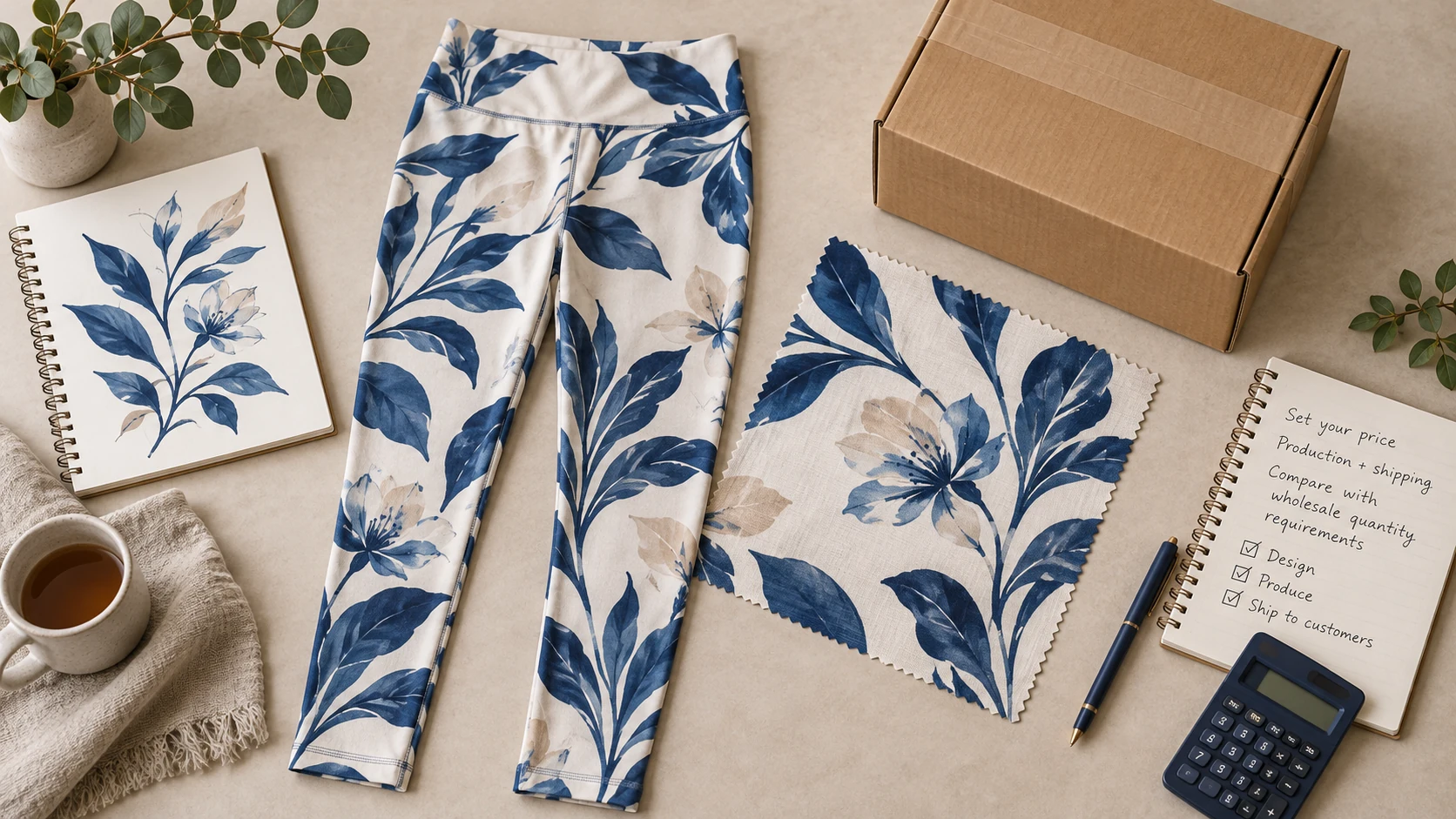
Art of Where is a print-on-demand supplier that makes your designs into products and ships orders to your customers. You set the store price and pay Art of Where for production and shipping. Compare its drop-ship price with the wholesale quantity requirement before assuming a lower catalog price applies to one customer order.
Suppose you want to turn a botanical illustration into leggings. Three prices appear in the table, your store collects the buyer’s payment, and the supplier still needs to be paid. Understanding those relationships is more useful than importing a large collection and hoping the order sorts itself out.
The POD supplier comparison covers the wider provider choice. This article focuses on Art of Where’s pricing conditions, current integration options and the first order you need to verify.
01
Choose a product and the way you will sell it
Art of Where produces custom printed goods. It is not a general catalog of unrelated ready-made products that you can resell with no design decisions.
Its current print-on-demand explanation describes a sequence from uploaded artwork and product choice through production and shipment. Fabric products can involve printing, cutting and sewing; other products have their own production steps.
For the botanical leggings, choose the exact garment, fabric, size range and design requirements. A flat illustration becoming clothing creates placement and sizing questions that a paper print does not have.
| First choice | Information to retain |
|---|---|
| Exact product | Product/fabric reference and available configurations |
| Design | Template, finished artwork and revision |
| Buyer offer | Size chart, care, inclusion and clear photographs or labeled mockups |
| Selling route | Supported integration or confirmed manual process |
| Order cost | Correct price mode plus destination shipping and additions |
Begin with one product. It is easier to inspect a single size range and artwork mapping than to diagnose fifty products with different templates at once.
If you are still choosing the business model, the print-on-demand guide explains its stock and cash differences. Here, the immediate decision is how this particular product will be produced and paid for.
02
Read the three price columns correctly
Suggested retail price, wholesale price and drop-ship price are not three interchangeable costs.
The public Art of Where pricing page, checked on October 14, 2026 in its USD view, lists the following for leggings:
| Price column | Listed amount | How to interpret it |
|---|---|---|
| Suggested retail | $40.00 | A suggested selling price, not your guaranteed revenue |
| Wholesale | $24.00 | A buying condition tied to its wholesale quantity rules |
| Drop ship | $26.00 | The listed product price for the drop-shipping route |
The page describes wholesale access from six items per design. Check the actual product, configuration and account conditions before ordering; not every row has a different wholesale and drop-ship price.
For six items of the supported same-design configuration, the listed unit-price comparison is $144 at $24 versus $156 at $26. The difference is $12 before delivery and stock costs.
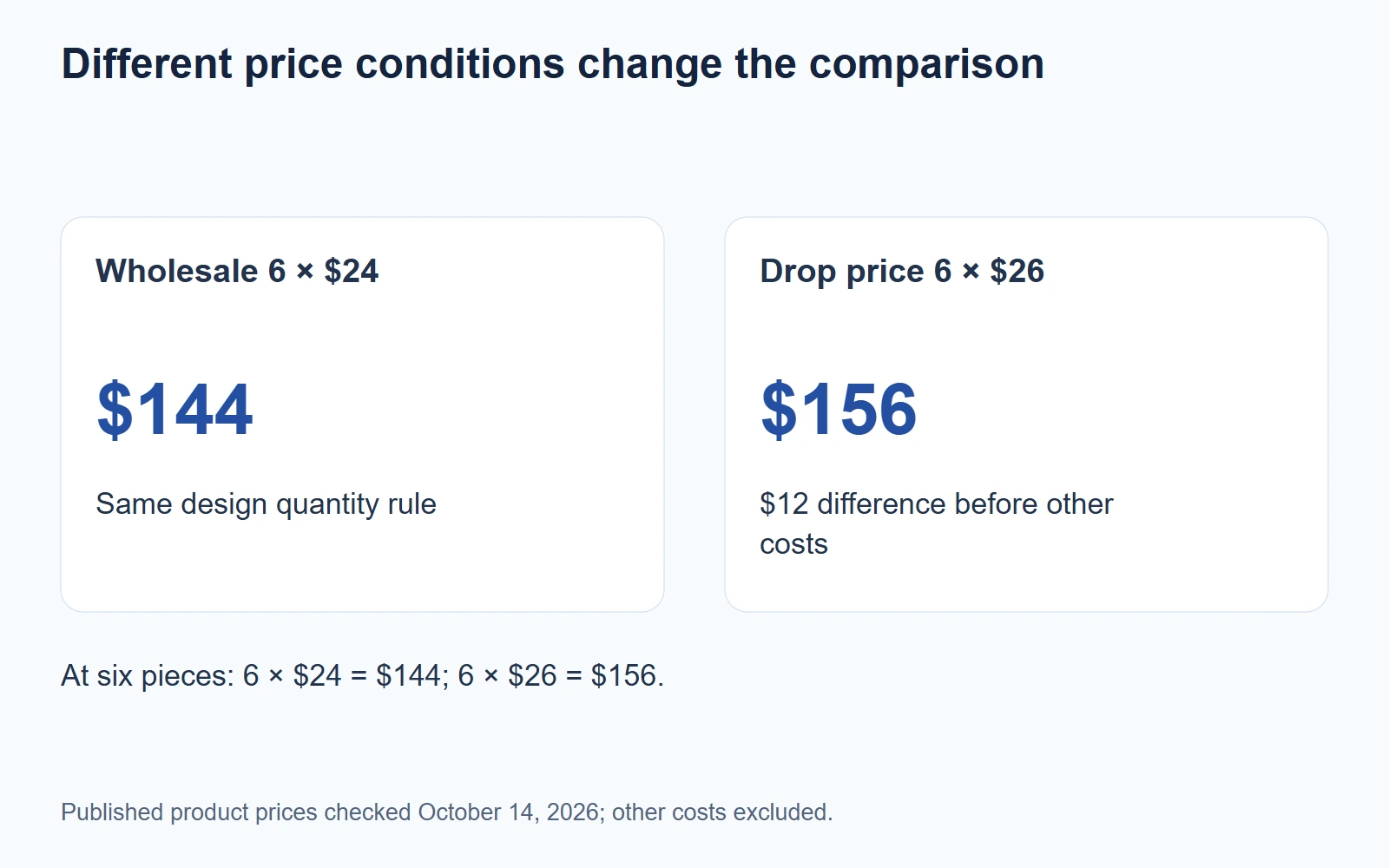
That does not mean buying six saves $12 on six separately fulfilled customer orders. A bulk purchase can need inbound postage, storage, individual packing and reshipping. It also requires money for products that may not yet have buyers.
If an older article calls one column a “regular” price, identify what it actually describes. A suggested retail figure is not necessarily the amount your business pays to manufacture a customer order.
Obtain the current account quote for the exact size, fabric, branding and destination. Public tables help you understand the price modes; they do not settle every line of the final order.
03
Check the current integration before building the store
Use the current support page rather than an old review or installation article. Integration availability can change while older pages remain searchable.
Art of Where’s WooCommerce support notice, updated July 28, 2026, says its former WooCommerce integration is no longer supported or available for new installations. The notice lists Shopify, Etsy, Big Cartel and Squarespace as current integration options.
| Your situation | Useful next decision |
|---|---|
| Building a new supported store | Read the current setup and order behavior for that platform |
| Already using WooCommerce | Confirm a workable manual route or choose another provider; do not start with obsolete installation instructions |
| Selling through another platform | Ask what product and order process is supported |
| Using multiple suppliers | Decide which products each provider fulfills and how shipping appears |
The Shopify app listing describes connection and order synchronization. That is a stated feature, not proof that your particular account, shipping settings and variants are working.
Also check the platform’s own current fees. Legacy supplier pages can contain old Shopify or Etsy prices. Do not use those historical figures to budget a new store simply because the product-production information remains useful.
If you compare Art of Where with another app, separate catalog fit, integration support and received-product evidence. The AOP+ guide covers that different provider’s workflow; its billing or cancellation rules do not transfer to Art of Where.
04
Prepare one product and a complete variant record
Use the selected product’s current template and instructions. The artwork needs to work on the physical item, including seams or other boundaries relevant to that product.
For the proposed leggings, keep a record such as ART-LEGGINGS-M-v3. This is an illustrative store label, not a manufacturer code.
| Record field | Detail to attach |
|---|---|
| Product | Exact Art of Where garment and fabric |
| Size | M under the correct product chart |
| Artwork | Version 3, exported from the selected template |
| Preview | Front/back or relevant views with important details checked |
| Store variant | Linked supplier product/variant reference |
| Branding | Only the supported additions actually ordered |
Follow the documented creation and publishing route for your chosen platform. Inspect the final product page on a phone, not only inside the design tool. Compare the size chart, design, care and included items with the supplier product.
For an image crossing several panels, inspect the relevant boundaries. A preview can help locate the design, but received printing and sewing still need a sample check.
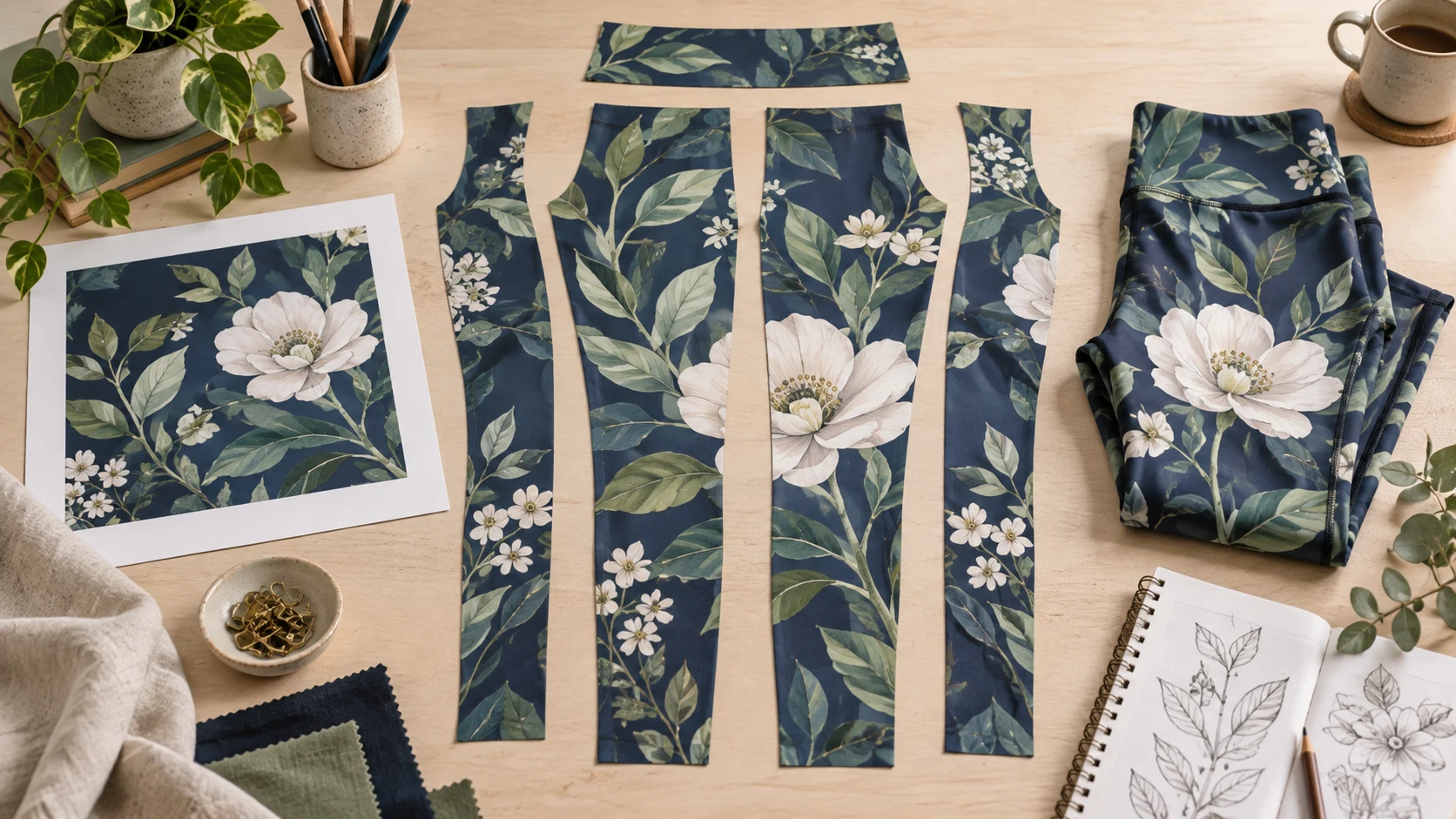
If you change the fabric, size or product, recheck the affected template and placement. A design approved on one product does not automatically fit another just because the artwork file is the same.
05
Charge the customer and fund production separately
Your customer pays your store. Your store pays Art of Where. Those are separate transactions with separate records.
The supplier-payment help states that the store owner pays production and shipping. Its integration shipping explanation also explains that your checkout shipping charge and its charge to you are separate.
Here is a worked example using the listed $26 leggings product price and assumed other inputs:
| One order | Amount |
|---|---|
| Store sale | $49.00 |
| Product | −$26.00 |
| Assumed shipping | −$7.00 |
| Assumed payment cost | −$1.80 |
| Assumed acquisition cost | −$8.00 |
| Remainder before additions, fixed costs and tax | $6.20 |
The $7 shipping amount is illustrative, not a current destination quote. Labels, packaging, applicable tax, plan costs and remedies may add to the real order.
If your checkout charges the buyer only $4 for shipping while the provider charges you $7, the difference still has to be covered by the sale. “Customer paid shipping” does not mean the two amounts match.
Test one-item and multi-item baskets for each delivery market you intend to serve. Also keep cash available for production while the store payout is pending. A paid customer receipt is not proof that the provider has received usable funds.
06
Approve a sample and observe one integration order
A manual sample and a paid storefront order answer different questions. The sample helps assess the physical product; the storefront order helps assess the connection and funding.
For the proposed leggings, use the actual product’s care and sizing instructions. Record print placement, construction, dimensions and any supported branding. These are proposed checks, not results from an order we placed.
| Check | Useful evidence |
|---|---|
| Artwork and print | Approved file compared with the received front/back |
| Garment | Exact fabric, construction and measurements |
| Branding | Ordered label or pack actually present |
| Order identity | Store ID linked to the provider order |
| Funding | Correct production and shipping charge |
| Delivery | Tracking and received product tied to the same order |
Then run a controlled paid store order after the mapping and listing are ready. Compare the customer receipt, supplier acceptance and charges. Do not assume a successful product publication proves every later step.
If the order has not appeared or is awaiting payment, locate the last confirmed state before sending another order. An unnecessary retry can produce two garments and two charges.
Keep the sample approval tied to the exact product and artwork revision. If either changes materially, inspect the affected physical details again rather than relying on an unrelated earlier sample.
07
Use the current cancellation and defect rules
Read the current return policy before the first sale. An artwork mistake, wrongly chosen size and manufacturing defect do not have the same provider remedy.
The checked policy includes these conditions:
| Situation | Stated provider condition |
|---|---|
| Early cancellation | Self-cancellation within six hours; production already started limits changes or cancellation |
| Product issue | Report within 14 days of receipt, with photographs |
| Incorrectly ordered size | Not automatically replaced or remade |
| Manufacturing defect | Provider assesses and provides the stated defect remedy |
Confirm the policy for the actual order when using it. Do not assume a preview problem will always cause the supplier to stop production for you; the seller still needs to submit an appropriate file.
For a complaint, retain the order number, artwork and clear photos. A size issue should show measurements using the product’s method, not only a photograph of its size label.
The provider’s terms are separate from your customer-facing responsibilities. A supplier refusing a remake does not automatically settle the buyer’s remedy. Keep enough cash and a clear store policy to handle that difference.
If the offer requires a custom construction, branded stock or a China-side production alternative beyond the provider’s catalog, send AIDrop the product and fulfillment requirements. This is a separate sourcing review; AIDrop does not operate or repair your Art of Where account.
08
Art of Where dropshipping questions
Is a free account the same as a free order?
No. Account or app access is different from the product, shipping and additions charged for fulfillment. Your ecommerce platform can also charge its own fees. Use the actual product and platform quote for the final budget.
Can I add my own labels or packaging?
Only through the supported product and branding options. Confirm the addition, cost, artwork and received result. A general custom-branding page is not proof that every product supports the same pack.
Will a mixed basket arrive together?
Confirm production and shipment grouping for the actual products and destination. If more than one parcel is necessary, explain that before checkout and keep the tracking visible to the customer.
Does a provider refund automatically refund my customer?
No. Supplier reimbursement and the customer’s payment are separate records. Verify both and process the appropriate store remedy rather than assuming one transaction changes the other.
Sources and scope
Public documentation was checked on October 14, 2026. Published product-price examples are tied to the cited USD table; other cost inputs and tests are illustrative or proposed. No account installation, physical sample or delivery test is claimed.
CJdropshipping Review: Costs, Warehouses, Quality and Fulfillment Fit
CJdropshipping is a practical option for sellers who want sourcing, store connections, packaging and fulfillment in one

CJdropshipping vs DSers: Who Sources, Pays and Ships the Order?
CJdropshipping can source and physically fulfill an order; DSers maps a store product to supported external suppliers

AutoDS Review: Evaluate the Automation You Would Actually Use
AutoDS can reduce listing and order work, but its value depends on your sales channel, tier, add-ons
