
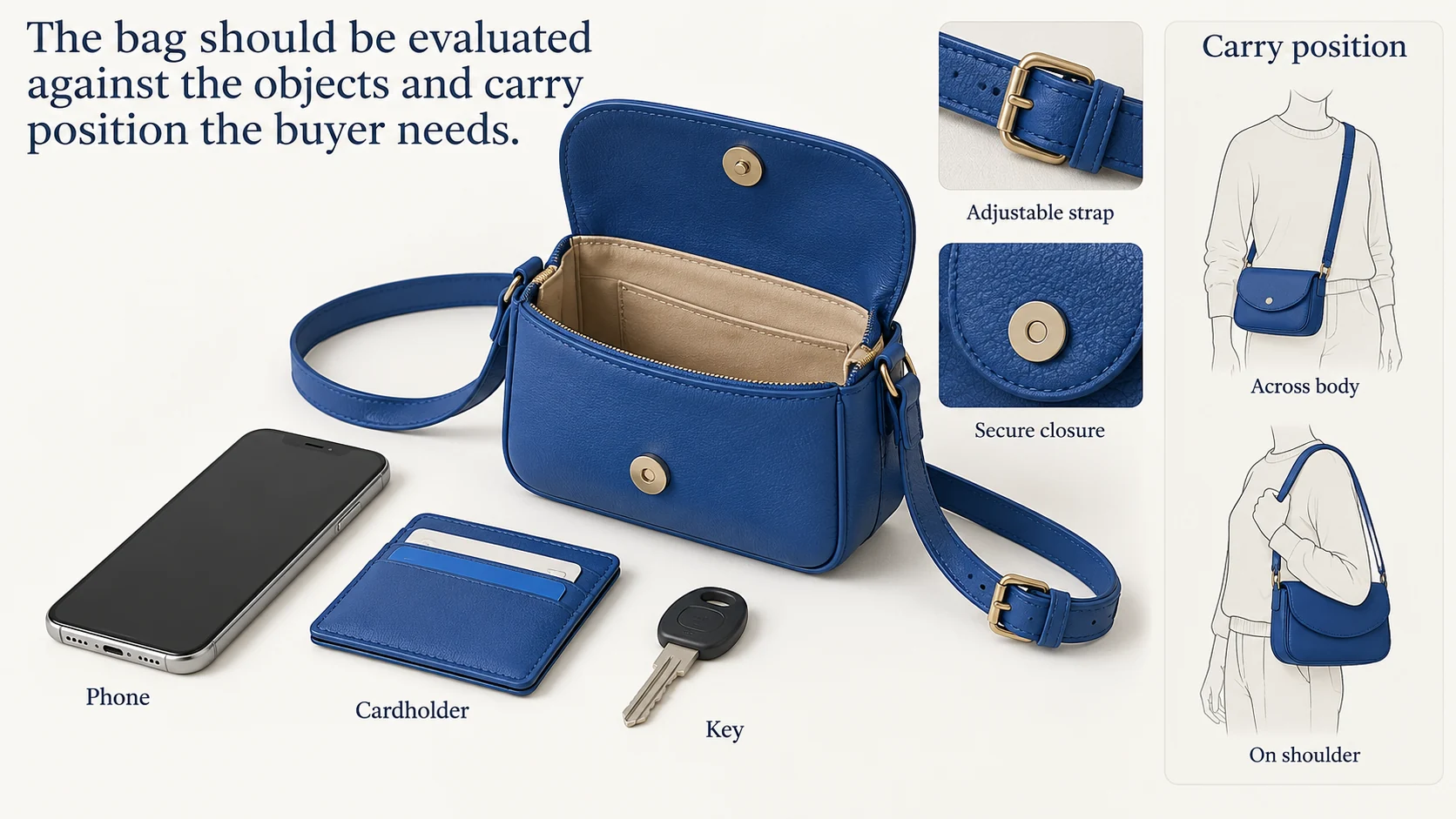
Purse dropshipping works through ready-made supplier catalogs or a sourcing partner that finds a specified bag and coordinates fulfillment. Choose a route after defining what the bag must carry and how the customer will use it. Then verify the opening, strap, material and packed shipping cost—not just the outer dimensions in a listing.
A crossbody purse can look large enough for a phone and still have an opening that makes the phone awkward to insert. A structured handbag can look profitable until protective packing raises its chargeable weight. Those are product decisions you can check before a shopper discovers them for you.
Provider pages were checked on October 13, 2026. The dimensions and calculations below are illustrations, not measurements of a supplier’s actual product or a carrier quotation.
01
Define the job the purse must do
Start with the customer’s everyday load. A phone, a few cards and a key need a different bag from a wallet, glasses case and small cosmetic pouch. “Roomy” does not tell the buyer whether those objects fit.
Pick one clear use: light crossbody for short trips, structured everyday handbag, small occasion purse or another defined job. List the essential objects, preferred carry position and closure. This gives you a useful basis for comparing products.
For a phone purse, the product page should explain usable access and phone fit. For a shoulder bag, strap drop and opening may matter more. For an occasion purse, a short chain or handle shown in the photo should be identified as included or optional.
Our clothing and accessories guide covers the broader store and supplier decisions. Here, the aim is a bag whose actual capacity and shipping economics support one customer promise.
02
Compare catalog access with a specified sourcing route
The checked AppScenic bags and purses category describes a marketplace of suppliers, regional sourcing and connected catalog/order functions. It is a place to investigate ready-made listings. Region-wide marketing does not prove the origin, availability or cost of every purse.
A clothing catalog with a handbag category can also provide leads. Inspect live SKUs and confirm whether the specific bag can be fulfilled under your account. A navigation label alone is not proof that a usable dropshipping product is available.
| Route | What it can help you do | What you still need |
|---|---|---|
| Supplier marketplace such as AppScenic | Find and connect listed bags | Exact supplier, origin, quote and return terms |
| Existing clothing supplier’s accessories range | Add a compatible ready-made accessory | Verified live stock and bag-specific specifications |
| Sourcing coordination through AIDrop | Find a bag against a defined specification | Approved sample, material evidence, packing and destination quote |
Use the same request across routes: style code, outer and usable dimensions, opening size, strap measurements, material by component, closures, packed dimensions and claim handling. Our supplier selection guide helps compare the wider arrangements.
Do not rank a supplier’s physical quality from an attractive catalog or an automation feature. An imported photo shows a selling idea; a received sample shows whether that item supports it.
03
Measure the opening, inside and strap
Outer width, height and depth describe the bag’s shape. The opening and interior describe what can pass into it and remain inside. Linings, dividers, zip ends and curved corners can reduce usable space.
Imagine a purse measuring 20 × 12 cm externally. A phone measuring 16.5 × 8 cm appears to fit those numbers. But if the opening is about 17 cm wide, angled and partly obstructed by the zip, insertion may be awkward. The comparison is a reason to check the actual objects together, not a claim about a particular bag.
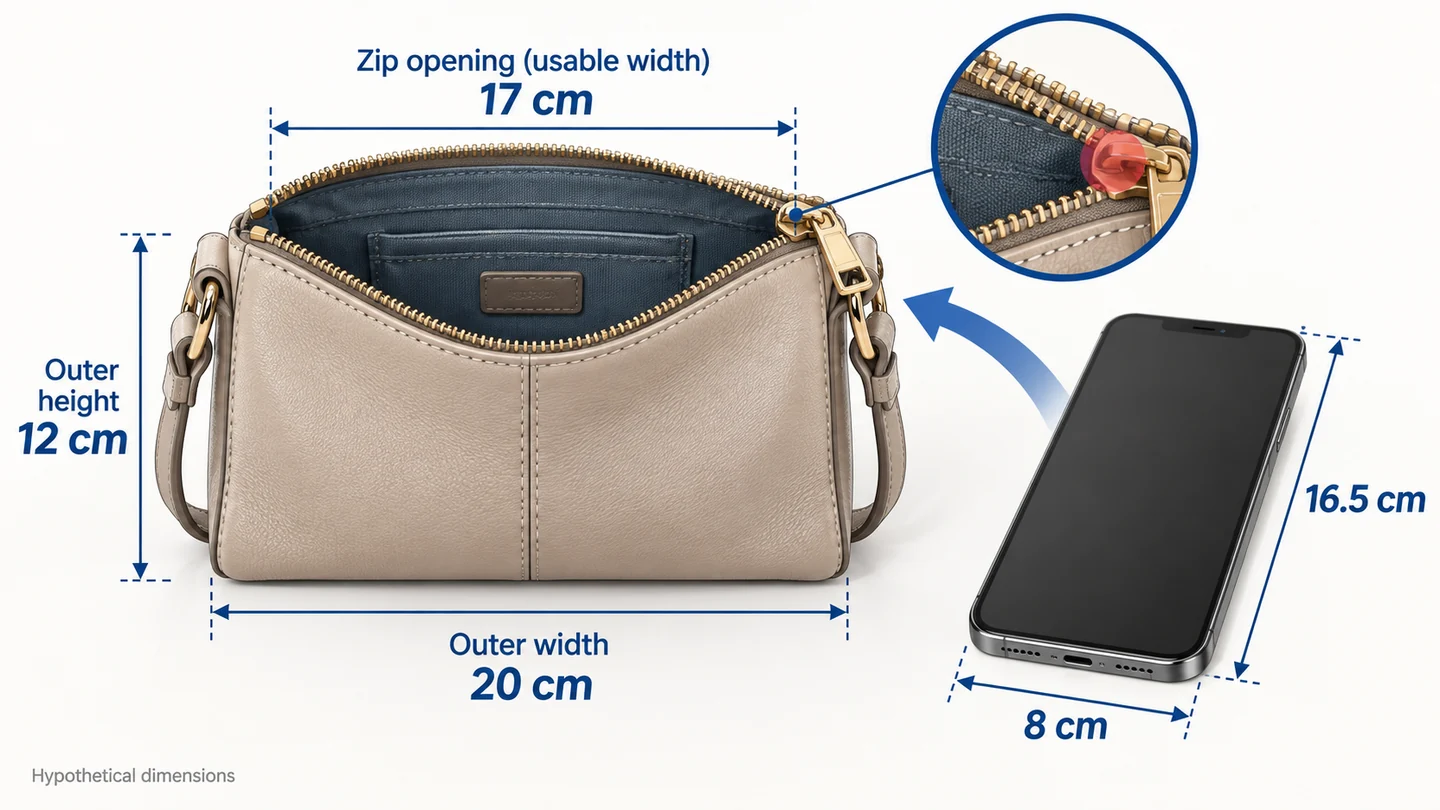
Create a sample record with these measurements:
| Measurement | Why it helps the buyer |
|---|---|
| Outer dimensions | Understand the overall size |
| Opening width and shape | Judge whether an object can enter comfortably |
| Usable main compartment | Judge the actual carrying space |
| Strap drop | Estimate where the bag hangs under the stated method |
| Adjustable strap range | Understand the available carry positions |
Explain the strap measurement method. A strap’s total length and the drop from the top of the strap to the bag are different figures. Do not use them interchangeably on a product page.
For the sample, place the intended phone, cardholder or wallet inside and close the bag normally. Photograph that arrangement with the actual objects and bag when available. If you use an editorial illustration to explain access, label it as an illustration rather than proof of a supplier’s capacity.
04
Inspect materials and the points that take strain
Request the composition for the outer surface, lining and trim separately. A leather-look bag is not automatically leather, and a leather component does not mean every panel is leather. Use the documented material instead of an appearance-based label.
Work through the sample with the bag’s intended use in mind:
- Attachments and seams: Inspect the strap joins and stitching near load points.
- Access and lining: Open the zip, check closure alignment and inspect the inside lining.
- Normal load: Carry the ordinary intended contents; do not invent a certified weight limit.
- Shape after unpacking: Check corners on a structured bag, or folds and surface recovery on a soft purse.
- Observed issues: Record smell, transfer or surface wear under the specific conditions. Ask whether an issue is a defect or a construction limitation.
One sample does not prove that every unit will perform identically.
Avoid “genuine leather,” “waterproof,” “scratch-proof” or durability guarantees without applicable evidence. A useful description names the material, construction and care information the buyer can use.
Also examine logos and distinctive designs. Do not source counterfeit branded bags or reproduce protected branding to make a generic product feel more valuable.
05
Quote the protected parcel, not the empty bag
A purse may need filling, a protective sleeve or a box to preserve its shape. Those materials add volume and weight. Quote the product with the packing you actually intend to use.
Suppose a protected parcel is 30 × 22 × 12 cm and weighs 0.8 kg gross. Under an illustrative volumetric divisor of 5,000, its dimensional weight is 30 × 22 × 12 ÷ 5,000 = 1.584 kg. A service that charges the greater of actual and dimensional weight would start from the larger figure, subject to its own rounding and rules.
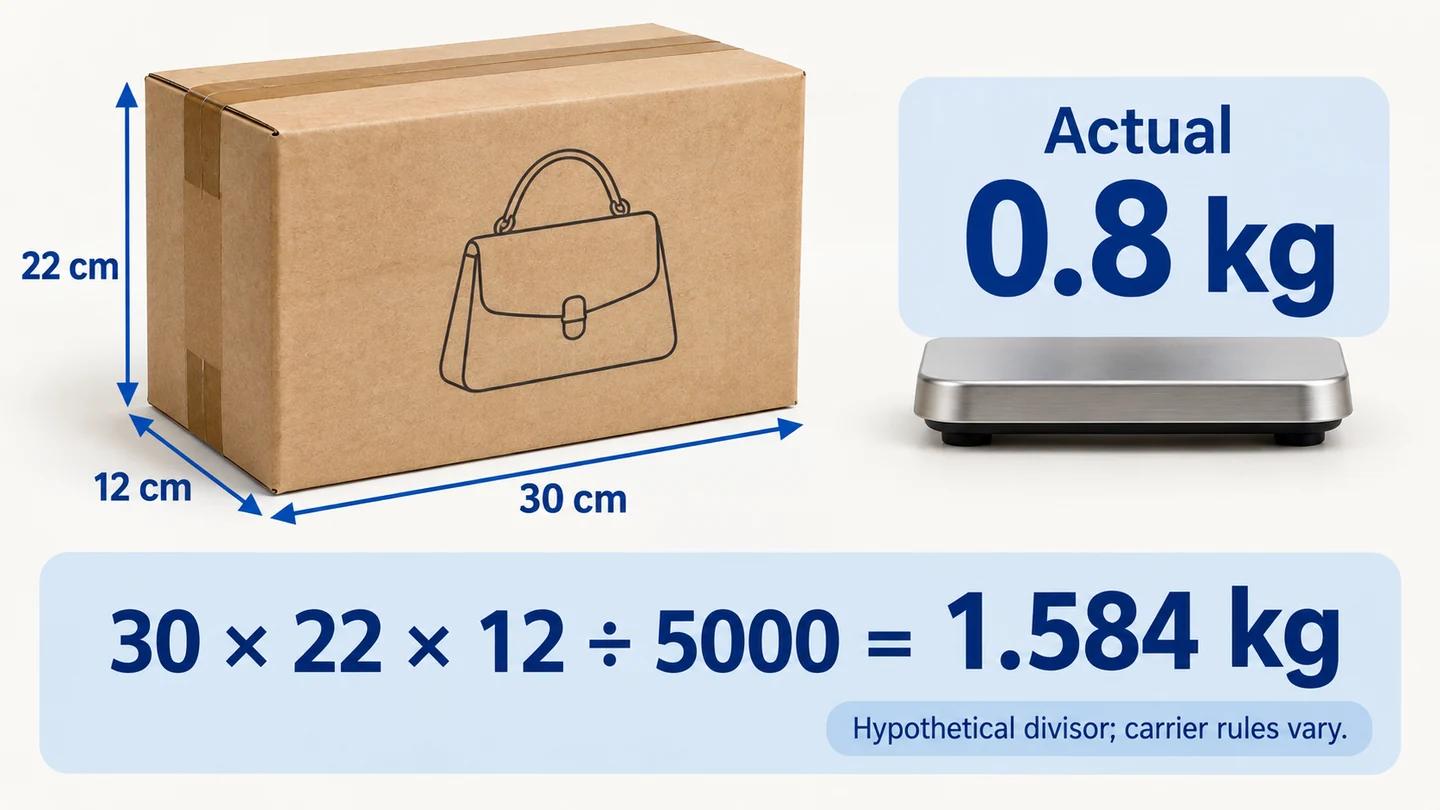
The divisor is not universal. Obtain the logistics service’s actual divisor, rounding increment and surcharges. Reducing the box can help only when the purse still arrives without crushing or damaging contact.
| Packing question | Useful evidence |
|---|---|
| Does the shape need support? | Sample packing and arrival condition |
| Can hardware rub the surface? | Protected strap, chain or closure arrangement |
| Is the quoted size the final parcel? | Closed package dimensions and gross weight |
| Will a smaller parcel damage the bag? | A controlled packing and shipment check |
Ask for a photograph of the supplier’s actual closed parcel. Compare its dimensions, interior support and hardware protection with your quote, then use a controlled shipment to check the arrival condition.
06
Price the bag with packing and remedies included
Consider a hypothetical $45 retail sale. The following figures are not supplier rates:
| Item | Amount |
|---|---|
| Bag | $15.00 |
| Shipping | $11.00 |
| Store payment fee | $1.70 |
| Protective packing | $2.00 |
| Allowance for problems | $2.00 |
| Remaining before acquisition and overhead | $12.60 |
If a more protective parcel adds $3 to shipping, the modeled remainder falls to $9.60. Compare that with the loss caused by a crushed structured bag. Cheapest packing and lowest total cost are not always the same choice.
Ask what the supplier will remedy: wrong item, broken closure, defective strap attachment, transit damage and change of mind can have different rules. Determine whether the buyer needs to return the item and where the authorized address is.
Use the order-cost guide to separate those expenses from revenue. Replace the planning allowance with your own experience as completed orders accumulate, and investigate repeated product-specific problems.
07
Make the product page and first order agree
Show the bag’s closed shape, open compartment, included strap or handle and usable scale. Use verified measurements and list what is included. Styling objects should not look like bundled products.
Place a controlled order for the exact variant. Match the supplier code, store order, parcel and received item. Check whether the customer can follow tracking and whether the delivery wording fits the actual route.
If customers repeatedly ask whether a phone fits, improve the capacity information. If arrivals are crushed, revisit packing. If colors are wrong, inspect variant mapping and supplier selection. Each issue points to a concrete correction rather than another paragraph of product praise.
For a bag sourced against specific capacity, material and packing needs, ask AIDrop for a scope review. Send the intended load, dimensions, design requirements and destination. Those details support a meaningful sample and freight comparison.
08
Questions about purse dropshipping
Can I use outer dimensions to promise phone fit?
Check the opening and usable interior with the intended phone size. External dimensions alone can overstate access or capacity.
Does a supplier’s regional catalog guarantee local dispatch?
Verify the selected SKU’s supplier and dispatch origin. The marketplace’s overall regional reach is not a delivery promise for every listing.
Should I remove the box to save freight?
Only if the actual bag and alternative protection tolerate it. Quote and test the final packing; reducing volume is not a saving when it creates damaged arrivals.
Can I call a synthetic bag leather?
Use the documented material composition. Leather appearance, trim or a supplier’s loose marketing language is not enough to make a whole-bag leather claim.

Clothing Dropshipping: Sizes, Variants, Samples and Returns
Verify apparel sizes, variants, samples, labels and returns before launch. Build a clothing dropshipping offer around accurate
Clothing Dropshipping Suppliers: 5 Options for Different Stores
Compare Trendsi, Printful, Printify, Apliiq and BrandsGateway by clothing model, fit information, stock, shipping and return costs.
Shoe Dropshipping: Sizing Evidence, Variants and Return Exposure
A shoe listing needs model-specific fit evidence, exact size-color stock and a workable exchange route. Compare one
