
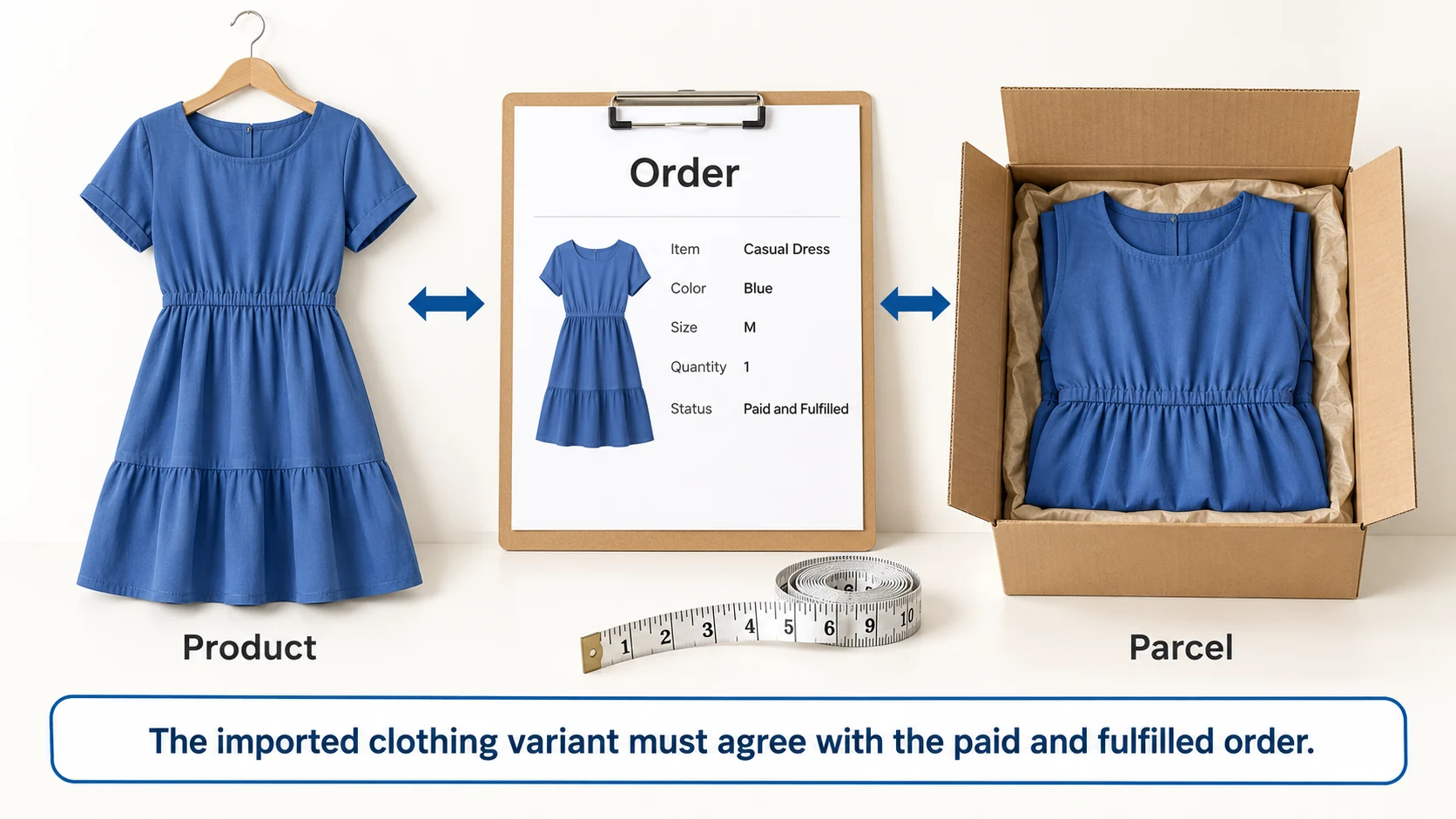
Shewin offers a Shopify app for importing clothing and sending customer orders to its fulfillment service. The app is listed as free to install; products, shipping and payment-related charges still affect every sale. It can suit a small fashion store that wants a supplier-connected range, provided the imported stock, delivery origin and fit information support the offer.
Begin with one dress or top in one clearly identified size. Check whether its quantity represents ready stock or a preorder, calculate delivery to your customer’s address, and confirm the current remedy in writing. Those details decide whether an attractive catalog item is ready to sell.
This guide checks public documents as of October 13, 2026. We have not installed the app or inspected a Shewin sample. Where the pages disagree, the uncertainty is kept beside the decision it affects.
01
What does the free app actually provide?
The Shopify app listing describes product importing, inventory updates and direct fulfillment without Shewin branding. These features can reduce repeated catalog and order work. They do not establish the quality, delivery time or profitability of a specific garment.
Free installation means the app’s installation price is free on the listing. Obtain the actual product and shipping charges before setting a retail price. Ask how your account pays for orders and what happens when payment fails.
The FAQ currently describes Shopify as the native supported store connection. If you use another selling channel, verify the current supported route and its responsibilities instead of assuming a Shopify feature also applies there.
For other routes, our clothing supplier comparison separates catalog suppliers from sourcing partners and different fulfillment arrangements. Choose the route before committing your store to its app.
02
Check whether the imported quantity is ready stock
Shewin’s FAQ says preorder and backorder products can have zero actual stock while a virtual quantity permits import into the store. It also describes allocation according to payment sequence. A number shown in your storefront therefore needs context.
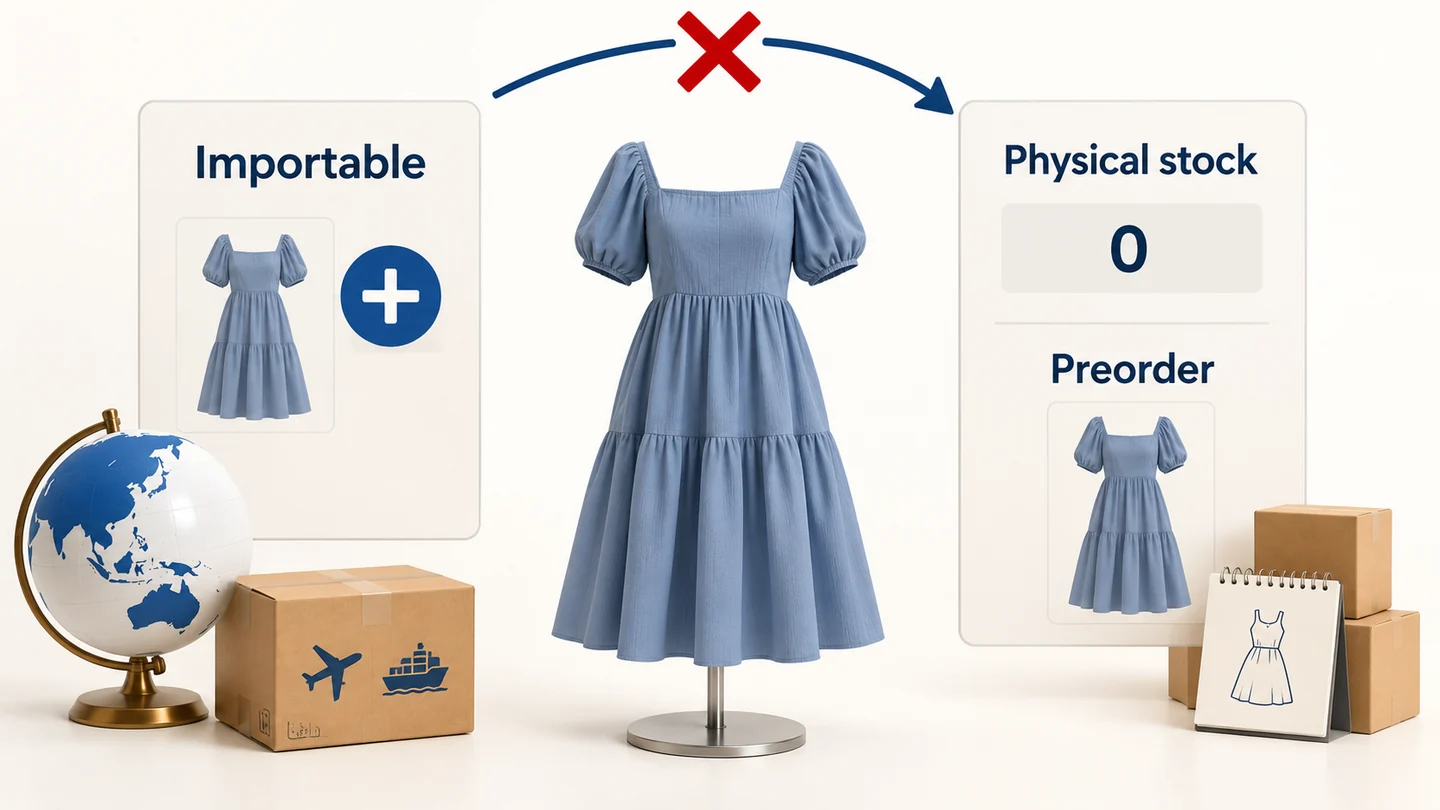
Ask which of these states applies to the selected size and color:
| Product state | Store decision |
|---|---|
| Available now from the confirmed origin | Use the confirmed processing and delivery estimate |
| Preorder or backorder | Publish only with a substantiated availability date and clear buyer wording |
| Stock or date unclear | Keep the variant unavailable while checking |
Suppose a blue medium is importable but the physical stock is zero. A customer can still see an attractive product page. If the page promises immediate dispatch, the problem is your offer’s promise, even though the import worked as designed.
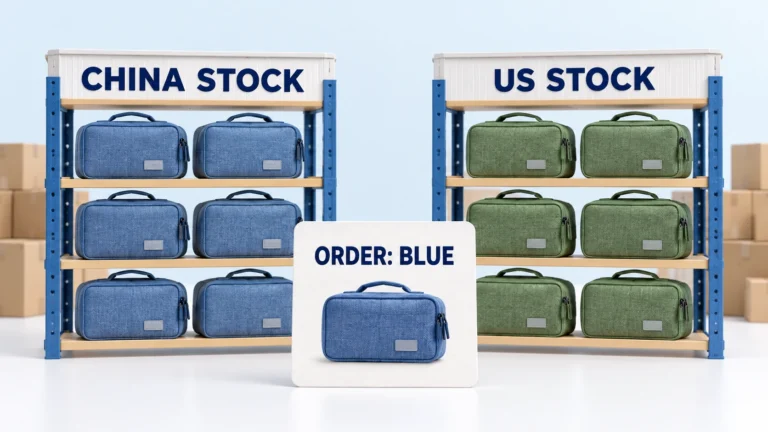
Record the warehouse or dispatch origin for the exact variant. Shewin’s catalog describes China and US sourcing, but that does not mean every dress is available in both places. Switching origin can change shipping cost and arrival expectations.
Before launch, inspect how the store behaves when a variant becomes unavailable. Does it stop selling, remain purchasable or display preorder wording? Verify the actual account behavior; an inventory-sync feature description cannot answer every configuration question.
03
Map one variant and inspect the live listing
Use the current app instructions to connect the store and import a small selection. Avoid changing or recreating variants casually while testing the connection. You need a stable relationship between the supplier code and the choice the customer buys.
Build a record like this, replacing the illustrative labels:
| Field | Example |
|---|---|
| Store SKU | DRESS-BLUE-M |
| Supplier identifier | Exact Shewin product and variant code |
| Selected option | Blue, medium |
| Stock state | Confirmed ready stock or explicitly dated preorder |
| Dispatch origin | Confirmed origin for this variant |
| Customer destination | Address used for the quote and trial |
Open the customer-facing page on a phone. Choose each imported size and verify that its image, price, availability and size information change as expected. A correct product title can conceal a wrong variant underneath it.
Replace a generic size-chart image with the information that applies to this garment. Explain whether the numbers are body measurements or finished garment measurements. If the supplier cannot answer that question, request clarification before customers use the chart.
The clothing dropshipping guide covers the wider fit and product-page work. Keep this app trial focused on whether the actual variant can be sold and fulfilled correctly.
04
Price standard and express delivery separately
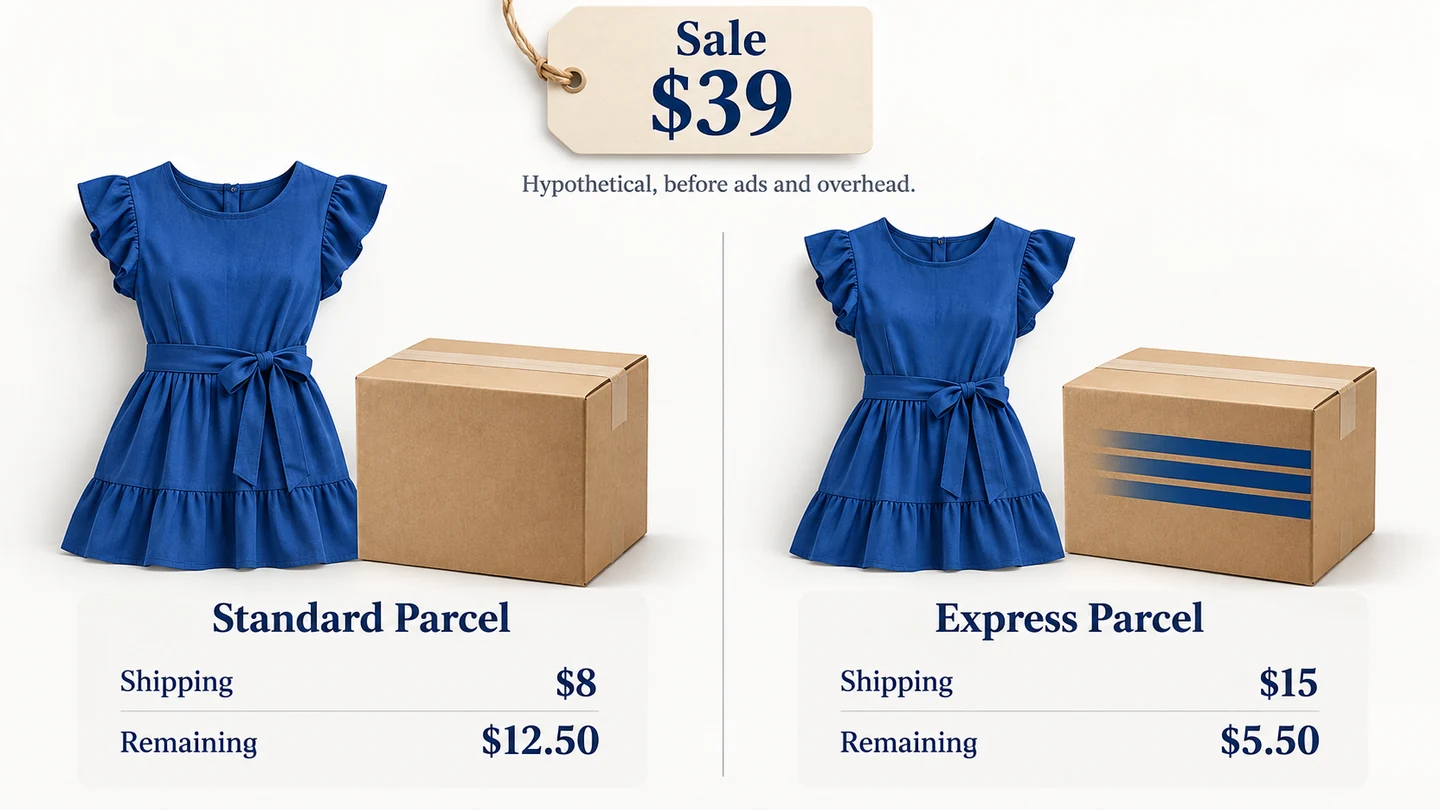
The FAQ describes standard and express options with weight-based charges. Use an actual destination quote for each option. A faster service can absorb most of a dress’s remaining margin when offered at the same customer price.
Consider an illustrative $39 dress; these are merchant teaching figures, not Shewin quotes:
| Cost | Standard example | Express example |
|---|---|---|
| Garment | $15.00 | $15.00 |
| Shipping | $8.00 | $15.00 |
| Store payment fee | $1.50 | $1.50 |
| Allowance for problems | $2.00 | $2.00 |
| Remaining before ads and overhead | $12.50 | $5.50 |
Charging the same price while absorbing an extra $7 in shipping cuts the modeled remainder by more than half. If you offer express, decide whether the customer pays the difference, the store absorbs it or the product simply does not suit that service.
Try a second garment or quantity using a new quote. You cannot assume two products share one cheap parcel merely because they come from the same catalog. Add any actual payment-related charges to the worksheet, and compare the buyer’s delivered total with a relevant local alternative.
Use the cost calculator to explore a sourcing alternative with the applicable inputs. It does not quote Shewin’s account-specific freight.
05
Get the return terms for your account in writing
The public pages do not offer a clean single deadline. The FAQ mentions reporting quality issues within three days. The return policy describes 14-day returns, 30-day defect claims and an additional seven-day wording. Conditions include unused, unwashed items with tags and different handling for non-quality returns.
Do not select the longest number and promise it to customers. Ask: “For this SKU and account, when must I report damage, when is a change-of-mind return allowed, who pays postage, and which address is authorized?” Keep the dated reply with the product record.
Check sets and hygiene-sensitive products separately. Returning one part of a matching set can differ from returning an individual top. The original parcel’s address may also be different from the authorized return address.
For a defect, contact the supplier immediately with the order ID, variant, delivery date and clear photographs. Handle your customer’s next step through your own store. The supplier’s willingness to reimburse you and your store’s obligations to the buyer are separate questions.
Set aside a planning allowance for cases your chosen store policy covers but the supplier does not. A dress with good headline margin can be expensive if poor fit repeatedly creates unrecoverable returns.
06
Trace the last confirmed state of the first order
Place a controlled paid order to a supported address, then compare the store record with the supplier record. Confirm the variant, quantity, payment and current stock state before judging delivery.
Follow this sequence when the order appears stuck:
- Store payment: confirm whether payment was completed, rather than only authorized or attempted.
- Supplier receipt: locate the corresponding order and compare its variant and address.
- Supplier payment and allocation: check whether the supplier accepted payment and reserved or allocated the item.
- Dispatch: distinguish a generated tracking number from the parcel’s actual carrier acceptance.
- Arrival: compare the received size, color, contents and packaging with the product page.
If a paid store order does not appear at the supplier, save the IDs and timestamps and investigate the connection. Do not immediately create another manual order; the original might still be processing. If stock has sold out, communicate the confirmed options to the buyer rather than inventing an arrival date.
For the sample, measure the garment and photograph it in ordinary light. Record any fit, seam, transparency or color issue. That evidence belongs in your product decision, not just in the app troubleshooting record.
07
Decide whether the supplier suits the offer
Use Shewin for a limited range when ready-stock status, fit information, landed cost and remedy are clear, and your trial order has a complete trace. Hold a variant that needs an unsupported deadline or has unresolved stock and return terms.
If your range needs sourcing beyond a catalog, custom packaging or China-side inspection, request an AIDrop review. Send the garment specification, target market and expected orders. We can review that sourcing scope; app installation or a third-party refund outcome is not part of that promise.
08
Questions before importing more products
Is every importable item ready to ship?
No. The FAQ allows virtual quantities for some preorder or backorder products. Check the selected variant’s actual status and origin before using a ready-stock delivery promise.
Does a US catalog option mean every product ships from the US?
No. Confirm origin at the SKU and variant level, together with the destination quote. A catalog-wide description cannot establish the route for a particular order.
Should I promise the longest public return window?
Obtain the current account-specific terms because the public pages contain conflicting wording. In an actual problem, report it promptly and keep the evidence rather than waiting for the longest stated deadline.
What documents might a US business need?
The FAQ discusses EIN, business-license and resale-document requirements for new US clients without a firm implementation deadline in the checked passage. Ask what applies to your account now. Do not assume an announced policy and an active account requirement are identical.
CJdropshipping Review: Costs, Warehouses, Quality and Fulfillment Fit
CJdropshipping is a practical option for sellers who want sourcing, store connections, packaging and fulfillment in one

CJdropshipping vs DSers: Who Sources, Pays and Ships the Order?
CJdropshipping can source and physically fulfill an order; DSers maps a store product to supported external suppliers

AutoDS Review: Evaluate the Automation You Would Actually Use
AutoDS can reduce listing and order work, but its value depends on your sales channel, tier, add-ons
