
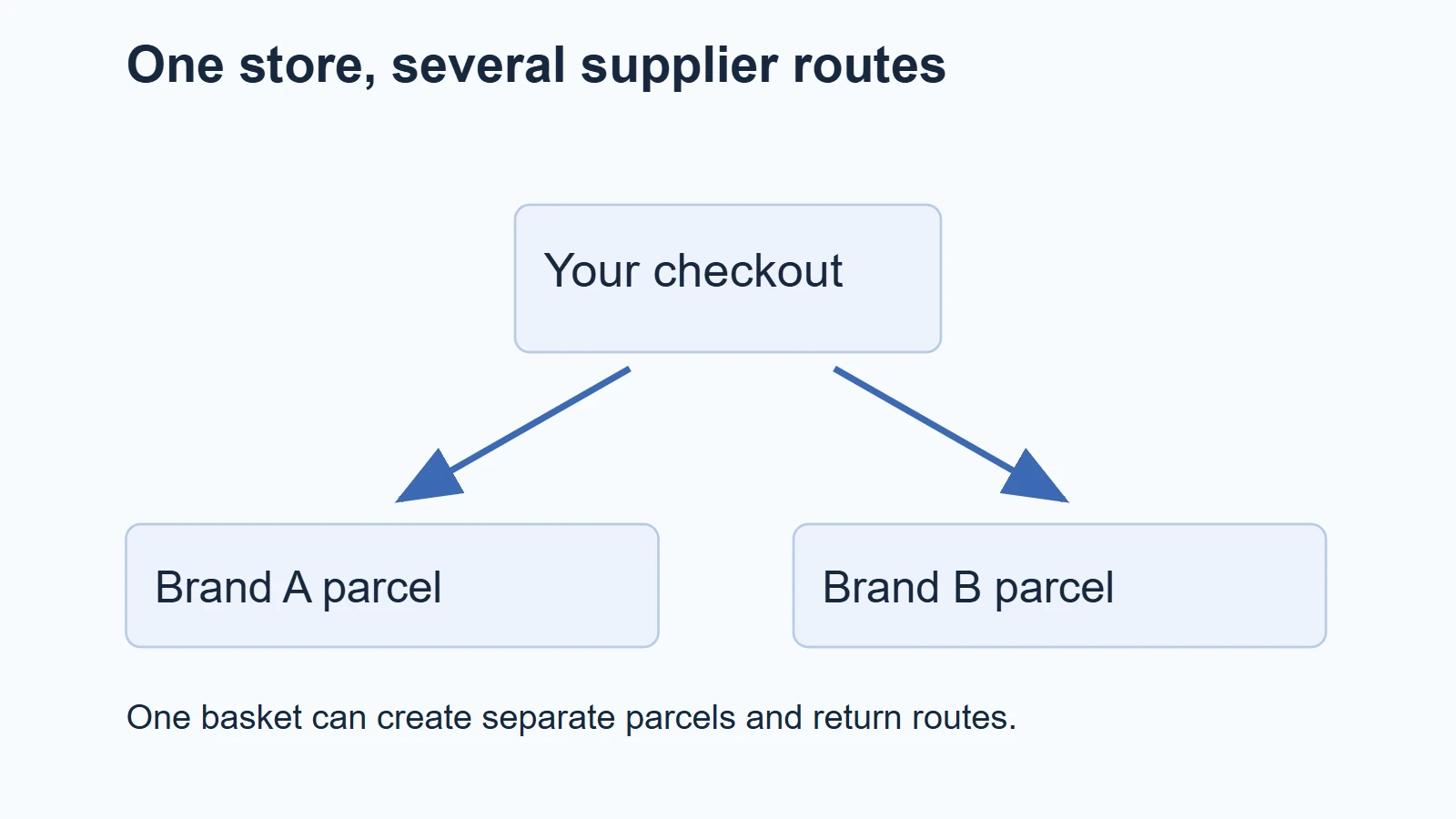
Orderchamp offers dropshipping from participating brands to a retailer’s customers. Check your access plan, which brands accept your store and what each brand ships, charges and accepts back. One connected store can still produce several parcels and several return rules.
Start with a small assortment that makes sense together. A customer buying two related home accessories should understand the delivered price, whether they arrive separately and where to ask for help. Those questions matter more than importing the largest possible catalog.
01
Choose the access route you actually have
Orderchamp’s current public help describes more than one retailer route. Do not apply the terms of a supplier subscription or an invited partner plan to an unrelated retailer account.
The free Partner Plan guide describes an invitation from a brand. The retailer signs up through that brand’s link, enables the plan and accesses its dropshipping catalog. The guide states a 3.5% processing fee when using its automated payment solution.
That is not a promise of unrestricted free access to every brand. Confirm what the invitation covers and what amount the processing percentage applies to before including it in a margin calculation.
For other retailer plans, the subscription help article directs users to account-specific plan details. It states that monthly and annual billing both entail a 12-month commitment. Monthly payment and a cancel-any-month contract are different things.
| Before enabling a plan | Confirm |
|---|---|
| Access route | Brand invitation or the relevant paid retailer offer |
| Catalog scope | Which brands and product limits apply |
| Contract | Amount due, billing frequency and commitment |
| Transaction charges | Applicable fee, calculation basis and exclusions |
| Account role | Retailer dropshipping, not a supplier/Cloud workflow |
Use the offer shown to your account and retain its terms. Public descriptions explain the options; they do not establish your private account’s acceptance or price.
02
Build a small assortment around brands that fit
The wider dropshipping suppliers guide distinguishes marketplaces from individual suppliers. On a multibrand service, every additional brand can introduce another shipping origin, charge and return condition.
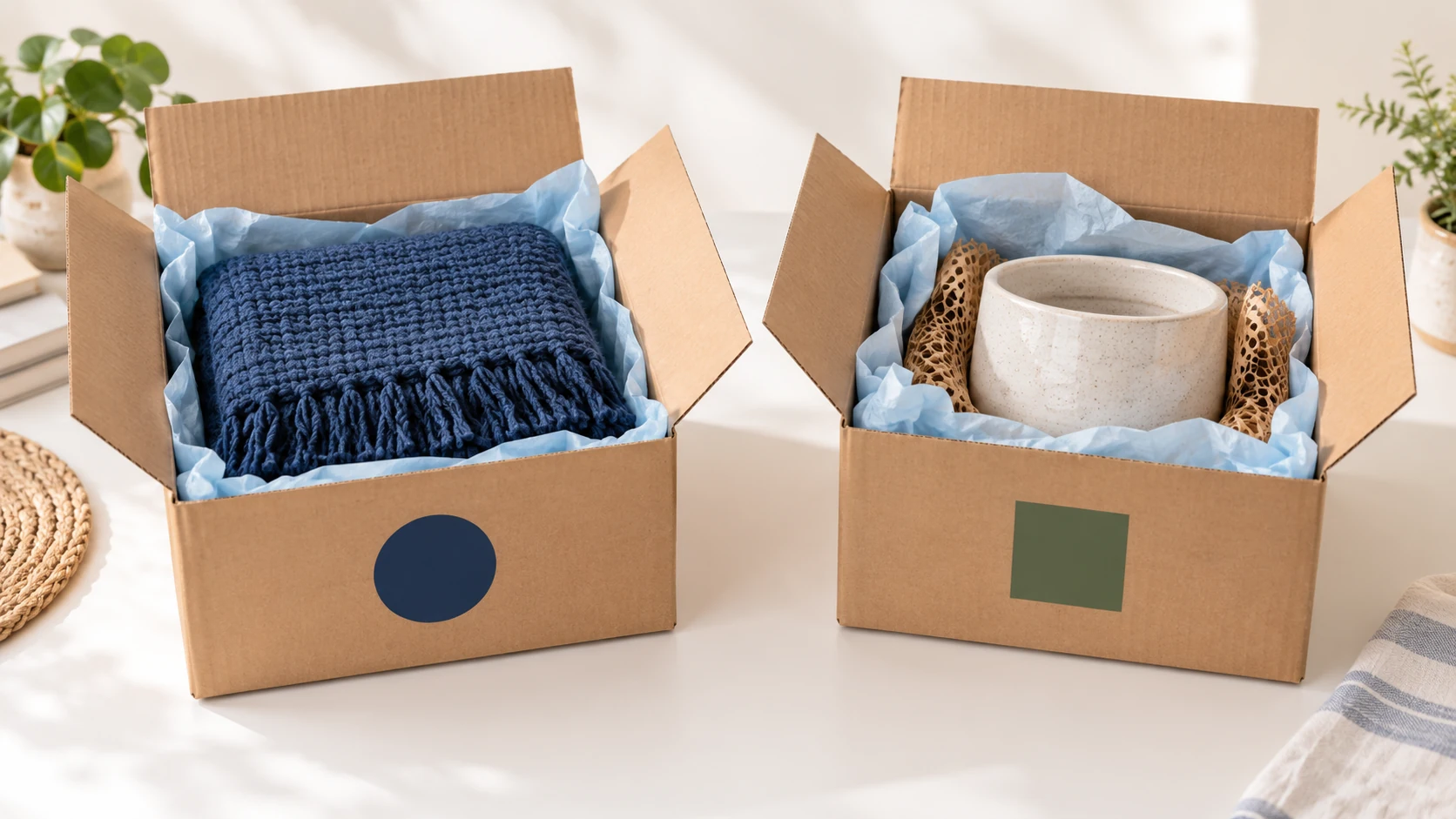
Choose products around a customer need. For example, a small home-office range could include a desk organizer and a lamp. Before selling them together, establish whether they come from one brand or two and what the customer will receive.
Keep a brief assortment record:
| Field | Organizer | Lamp |
|---|---|---|
| Brand and exact product | Account-confirmed reference | Account-confirmed reference |
| Approval to sell | Confirmed or unresolved | Confirmed or unresolved |
| Shipping origin and destinations | Current brand conditions | Current brand conditions |
| Stock-update route | Confirmed method | Confirmed method |
| Return scope | Limited or full, as shown | Limited or full, as shown |
This is a proposed planning record, not an actual Orderchamp catalog comparison. Do not fill unresolved cells with assumptions to make a collection look ready.
Review product information and image rights before publishing. If you change a title or description, preserve the underlying specification. A more attractive product name should not turn a small lamp into a room-lighting promise the supplier has not supported.
03
Make one mixed basket make financial sense
Orderchamp’s dropshipping FAQ describes brand-set shipping and handling charges. A single customer checkout therefore does not establish one supplier freight charge.
Consider this invented €60 two-brand basket. It excludes VAT treatment and any plan-specific processing charge that has not been confirmed:
| Cost | Amount |
|---|---|
| Goods from both brands | €28 |
| Brand A freight | €5 |
| Brand B freight | €6 |
| Handling | €1 |
| Store payment processing | €2 |
| Advertising acquisition | €10 |
| Left before other costs | €8 |
If the customer pays an additional €5 delivery charge, add that to income once. It does not erase both brand freight bills. If the €60 already includes delivery, do not add it again.
Test the combinations that change checkout
Use A alone, B alone and A plus B for the same supported destination. Also try a destination that one brand does not serve. Compare the storefront charge with the actual supplier-side charges and confirm that an unavailable combination is handled clearly.
If the basket is unprofitable, the options include a different assortment, a different retail price or a delivery policy that reflects the service. Calling two items a bundle does not make two suppliers pack them together.
Explain separate parcels before payment when they are expected. Our split-shipment guide covers the customer messages and tracking relationships in more detail.
04
Test the order states your connection sends
Installing an app and importing a product are early events. The useful test continues through customer payment, supplier order creation, the relevant supplier payment or acceptance, dispatch and tracking.
Orderchamp’s integration documentation describes maintained connectors and an API route. A custom integration is a separate implementation, with explicit setup requirements. Choose the route your store and account support rather than treating an API page as a ready installation.
For a proposed one-item test, compare:
- The selected store variant and its corresponding brand product.
- Quantity and the customer’s supported address.
- The resulting supplier order and applicable charges.
- Stock or order-acceptance changes returned to the store.
- Shipment contents, tracking and the message the buyer receives.
Repeat with the mixed basket if that is part of your offer. Each parcel needs its own useful tracking relationship. One order marked complete should not conceal the other brand’s unshipped item.
The developer documentation describes test orders that receive simulated fulfillment and fake tracking after about ten minutes. That can check software flow. It is not evidence of real packing, carrier collection or delivery speed.
If an order or import is missing
Find whether the problem is product availability, brand/account approval, a disconnected variant, supplier payment or the connector itself. Save the current product and order IDs and ask about the existing record before recreating it.
A second import can create a duplicate listing; a second supplier order can create a duplicate shipment. Correct the failed relationship, then repeat the smallest relevant check.
05
Use the current brand return setting
An older public FAQ describes a limited return arrangement and future plans for platform support. Current help articles give more specific return and refund instructions. Read the current brand settings and the relevant help for your order instead of relying on the older summary alone.
The return guide distinguishes limited returns, such as damaged or incorrectly supplied goods, from fuller return acceptance that can include a change of mind. Confirm which option the brand offers before you publish your own return policy.
| Customer situation | What you need to establish |
|---|---|
| Wrong product | Order contents, item label and brand claim route |
| Damaged product | Product and parcel evidence, report and remedy |
| Unwanted but correct item | Brand eligibility, return instructions and costs |
| Two-brand return | Separate authorization and destination for each affected item |
Supplier policy and your customer’s legal rights are separate. A brand declining a particular reimbursement does not by itself establish what your store may refuse to the buyer.
Confirm both refunds
The refund help explains the supplier-to-retailer refund and the retailer’s responsibility to refund the customer. One is not proof that the other happened.

Keep the return authorization, destination, item quantities, shipment evidence, brand receipt and supplier refund record. Then separately check the buyer’s refund in your store payment system. If the buyer needs a remedy before the supplier finishes its investigation, handle that as your store’s decision and track the outstanding recovery.
For a store that instead needs several China-sourced items inspected and packed together, ask AIDrop to review that basket. Include exact product references and destinations. Consolidation must be physically arranged; it does not follow from using a single storefront.
06
Orderchamp questions
Is dropshipping the same as placing a wholesale order?
No. Confirm the dropshipping route for the selected brand and account. A wholesale purchase shipped to your business has different stock and dispatch responsibilities from a brand shipping to your customer.
Is the free Partner Plan available to everyone?
The reviewed guide describes joining through a brand invitation. Confirm that invitation’s catalog and fee conditions rather than assuming free access to the entire marketplace.
Can two brands ship one parcel?
Do not assume so. Establish the actual fulfillment arrangement. If items ship separately, include both costs and show the customer what to expect.
Does monthly billing mean I can leave after a month?
The retailer subscription help states a 12-month commitment for both monthly and annual billing. Read your actual offer and cancellation conditions before enabling it.
Who should the customer contact?
Your store should provide a clear support route. Work with the brand on product, order and return issues, and with platform support on technical problems. Do not make the buyer work out which part of your supplier network failed.
CJdropshipping Review: Costs, Warehouses, Quality and Fulfillment Fit
CJdropshipping is a practical option for sellers who want sourcing, store connections, packaging and fulfillment in one

CJdropshipping vs DSers: Who Sources, Pays and Ships the Order?
CJdropshipping can source and physically fulfill an order; DSers maps a store product to supported external suppliers

AutoDS Review: Evaluate the Automation You Would Actually Use
AutoDS can reduce listing and order work, but its value depends on your sales channel, tier, add-ons
