

Faire does not offer dropshipping to a retailer’s customers. Its US/Canada retailer terms require a physical receiving address and explicitly say it does not provide that service. You can use Faire to buy wholesale stock for a retail business, then fulfill your own customer orders under the applicable brand and platform rules.
That can still be useful for an online store. You just need to budget for inventory and a receiving-and-shipping arrangement. Connecting Faire with store software does not remove those requirements.
01
Can Faire send orders straight to your customers?
Section 7 of the US/Canada retailer terms requires a valid physical receiving address and states that Faire does not offer customer dropshipping. The same section restricts forwarding purchased products overseas. Check the terms applicable to your own account and region before ordering.
In practical terms, do not build a store whose plan is to submit a new Faire order to each retail customer’s address. A one-unit listing or a low brand minimum would not override the platform’s terms.
The terms also contain a no-circumvention provision for brands introduced through Faire. Do not treat contacting a discovered brand outside the platform as an automatic workaround. If you need clarification, ask Faire through its supported process and retain the answer.
| Plan | What it means for your store |
|---|---|
| Supplier sends each Faire purchase directly to your retail buyer | Faire does not offer this dropshipping service |
| You buy wholesale stock, receive it and ship retail orders | A stocked retail model, subject to account and brand terms |
| An approved receiving/fulfillment partner handles your stock | Requires confirmation of the receiving, regional and brand arrangements |
| A separate supplier explicitly offers individual-order fulfillment | A different sourcing agreement that must permit your products and channel |
The distinction is the inventory transaction. In wholesale retailing, your business buys stock before the eventual consumer order. Paying a warehouse to ship it still leaves your business owning that stock.
02
What the Faire–Shopify connections actually do
An integration has an actor, a direction and a set of records. It may bring a wholesale purchase into a retailer’s inventory, or help a brand sell wholesale. Neither description establishes that the brand will fulfill your consumer orders.
Faire’s Shopify inventory-sync article is in its help center for brands and refers to the Faire: Sell Wholesale sales channel. It describes linking Shopify inventory to Faire. That is different from an online retailer buying other brands’ products.
Faire also describes retailer POS integrations in its integration announcement. Bringing wholesale purchases into a store’s inventory system reduces data entry. Your business still needs to receive the goods and fulfill the eventual retail sale.
Before installing anything, answer four questions:
- Am I configuring this as a brand selling wholesale or as a retailer buying stock?
- Which product and inventory records move, and in which direction?
- Which physical location holds the quantity shown to customers?
- What actually creates a shipment when a consumer checks out?
If the last answer is “our warehouse receives and ships the stock,” budget for that work. If nobody is assigned to it, the catalog connection is not a complete fulfillment plan.
03
Using Faire for an online store means owning stock
Faire’s retailer eligibility guidance covers eligible retail businesses, including online stores. Eligibility does not imply that every brand allows every channel or that every account receives the same commercial terms.
A straightforward stocked route looks like this:
- Establish an eligible retail business and the applicable account terms.
- Select a brand and confirm its case packs, minimums, product-use and channel conditions.
- Buy stock for an agreed physical receiving location.
- Receive, count and check the goods before making the actual available quantity saleable.
- Pick, pack and dispatch your own customer orders, or use a confirmed fulfillment partner for that work.
For a small launch, a few well-chosen products may be easier to learn from than a large wholesale order. You need to know what will sell, how many units the supplier requires and how much cash remains after the purchase.
If you plan to use a third-party warehouse, confirm the arrangement before paying. It must be able to receive the supplier’s cartons, identify your goods, report discrepancies and fulfill your retail packs. Check that the address and any forwarding fit Faire’s regional rules and brand conditions. A 3PL address is not blanket permission to bypass restrictions.
The inventory management guide explains how available stock, locations and order deductions can differ. With purchased wholesale goods, count what was actually received rather than treating a purchase-order total as immediately sellable inventory.
The cash committed to twelve wholesale units
A lower wholesale unit price can be attractive while the first order still ties up more cash than you expected. Look at the complete purchase and the number of units that remain unsold.
Suppose you buy twelve units at $12 each and pay $18 to receive the carton. This is an illustrative example, not a Faire brand’s actual minimum or price.
| Purchase calculation | Amount |
|---|---|
| Twelve units × $12 | $144 |
| Inbound delivery | $18 |
| Initial cash committed | $162 |
| Received cost per unit | $13.50 |
If one unit sells for $29, then $13.50 stock cost, $4.50 outbound delivery, $1.20 payment processing and $5 acquisition leave $4.80. That contribution still has to cover picking, storage, returns, overhead and applicable tax.
If only six units sell, six remain. Their allocated received cost is $81. You own that inventory, but it is not cash available to pay another bill. Do not call the remaining stock profit just because the first sales brought money into the account.
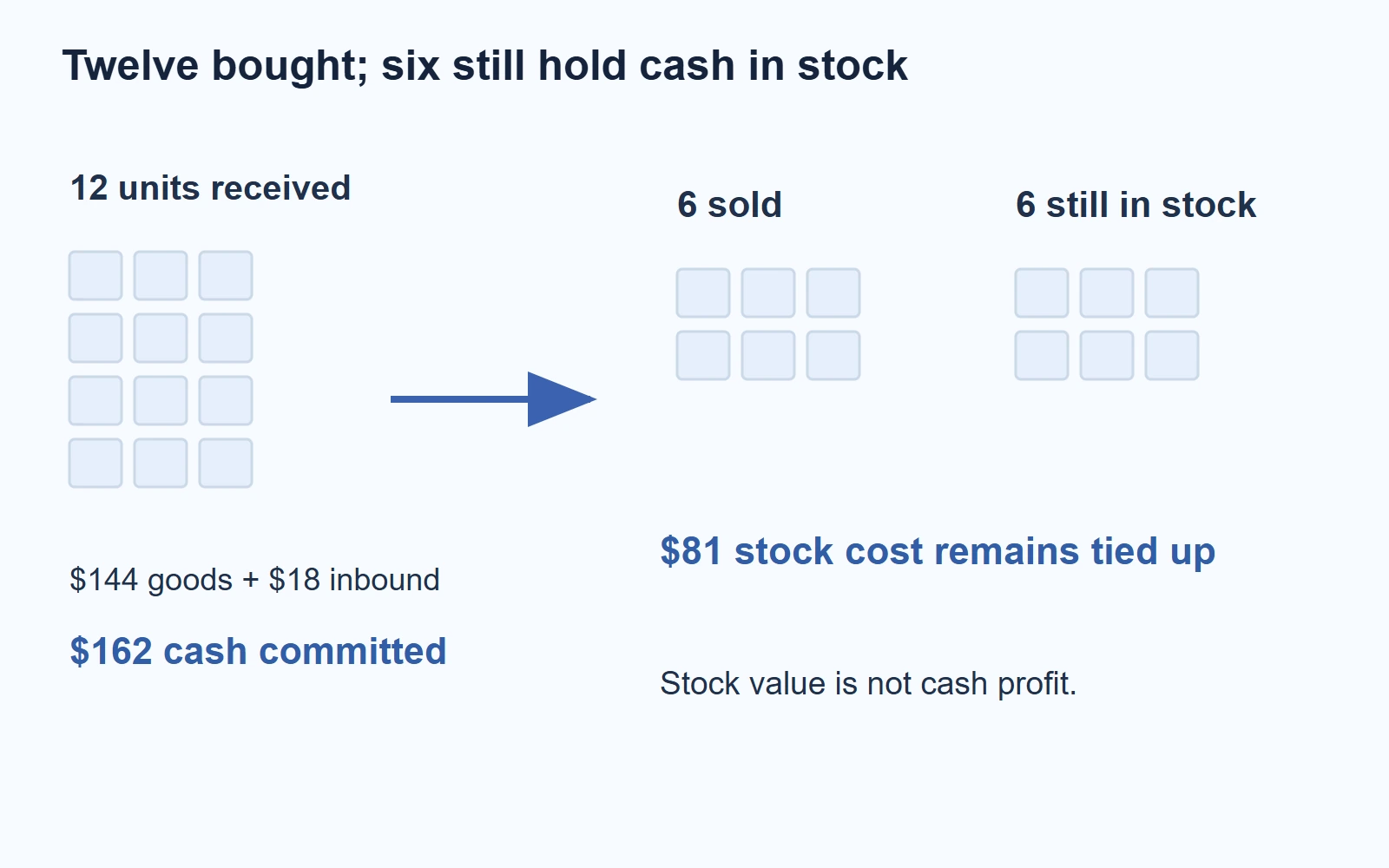
This is where pack size changes the decision. A slightly higher unit price for a smaller permitted first purchase can preserve useful cash, while a larger case may work once demand is demonstrated. Compare the actual available choices rather than assuming the lowest unit price is always the best launch.
Check payment terms and return eligibility for the exact brand and account. Credit approval, opening-order benefits and promotional offers are conditional. Do not make a launch plan that depends on receiving terms you have not been granted.
Receive the stock before promising it to a customer
Make one complete receiving-and-retail-dispatch plan. Choose an exact item, brand, case quantity and receiving address. Record product-asset permissions, invoice total, expected arrival, discrepancy process and the conditions for a wholesale return.
When the carton arrives, count the actual units and separate damaged or uncertain items from saleable stock. For example, if twelve were invoiced but eleven arrived, opening the store at twelve units can create a retail order you cannot fill. Resolve the discrepancy and set the available quantity from the goods you can sell.
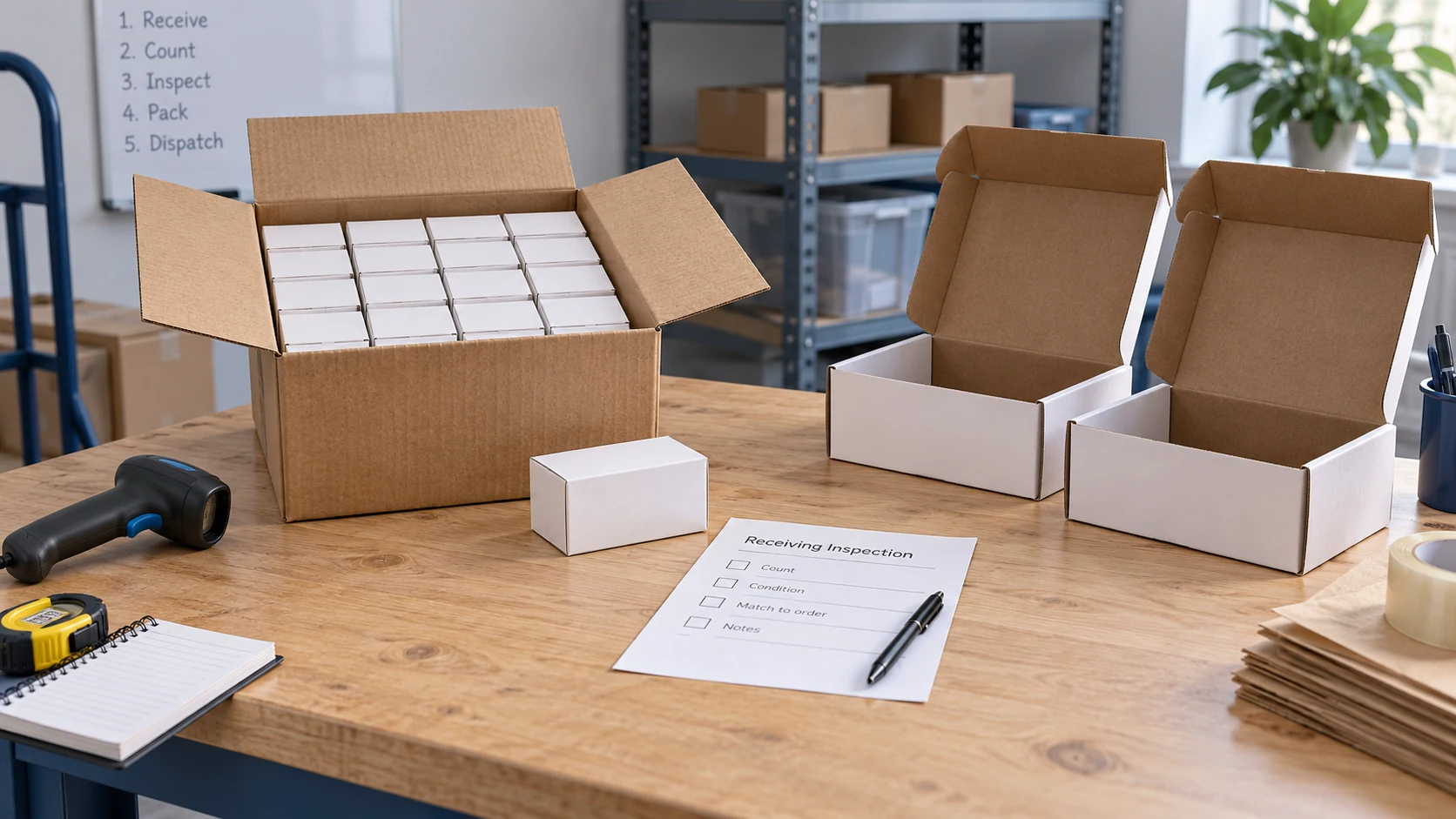
Next, test a retail order through your intended fulfillment route. Confirm the correct unit is picked, the customer-facing packing is right and tracking reaches the buyer. If a 3PL is involved, check the received SKU and pack quantity against its pick instruction.
Verify a return destination and customer-service contact as part of that test. Your buyer’s request and your wholesale supplier claim are separate transactions; an approved customer refund does not necessarily produce an immediate supplier reimbursement.
04
First-order returns do not erase the inventory risk
Faire’s current retailer return guidance describes returns on an opening order with a brand, typically within 60 days, with the actual eligible window displayed in the portal. Subsequent orders with that brand are not covered simply because you choose a product you have not bought before. The policy also says Faire does not currently offer exchanges.
The detailed returns policy sets conditions and exclusions. Original shipping to your business remains your cost, and a return benefit should not be treated as permission to buy any volume without risk.
For the twelve-unit example, ask what could happen to six slow-selling units before ordering the case. If they qualify for a wholesale return, note the portal deadline and process. If they do not, your options may involve retaining stock, adjusting the offer or another permitted disposition. A hypothetical future discount sale is not cash you have already recovered.
Your retail buyer uses a different return process. Do not give them a Faire wholesale label or promise that Faire will approve their individual request. Keep the customer’s remedy, your inventory record and any eligible wholesale recovery connected but separately tracked.
05
Need supplier-to-customer shipping instead?
First decide what you are trying to avoid or gain. “I want to sell without storing cartons at home” and “I do not want to purchase stock before a sale” are different requirements.
| Your goal | Route to investigate | Main commitment |
|---|---|---|
| Sell your own printed design without a production run | Print-on-demand provider | Product, artwork, sample and per-order production cost |
| Sell existing goods without buying the stock first | Supplier explicitly offering customer-order dropshipping | Sales permission, exact catalog, payment and fulfillment terms |
| Sell a curated branded assortment and control stock | Wholesale purchase plus your own fulfillment | Inventory cash, receiving, storage and dispatch |
| Keep your purchased stock away from your premises | Wholesale plus an approved 3PL arrangement | The same inventory commitment plus outsourced service fees |
The supplier guide compares the main sourcing channels. Use it to build a shortlist whose actual service matches your goal.
For custom branding, also distinguish changing packaging from changing the product itself. The private-label and white-label comparison explains the development and ownership questions. Buying a brand’s products through Faire does not automatically grant permission to relabel them as your own.
For a separate sourcing or fulfillment arrangement, send AIDrop your product, stock and destination brief. We can review the work that would need quotation. That does not create a Faire partnership or change Faire’s permission requirements.
06
More questions about Faire
Can I buy on Faire for an online-only store?
Eligible online retailers can apply under Faire’s account rules. Check your region, business eligibility and each brand’s selling conditions. Online-store eligibility does not include customer dropshipping.
Does a low minimum mean a brand will ship to my buyer?
No. A brand’s minimum controls its wholesale purchase size. Faire’s shipping and platform terms still apply to the transaction.
Can I contact a Faire brand to arrange an off-platform order?
Review the no-circumvention terms and use Faire’s supported clarification route. Do not assume you can bypass the platform for a brand it introduced to you.
Can I use a warehouse instead of holding stock myself?
Potentially, after confirming the receiving address, region, brand and fulfillment conditions. You still buy the stock and need to pay for receiving, storage and retail dispatch.
Will Faire’s return terms cover every customer return?
Wholesale return eligibility and the remedy you owe a retail customer are different. Check the exact account and brand terms, then design a customer process you can fund and operate.
Sources and scope
Policy and integration sources were checked on October 15, 2026. The stock and cost examples are illustrative. No Faire account transaction, warehouse arrangement or integration test is claimed.
CJdropshipping Review: Costs, Warehouses, Quality and Fulfillment Fit
CJdropshipping is a practical option for sellers who want sourcing, store connections, packaging and fulfillment in one

CJdropshipping vs DSers: Who Sources, Pays and Ships the Order?
CJdropshipping can source and physically fulfill an order; DSers maps a store product to supported external suppliers

AutoDS Review: Evaluate the Automation You Would Actually Use
AutoDS can reduce listing and order work, but its value depends on your sales channel, tier, add-ons
