
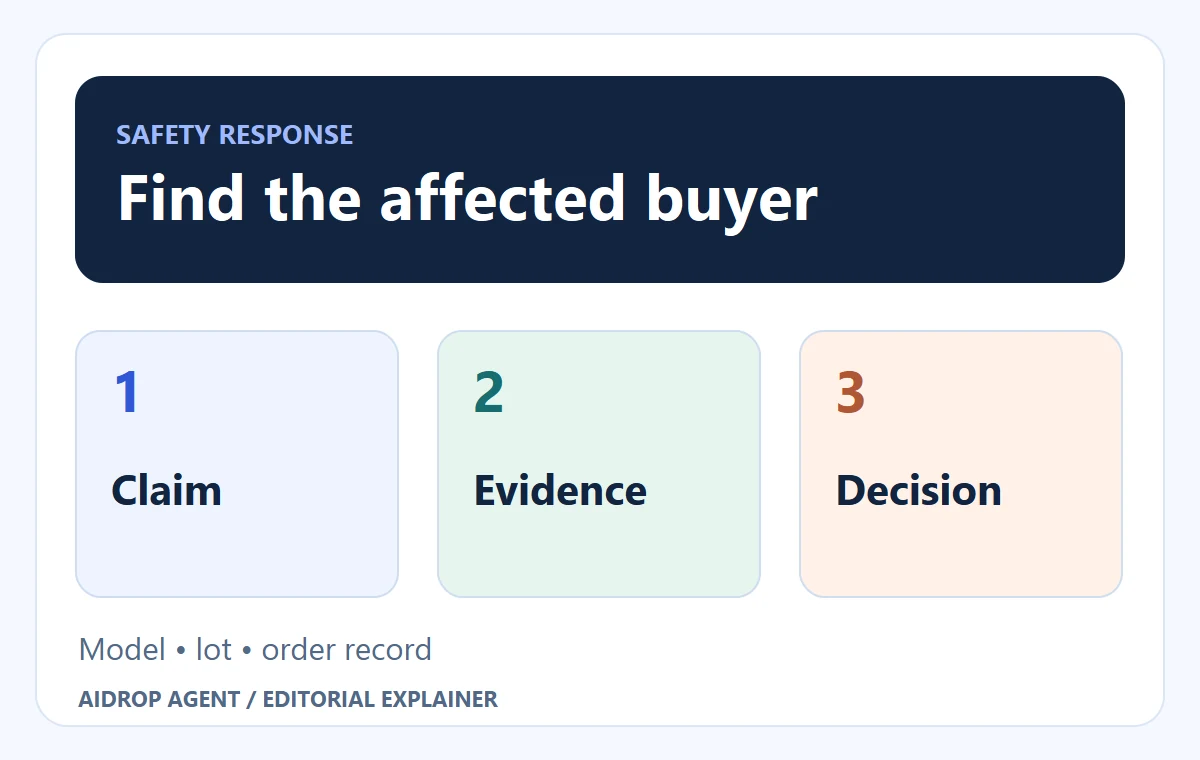
If a dropshipped product is recalled, stop sales of the affected item, match its model and lot to orders, and find the buyers. Follow the official remedy and record each action. Outsourced fulfillment does not remove your responsibility for the customer and order records.
This guide uses US CPSC consumer-product recalls as its operating example. The exact obligations and remedy depend on the product, your role and the official notice. When the match or reporting duty is uncertain, get a product-safety specialist or appropriate counsel involved promptly; do not wait for a supplier’s reassuring one-line email.
Explore the broader topic: Dropshipping Risk Management.
01
Match the recalled item to the item you actually sold
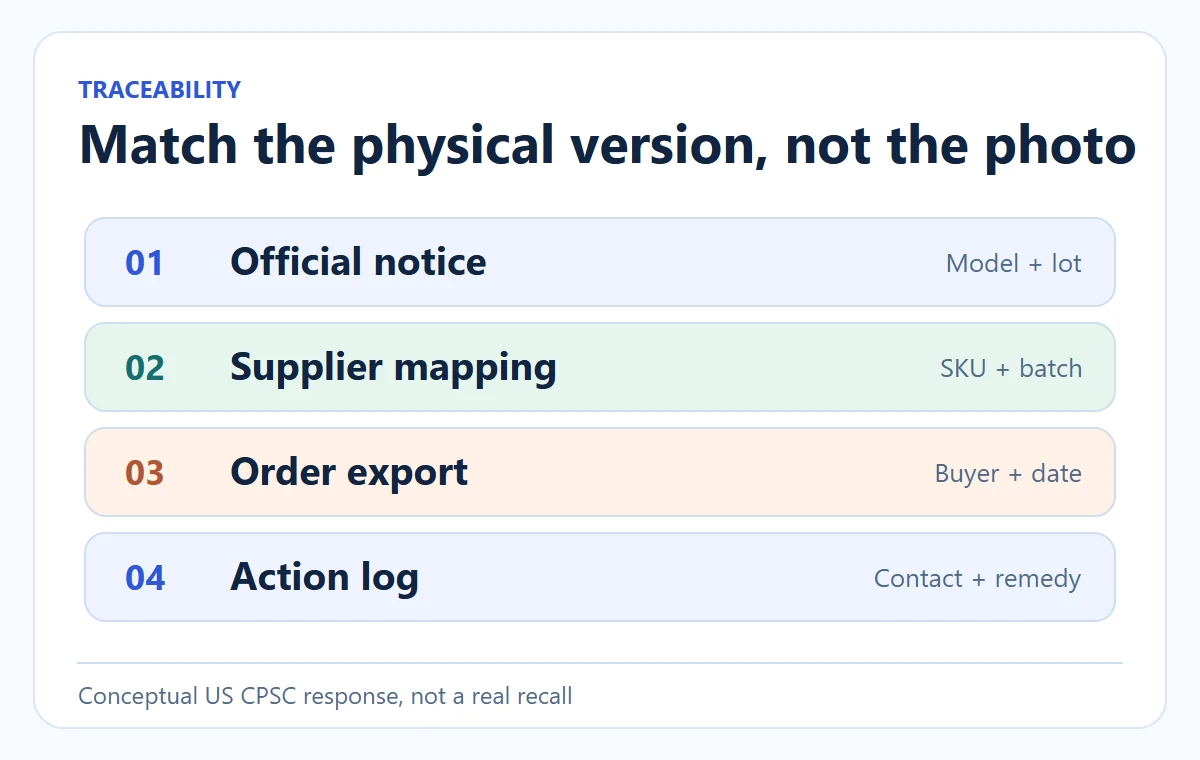
Start with the official CPSC recall database and online-seller guidance. A headline like “desk lamp recalled” is too broad. Copy the manufacturer, brand, model number, production or date-code range, identifying photos and stated hazard from the notice. Those fields decide whether your unit is affected.
Map the lamp code to the manufacturer lot
Imagine your store lists a black plug-in desk lamp under LAMP-BLK-01. Your supplier uses that code for two production batches. The recall names only model DL-420B with a date mark from a certain run. A matching storefront photo alone proves neither inclusion nor exclusion. Ask the supplier for the model and lot mapping for every fulfilled order. Check any sample, packaging photo or serial record you hold against the notice.
Hold the plausible affected variant
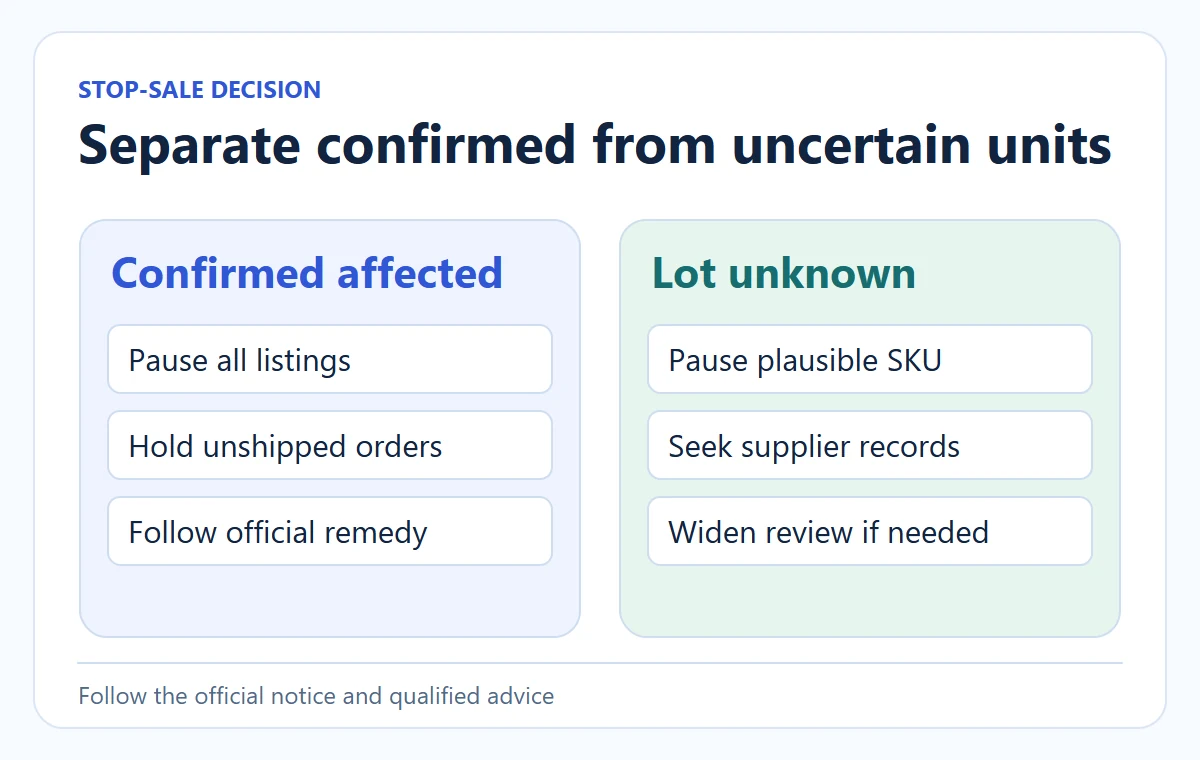
Until the match is resolved, pause the plausible affected variant. Do not simply replace its title and keep selling the same upstream SKU. If a second variant is demonstrably outside the recall, document why before leaving it live. This is a case where a clean supplier data record is more valuable than a broad product category tag.
| Record to compare | What it can establish | What it cannot establish alone |
|---|---|---|
| Official notice | Affected model, lot, hazard and remedy | Which exact customer received that lot |
| Supplier SKU map | How catalog codes connect to manufacturer items | That all past shipped units used one version |
| Order export | Buyer, date, destination and store SKU | Physical lot without supplier fulfillment data |
| Tracking and packing records | Which parcel went to which order | That the item inside was outside the recall |
On a phone, swipe the table sideways to compare every column.
Leave unknown lots unresolved
If the supplier cannot identify lots, widen the possible affected set and seek the official response route. Guessing is not a way to keep the listing active.
02
Stop the selling and fulfillment paths
The CPSC’s retailer and reverse-logistics guidance says businesses must monitor recalls and must not sell recalled products. Pausing the storefront page is only one path. Check marketplace listings, product feeds, ads, email campaigns, automated upsells and any duplicate supplier SKU in another collection.
Give each order state its own action
Separate delivered, in-transit, paid-unshipped and unpaid orders. Give the supplier the exact unshipped IDs to hold. For a dispatched parcel, ask about interception; for a delivered unit, follow the official remedy. Do not give handling or use instructions that contradict the notice.
Assign one person to maintain a dated action log: when you learned of the issue, source of the notice, affected SKU mapping, listings paused, supplier contact, open orders held and customer communication sent. A spreadsheet with evidence links is enough to begin. The purpose is to know which decision was made from which evidence, not to decorate a compliance binder.
Stop a Shopify product and verify the sales paths
For a product that may contain affected variants, the current Shopify product instructions give Products → product → Status → Draft → Save. This is a proposed stop-sale action, not a change made to a store here.
Reopen and check purchase access
Confirm the saved Draft status and test the old product URL, cart and relevant sales channels. Unlisted is insufficient: it can still allow purchase through a direct URL. If only one variant is affected, use the applicable variant/channel controls while ensuring the affected unit cannot be bought.
Stop the upstream paths too
Hold the mapped supplier item and the exact unshipped order IDs, pause its ads and promotional sends, and verify the feed does not republish it after the next sync. Do not delete the identity and order evidence while removing the buying path.
An order already paid, dispatched or delivered needs a separate response. A hidden page does not cancel a supplier purchase or notify a buyer.
Do not let a feed re-publish the product overnight
Prevent the next feed from undoing the hold
A synced supplier catalog may set the item back to “available” at the next update. Disable or quarantine the upstream mapping until the affected lot and replacement product are resolved. Check the live URL and marketplace feed again after the next scheduled sync. The inventory-buffer guide explains how feed state can differ from the actual order release decision.
03
Find every buyer who may have received it
Export order IDs, email/contact details, supplier order IDs, dates, variants and delivery status. Ask the supplier for the corresponding manufacturer model and lot. Keep confirmed affected, potentially affected and confirmed unaffected groups separate; they may require different actions as facts arrive.
Export full orders, then match them to the supplier lots
Shopify’s order-export instructions describe Orders → filter the relevant orders → Export → choose the scope and format → Export orders. Export transaction histories alone is not the full buyer-and-item record.
Keep the item lines
Check that the saved file covers the sale dates and product/variant identifiers you need. Multi-item orders can occupy several lines; do not count every line as another buyer or discard a lamp line because an adjacent row looks blank.
Reconcile the potentially affected set
Join the store order and exact variant to supplier order, manufacturer model and lot evidence. Keep unknown lots in the unresolved set. Compare the file’s order count with the supplier mapping and record why any order was excluded.
Limit access to customer data to the recall work. A successful download proves that the file exists, not that every buyer or lot has been identified.
Keep the 32 unresolved orders in the set
For the desk-lamp example, suppose 82 orders used the storefront SKU. The supplier can document that 50 were from a later lot outside the notice, while 32 have no traceable lot. Contact and remedy planning should focus on the 32 potentially affected units rather than falsely asserting all 82 were safe. The numbers are illustrative; a real recall notice and official advice control the scope.
Use the official safety and remedy wording
Customers need a plain notice that identifies the product and tells them what to do next according to the official remedy. Avoid a promotional email template or a vague “quality update.” The CPSC recall-conduct guidance addresses consumer communication and remedy planning. Save the version sent, date, channel, delivery failures and responses. The store may have the only direct customer relationship even when the supplier shipped every parcel.
The customer-service guide can help assign the support queue, but a recall message needs its own clear owner and escalation path.
04
Follow the official remedy and assess reporting
Follow the named remedy and handler
A recall can call for a refund, repair, replacement, disposal instruction or another remedy. Do not invent your own replacement with an untested supplier model. Confirm who supplies the remedy, who pays postage and how a customer proves completion. If the official notice has a remedy registration or contact point, coordinate with it rather than sending buyers only to your ordinary returns form.
The CPSC duty-to-report guidance covers manufacturers, importers, distributors and retailers who obtain reportable safety information. It describes reporting within 24 hours; an injury is not required. Assess the trigger promptly instead of waiting for the supplier to reply.
A firm need not report information it actually knows was already adequately reported, but that knowledge must be documented. If adequate reporting is uncertain, the guidance says to report. Reporting does not by itself mean a recall is required. Determine your role and the applicable response with qualified help; do not treat a general investigation allowance as permission to delay an urgent report.
Do not improvise ordinary return shipping
The usual returns process is not automatically the right route. A recall may forbid ordinary resale or require a specific disposition. Customer support, supplier operations and the official notice should use the same instructions.
05
What if the supplier cannot cooperate?
Escalate without declaring the item safe
Escalate to the manufacturer, importer, platform and relevant authority as appropriate rather than concluding the product is safe. Your store’s order data may identify buyers even when upstream lot data is missing. Preserve the supplier’s non-response and widen the potentially affected group if necessary. A response plan should be based on evidence available, not on the assumption that the upstream party will eventually send a spreadsheet.
A changed title does not clear the model
Do not restart sales with a new product title, photo or supplier listing until the actual item has been checked against the recall scope. A relabeled affected model remains affected. If a replacement model is offered, treat it like a new product: obtain the exact model identification, applicable safety evidence, sample and carrier route, then update buyer-facing claims.
This work is more demanding for a store importing hundreds of loosely mapped SKUs than for a store selling a small, approved set. That is one reason to limit catalog breadth to products you can identify and support. The saved mapping and one rehearsal of the stop-sale process can shorten a real response by hours when it matters.
06
Build traceability before the next safety event
A recall response is much easier when each customer order retains the supplier SKU, manufacturer model, variant and, where available, batch or lot. Ask the supplier which identifiers it can export with order IDs. If its system only records a generic listing title, document that gap and decide whether a higher-risk product should stay in your catalog.
For the desk lamp, a compact trace record might be:
Store order
1042
Supplier order
SUP-778
Supplier SKU
LAMP-BLK-01
Manufacturer model
DL-420B
Lot/date code
Unknown
Destination
US-CA
Preserve the evidence gap
“Unknown” is better than inventing a lot number. It tells your team why the order belongs in the potentially affected set. Ask the supplier to resolve it, preserve the original order export and record every change. If the supplier later provides a lot, keep both the original unknown status and the dated evidence that narrowed it.
Save the version used for the sale
Do not store only a current catalog feed. Feeds overwrite prices, descriptions and sometimes product identifiers. Keep the product and supplier version that was live when each order was placed. That historical link can also resolve ordinary wrong-item disputes and packaging changes, not only recalls.
Give customer support a controlled message
Support agents need one current approved response, not a collection of contradictory supplier emails. The response should identify the product, explain whether the buyer’s order is confirmed or potentially affected, direct them to the official remedy steps, and tell them how to contact your team. Do not include an invented hazard description or tell the buyer that continued use is safe when the official notice says otherwise.
Keep the buyer notice specific to the official remedy
Use one approved notice for the affected model and lot, with the official source link. The following are fields to fill from the actual notice, not invented instructions for the fictional lamp.
Identify why this buyer is contacted
Include their order reference, the manufacturer model, the relevant lot information and whether the unit is confirmed affected or still being checked. Do not present an unknown lot as cleared.
Give the authorized next step
Copy the applicable safety and remedy instructions accurately from the official notice, name its remedy contact and explain your store’s help route. State what the buyer should send and when your team will update them; do not invent a return address, disposal method or replacement model.
Track the response and completion
Keep notice date, delivery failure or bounce, buyer reply, remedy request and actual completion as separate events. Assign follow-up when the message fails or the remedy stalls. “Sent” is not “read” and “approved” is not “completed”.
This is a proposed communication record. A hazard-specific notice controls the safety wording; the ordinary returns template does not.
Follow up failed notices and open cases
Track undelivered email, bounced messages and buyers who ask follow-up questions. A “sent” count does not prove that every customer saw the notice. Coordinate any further outreach with the recall owner and official guidance. For a large affected set, a dedicated response queue prevents ordinary returns and product questions from burying urgent messages.
07
Restore only a verified unaffected or remedied product
A new supplier SKU does not clear the same affected model. Verify manufacturer model and lot, update the listing and fulfillment mapping, and inspect a permitted test order. A product covered by the recall can return to sale only under an officially valid remedy and applicable conditions, not because it appears fixed.
Remove an item you cannot safely identify
If the supplier cannot provide a reliable model/lot mapping, the honest outcome may be to remove the product. This is particularly important for a store with many imported listings: the catalog feed is optimized to publish products, not to prove a safety correction. Our quality-control guide covers the sample/specification side of a relaunch.
Ask for traceability help within the right scope
AIDrop Agent can help a merchant organize China-side supplier data, sample matching, packaging checks and order traceability. A recall remedy or legal reporting decision must follow the relevant authority and qualified advice. If you need an operational trace of a product sourced in China, send the product model, supplier record and destination through the inquiry form.
08
Frequently asked questions
Can I keep selling because I never physically held the goods?
No. The US CPSC retailer guidance addresses sale and monitoring of recalled products; outsourcing fulfillment does not make a recalled listing safe to offer. Match the exact product and follow the official notice.
What if the supplier says my units were not affected?
Ask for the model and lot evidence that supports the claim and compare it to the notice and fulfilled orders. Pause plausible affected units while the gap remains.
Should I issue a normal store refund immediately?
Follow the official remedy and the customer’s applicable rights. A refund may be part of the remedy, but an ordinary returns flow can conflict with required handling or customer notice. Coordinate the action and document it.
Is Dropshipping Legal? What Your Store Is Responsible For
Learn the US responsibilities behind dropshipping: product safety, licenses, taxes, shipping promises, intellectual property, imports and customer

Dropshipping Taxes: The Records and Questions to Prepare
Income tax, sales tax and import charges follow different rules. Use a US operating baseline to separate

Dropshipping Copyright and Trademarks: Check Products, Images and Store Claims
Check dropshipping products, images and store claims separately. Review supplier permissions, intended uses, launch decisions and infringement
