

A dropshipping HS code must describe the goods that actually cross the border. Collect the material, function and packed contents, identify the destination’s tariff system, and have the responsible importer or broker review the classification. A supplier’s number is a lead, not approval for every country.
Give the responsible reviewer the actual goods
A listing called ‘wooden desk organizer’ might contain a composite tray and steel frame. Before choosing digits, get the facts for that complete set. The worksheet below helps you ask an importer or broker a question they can answer.
The United States HTS published by the USITC is based on the international Harmonized System but adds US-specific detail.
The US International Trade Administration explains that HS codes are used to classify goods in trade; the EU has its own Combined Nomenclature.
This article is about collecting the facts and controlling a classification decision. The commercial-invoice guide covers the different task of making the shipment document match the real parcel.
Explore the broader topic: Is Dropshipping Legal? What Your Store Is Responsible For.
01
Begin with a product fact sheet
“Desk organizer” may describe a bamboo tray, plastic drawer unit or metal rack. Those products can have different classification questions.
Collect construction and composition facts
Ask the supplier for the actual composition, dimensions, main use, component list, photos of the physical product and package, country where it was made, and any model or technical specification that changes its identity. A marketing keyword such as “eco-friendly” is not a material description.
For an illustrative organizer, the listing says “wooden desk organizer.” The supplier sample is a bamboo-fiber composite with a removable steel frame. Before anyone searches a tariff database, identify whether the frame is a functional component, how the composite is made and what the complete set looks like when imported. Otherwise a search result for a simple wooden tray could be attractive but wrong.
Give the reviewer one physical product version
Use a fictional ORG-V1 packet for the bamboo-fiber composite organizer and removable steel frame. This is a request worksheet, not a classification decision. Leave unknown material percentages, manufacturing facts and proposed codes marked unconfirmed.
Describe what is imported
One complete organizer set: composite tray plus removable steel frame. Attach current photos, construction, main use, component materials, actual dimensions and packed contents. Ask the supplier whether the frame is functional and how the composite is made.
Ask an answerable question
“For ORG-V1 imported into [destination], please review the attached physical specification and set. Which heading/subheading and national extension apply, what notes or rulings support it, and what additional facts are needed?” Include the reviewer, decision date, source edition and unresolved fields in the response.
If the answer needs composition data the supplier cannot provide, keep the classification pending. Do not invent 60% bamboo or paste a plain wooden tray’s code onto this composite set to complete the worksheet.

| Product fact | Source to request | Why it matters |
|---|---|---|
| Main and secondary materials | Supplier specification plus actual sample or reliable photos | Material can change the relevant headings and notes |
| Function and construction | Technical sheet and use demonstration | A container, furniture component and decorative article may differ |
| Included pieces and retail set | Packing list and carton contents | A set or accessory may change the analysis |
| Country of origin | Manufacturing evidence, not shipping warehouse address | Origin affects trade treatment separately from code selection |
| Destination and importer | Customer route and commercial arrangement | National tariff digits and responsibility vary |
These facts let the responsible reviewer evaluate the product. Trade.gov’s classification guidance points to the official tariff system, rulings and interpretation rules for mixed materials and sets. A photo or a marketing description alone leaves important facts unanswered.
02
Separate the global HS concept from the destination code
The first six digits of the Harmonized System provide an international structure, but countries extend it. The US HTS has additional subheadings and statistical detail; the EU Combined Nomenclature uses its own eight-digit coding system.
A six-digit number copied from a China export record is therefore not automatically the complete number to use on a US entry. Nor should a current US code be pasted into an EU shipment without checking that jurisdiction’s system.
Check the destination and the edition before the digits
Trade.gov distinguishes the international six-digit HS structure from the complete ten-digit US import HTS or US export Schedule B number. The EU’s Combined Nomenclature adds eight-digit subdivisions. Confirm further entry detail with the actual destination reviewer.
US import worksheet
Product version ORG-V1; destination US; current HTS edition checked ___; candidate and notes ___; responsible review ___; complete required import code ___; effective date ___; status pending or approved. Do not use the US export Schedule B merely because it has ten digits.
Another destination
Keep a separate destination record with its own approved code, notes and effective date. A six-digit export code on the supplier’s record does not settle a US entry or an EU declaration. Preserve the upstream code for what it actually describes.
At our October 11, 2026 check, the USITC announcement lists 2026 HTS Revision 21, published October 9. A cached search result still displaying Revision 20 is not proof of the current edition. Recheck the live schedule for the declaration date; this dated observation is not a permanent tariff update.
Ask what this declaration field requires
The confusion often appears in shipping software: a field labelled “HS code” may accept a short number, while the carrier or broker needs more detailed destination data. Ask the person preparing the actual declaration what length and supporting description the route requires. The document should identify the goods in ordinary words alongside the classification; a precise-looking number cannot rescue a vague item description.
Code, origin and value answer different questions
Do not merge classification with other customs questions. Code, origin, value and importer identity are separate fields. A product can have a plausible code and still be delayed because its origin was misstated or the invoice value does not match the transaction.
The customs-duties guide deals with the cost consequence; this page deals with how to avoid guessing the classification input.
03
Research a candidate without treating a search result as approval
Search the current destination tariff schedule using both the product name and the relevant materials/functions. Read the surrounding heading, chapter notes and exclusions rather than taking the first matching search hit.
Search for candidates, then record the reason
For a US review, start at HTS with the verified ordinary product name and relevant materials. Use the organizer’s real specification rather than only “eco desk accessory.” The following is a research procedure; we have not assigned this fictional set a code.
Read the surrounding rules
Open a relevant result and inspect its heading, subheadings, section/chapter notes and exclusions. Keep the source edition and the physical facts that made it a candidate. A matching keyword is not enough.
Compare official rulings
Use CROSS to investigate comparable goods. Compare composition, construction, function and packed set; record material differences. Give the reviewer the candidates and unresolved questions, not a declaration that a similar photo makes the ruling yours.
For a consequential unresolved US classification, the importer or broker can assess CBP’s binding-ruling route and current requirements. Do not label a supplier email, a search result or this worksheet as a binding ruling.
Compare physical facts, not thumbnails
Keep the shortlisted headings and rulings in the same packet as the sample specification. Mark differences that still need review, such as a removable frame versus a fixed support; do not hide them behind the supplier’s marketing name.
For US imports, the USITC HTS publishes the current schedule, while CBP is the authority that determines the correct treatment of an imported item.
An apparent tariff match still needs the actual product facts and the importing authority’s treatment. Keep classification separate from the eventual duty calculation: origin, value, entry date and applicable trade measures can change that calculation.
For difficult or consequential cases, CBP provides an electronic binding-ruling process with detailed factual requirements. A broker or importer can assess whether that path is appropriate before commercial volume is shipped.
Keep a decision packet instead of “probably X”
For the illustrative bamboo-and-steel organizer, the useful output is not “probably code X.” It is a short packet showing the real sample, material percentages or construction details, uses, complete packed contents, proposed headings considered, reason for any exclusion, and the responsible reviewer’s decision.
Reopen approval after a material change
If the supplier changes from bamboo composite to all-plastic after approval, reopen the decision. The item that crosses the border is what matters.
04
Connect the approved code to the parcel and listing
Keep approval with its SKU version
Once the responsible party approves a classification for a defined product, store it with a versioned SKU specification. Do not let a supplier feed overwrite it merely because the supplier updated its catalog text. On each shipment, compare the picked goods and packing record with the approved specification.
Check the actual included accessories
If the carton contains an adapter, spare battery or additional accessory, ask whether the existing classification and invoice lines still describe the parcel correctly.
Preserve country-specific records
The export and import declarations may use different national extensions. Keep the upstream supplier record, destination broker instruction and carrier document connected to the same SKU revision, but do not force one country-specific number into every field.
For US imports, 19 CFR 141.86 specifies invoice information such as a detailed merchandise description, quantities, value/currency and origin, with parcel contents identified. Put the approved classification data where the actual entry and carrier/broker process require it. Do not turn that into a claim that every invoice universally requires the same HTS field.
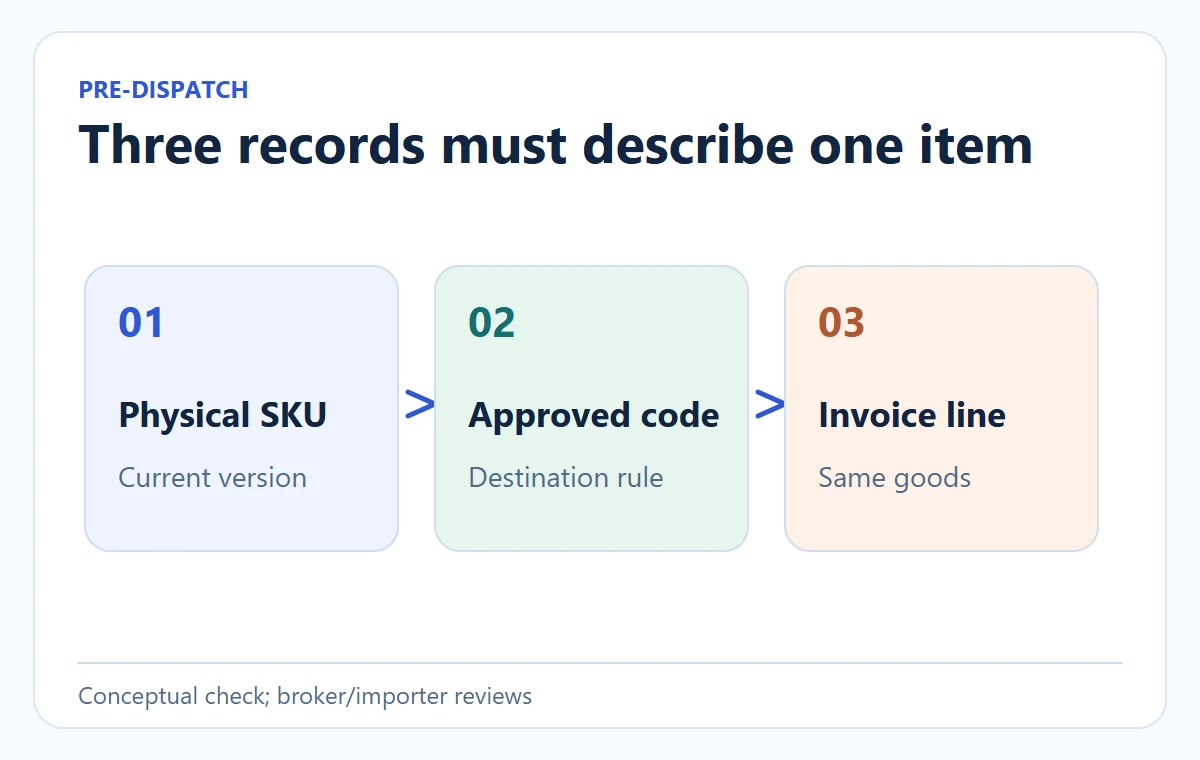
A practical pre-dispatch check can be a three-way match: physical product sample or verified current SKU, approved classification record for the destination, and the commercial invoice/label data sent to the carrier. If one differs, hold that shipment until the responsible party corrects it. Fixing the store product page alone does not correct a document already lodged with a carrier.
05
Know when the question needs specialist review
Identify the difficult classification case
Escalate when the material is mixed, the item has several functions, a kit or set includes different goods, the supplier changes components, the proposed code has large duty or restriction consequences, or customs has already queried a prior parcel.
Hold a classification that still needs facts
Put unresolved classification on the same hold list as other dropshipping operating risks. Name the reviewer and the evidence still needed so a missing answer cannot quietly become an approved shipment.
Ask which classification fits these goods
The question is not “Which code is cheapest?” It is “Which classification fits the actual goods under this destination’s rules?” Record uncertainties and decisions instead of masking them with a generic code from a marketplace.
AIDrop Agent can help gather China-side product, packing and supplier records for a broker or importer’s classification review. Send the physical item description, destination, current code proposal and any customs query through the review form. We do not treat an illustrative article or a supplier catalog code as a binding customs decision.
06
Keep the classification decision usable by the team
A code written in a spreadsheet without its reason will become unreliable when a product changes.
Keep the classification decision with the product it actually covers:
- Scope: Exact product version and destination.
- Product facts: Materials and function used in the decision.
- Candidate headings: Options considered and the reason for the chosen classification or exclusion.
- Review: Responsible reviewer or broker and decision date.
- Authority record: Source schedule revision and any ruling or advice reference.
Make the approved scope visible
The next person can then tell whether the record applies to a new color variant, a new component or a different destination.
A plastic support changes the review facts
For the illustrative organizer, suppose the supplier replaces the removable steel frame with a fixed plastic support. Do not let a feed update overwrite the material description while retaining the old code.
Record why the changed item is or is not covered
Hold new shipments, obtain the revised specification and ask the responsible classifier whether the change affects the conclusion. If the answer is no, record why; if it changes, version the code and documents. This produces an audit trail without presenting the store as the customs authority.
A provisional code gives a provisional estimate
The same discipline helps with customer-facing cost estimates. A duty estimate based on a provisional code and origin should be marked as such until the actual route data is confirmed. A buyer’s checkout surprise may come from a classification error, a value error, a different importer arrangement or a tariff change.
Investigate each field rather than automatically changing the HS number to make the calculator display a lower charge.
Warehouse country is not manufacturing origin
Do not confuse a manufacturer’s country with the country of origin used for customs. A product shipped from a warehouse in China may have been made elsewhere, and a product assembled from imported parts may require a closer origin analysis. Classification and origin interact in the duty calculation but are not the same decision.
Ask for origin evidence
If the supplier cannot substantiate the origin it places on an invoice, ask for manufacturing evidence before making a buyer-facing landed-cost claim. A warehouse address is logistics data, not proof of where the good was made.
Preserve the original submitted document
When a customs query arrives, preserve the original document and the question from the authority or carrier. Do not edit a local spreadsheet and pretend that was the information originally filed.
Correct through the actual declaration channel
The broker or importer should submit a supported correction through the applicable channel, with the product facts and revised classification rationale attached. After release, update the approved SKU record so the next parcel does not repeat the same error.
This turns a customs hold into a controlled data repair rather than an improvised one-off code change.
07
Frequently asked questions
Can I reuse my supplier’s HS code?
Use it as a lead, not an automatic answer. Confirm what goods and export jurisdiction it describes, then check the destination’s required tariff detail against the actual product.
Is an HS code the same as the duty rate?
No. Classification is one input. Origin, trade measures, value and applicable programs can affect the actual charge. The importing authority and current schedule control the result.
Do I need a new review when a supplier changes a material?
Yes, if the change affects the product facts used in classification. Preserve the old SKU version and evaluate the new physical item before reusing the prior code on new parcels.
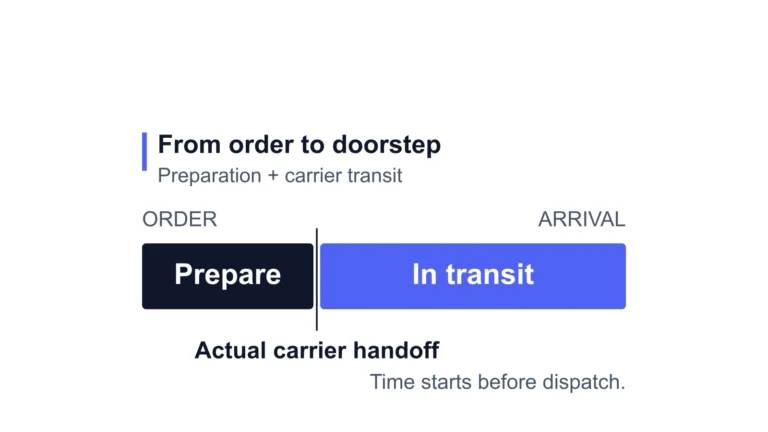
Dropshipping Shipping Times: What to Promise Your Customers
Use product-specific processing and transit estimates to set a delivery promise. Named route examples and a worked
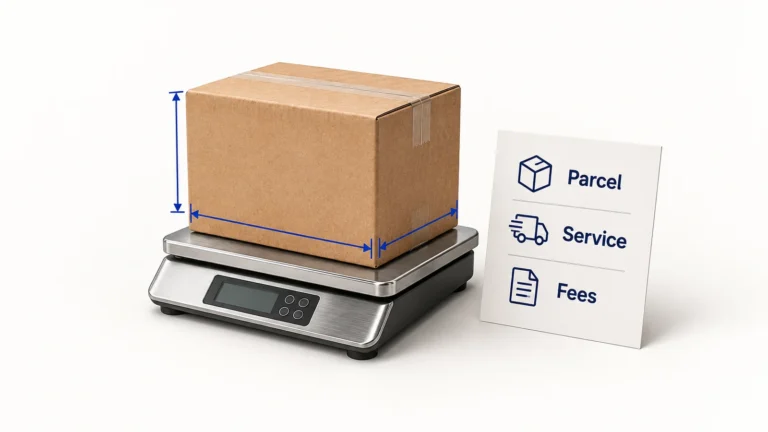
Dropshipping Shipping Costs: Compare the Whole Parcel Quote
Calculate dropshipping shipping costs from packed dimensions, billed weight and fees. Compare a worked parcel quote, import
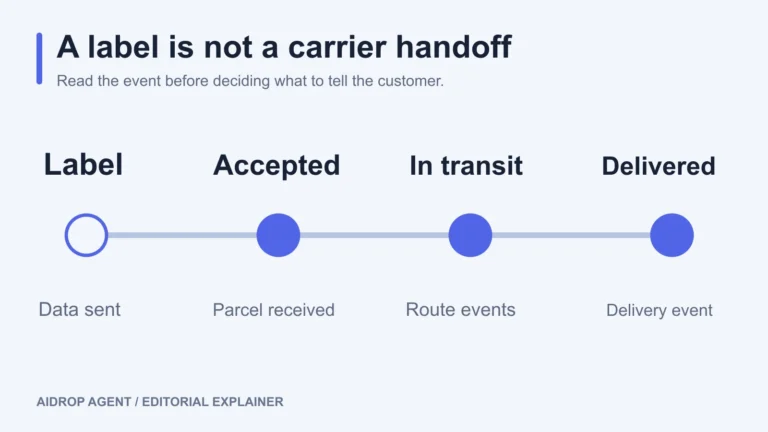
Dropshipping Tracking: Set It Up and Handle Missing Updates
Set up parcel-level tracking, interpret carrier events, and investigate missing updates without mistaking a shipping label for
