
DropCommerce is worth testing for US or Canadian customers when one supplier’s product, delivered cost and return terms fit your offer. Use the free catalog to shortlist and sample. Pay for processing or automation after that specific order path works.
It is tempting to see “US suppliers” and assume every parcel will arrive quickly. That is a platform description, not a quote for your customer’s address. Before importing 200 listings, find out what happens to one paid order, including a damaged one.
Explore the broader topic: US Dropshipping Suppliers: Verify Stock Origin, Coverage and Order Terms.
01
What DropCommerce does between your store and the supplier
DropCommerce gives a merchant access to product listings from US and Canadian suppliers and a Shopify app to connect those listings to a store. Your store takes the customer order. The supplier supplies and ships the item. You still set the selling price, explain the delivery promise, answer the buyer and arrange a remedy when something goes wrong.
That division matters. A platform can move order data; it cannot make a fragile mug survive a particular packing method or guarantee that a supplier has stock for tomorrow’s sale. The DropCommerce Shopify app listing describes the integration and notes that external charges may be billed outside the Shopify invoice. Treat the listing as a feature description, then verify the order in your own account.
Approve this mug, not a warehouse headline
Pick a product you can inspect. Imagine a ceramic mug offered by a supplier with a warehouse in the US. Record its exact SKU, size, color, stated contents and supplier name. Order a sample to the destination market.
Check capacity, contents and packing
Compare the sample with the catalog photograph: glaze, handle, capacity, packaging and any included insert. A listing is ready only when the item you can send matches the item you promise. Our sample-testing guide shows how to document that comparison.
The first handoff to watch
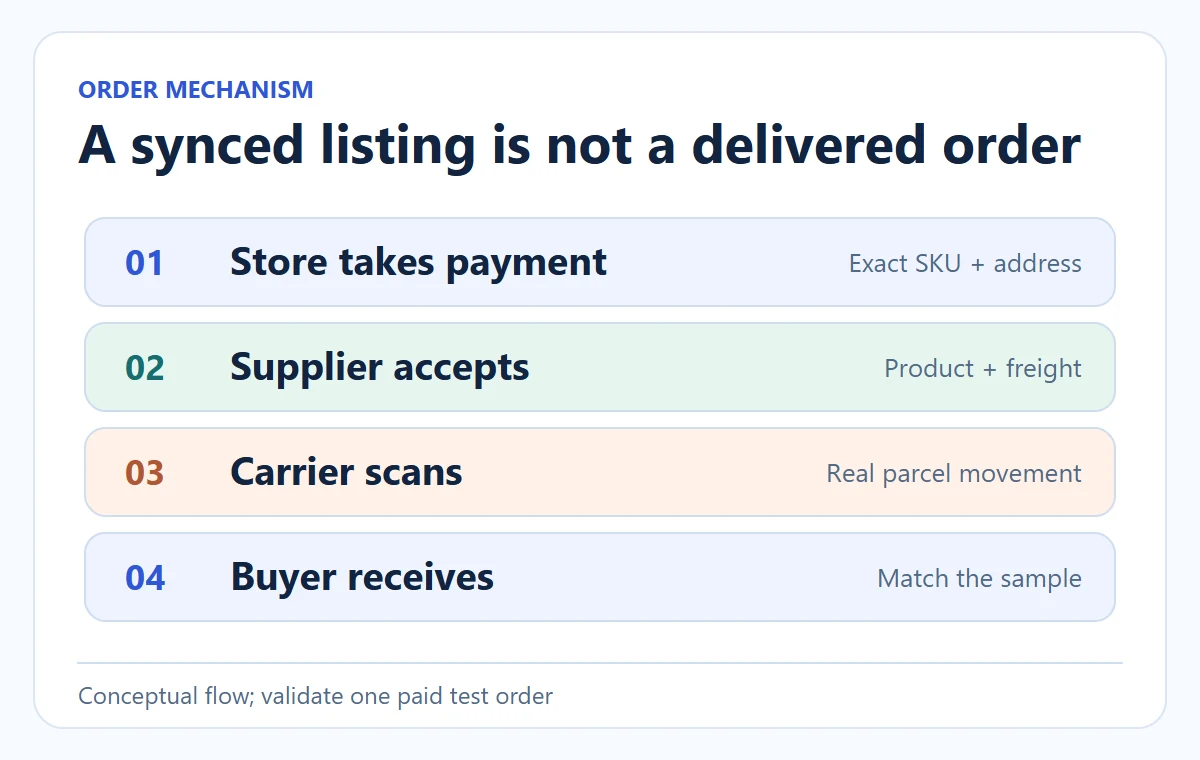
Place a test order through the path you intend to use for buyers. Check whether the order reaches the supplier, when payment is requested, whether the address and variant survive the transfer, and when the tracking number comes back. An imported product can look correct while an order is still stuck at the payment or supplier-acceptance step.
Write the result as a sequence of observable events, not “integration working”:
Match the store order
The Shopify order contains the exact supplier SKU and customer address.
Check supplier acceptance and cost
The supplier accepts that same SKU and shows the final product and shipping charge.
Find physical carrier receipt
A carrier receives the parcel; tracking identifies an actual movement, not only a label.
Compare the delivered mug
The delivered item matches the approved sample and packing expectation.
If an event fails, keep the listing out of a paid campaign until you know who repairs it.
Pay the supplier, then verify the saved order
DropCommerce’s order instructions explain a common first-sale surprise: your customer can have paid while the supplier order is still Pending. Supplier payment is a separate transaction.
Review before paying
On a paid processing plan, open Orders and the Pending order. Check the exact mug, quantity, destination and product-plus-shipping total. Register the merchant card through Settings → Account Details if required. Resolve an incomplete address before authorizing the purchase.
Pay once and reopen
For the permitted test, use Pay Supplier & Fulfill Order. Reopen its saved details and confirm payment and Paid/Processing. If payment fails, inspect the charge and existing order before retrying. A paid supplier order is still not a carrier pickup or proof of delivery.
The automated-payment guide says Professional can pay using the stored card when enabled. Test that choice deliberately; do not assume importing a mug turns automation on. No purchase was made for this review.
02
Choose a plan by the next order action
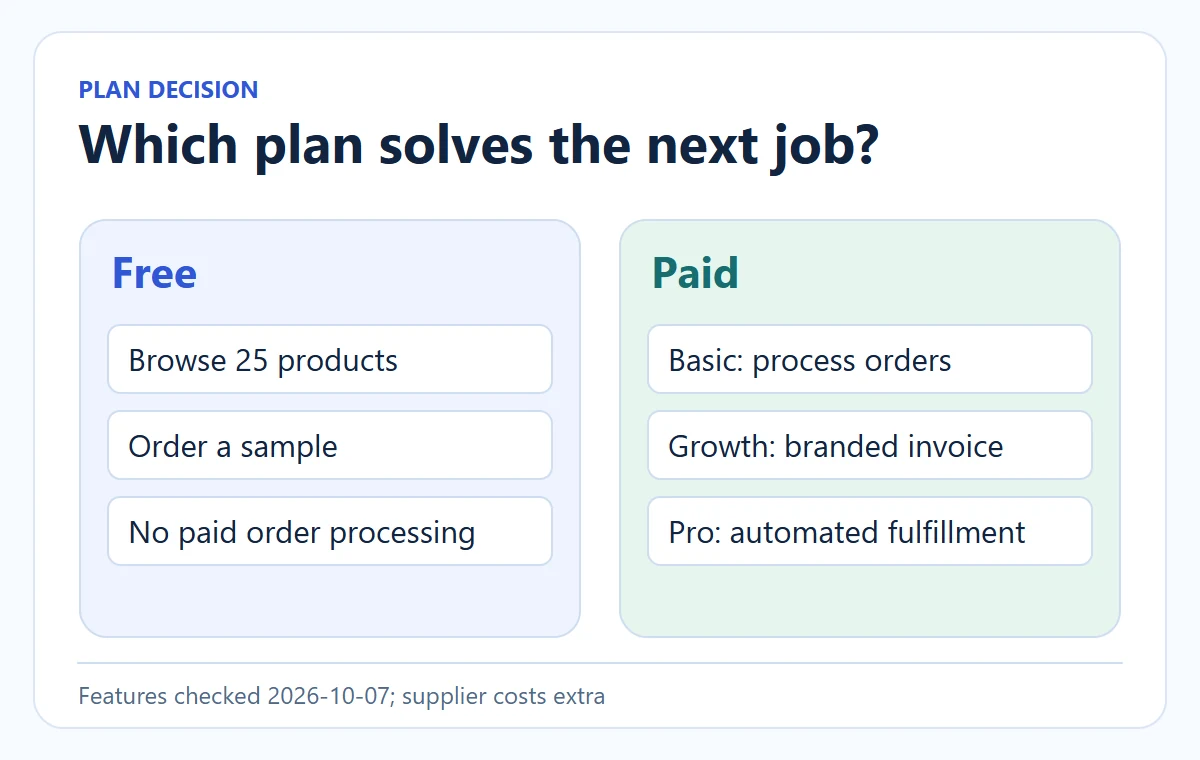
On its pricing page, rechecked October 11, 2026, DropCommerce displays Free with 25 products and sampling, Basic at $29 monthly for order processing, Growth at $55 with branded invoicing and 250 products, Professional at $95 with automated fulfillment and unlimited products, and Executive at $149 with an account manager.
These are the website’s displayed monthly USD plans; confirm the actual billing option in your account. The page says there is no DropCommerce transaction fee on paid plans. Product, freight, payment processing and remedy costs still belong in the order calculation.
| Your immediate job | Plan feature to verify | What remains outside the subscription |
|---|---|---|
| Browse a shortlist and order a sample | Free catalog and sampling | Sample, shipping and any supplier charge |
| Send a real customer order | Basic order processing | Product, freight, payment and returns |
| Put your invoice in the parcel | Growth branded invoicing | Whether this supplier and parcel support your brand promise |
| Reduce manual order actions | Professional automation | Exceptions, stock errors and customer support |
On a phone, swipe the table sideways to compare every column.
Buy a plan for a task you already need
The plan changes how you process an order; it does not create a margin. If you have not yet approved a sample or a workable quote, paying for automated fulfillment solves the wrong problem. If you already process a predictable volume, the monthly subscription can be compared against the hours and errors it saves. Make that decision with your own order count rather than a plan label.
Put the subscription into a real order calculation
Suppose you sell the mug for $32. Ask the supplier for the product price, shipment to a specific ZIP code, packaging or handling charge, and whether taxes or other charges appear before checkout. Then calculate:
Selling price − supplier product − supplier shipping − payment fee − expected refund/defect cost − allocated app subscription = contribution before customer acquisition and overhead.
The $29 Basic fee would be $2.90 per order at ten orders a month, or $0.29 at 100 orders, purely as an allocation exercise. You still need the supplier’s actual order charge. Ten orders are not a promise of volume; a slow first month might allocate even more per parcel. Our shipping-cost guide explains why the destination and service have to be in the quote.
Work the mug calculation all the way through
Use these fictional values to see the effect of a slow month. They are not a supplier quote or a prediction of sales.
Ten fulfilled orders
At $32 collected, subtract $12 product, $6 shipping, $1 payment fees, a $2 expected defect/refund allowance and $2.90 app allocation: $8.10 remains before acquiring the buyer and fixed overhead. Any separate packaging charge still has to be deducted.
One hundred fulfilled orders
With the same inputs and $0.29 app allocation, the remainder is $10.71. If acquiring each buyer costs $11, even this higher-volume version loses money before overhead. A smaller subscription share cannot rescue the offer by itself.
Basic to Professional adds $66 monthly at the displayed rates. Compare that increment with your own measured time saved and exception costs; product count alone does not tell you whether the upgrade pays.
Do not copy a supplier’s suggested retail price into your store and call the difference “profit.” The buyer may pay you once, but you pay for the product, delivery, payment processing, acquiring the buyer and any remedy. Record those on the same SKU sheet.
03
A return tests the relationship more than the happy-path order
The platform’s return guidance asks merchants to contact DropCommerce or the supplier. If a supplier has not shipped, the team may stop shipment and begin a cancellation or exchange. After shipment, the supplier’s own return policy matters. That is why a generic “30-day returns” promise copied from another store is unsafe.
Ask before publishing the mug:
Accepted return reasons
Does this supplier accept a change-of-mind return, a damaged-item claim, or both?
Approved receiver and label payer
Where does the buyer send the parcel, and who pays the return label?
Evidence for a cracked mug
What evidence is required for a cracked item? Is an image enough, or must the unit be sent back?
Authority and buyer update
When is a refund or replacement authorized, and who tells the customer?
Keep the return attached to the order
You own the customer conversation even when the supplier accepts the parcel. Save the supplier’s written policy with the SKU and create a short response for the buyer. A consumer should not have to discover a supplier’s process after they have already mailed a mug to the wrong address. The wider returns guide covers that storefront-side decision.
Give a product-specific delivery estimate
The same separation applies to shipping speed. DropCommerce’s pricing page describes fast US shipping and refers to 3–5-day receipt. Do not print that as a universal delivery guarantee. Check processing time, destination, carrier service and a tracked sample; then write a delivery estimate you can support for the product you actually sell.
04
Keep a one-SKU launch record
A small record makes a later plan or supplier change much easier to judge. It can be a single row in a spreadsheet, with the values filled from your actual sample and order:
| Field | Mug test entry |
|---|---|
| Product identity | Supplier, exact SKU, sample date and approved photos |
| Market | ZIP-code range tested and excluded addresses |
| Costs | Product, freight, fees, app allocation and expected remedy |
| Order proof | Acceptance time, first carrier scan and delivered-item match |
| Exception | Return address, evidence required and refund owner |
On a phone, swipe the table sideways to compare every column.
Try an address change on your own order
For the mug, make the test slightly harder than a perfect order. Change the shipping address before supplier acceptance. See whether the update moves upstream or whether you must cancel and replace the supplier order. Do this only with your own order. A merchant who learns that limit after a customer moves will face a preventable resend cost.
Save the approved sample version
Compare the product name and variant in your storefront, the DropCommerce order view and the physical parcel. If the supplier replaces a component, an integration may keep sending the same SKU while the buyer sees an old photograph. Add a version date to the sample record so the next shipment has something concrete to match.
Test automation against exceptions
Check exceptions before enabling automation
A manual processing plan may be slower but lets a person inspect an unusual address or split item before release. Automated fulfillment can move an incorrect order faster if the underlying data is wrong. Before upgrading, test a normal order, an order with a missing apartment number and an unavailable variant. Record which are held and which move without intervention. “More automated” is useful only when that behavior matches your support capacity.
Quote the actual ZIP code
For the cost row, quote the destination you actually sell to. A US supplier may price Alaska, Hawaii or a remote address differently from a major city. If the product page says “free US shipping,” decide whether your price absorbs the expensive zones or checkout must restrict them. A US warehouse does not establish a universal US delivery charge.
For a damaged-mug rehearsal, link the store order and supplier order to the exact SKU, delivery date, damage photos and packing photos. Ask the supplier or DropCommerce support for the authorized remedy, any return receiver and label payer, and when a decision will be available.
Save the request and reply together. Tell the buyer what is confirmed and when you will update them. After approval, record the replacement order or actual refund transaction; “approved” is not the money movement.
If the supplier does not answer in time, escalate the unresolved buyer case. Do not mark it complete merely because you sent the claim.
Wait for stock and the approved receiver
Do not promise a replacement while stock is unknown or send the buyer to an unapproved return address. If the supplier requires a physical return, calculate postage and breakage risk before offering change-of-mind returns on that SKU.
This is the difference between a “returns page” and a return operation. The page is the public promise; the operation is an order ID, evidence, supplier decision, buyer update and credit. If the record cannot show both, the product is not ready for wider promotion.
05
Decide whether the test supports a live listing
The final choice is smaller than “Is DropCommerce good?” It is: Can this supplier fulfill this SKU to my customer under my promise? A useful release record has four lines: approved sample, complete landed order charge, observed test tracking and supplier return rule. If one is missing, the listing remains a candidate.
DropCommerce may fit a merchant who values domestic supplier access and a Shopify order path. It may be a poor fit for a store that needs a very specific private-label specification, a destination the supplier does not serve, or return terms incompatible with its offer. Compare those needs with the wider supplier-selection guide rather than treating the catalog as a supplier-quality ranking.
Ask for an order-based sourcing comparison
If you want to compare a US supplier route with China-side sourcing and fulfillment, AIDrop Agent can review the SKU, sample standard, packaging, destination and exception process with you. Send the actual product and target market through the review form so the comparison is based on an order, not a headline delivery claim.
06
Frequently asked questions
Is DropCommerce free for customer orders?
Its current pricing page offers a free tier for browsing products and ordering samples, with a 25-product limit. Order processing is listed on the paid Basic tier. Check the current account checkout before relying on a price or feature.
Are all products shipped in three to five days?
The site makes a broad fast-shipping claim. A particular order depends on supplier processing, stock, destination and carrier service. Use a tracked test order and a product-specific estimate.
Who decides if a customer can return an item?
The supplier’s return policy is material after shipment. DropCommerce’s guidance describes contacting support or the supplier to arrange the process. Your store still needs a clear buyer-facing policy and support route.
CJdropshipping Review: Costs, Warehouses, Quality and Fulfillment Fit
CJdropshipping is a practical option for sellers who want sourcing, store connections, packaging and fulfillment in one

CJdropshipping vs DSers: Who Sources, Pays and Ships the Order?
CJdropshipping can source and physically fulfill an order; DSers maps a store product to supported external suppliers

AutoDS Review: Evaluate the Automation You Would Actually Use
AutoDS can reduce listing and order work, but its value depends on your sales channel, tier, add-ons
