

For Christmas dropshipping, start with a few gifts or decorations for one clear buyer: personalized ornaments, stockings or sacks, greeting cards, or a useful gift with a seasonal design. Choose an available supplier route and sample it early. The product must arrive before the buyer’s occasion, which may be well before December 25.
A durable ornament can lose most of its gift value if it arrives after the tree is decorated or the office exchange is over. That makes timing part of the product. You are selling a gift for an occasion, as well as a physical object.
The catalog examples below were checked on October 12, 2026. They show products to investigate, not measured bestsellers. No carrier’s official 2026 holiday cutoff is asserted here.
01
Pick the buyer and the occasion before the product
“People buying Christmas gifts” is too broad to guide a small store. A baby’s first Christmas, a family moving into a new home and an office gift exchange call for different products and messages.
For a first-Christmas ornament, the name and year may be the reason to purchase. For an office gift, the buyer may care more about a sensible budget and having something ready to wrap. For tree decorations, arrival before the household decorates can matter more than arrival before Christmas Day.
Write a one-sentence offer before choosing a supplier: “A personalized ornament for a baby’s first Christmas, with the name and year clearly shown.” Then record when that buyer expects to use it.
This small step narrows the assortment and improves the product page. You can show the relevant detail instead of filling the page with vague statements about festive magic. It also helps you avoid testing ten unrelated items with ten different production and shipping arrangements.
02
Six Christmas products worth investigating
These ideas have identifiable supplier starting points. Confirm the actual item, destination and availability before making any of them a store offer.
| Product | A clear buyer use | Supplier route to investigate | The difficult check |
|---|---|---|---|
| Personalized ornament | First Christmas, family name or new home | Prodigi’s Christmas catalog | Material, spelling, printed side and protective packing |
| Stocking or gift sack | A named place for small gifts | Prodigi sacks or Gooten stockings | Finished dimensions, personalization and included features |
| Greeting card | A message for family, colleagues or customers | Gooten holiday catalog | Size, printed sides and whether an envelope is included |
| Seasonal cushion or blanket | A usable home gift with original artwork | MerchOne Christmas catalog | Fabric, size, printed area and care information |
| Designed mug | A modest personal gift | MerchOne Christmas catalog | Exact mug specification, print and parcel protection |
| Wrapping paper | A coordinated gift presentation | Gooten holiday catalog | Sheet or roll format, dimensions and shipping cost |
Prodigi’s Christmas page lists ornaments in several materials and gift sacks, with UK fulfillment information for that range. Gooten’s holiday collection includes products such as stockings, cards and wrapping paper. MerchOne’s collection supplies further home-gift starting points.
Choose perhaps three products that serve one buyer, rather than copying all six into your store. An ornament, a matching card and coordinated wrapping could form a clear theme, but their shipping arrangements still need checking before being sold as one gift set.
Electrical decorations and toys need their own product-specific compliance work. Do not add them simply to make the assortment look larger.
Look closely at one real ornament specification
Prodigi’s XMAS-PLAS-BAUB bauble describes a specific object:
| Listed detail | What the buyer receives |
|---|---|
| Size and origin | 79 × 84 mm; fulfilled from the UK |
| Satin card insert, displayed on both sides inside a clear plastic ornament | |
| Included fitting and packing | Hanging string; boxed packing |
That is a different object from a directly printed ceramic ornament. For the bauble, inspect whether the name is readable through the shell and what the insert looks like from the side. For ceramic, inspect the printed face, reverse and edges. The same “Mira, First Christmas” artwork needs a product-specific template in either case.
This distinction also improves the sales copy. “Personalized clear bauble with a printed insert” explains the physical product more accurately than “luxury hand-painted ornament.” If the buyer wants a ceramic keepsake, choose and sample that ceramic SKU instead of borrowing its description for the plastic one.
Ask for the current item-and-destination quote. The catalog’s starting product price excludes delivery and taxes; it cannot establish the delivered cost or Christmas arrival deadline for your buyer.
03
Choose stocked goods or print on demand
Stocked goods already exist, so an available item can proceed to picking and dispatch. Print-on-demand goods add artwork preparation and production. Personalized goods may also require checking the buyer’s exact input.
For an original family ornament, print on demand avoids buying a finished piece for every possible name. For an existing unprinted decoration, verified stock and a dependable packing arrangement may be more important than customization.
Neither route removes fulfillment constraints. Stock can run out; a POD provider can have unavailable materials, production queues or route restrictions. Obtain the current item-specific answer rather than treating a catalog as unlimited supply.
| Offer requirement | Route worth exploring | What to establish early |
|---|---|---|
| Original printed design | POD | Template, sample, production and delivery |
| Name or year for each buyer | Personalized production | How buyer data reaches artwork and approval |
| Existing decoration shipped individually | Stocked supplier | Variant stock, order handling and protective packing |
The print-on-demand guide covers the wider model. For Christmas, compare its extra production time with the buyer’s use date, not only its lack of finished inventory.
04
Make personalization hard to misunderstand
A personalized gift needs a dependable path from the buyer’s words to the finished print. A connection between the store and supplier does not automatically prove that every name and date transfers correctly.
For a fictional ornament order, your working record might be:
| Information | Approved example |
|---|---|
| Buyer input | MIRA |
| Printed year | 2026 |
| Design | First-Christmas ornament, version 2 |
| Final artwork | The correct name and year inside the print area |
| Approval | Saved with the relevant customer order |
These are merchant record labels, not fields claimed to exist in a particular supplier app. Choose a process your actual store and provider support.
Tell the buyer what happens to capitalization, spelling and dates. If you change “MIRA” to “Mira,” make that rule visible. If you send a proof, explain when production starts and how a correction must be submitted.
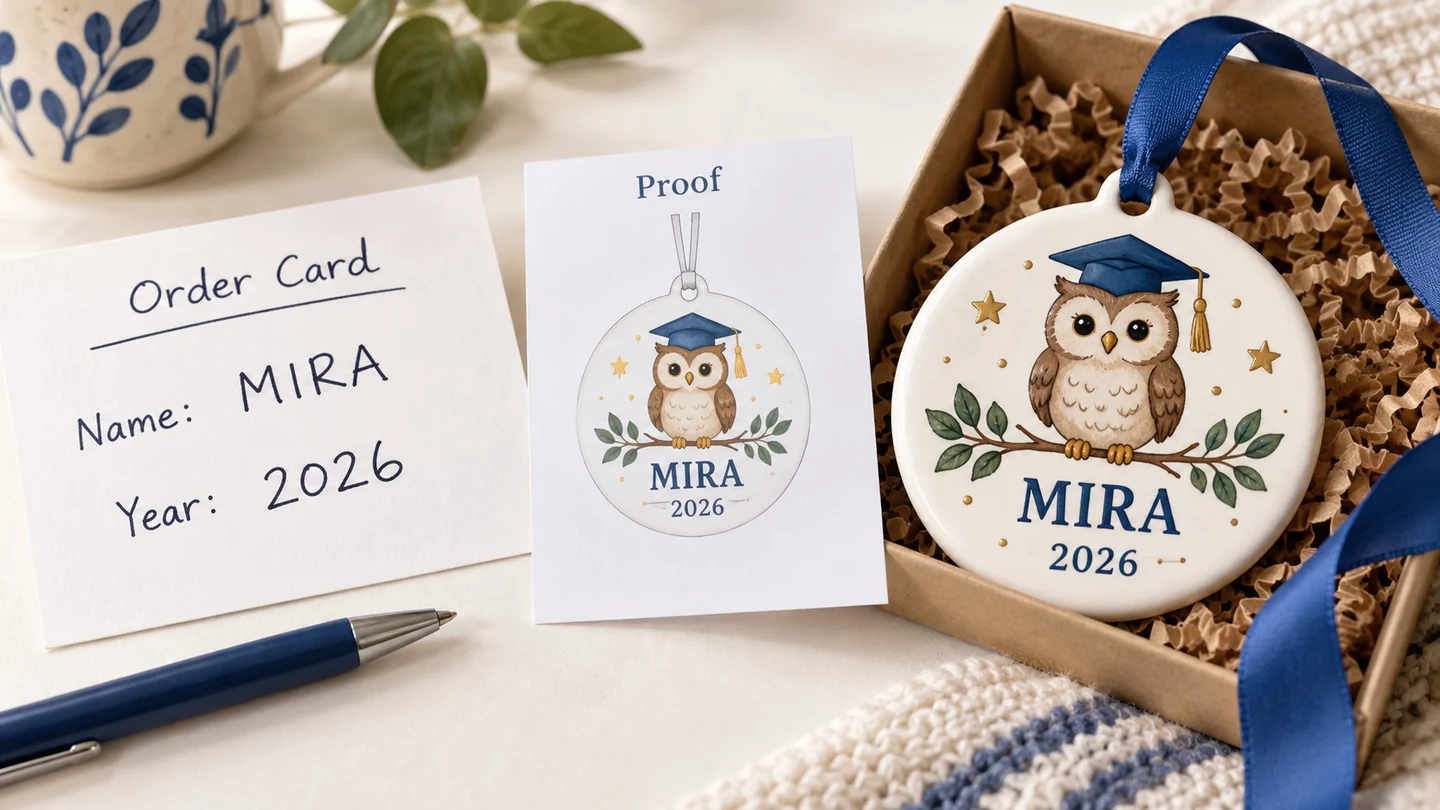
Test one personalized order before launch. Compare the customer input with the supplier artwork and final sample. Also work through a correction before production: who changes the file, which version is retained, and how do you prevent the original version being printed?
Keep the production file separate from the generic storefront mockup. A picture reading “Your Name” advertises the option; it does not confirm that Mira’s actual order contains Mira’s name. The file-and-sample guide explains what to save with an approval.
05
Work backward from when the gift will be used
Ask when the buyer needs the item, then subtract the stages that must finish before it arrives. A gift exchange on December 12 has a different deadline from an ornament intended for Christmas morning.
Here is an illustrative planning allowance, not a provider or carrier commitment:
| Stage | Example allowance |
|---|---|
| Personalization and proof | 2 working days |
| Production | 4 working days |
| Transit | 7 working days |
| Contingency | 3 working days |
| Total to work backward from the use date | 16 working days |
Convert those stages using the actual supplier, carrier and destination calendars. Working days are not calendar days, and holidays may differ between production and delivery locations. Obtain written route-specific information before setting a cutoff.

Then update the product page, cart message and advertising together. A homepage banner saying “Order in time for Christmas” should not coexist with a personalized item whose supported arrival window has already passed.
For US orders, the FTC merchandise-order rule requires a reasonable basis for the advertised shipping time and addresses delayed shipment and refunds. Shipping on time and arriving before a gift occasion are different standards; plan the customer promise accordingly.
Do not derive an official holiday cutoff from one sample or a general shipping estimate. Ask again when production capacity or the route changes.
Turn the allowance into a calendar you can inspect
Suppose your buyer needs delivery by the end of December 23, 2026, ready to use the gift on December 24. For this teaching example only, assume every stage runs Monday–Friday, no public holiday interrupts it, and work starts the day after the order. The sixteen-working-day allowance would look like this:
| Illustrative stage | Dates under those assumptions |
|---|---|
| Order received | December 1 |
| Two proof days | December 2–3 |
| Four production days | December 4, 7, 8 and 9 |
| Seven transit days | December 10, 11, 14, 15, 16, 17 and 18 |
| Three contingency days | December 21–23 |
This is not a December 1 cutoff for any real service. Substitute the confirmed production and carrier calendars, holidays, collection times and route estimates. The table makes the dependencies visible; it does not turn the assumptions into delivery evidence.
If the buyer approves the proof two working days late, move the later stages too. Do not leave the original arrival message on the product page merely because the supplier’s manufacturing estimate stayed the same. Record when proof approval must happen, as well as when payment must happen.
If the revised route cannot support December 23, offer a supported later occasion or decline that timing before taking the order. A faster transit service is useful only if production can still finish in time to hand it over.
06
Price one gift and one mixed basket
Suppose an ornament sells for $24 and the customer pays $4 toward delivery. The store receives $28. These numbers are hypothetical:
| Cost | Amount |
|---|---|
| Ornament production | $8.00 |
| Shipping | $6.00 |
| Packing | $1.00 |
| Payment fees | $1.20 |
| Planned remedy allowance | $1.50 |
| Advertising | $6.00 |
| Total | $23.70 |
| Remaining before tax and overhead | $4.30 |
A 10% discount on the $24 product removes $2.40, leaving $1.90 on those assumptions. The “small” holiday promotion has used more than half the original contribution.
Now add a mug from another supplier to the cart. If the two products ship separately, the second shipping charge does not disappear because the buyer checks out once. Quote the actual mixed basket and confirm whether the customer receives one parcel or two.
Run three cart checks before promoting a bundle:
- One ornament.
- Two ornaments from the same route.
- An ornament and a mug from different routes.
Compare charged shipping, supplier bills and messages in each case. Make the parcel count clear; an ornament arriving first should not suggest the mug was forgotten.
For a worked mixed basket, keep the fictional $24 ornament and $4 customer shipping charge. Add an $18 mug with $9 production and $7 separate freight:
| Basket component | Illustrative result |
|---|---|
| Total collected: $24 + $4 + $18 | $46.00 |
| Mug production and separate freight | $16.00 |
| Mug’s additional contribution before its other expenses | $2.00 |
A 10% promotion across the $42 product subtotal removes $4.20. The earlier ornament contribution of $4.30 plus the mug’s $2 becomes $6.30; after the discount, $2.10 remains before the mug’s additional fees and remedy costs. Increasing the basket value did not automatically create a healthy bundle.
You could charge appropriately for both routes, select a same-route companion product, or keep the mug as a separate offer. Check the actual combined quote before choosing. If two parcels remain, tell the buyer which item comes in each parcel and provide the corresponding tracking; do not advertise a single ready-to-wrap gift box.
07
Photograph the gift and protect the arrival
Order samples early enough to change the offer. A late sample that reveals a missing hanging string or unreadable name leaves little time to fix the product before the rush.
Use photographs that answer the buyer’s physical questions:
- Ornament: front, reverse, edge, scale and included string or fitting.
- Sack or stocking: opening and useful dimensions.
- Printed homeware: material and a close design detail.
Use real sample photographs to support the sales offer. Educational illustrations can explain personalization or packing, but cannot prove the actual color, finish or supplier quality.
Inspect the whole parcel as it arrived. Brittle ornaments and mugs need protection from movement and contact, while fabric gifts need suitable protection from dirt and moisture. Agree on the actual packing arrangement and include any extra cost in the quote.
Follow tracking until delivery and record any observed problem. Do not publish a tested breakage rate or guaranteed intact arrival when you have not gathered the evidence.
08
When the cutoff passes or an order slips
Once a route can no longer support the promised occasion, remove the arrival claim. You can still offer the product for a later use if the customer knowingly chooses it; presenting an expired promise merely transfers the problem to support.
For an existing delayed order:
- Find the last confirmed stage: artwork approval, production or carrier travel.
- Tell the buyer while a useful choice remains. For example, explain that the December 12 gift exchange is at risk and give only the new timing you can support.
- Offer the available cancellation or remedy. Do not silently substitute an unrelated gift.
For US shipment delays, follow the applicable consent and refund steps explained in the FTC business guidance. A changed tracking estimate is not a substitute for the required handling of a delayed shipment.
For the practical order investigation, the delivery-exceptions guide helps distinguish a production problem from a carrier problem. Keep the buyer’s occasion visible while deciding what action still helps.
09
Christmas dropshipping questions
What is the best Christmas product to dropship?
There is no supported universal winner. Choose a product with a clear buyer, an available route, an inspectable sample and enough contribution after delivery and marketing. Catalog presence is not demand evidence.
Can I start late in the season?
Only with a product and destination whose current timing supports the occasion you advertise. A simpler stocked item may remove personalization work, but it still needs verified availability and transit.
Does POD eliminate seasonal inventory risk?
It reduces finished goods made in advance. It does not remove production funding, sample costs, prepaid materials, advertising or missed-occasion remedies.
Can I use famous Christmas characters?
Use original artwork or obtain the relevant commercial permission. A seasonal theme does not remove copyright or trademark restrictions.
For a China-sourced decoration or gift set, ask AIDrop for an item-specific sourcing and packing proposal. Send the design, quantity, destination and required use date. Confirm the route before presenting the gift as an on-time Christmas offer.
Gift Basket Dropshipping: Choose a Supplier and Keep the Gift Promise
A gift basket can be dropshipped, but the recipient must get the contents, message and delivery experience

Wedding Favor Dropshipping: Get the Count and Event Date Right
Wedding favors can ship directly to a host or venue, but the sold unit, guest count and
Party Supplies Dropshipping: Build a Kit That Arrives Complete
Some suppliers direct-ship party goods. A useful event kit still needs enough of each piece, a supported
