
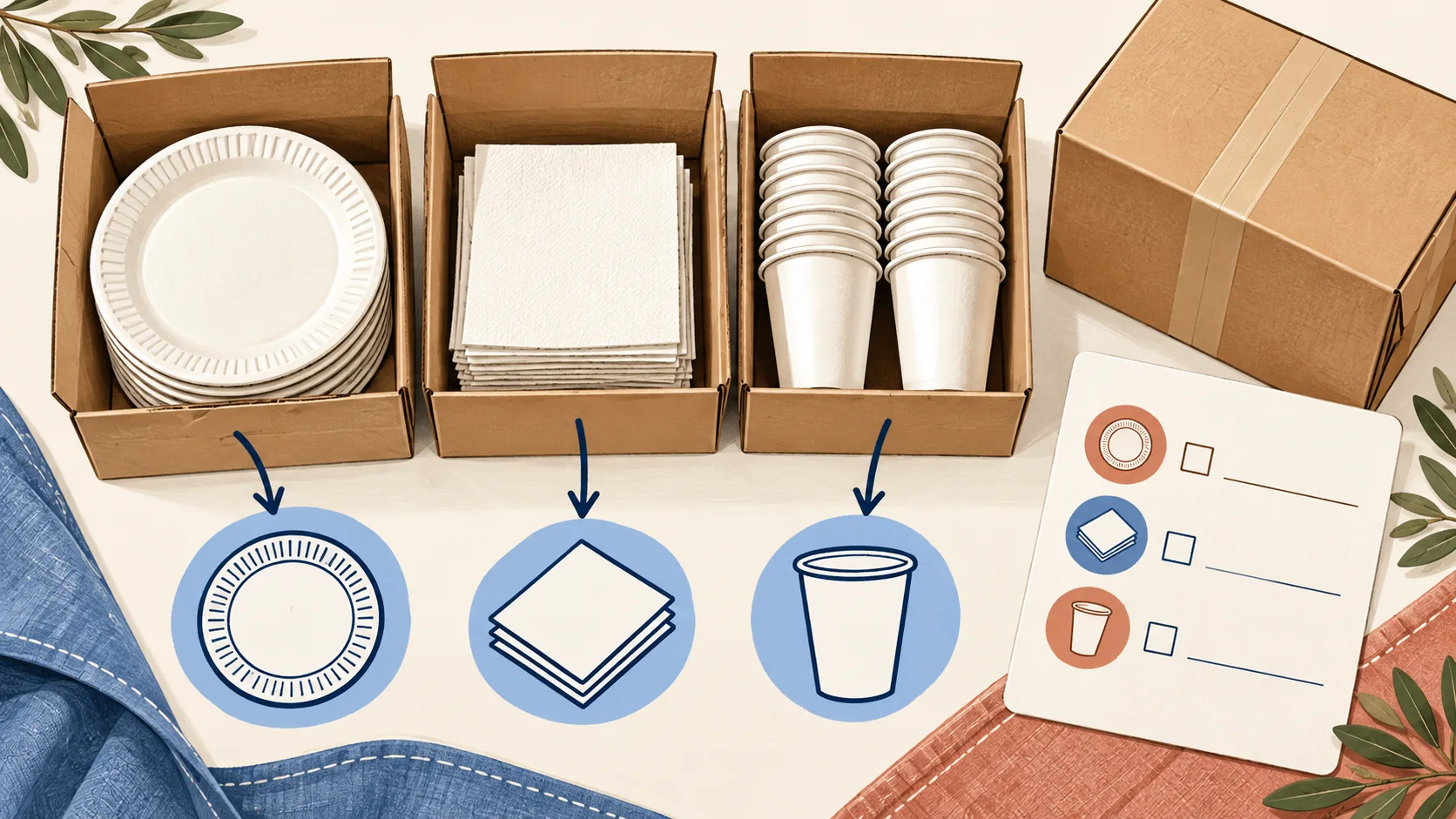
Yes, you can dropship party supplies. At least some wholesalers will take a retailer’s order and send it straight to the customer. The tricky part is selling an event rather than a random box of decorations: the table must have enough of each piece, and the box must arrive while the host can still use it.
Imagine a customer buying a “party set for 24” on Tuesday for a Saturday dinner. The picture has plates, napkins and cups. The delivered kit has 24 plates, 32 napkins and no cups. Its total piece count might still look impressive, but the customer cannot set the table she pictured. That is the question a party-supply store needs to solve before it offers a kit.
01
Find a source that will ship this order
In a dropshipping order, your store sells the item and takes the customer’s payment. The source holds the goods, then packs and sends an order to the customer’s address. Your store owns the product description and the customer conversation. If a carton is short, the host writes to you.
Yacanna, a US party-supply distributor, says it has no minimum purchase and will drop ship directly to customers with the retailer’s business name on the shipment. It also provides order tracking. That establishes a possible one-order model. It does not establish that every catalog item is available, that two products can be assembled into one kit, or that a specific event date can be met.
No minimum can still mean extra fees and parcels
Other sources may be wholesale without being a convenient one-box party-kit service. MDM Distributors says it has no minimum, but adds a surcharge for orders under $50; it describes more than one shipping origin and a freight charge calculated after an order is pulled and boxed. Ask whether your chosen components are stocked together and whether the source will ship them as one customer order. Do not translate “no minimum” into “no extra cost” or “one box.”
The basic supplier request is short: can you buy these exact SKUs one order at a time, to this US address, with tracking and a customer-facing packing slip? If the answer is unclear, do not promise a curated kit just because an app lists the separate pieces. For the broader source-model decision, use our dropshipping suppliers guide.
02
Read the included list, not the big piece count
A useful kit listing says how many dinner plates, cups, napkins, utensils and decorations the buyer gets. A headline such as “165 pieces for 24 guests” does not mean there are 24 of every item. Decorations, extra napkins and individual forks all add to the total.
One live retail example shows why this matters. An Oriental Trading summer-party kit page labels the product 165 pieces for 24 guests. Its introduction also calls it a 101-piece kit and mentions cups. The detailed included list adds up to 165 pieces—plates, napkins, fork-and-spoon sets, tablecloths and decorations—but does not list cups. The same page marked the item out of stock when rechecked on October 11, 2026.
The retail example is not a supplier offer
That retail page shows why you should check the pieces inside a kit. It is not a verified dropship supplier or an available kit. Compare the headline and photo with the component list and current stock before making the same promise to a buyer. The page also says assortments may change, so agree on substitutions before promising an exact appearance.
Say exactly what is in the box
When you build your own listing, show a compact “in the box” list. Say which pieces are required for each guest, which are shared decor, and what is not included. If cups are not included, say so where a buyer can see it before checkout. A substitution such as “similar color may replace blue napkins” needs supplier permission and buyer-facing wording; it cannot silently turn into a different theme.
03
Work out the guest count before naming the kit
Here is a fictional adult dinner table, not a supplier product. You want to offer at least one dinner plate, one napkin and one cup to each of 24 guests. The source sells those components in different pack sizes:
| Piece | Pieces per pack | Packs needed for 24 guests | What arrives |
|---|---|---|---|
| Dinner plates | 12 | 2 | 24 plates |
| Napkins | 20 | 2 | 40 napkins |
| Cups | 8 | 3 | 24 cups |
On a phone, swipe the table sideways to compare every column.
The arithmetic is 24÷12 = 2 plate packs; 24÷20 rounds up to 2 napkin packs; 24÷8 = 3 cup packs. Extra napkins are fine. Only one cup per guest leaves no spare if one is crushed, so a store might choose an extra pack and price it. That is a product decision, not a universal requirement.
One kit and separate items need different promises
Now decide whether these are a single stocked kit or three separate items. If the supplier holds three items at different locations, they could arrive on different days. A customer who ordered “one party kit” may not know to expect three tracking numbers. Confirm whether the supplier can pick, check and ship the complete mix; otherwise describe it accurately as separate items with separate shipment possibilities.
Check sizes, counts and colors against packing evidence
Before you publish a themed set, ask for a current sample or item-level photos and a packing list. Check the actual plate size, cup volume, napkin count, colors and packaging condition. A styled photograph is not a packing slip.
04
Plan backward from the event, not forward from checkout
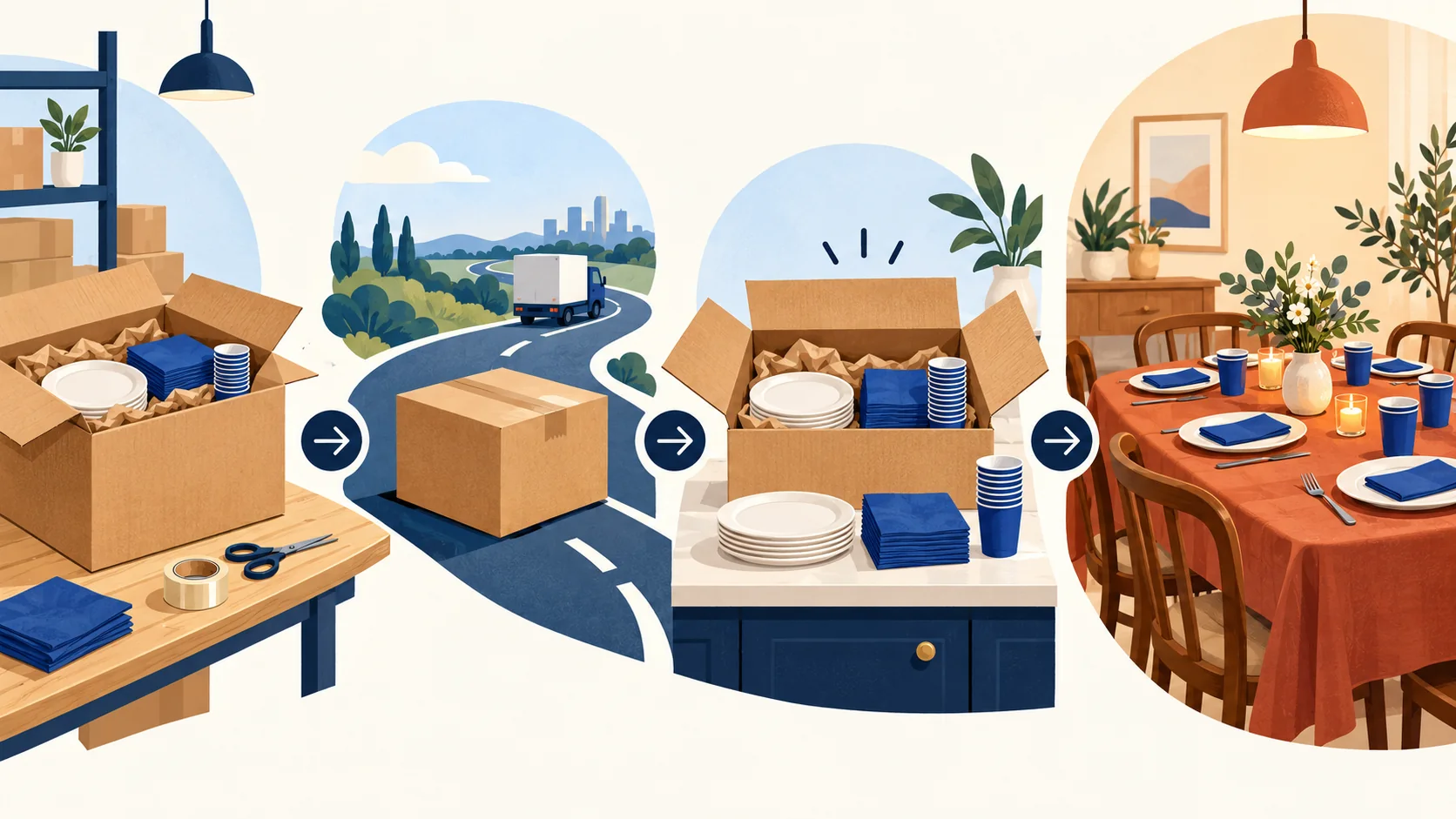
The event date is a hard customer deadline. A supplier’s “ships in two days” usually speaks about processing: getting the order ready and handing it to a carrier. Transit to the customer’s address happens after that. The customer also needs time to open the box and report a missing piece before the party starts.
Processing comes before transit
Party Express’s published shipping terms make the distinction plainly: its transit estimate excludes its processing period, and it says to count business days. It also says its service does not offer Saturday delivery. These are Party Express’s terms, not a schedule for another source. MDM’s published windows vary by warehouse and stock. Neither page proves arrival for your kit.
For a real order, work backward with the source’s current terms:
- Event and setup: When must the customer have all pieces in hand, not merely a tracking email?
- Receipt buffer: How much time is needed to notice a short carton and still fix it?
- Transit: What is the current service and estimated delivery for the destination ZIP, including every parcel?
- Processing and cutoff: When must a paid, correct-address order reach the source for those parcels to leave?
Hold the unsupported Saturday promise
If any part is unknown, display an estimate with an appropriate limitation or stop accepting orders for that event date. Do not turn a supplier’s best-case dispatch into “guaranteed by Saturday.” A missing carton arriving after the birthday is not useful just because a carrier eventually delivers it.
The kit is usable only when the plates, napkins and cups are present. If cups leave a second warehouse, plan around the later delivery, not the first parcel.
Work backward from setup through the receipt check, the slowest transit, each warehouse’s processing cutoff and paid-order acceptance. Average transit across two boxes cannot tell you when the complete tableware is ready.
If the cups have no carrier scan
If the cups have no carrier scan
In the Tuesday-to-Saturday example, suppose plates and napkins arrive Friday but the cups have only a label. The kit is incomplete. Contact the source for the actual cup dispatch and tell the buyer what is known.
If a complete replacement cannot arrive before setup, use the agreed shortfall remedy. Those dates are illustrative, not a supplier delivery quote. Assign someone to follow every tracking number and decide when a replacement would arrive too late.
Allow time for artwork and production
Allow time for artwork and production
For custom names or licensed themes, the clock begins even earlier: artwork approval, production and permission can add steps. This article’s worked kit uses plain adult tableware and decor; it does not assume a custom-print or branded-character program.
Turn the event date into an order cutoff
Here is a fictional calendar with no holidays: setup is Saturday, Friday is kept for opening and checking the kit, transit takes three business days after pickup, and processing takes two business days. These are teaching assumptions, not Party Express or another supplier’s quote.
All parcels needed Thursday
Friday is the one-business-day receipt buffer before Saturday setup. The host must have every required component on Thursday; a first parcel with no cups does not meet that milestone.
Pickup needed Monday
Three transit business days after Monday pickup are Tuesday, Wednesday and Thursday. Confirm the actual service and pickup cutoff for each warehouse; printing a Monday label is not Monday collection.
Paid order needed the previous Thursday
For this assumed processing rule, Friday and Monday are the two processing days, ending in Monday pickup. A Tuesday order in the event week would process Wednesday/Thursday and arrive the following Tuesday under these assumptions—too late for Saturday.
Replace the assumed days with the source’s written destination-level answer and allow for holidays, missing-piece recovery and your actual cutoff. Offer a faster verified route, an earlier order deadline or a clear hold when the event cannot be supported.
05
Set a price and a shortfall remedy the store can honor
Low-cost party goods can become expensive once they are picked from several SKUs. Price all packs, any under-minimum surcharge, packaging or kit labor if the source actually offers it, shipping for the destination, payment fees and likely replacements. A $4 pack of napkins is not a $4 order if it needs its own parcel.
Fill every applicable quoted line before publishing. This fictional arithmetic uses the seven packs above and an assumed agreed packing service; it is not a supplier offer or AIDrop price.
Fictional 24-guest cost
- Plates: 2 packs × $4 = $8; napkins: 2 × $3 = $6; cups: 3 × $2 = $6. Components total $20.
- Assumed complete-order delivery $8; agreed packing $2; payment $1.50; service/remedy cash kept aside $3.50.
- Customer price for this example: $42. Any actual surcharge or separate parcel must be added to the quote.
Planning remainder: $42 − $20 − $8 − $2 − $1.50 − $3.50 = $7 before ads, taxes and overhead. The $3.50 is an unspent budget, not a known claim rate.
If the cups need another $6 parcel, the same example leaves $1. You still must check that the cups arrive before setup; a positive remainder does not make a late kit useful.
Get the actual supplier remedy in writing
Returns are not one standard “party supplies” rule. Yacanna says approved returns have no restocking fee. MDM says wholesale sales are final and its own page has conflicting refused/cancelled-order restock percentages in different paragraphs. Do not pick one of those figures and build your store policy around it. Get current written terms for the exact supplier, products and sales channel.
Short, damaged and late kits are different cases
Ask what happens in three different situations: the carton is short, it is damaged, or it arrives after the event date you promised. A supplier may offer replacement for damage but not refund a usable item after the party. Your buyer-facing policy needs to reflect what your store can deliver, even when a supplier’s policy is narrower. Capture the packing slip, tracking and customer photos so a missing-piece claim can be handled quickly.
Children’s items and licensed themes need their own evidence
Some party items need separate product-rule review. CPSC guidance treats certain small parts, balloons and age-targeted children’s products differently. This adult paper-tableware example does not make a children’s toy or balloon bundle compliant. If you sell one, review each component, label and listing under the applicable rules. Do not copy a character image or claim food-contact suitability without product-specific evidence.
06
Release or hold the proposed 24-guest offer
Our fictional pack math gives 24 plates, 40 napkins and 24 cups. That answers the quantity question. It does not prove that one supplier has those packs in matching colors, will allow the mix, will deliver all cartons to the venue before setup, or will fix a missing cup pack.
Exact SKU and piece list
Status in the example: Pack sizes illustrated, supplier SKUs unknown
Next action: Request item-level list and current photos
Stock and allowed substitutes
Status in the example: Unknown
Next action: Get written stock/substitution rule
One-address delivery before setup
Status in the example: Unknown
Next action: Get processing, transit and all tracking paths
Full delivered price
Status in the example: Unknown
Next action: Quote all packs and charges to venue ZIP
Short or late kit remedy
Status in the example: Unknown
Next action: Agree replacement/refund route before sale
Hold the offer. Send a source request that names the exact 24-guest contents, venue ZIP, latest acceptable arrival date and buyer-facing substitutions. Ask for one-unit order eligibility, stock, packed-unit counts, total cost, shipment origin(s), processing cutoff and missing/late-item procedure. If the reply supports every promise, write the listing in the same plain terms. If it does not, narrow the offer to individual components or choose a different source.
The dropshipping products guide covers product selection across categories. This article stays with the event kit that has to be complete and useful on time. If you have a defined party-supply sourcing or packing project, send AIDrop Agent the item list, destination and required date so the team can assess whether the requested scope is feasible. This does not claim that AIDrop already assembles or guarantees party kits.
Questions about a complete party kit
Does “for 24 guests” mean 24 of every item?
Only an included list can establish that. The fictional kit needs two plate packs, two napkin packs and three cup packs: 24 plates, 40 napkins and 24 cups. A big total can include shared decorations while omitting cups.
Can I combine products into one dropshipped kit?
Ask whether the actual supplier will pick and check the exact mix as one order, and whether it leaves in one box or several. Permission to buy separate SKUs is not permission or a quote for a packing service.
Can I promise a Saturday party from a Tuesday order?
Only a current destination-level processing, transit and all-parcel plan can support that promise. The calendar above fails under its stated assumptions. A faster first parcel or a tracking label does not make the complete kit arrive.
Can a customer return decorations after the event?
Use the actual store obligations and product-specific supplier terms. Final-sale stock, approved returns, damage and late delivery can have different remedies. Agree the route and who funds it before selling.
Gift Basket Dropshipping: Choose a Supplier and Keep the Gift Promise
A gift basket can be dropshipped, but the recipient must get the contents, message and delivery experience

Wedding Favor Dropshipping: Get the Count and Event Date Right
Wedding favors can ship directly to a host or venue, but the sold unit, guest count and
