
All case studies / Packaging decisions
Three carton sizes, three shipping bills
Same 0.5 kg organizer, three box sizes, three shipping estimates. All three go to ZIP 10001. The larger boxes cost more on the quoted YunExpress route even though the parcel weighs the same on a scale.
Compare all three cartons
All three cartons weigh 0.50 kg on the scale and go to ZIP 10001. Standard and Economy include $0.90 for packing. The UPS values are a domestic postage benchmark from the 2026 Daily Rate Guide. Add inbound freight, warehouse costs and packing to model U.S. stock.
Outer carton
YunExpress chargeable weight
Estimated cost per parcel
20 × 15 × 10 cm
0.500 kg
Volume 0.375 kg
Standard $15.39
Economy $11.81
UPS $15.80 · Small
25 × 18 × 12 cm
0.675 kg
Volume 0.675 kg
Standard $18.32
Economy $14.63
UPS $18.95 · Medium
30 × 20 × 15 cm
1.125 kg
Volume 1.125 kg
Standard $25.52
Economy $20.68
UPS $18.95 · Medium
Model inputs for one parcel per order, checked Nov. 11, 2026. Freight estimates come from the AIDrop calculator using the YunExpress Standard weight rule. Domestic postage uses the UPS 2026 Daily Rate Guide, Ground Simple Rate for the contiguous U.S. Excludes import charges and special packing.
Calculate the weight the carrier uses
Dimensional weight in kg = sealed length × width × height in cm ÷ 8,000 for this YunExpress route. Compare it with the scale weight and use the higher number as the starting point. The service then applies its billing rules.
- 20 × 15 × 10 ÷ 8,000 = 0.375 kg. The scale’s 0.50 kg is higher.
- 25 × 18 × 12 ÷ 8,000 = 0.675 kg. Use the dimensional weight.
- 30 × 20 × 15 ÷ 8,000 = 1.125 kg. Use the dimensional weight.
In this example Standard freight plus packing rises from $15.39 to $18.32 to $25.52. Check the calculator for the service available to your postcode and compare the billed weight on the first invoice.
Set a carton limit before you quote
At 4,000 cm³, dimensional weight equals the 0.50 kg on the scale under this route’s 8,000 divisor. With a 20 × 15 cm base, that is about 13.3 cm high. Stay below that packed height to keep dimensional weight below 0.50 kg, then check the selected service’s minimum weight and rounding on the quote.
Give the packer a box size to check
Ask the packer to measure the sealed carton at its widest points, including any bulges. Allow a little room below the limit so a small difference in measurement doesn’t change the bill.
Ship one test in the smaller carton and check arrival condition. If the item needs more protection, compare what a bigger box adds to each shipment with the cost of replacing damaged items. Keep a photo of the closed carton and the carrier’s billed weight.
Enter each sealed size at 0.50 kg and ZIP 10001 to reproduce the example. Before switching cartons, ship one test. Check the item arrived intact and the invoice used the weight you expected.
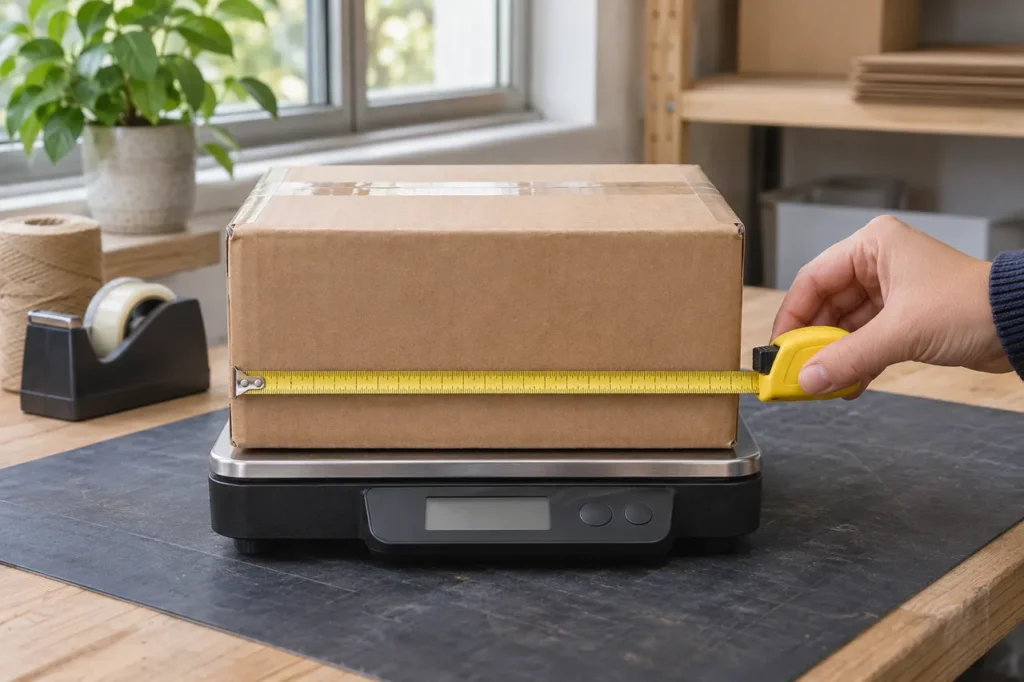
When a smaller carton changes the rate
Moving from 30 × 20 × 15 cm to 25 × 18 × 12 cm cuts the YunExpress Standard estimate in the table by $7.20 per parcel ($25.52 − $18.32). Before any carrier rounding, those two boxes are about 549 and 330 cubic inches. Both fall in the 251–650 cubic inch Medium tier, so the UPS Ground Simple Rate benchmark is $18.95 for either box. If you use a zone-based rate, check the sealed parcel with your own rate and destination.
Try the smaller carton with the actual item and check it again on arrival. In a public case, Packsize reports a 20% reduction in shipping volume after DeinDeal and MyStore switched to cartons sized to individual shipments. Read the public packaging case.
Use the saving to set your budget for added protection. In this example, if the smaller carton needs another $0.60 of padding per parcel, $7.20 minus $0.60 leaves $6.60 per parcel, or about $660 across 100 parcels at the displayed rates. Compare that with the cost of extra damage and replacements before you change boxes. With the two cartons in the same UPS size tier, the postage saving in this comparison is zero.
If you buy 30,000 units already packed in the 25 × 18 × 12 cm boxes, those boxes take up 162 m³ (25 × 18 × 12 × 30,000 ÷ 1,000,000) before adding pallets or outer cartons. That already exceeds the published capacity of two standard 40-foot containers. Check container capacity before pricing U.S. stock.
If the box can’t be made smaller, compare the cost of direct shipping with stocking near your buyers. Compare available shipping routes or send your product and packed dimensions for review.