

You can source 3D illusion lamps through a dropshipping catalog such as CJ, or request a manufacturer quote for an original acrylic design. Most of these lamps use an engraved flat panel lit from its base. Verify the exact panel, base, power supply and packing, then show buyers the lamp both lit and unlit.
A glowing photograph can make a flat lamp look like a floating sculpture. That effect attracts attention, but the customer receives a physical panel and base. A good offer makes the effect appealing without hiding what is in the box.
The supplier examples below are public listings checked on October 12, 2026. They are leads to investigate, not independently tested recommendations. The sample procedure describes checks you should perform before launch.
Explore the broader topic: Home Decor Dropshipping: Fragility, Dimensions and Presentation.
01
Understand what a 3D illusion lamp actually is
An engraved acrylic panel guides light from the base through the panel. Its marked lines scatter the light, making the outline visible. From the front, a carefully drawn shape suggests depth even though the panel itself is flat.
For example, this retailer’s illusion lamp explicitly describes a two-dimensional engraved disc. Longood’s LG-LED-071 is another documented acrylic-and-base construction. These examples explain the mechanism, not the quality of every lamp sold under the phrase “3D.”
A 3D-printed moon lamp is a different product: it has a shaped physical shell. A flat acrylic illusion lamp is also different from a holographic display. Decide which construction your offer describes before sourcing it.
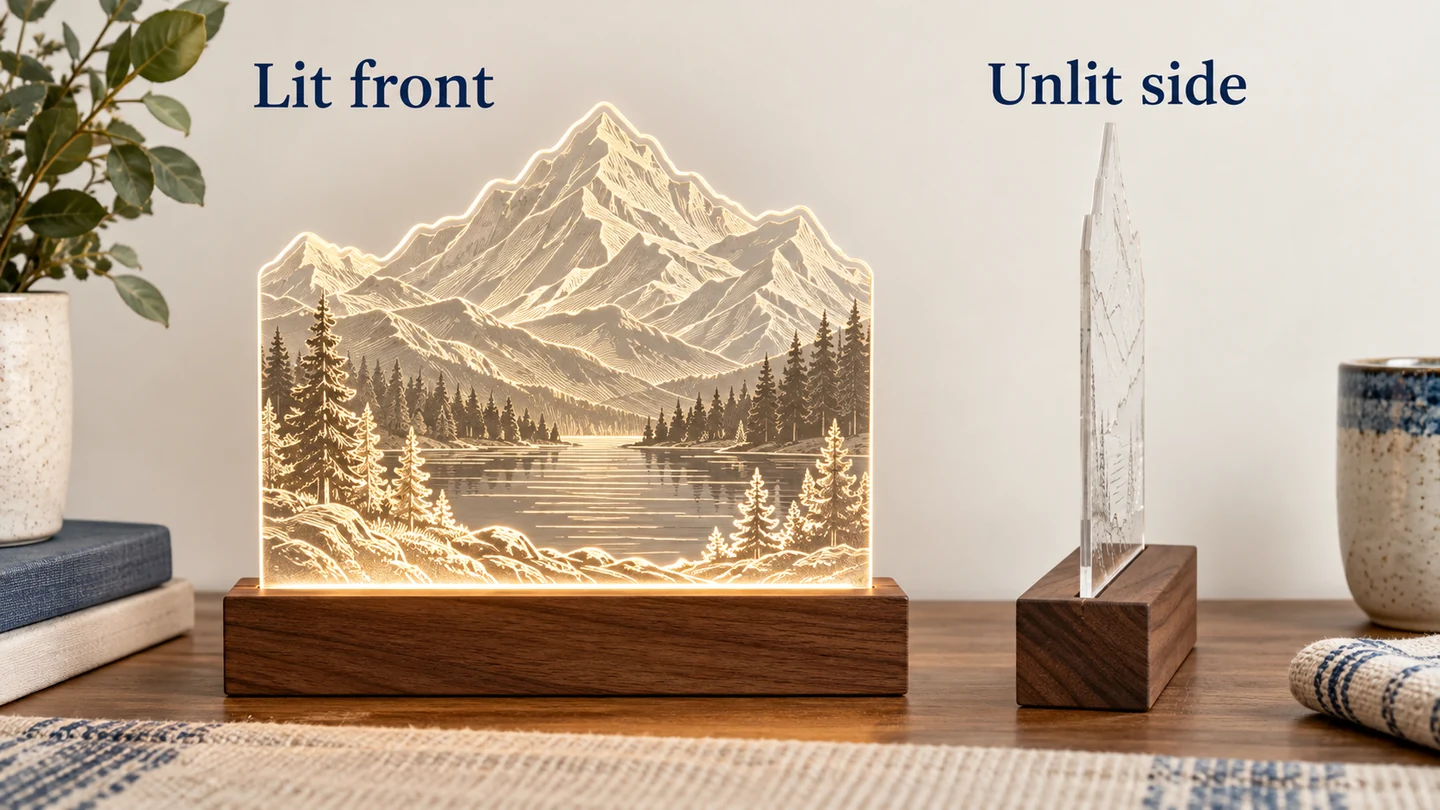
On a product page, a sentence such as “An engraved acrylic panel creates a glowing 3D illusion when lit” sets a useful expectation. Pair a front view with an unlit side view so the buyer can see the physical shape.
02
Find a supplier for an ordinary design or your own design
For an existing design, CJ’s acrylic USB lamp listing is a catalog starting point. Obtain the exact variant’s current price, availability and destination shipping quote before publishing it.
For original artwork or a different base, investigate a manufacturing route. Longood’s model page and ME Acrylic’s illusion-lamp page provide product leads. A manufacturer displaying a lamp does not establish that it accepts individual customer orders or offers dropshipping.
| Route | Suitable question to ask | Confirmation you need |
|---|---|---|
| Existing catalog design | Can this exact item be sent to this postcode? | Variant, stock, full parcel contents and delivery quote |
| Original engraved panel | Can you make this artwork with this base? | Sample cost, artwork format, quantity and production terms |
| Custom or branded arrangement | Can you store and fulfill individual orders? | Inventory ownership, handling, packing and order process |
Use artwork you own or have permission to sell. A recognizable movie character appearing in a catalog is not proof that you can use it commercially. An original mountain, pet outline or abstract design avoids building the offer around an unexplained character license.
A useful product-sourcing inquiry says what must be made and delivered: original panel design, chosen base, destination, expected order quantity, required accessories and packing. A request for “your best 3D lamp” leaves too many decisions to someone else.
03
Resolve the power supply and what is in the box
The lamp’s input, any mains adapter and a remote-control battery are separate components. Confirm all three when they are present.
The CJ example has a USB selector alongside a broad voltage field. Those fields are insufficient for writing a precise electrical description. Longood describes a 5 V input for its particular model; that does not make every catalog lamp a 5 V device.
Ask the supplier to complete a component list:
| Component | Detail to confirm |
|---|---|
| Acrylic panel | Design, dimensions, thickness and protective film |
| Base | Exact model, input rating and controls |
| Cable | Connector at each end and included length |
| Adapter | Included or excluded, rating and destination plug |
| Remote | Included or excluded, battery type and whether supplied |
| Other accessories | Any instructions, hanging parts or spare pieces |
If the adapter is excluded, say so plainly in the offer. A USB cable in the photograph should not imply that a wall adapter is included. Likewise, a model with battery operation needs the actual battery requirement; USB power by itself does not mean wireless use.
Request photographs of the real variant and its packaging information. Resolve conflicting specifications before placing a sample order. Do not combine the attractive picture from one variant with the power details from another.
Give the supplier one complete version to quote
For an original mountain panel, a fictional inquiry could read:
Please quote one engraved mountain-panel lamp with the identified USB-powered base. Specify the base input from its label, panel dimensions and thickness, included cable and controls. Quote the version without a wall adapter or remote separately from any version that includes them. Show the exact contents, packed dimensions and gross weight for delivery to [destination/postcode].
That request leaves the rating to verified product evidence. It does not turn the 5 V specification of one cited model into a specification for an unidentified base.
Read the answer against the photographs. If the reply says “USB” while the picture shows a battery compartment, ask whether the sample supports both power options and what it includes. If the supplier sends only an attractive scene image, the electrical and packing questions are still unanswered.
Separating versions also makes the sale clearer. A basic panel-and-base offer may be easier to describe than one with an unidentified adapter and remote. If you choose the latter, its extra components, documentation and costs become part of the approval; they are not free additions to the same product record.
04
Order a sample and check the light, controls and acrylic
Inspect the item first in daylight. Look for scratches, chips, loose components and an unclear design. Follow the supplied instructions for any protective film, then insert the panel as directed without forcing it.
Use the specified power source. Check the available controls and observe each advertised mode. Compare the real product with the listing: does a promised color change actually occur, and does the remote control the sampled base?
Then check it in a normally lit room and in a darker setting. A dramatic dark-room photo does not show how visible the effect will be on a bright desk.
| Sample observation | Why it matters for the offer |
|---|---|
| Panel fits the base correctly | The customer should not need to modify the item |
| Engraved design is clear | The glowing image depends on those lines |
| Cable and controls work as described | Included parts must match the selected variant |
| Base is stable on the intended surface | A tall panel changes the way the object stands |
| Surface arrives protected | Visible acrylic scratches spoil the effect |
Record the actual model and any failures, with photographs or a short video. Stop using a faulty unit, particularly if it has an abnormal smell, damage or unexpected heating, and ask the supplier to investigate. A basic functional check is not an electrical safety assessment or certification.
Our quality-control guide explains how to turn sample observations into an approval record. Use the lamp’s real observations rather than declaring the supplier “high quality” after looking at its catalog.
When the effect disappoints, identify the physical issue before changing the photographs:
| What you observe | A discriminating check | What the result changes |
|---|---|---|
| Panel looks cloudy | Follow the supplied protective-film instructions and inspect again | Unremoved film needs a clear setup instruction; permanent surface damage needs a supplier remedy |
| Lines are barely visible on a bright desk | Compare the same unit in normal and darker room light | Show both settings; do not photograph only the condition that hides the limitation |
| Remote does not operate the base | Compare the delivered remote, battery requirements and base with the approved contents | Resolve a mismatched or faulty component rather than promising unsupported modes |
| Panel wobbles or needs force to fit | Compare the panel and base models without modifying them | Pause approval and request a correctly matched unit |
These checks do not authorize opening an electrical base or modifying a battery compartment. They help separate presentation, assembly and product problems. Keep the genuine finding visible: if the panel is flat in daylight, show that physical form rather than editing the scene to look like a solid sculpture.
05
Remote controls and children's claims need another check
If the remote uses a button or coin battery, the battery compartment, warnings and applicable documentation deserve specific attention. A small accessory can introduce obligations that are easy to miss when considering only the USB-powered base.
The US CPSC’s button-battery guidance explains requirements under Reese’s Law and the applicable rule, including battery accessibility, testing and warnings. Determine what applies to the actual product and obtain model-specific documentation before selling into that market.
Check that the documents identify:
- The actual lamp model and included remote.
- The battery compartment and applicable warnings.
- The unit and packaging covered by the evidence.
A general supplier certificate for another model is insufficient. Do not add a certification badge to an educational concept picture.
Similarly, a colorful night light is not automatically a toy or a verified child-safe product. Avoid those claims, along with medical or sleep-treatment claims, unless the actual product and evidence support them. Positioning an item as adult decor does not automatically exempt it from applicable product rules.
06
Protect the panel and quote the packed parcel
Acrylic can arrive scratched even when it does not break. The panel, base and accessories should be secured so they cannot rub or strike each other inside the box. Ask the supplier how it separates and protects those parts.
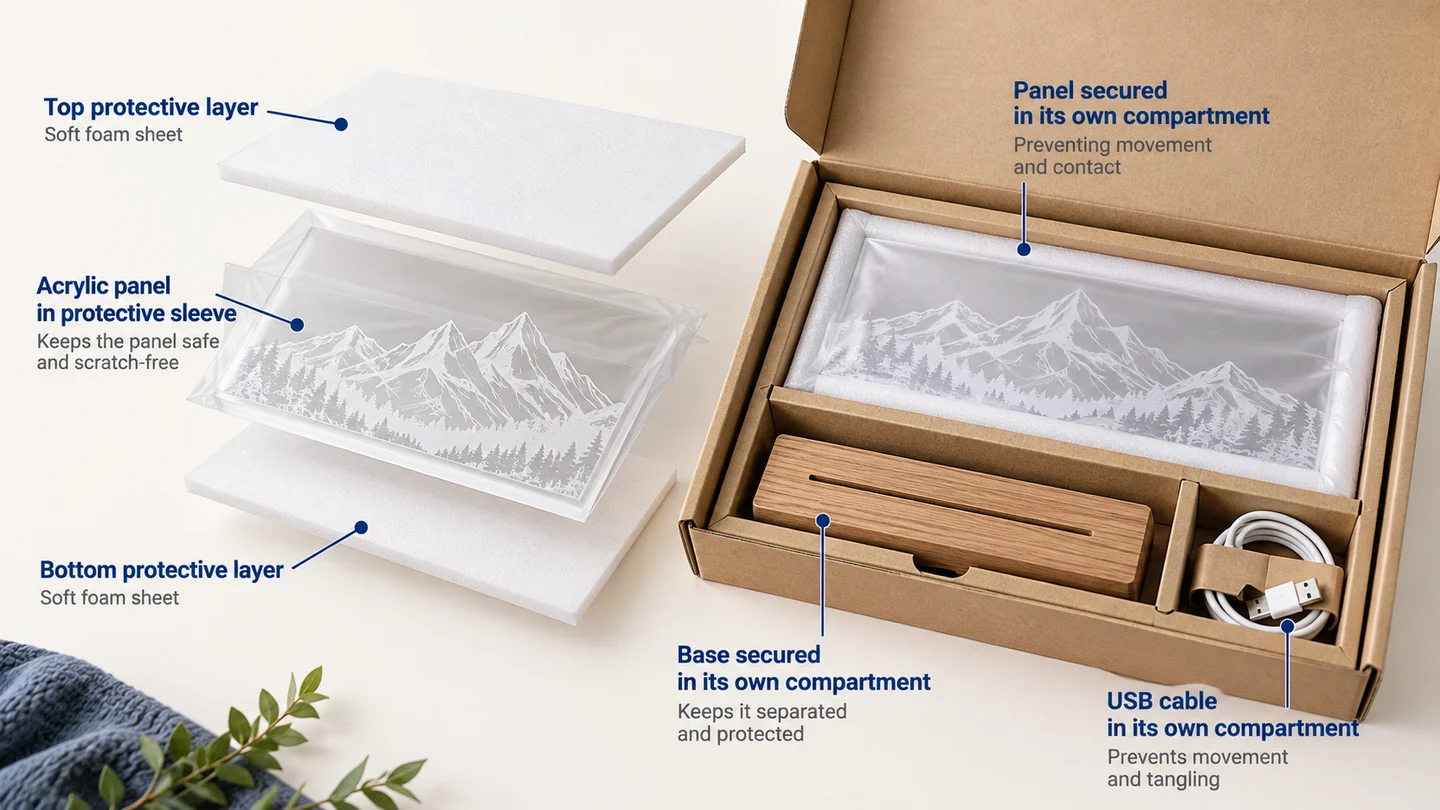
Save the approved packing arrangement after inspecting a sample shipment. Record the outer box dimensions and gross weight, including protective material. Those measurements, the destination and the available route determine the freight quote; the bare lamp’s weight is not enough.
A shipping field showing $0 before a destination and route are selected is not evidence of free shipping. Get a completed quote. For a larger protective box, also check dimensional weight.
Here is a fictional $29 lamp sale:
| Order cost | Example amount |
|---|---|
| Lamp | $5.50 |
| Shipping | $7.20 |
| Extra packing | $0.90 |
| Payment fee | $1.15 |
| Planned remedy allowance | $2.00 |
| Remaining before advertising, tax and overhead | $12.25 |
At $8 in advertising, the remainder is $4.25. These inputs are not supplier quotations or a measured breakage rate. If approved protection adds $1.50 of real cost, include it before deciding on the price; removing protection to preserve a misleading margin can simply move the cost into damaged orders.
For a damaged arrival, retain product, packaging and shipping-label evidence and contact the supplier with the order ID. Confirm who funds a replacement and whether its freight is covered. Your storefront remedy should not depend on a reimbursement you have not yet obtained.
Compare competing quotes with the same protected contents. These hypothetical offers are not yet equivalent:
| Quote | Delivered price | Packing arrangement |
|---|---|---|
| A | $12.00 | Loose base can contact the panel |
| B | $13.50 | Separator and secured accessories to inspect in a sample |
The $1.50 difference buys a different packing arrangement. It does not establish that B is simply overpriced or prove that its packing will work.
Before choosing B, inspect that packing in a sample parcel. Before choosing A, ask what it would cost to match the approved protection. You then have a like-for-like price comparison. One intact sample cannot supply a reliable breakage rate, so use a clearly labelled planning allowance until you have actual order results.
For a China-sourcing comparison, send AIDrop the same component and packing specification. Include the destination and ask for the protected parcel’s cost. This is more useful than comparing a bare-lamp factory price with an app’s delivered price.
07
Build a listing that shows the lamp honestly
Once the sample is approved, make a small set of useful real photographs: lit front, unlit side, an ordinary room view, controls and box contents. Those views answer different questions and do more than repeat the same glowing hero photo.
Show the scale using actual dimensions or an ordinary object in the scene. Describe the power source, cable and excluded adapter accurately. If you offer several designs, confirm that each displayed panel is available with the selected base.
An explanatory illustration can show how edge lighting works. It cannot prove a particular lamp’s brightness, safety or finish. Use real sample images for the sales offer and keep generated pictures identified as illustrations in educational content.
Give the buyer a clear delivery estimate based on the chosen variant and route, plus a contact path for faults. A compelling picture earns attention; a clear physical description helps the buyer remain confident after opening the box.
08
3D lamp questions before you place an order
Are all 3D lamps physically three-dimensional?
No. Many are flat engraved illusion panels. Printed moon lamps and other shaped lamps have different construction. Name the actual type in the offer.
Are USB lamps wireless?
Not necessarily. A USB-only model needs connected power. Battery operation is a separate feature to verify, along with the required batteries.
Can I sell any character design a supplier offers?
Catalog availability is not permission to use copyrighted or trademarked artwork. Use an original or appropriately licensed design.
Where can I get a comparable sourcing quote?
You can send AIDrop the panel design, base specification and destination to discuss China sourcing, sample review and protective packing. Ask for the item, handling, packing and freight separately. No rate or compliance approval is established by this article’s illustration.

Electronics Dropshipping: Compatibility, Documents and After-Sales Support
Electronics can be dropshipped when the exact model works for the claimed setup and has applicable documents,

Auto Parts Dropshipping: Find Suppliers and Avoid Wrong-Part Orders
Find a usable automotive supplier route, keep part and vehicle details accurate, price a complete filter order,

Phone Case Dropshipping: Match the Phone Before You Sell the Case
Compare ordinary and printed phone-case suppliers, build an exact model-to-item map, prepare artwork and calculate what a
