
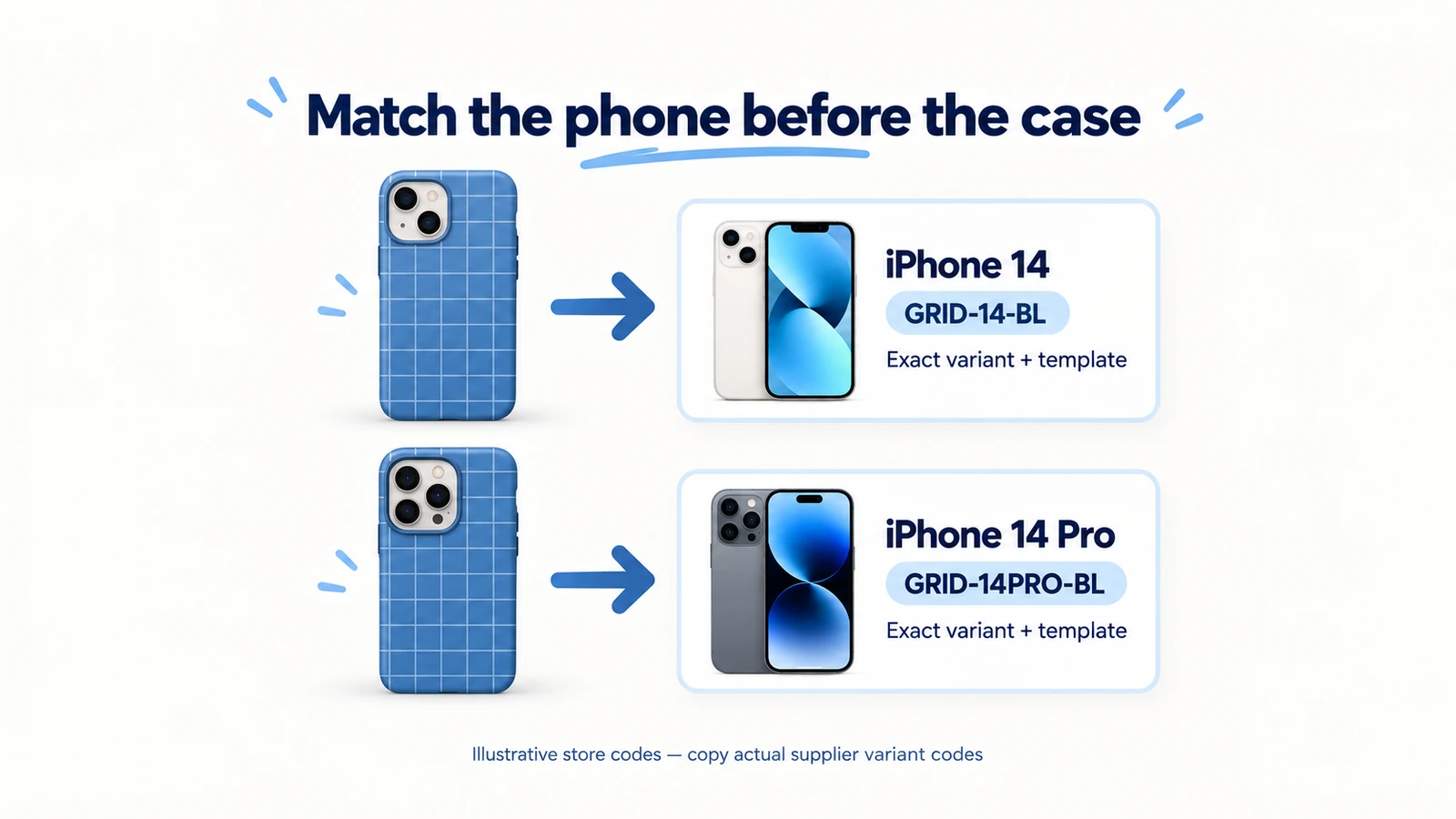
To dropship phone cases, choose an exact phone-model range and a supplier that can send each selected case to your customer. You can sell ready-made cases or have your own designs printed after an order. Get the matching supplier item, destination shipping cost and wrong-fit remedy clear before you publish the offer.
The supplier stores or makes the case and ships it; your store takes the payment and handles the buyer’s questions. The phone model is part of the product. A customer who orders an iPhone 14 case needs that case, even if an iPhone 14 Pro version carries the same artwork and looks similar in a catalog.
A small store could launch one blue-grid design for two verified phone models. That gives it two case files and two supplier variants to check, instead of a catalogue it cannot test. The example below is hypothetical; the products guide compares phone cases with other categories.
Explore the broader topic: Electronics Dropshipping: Compatibility, Documents and After-Sales Support.
01
Choose stock cases or printed cases
Ready-made cases suit a store selling the case’s color, construction or features. Print on demand, often shortened to POD, suits a store selling its own artwork: the provider prints the selected case after the order. Buying a batch of custom shells is a third arrangement and can require money committed to inventory.
These public options were checked on September 28, 2026:
| Option | What you can select | What to resolve before listing |
|---|---|---|
| PhoneFinesse through Doba | An ordinary iPhone 14 Pro case, supplier item D0102X33X4Y, with listed US dispatch | Account access is needed for price and inventory; confirm the exact color, destination charge and supplier terms |
| SPOKE Tough through Printify | Your printed design on a selected phone-model variant | Displayed starts were $11.25 for the case and $4.39 for shipping; obtain the chosen model and destination total |
| Printful phone cases | Clear, Snap, Tough and magnetic styles with different model ranges | Check the particular product’s construction, printing, destination availability and current basket |
On a phone, swipe the table sideways to compare every column.
Start with the supplier account and the exact product page. Select the phone model and style, check that your selling channel is permitted, then obtain a one-case order total to the destination you intend to serve. For POD, also select the actual print provider and design area. Order the sample through that arrangement before offering it to customers.
Confirm the actual destination
Destination restrictions can remove an otherwise suitable option. Printful’s Snap case page excludes South Korea, Hong Kong, Taiwan, Japan and Singapore. Its cached estimated arrival dates had already passed when checked; use the selected order’s current information for timing.
A bulk minimum is a different offer
Bulk customization needs a separate decision. GetCustomPhoneCases starts at 12 pieces, while a separate Pinpoint promotional specification requires 50. Those are batch offers, not evidence that either supplier will dispatch each customer order. If you prefer printed cases without buying that stock, compare the actual one-piece POD arrangement. The POD guide explains the wider production model.
02
Match the exact phone, then choose the shell
Make the phone model unambiguous
Ask for the full model name, including Pro, Plus or other suffixes. On an iPhone, Apple’s instructions point to Settings → General → About; tapping the displayed part number reveals the model number. A screen-size description or “the newer iPhone” is insufficient for choosing a case.
A SKU is an item code. Your store’s code needs to point to the supplier’s exact model and design choice. A provider’s general product number may identify a family of cases while a separate variant identifies the phone it fits.
For our hypothetical blue-grid range, the working map could look like this. The store codes below are illustrative, not supplier codes:
| Customer selection | Store SKU | Supplier selection to record | Artwork to check |
|---|---|---|---|
| iPhone 14 / blue grid | GRID-14-BL | Exact iPhone 14 variant in the chosen Tough product; copy its actual item code | File prepared for that variant’s template |
| iPhone 14 Pro / blue grid | GRID-14PRO-BL | Exact iPhone 14 Pro variant in the chosen Tough product; copy its actual item code | Its own camera opening and printable area |
On a phone, swipe the table sideways to compare every column.
Keep the supplier code, selected provider and current template with each row. If either supplier variant is unavailable, stop selling that selection until you have confirmed a replacement arrangement. Do not send the nearest phone model.
Compare both phone selections before release
For the proposed blue-grid offer, check each model separately. Your own GRID-14-BL and GRID-14PRO-BL labels organize your records; they do not replace the supplier’s real variant identifiers.
Select iPhone 14
On your storefront, select iPhone 14 and open its saved provider variant and design preview. Confirm the provider names that exact model, the template has the matching camera opening, and the blue-grid file is the version approved for it.
Select iPhone 14 Pro
Repeat for iPhone 14 Pro, using its own supplier variant and template. Compare the customer’s actual order selection with that record before paying for production. If both choices point to the same wrong model or preview, hold release and repair the mapping.
Then use the exact-model sample checks below. Two correct-looking previews cannot establish physical fit. This is a proposed verification procedure, not a completed case or merchant-account test.
Choose a shell you can describe
Then compare the shell. Printful’s Snap specifies a polycarbonate shell, while selected Tough cases use a polycarbonate outer shell and a TPU inner layer. Polycarbonate, or PC, and thermoplastic polyurethane, or TPU, are different plastics. Compare the stated layers, finish, grip, button covers and raised edges of the actual case rather than choosing by “premium” in the title.
Wireless charging does not mean MagSafe
Charging features also need the exact product. The inspected SPOKE Tough page says wireless charging but specifically says it is not MagSafe. Printful has a separate magnetic Tough option. A wireless-charging statement does not establish a magnetic ring, charging wattage or a drop-test result.
03
Prepare the design for that case
Printing adds a file-selection job to the product-selection job. A design that works on a flat preview can put a word under the camera opening or wrap an important detail around an edge.
Use this sequence for each model in the blue-grid example:
- Open the selected product’s file guidelines and template. Confirm file format, dimensions, resolution and which surface is printed. Do not borrow another model’s dimensions.
- Position the design inside the safe area. This is the area intended to keep important details visible. Extend a background to the required bleed area, which allows artwork to continue beyond the cut or printed edge.
- Check every model preview. Move text or distinctive parts of the grid away from openings and curved edges. If the provider offers several printable areas, inspect the area actually selected.
- Save the model-specific file and order a sample. Keep the file version with the supplier variant so a later customer order uses the design you approved.
Printful’s print-file guidance explains bleed and safe placement, while Printify’s design guide makes requirements dependent on the product and print company. There is no single export size or printing process for all phone cases.
Fix the model-specific artwork
If a sample cuts off the last letter of a name, change that model’s layout and order the corrected version before selling it. A mockup helps judge placement; the physical case lets you inspect the received print, surface and fit. Neither establishes that every future print will look identical.
Use artwork and photographs you own or are permitted to use. A provider accepting a file does not grant rights to a cartoon character, famous logo or downloaded photograph. The US Copyright Office’s photography guidance explains why the person who can download a photo is not necessarily its copyright owner.
04
Make the sample useful to the product page
When the sample arrives, compare its package label with your order map, then try it on the exact phone model. Check the camera opening, button operation, charging-port access, installation and removal. Inspect the print near openings and edges, the surface finish and the packaging it arrived in. These are proposed checks for your sample, not tests we performed for this article.
Test only the claimed charging combination
If charging or a magnetic accessory matters to the offer, try the intended combination. Apple’s MagSafe guidance explains that the phone, charger, power adapter and conditions affect charging. Finding that an accessory attaches does not measure charging power or certify the case.
Photograph the received case from useful angles, including the camera opening and side buttons. Show the finish and printed edges as well as the decorative back. Confirm permission before reusing supplier photographs. An ordinary sample inspection does not substantiate “military-grade,” waterproof or certified drop-protection language.
For the blue-grid product page, use an explicit selector such as “Phone model: iPhone 14 Pro.” Put the material, shell construction, finish, supported charging feature and care instructions beside it. A name such as “Blue Grid Tough Case” alone leaves the most consequential choice unclear.
Explain how to identify the model, which destinations you serve, and the production and transport estimates for that offer. Publish the actual return or replacement route. If the sample’s button cover does not work properly, resolve the product problem with the supplier before promoting the design; better photography cannot fix that fit.
05
Price a sale and a replacement
Keep the calculation in one currency
Calculate the order in one currency, using the selected case, provider and destination. Printful’s inspected grouped shipping table was in euros, whereas the SPOKE example displayed US dollars. Adding those figures directly would produce a misleading total. Premium-plan prices also require accounting for the subscription you would pay.
For a hypothetical $29 blue-grid sale, suppose the case and outbound shipping use the inspected SPOKE starting figures. The other amounts below are invented assumptions. This is a calculation example, not a completed supplier quote or a recommended selling price.
- Customer payment: $29.00
- Case: −$11.25
- Outbound shipping: −$4.39
- Payment fee: −$1.20
- Advertising to acquire this order: −$6.00
- Allocated design and store expense: −$0.80
- Contribution before tax and other expenses: $5.36
The listed expenses total $23.64. Contribution is what this sale leaves toward tax, remaining business expenses and profit; it is not take-home earnings. Replace every assumption with your own cost, and include handling, currency conversion or destination charges where applicable.
If the wrong model needs a remake
Suppose your listing caused the model mistake and you fund another case plus delivery at $15.64. The original expenses remain, so the order now leaves $5.36 − $15.64 = −$10.28. A provider declining a wrong-model claim does not make the customer’s problem disappear.
A full refund needs its own cash
A different outcome is a full $29 refund. If none of the original $23.64 costs is recovered, the sale-and-refund result is −$23.64. You also need $29 available to send back to the buyer. Provider credit, recovered fees or a usable returned case improve the result only when you actually obtain them.
Use that comparison before spending more on promotion. A narrow range with clear model selection may be viable at your actual costs; a design that sells well but repeatedly needs seller-funded remakes may not be. Keep a refund reserve rather than treating each day’s contribution as money you can withdraw.

06
Send the order the customer actually chose
Your customer pays your store; you still need to pay the fulfillment order. A connected shop may transfer the order, while another arrangement requires manual entry. Confirm the supported method and payment trigger with the selected provider, then check the first order rather than assuming an imported product is ready to fulfill itself.
Follow the case from purchase to dispatch:
- Match the customer’s model, design and finish to the supplier variant and saved file.
- Check the destination, address, current item availability and complete supplier charge.
- Submit and fund the order. Confirm supplier acceptance and the selected production or dispatch estimate.
- Follow the shipment and send the buyer accurate tracking and any necessary update.
Pause an unavailable variant
If the iPhone 14 Pro variant sells out, pause that selection and contact affected buyers about a confirmed wait, acceptable alternative or cancellation. A different finish, print provider or shell can change the offer. Get the decision before authorizing a substitute.
Keep production time separate from transport time. Printify’s shipping-options page limits its named Express offer to particular T-shirt styles; it is not a phone-case delivery promise. The case provider’s average production figure also does not say when a customer will receive the parcel.
For US orders, FTC shipment guidance keeps shipment and delay responsibilities with the seller even when a drop shipper fulfills the goods. Build a delay response into your store’s operation rather than waiting indefinitely for the supplier to answer.
If you are sourcing ordinary cases from China and need help clarifying model choices, samples or packaging, AIDrop’s product-sourcing service can help compare those inputs. Send a product or supplier link, customer destination and the specific question through contact. Confirm the work for your case; a sourcing review does not establish certified protection or a supported app connection.
07
Resolve a wrong-fit case by finding the cause
Ask for the phone’s exact model and useful photos of the case, its label and the mismatch. Compare them with the buyer’s selection, your page and the supplier order. That separates three problems requiring different corrections:
| What happened | What your store should address | What to ask upstream |
|---|---|---|
| Buyer selected a different model | Explain the available remedy under your policy and applicable customer rights | Whether a paid replacement or eligible return is available |
| Your page or order map directed the buyer to the wrong case | Correct the affected selector or mapping and arrange the remedy | Cost and availability of the correct case; do not assume supplier reimbursement |
| Supplier sent the wrong variant or a defective print | Arrange the buyer’s appropriate remedy and preserve the order evidence | Claim procedure, photos, deadline and replacement or refund terms |
On a phone, swipe the table sideways to compare every column.
Printify’s policy distinguishes damage or manufacturing errors from a buyer choosing the wrong size or color. Its defect process requires notice within 30 days of delivery and photo evidence. It does not fund every change of mind or phone-model mistake.
A wallet refund may not fund your buyer refund
Printful’s policy similarly has claim deadlines for quality problems and lost packages, while wrong-model choices and address errors can produce additional costs. A normal provider refund to its wallet is not automatically cash returned to your customer.
For ordinary stocked cases, read the selected supplier’s Doba terms, including non-defect eligibility, return address, postage and any restocking charge. Do this before using “free returns” in your offer. A supplier’s reimbursement conditions do not define all of the buyer’s legal rights.
Repair the cause of repeated mismatches
Keep the buyer’s response moving while you pursue the supplier claim. When a repeated mismatch appears, pause the affected variant, repair its actual cause and recheck a sample or order map before accepting more orders for it.
08
FAQ
Can I start without buying case inventory?
Yes, if your selected stock supplier or POD provider accepts individual customer orders. You still need money for samples, store expenses, supplier payments and remedies. A bulk custom-shell program can require an inventory purchase even when it later dispatches individual parcels.
Do iPhone 14 and iPhone 14 Pro use the same case?
Treat them as separate model selections. Use the exact supplier variant and check it on the named phone. A shared design or similar-looking product photograph does not establish interchangeable fit.
Can I sell phone cases without creating artwork?
Yes. Ready-made cases can be sold for their supported construction, color or features. Confirm your selling permissions and photo rights, and provide the same exact-model and remedy information a printed-case buyer needs.
How much should I budget to start?
Add your actual samples, store and design costs, planned advertising, supplier-payment timing and refund reserve. There is no universal startup figure in the inspected programs. Use a destination quote and your own numbers in the worked calculation before choosing a selling price.

Electronics Dropshipping: Compatibility, Documents and After-Sales Support
Electronics can be dropshipped when the exact model works for the claimed setup and has applicable documents,

Auto Parts Dropshipping: Find Suppliers and Avoid Wrong-Part Orders
Find a usable automotive supplier route, keep part and vehicle details accurate, price a complete filter order,
