
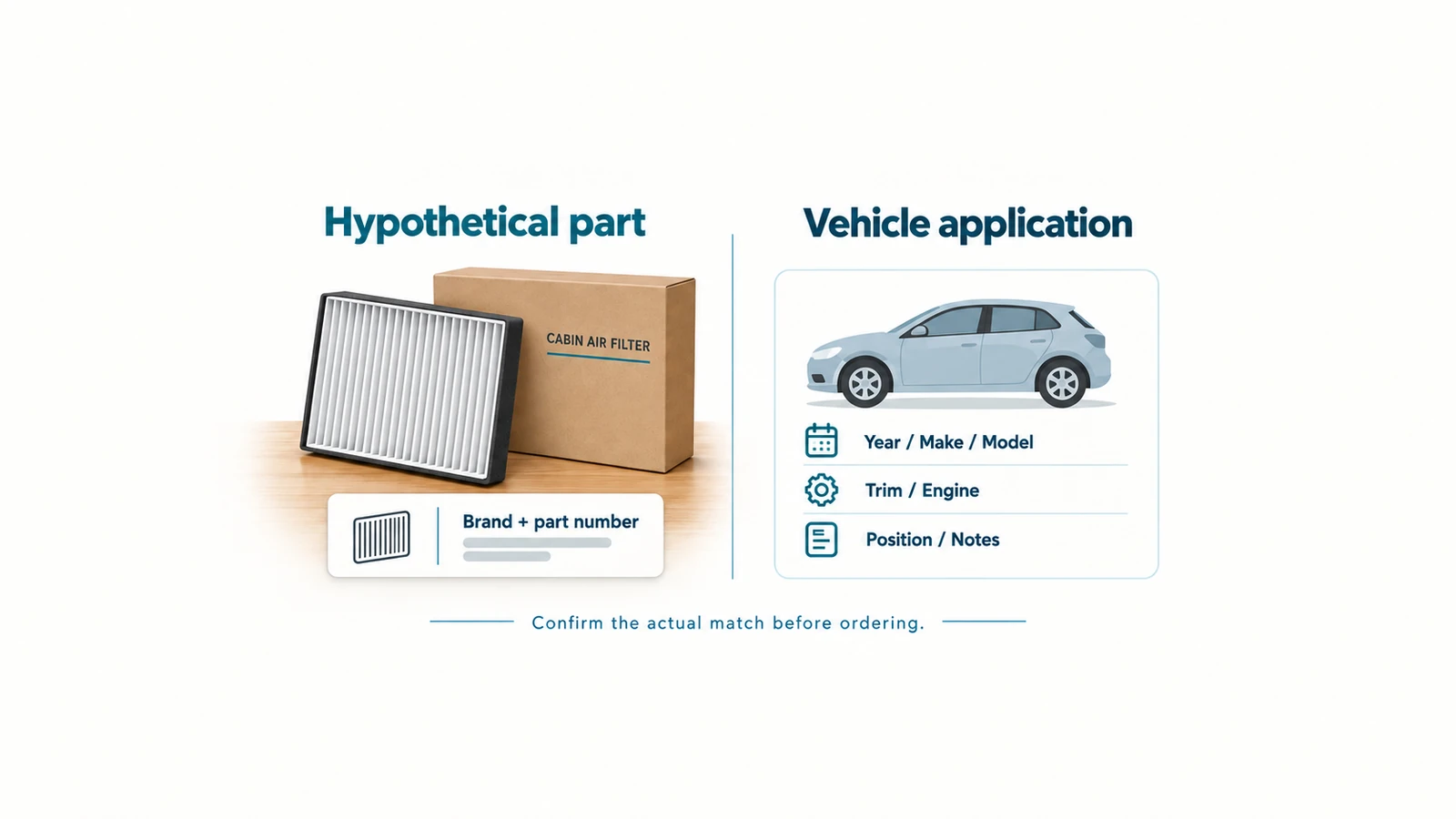
Auto parts dropshipping means an agreed supplier ships a part that your store sells and supports. Choose a part you can identify, confirm its exact vehicle applications, then secure individual-order terms and a delivered quote before listing it. Keep a wrong-fit remedy ready: a similar-looking replacement can repeat the error.
Your store remains responsible for the compatibility description, the order it sends and the response when a part does not fit.
This guide follows a hypothetical cabin-filter order to connect those decisions. Its prices are illustrative, and no example establishes that a particular filter fits a real vehicle. The actual supplier, manufacturer and destination requirements determine the offer you can sell.
01
Choose parts you can identify and support
Start with a specific job: replace a cabin filter, fit the correct wiper or protect a carpeted footwell. Choose a range for which you can state the item, supported applications and remedy when it is wrong.
If your idea is a scented accessory rather than a replacement part, use the car air-freshener guide. Its supplier, scent, artwork and parcel questions differ from the vehicle-fitment checks below.
A cabin filter and an engine air filter serve different parts of the car. Similar names do not make them interchangeable. For either one, the supplier must identify the exact part and the vehicles and configurations it supports.
Position and attachment matter
For wipers, check blade position, length and attachment. “Fits your make” can hide differences between model years, equipment versions and front or rear positions.
An organizer that does not depend on a vehicle’s fittings may be simpler to support. Floor mats still require attention to shape, retention and pedal clearance; trim-to-fit and vehicle-shaped mats are different offers.
Brake hoses, lamps, tires and other safety-related equipment need product-specific knowledge and documentation. If you cannot support their applicable requirements and installation questions, begin with a different range.
The cabin-filter order below is hypothetical, with no verified vehicle match. If you are still choosing a range, compare other categories in the dropshipping products guide.
02
Find suppliers with usable account and order terms
Compare a distributor, a manufacturer or a supplier-connected catalog for the same part and destination. Software can transmit an order; it does not grant a dealer account, brand-selling rights or fulfillment terms.
| Route or named example | What it can help with | What you still need to establish |
|---|---|---|
| Distributor account, such as Turn14 | Access to the distributor’s parts and applicable account/order services | Account eligibility, brand restrictions, exact stock, destination and the terms for that order |
| Sophio or PartsSquare | Automotive catalogs, storefront or order connections described by the provider | Which supplier supplies the physical part, your supply account, accurate applications and actual delivery terms |
| Spark Shipping integrations | Connecting supported automotive suppliers and order data | Supplier approval, correct mapping, current stock and what happens when the connection or order fails |
| Direct manufacturer or a sourcing partner | Discussing a specified product, packing and shipping arrangement | Authenticity and selling rights where relevant, supported applications, product documents and a written parcel quote |
On a phone, swipe the table sideways to compare every column.
These are routes to investigate, not suppliers we opened accounts with or ranked through test orders. An app or integration fee is separate from the part, dealer-account and order costs.
First reject any route that cannot identify the manufacturer part number, supported vehicle application and individual-order terms. Compare remaining quotes for the same part and destination, including the cost and process of a wrong-fit return. A catalog connection is useful only if its part mapping survives that comparison.
Get a written answer for special-order returns
Resolve cancellation and return terms before accepting a customer order. Turn14’s terms say special orders cannot be canceled or returned, while its support page says most can be returned with a 10% fee, subject to manufacturer exceptions. Ask which rule applies to your account and exact part in writing before promising a refund route.
For the hypothetical cabin filter, send a request like this:
Please quote this exact brand and manufacturer part number for shipping to this destination. Confirm the supported vehicle year, make, model, trim, engine and any position or application notes. Give us your supplier SKU, current stock location, packed weight and dimensions, part and packing charges, shipping charge and expected processing time. Explain the cancellation cutoff, wrong-part procedure, return authorization, restocking charge and warranty route. Confirm what product photos and brand information we may use.
Attach the part link and vehicle details. If the manufacturer part number or engine is unknown, hold the quote and listing until you resolve it. For the way these identifiers move between a catalog and an order, see supplier data requirements.
If you are considering a China-side supply route, AIDrop’s product sourcing service can discuss supplier, sample, packing and shipment coordination for a specified product. Send the part link, destination, application question and available documents so the team can confirm whether that work is feasible. That discussion does not establish vehicle fit, dealer or brand authorization, installation safety, or product approval.
03
Match the part number to the vehicle
A manufacturer part number, often shortened to MPN, identifies the manufacturer’s part. Keep the brand beside it. Your store and distributor may give that same part their own stock codes, or SKUs. All three codes must point to the same physical item; a similar-looking code is not enough.
The part’s applications describe where it fits. Record year, make and model, then retain trim, engine, position and limiting notes. Carry any source limitation into both the listing and supplier order.
For one proposed filter, your working record should contain:
- The brand and actual manufacturer part number, mapped to the supplier and store SKUs.
- The supported year, make, model, trim and engine, with position and application notes where relevant.
- The manufacturer’s or suitable catalog’s source for that match, including the version or date you used.
- Any missing information, the question sent to the supplier, and a hold until it is answered.
A VIN helps identify the vehicle; it is not a guessed fit
A customer’s vehicle identification number, or VIN, may help establish configuration. Do not invent a decoded result or assume the first search result resolves every qualifier. Our hypothetical filter has no verified real vehicle application, so it would remain on hold until the necessary part and vehicle information was confirmed.
On eBay, one physical part can be linked to multiple supported vehicles through the compatibility table. Missing engine or trim qualifiers can make that match too broad.
Put supported fitment into the listing
For eBay, use its seller fitment guide. Start with the real part’s brand, MPN and supported applications; the hypothetical filter in this article has no verified vehicle match.
Choose and populate
Use a Parts & Accessories category that supports compatibility. Create or edit the listing, then select the matching catalog part or enter supported vehicles manually. Compare any prefilled rows with the manufacturer’s information.
Inspect the buyer-facing result
Confirm the year, make, model, trim, engine and relevant notes in the listing’s compatibility section. Remove unsupported combinations. If an engine restriction is missing, correct it before offering the part. A catalog match helps populate a listing; it does not prove the part fits every vehicle shown.
Keep one physical part identified consistently across the listing, supplier order and compatibility information. Do not copy the applications of a similar-looking filter. We have not configured an eBay listing or installed a part for this article.
In supplier data, ACES describes vehicle applications and PIES describes product attributes and packaging. Receiving the files does not prove the data is current or correctly mapped to your SKU.
What “universal” means on a real product
Use universal only when the product genuinely does not require a vehicle-specific match. A manufacturer’s qualified description still has limits.
Read the limits behind “universal”
For example, WeatherTech’s Trim-to-Fit mat page lists part number 11AVMOTHSB with front mats measuring 19 × 27 inches, trimmable to 16 × 24 inches. It offers different set configurations and describes a semi-universal fit. The page says these mats are not intended for vinyl floors. Those are manufacturer-published conditions, not measurements or installation results from our own sample.
Before offering a mat, establish the exact set, floor type, retention and installation instructions. WeatherTech’s installation guidance also says to remove existing mats rather than stack new ones over them. Follow the instructions for the actual product, including left/right placement and retention where applicable. A mat must not interfere with pedal movement; “trim-to-fit” is not permission to improvise a safe installation.
Your usable output is one part record: exact item, supported applications and limits. Keep the offer on hold if any required match is unresolved.
04
Check the part and the finished parcel
Ask for a sample of the exact part you intend to sell. Compare its brand, part number and version with the order record. Check ordinary condition, supplied pieces, labels, instructions and the finished package. A sample of a different version cannot answer those questions for your proposed item.
Fit dimensions and shipping dimensions serve different jobs
The part’s dimensions and the parcel’s dimensions have different jobs. A filter’s dimensions may help identify it; the finished carton affects shipping charges and protection. Ask for the packed weight and size, not just a product weight copied from the catalog. Dense parts may damage a weak box, and a bulky light parcel may cost more to ship than expected.
An ordinary inspection can reveal a torn filter or missing fitting. It cannot prove fit, braking, crash or lighting performance. The quality control guide explains how to use the sample as a packing reference.
Check import and recall questions separately
If you import automotive equipment into the US, identify the exact equipment before relying on a general supplier statement. NHTSA says equipment covered by an applicable Federal Motor Vehicle Safety Standard must conform at import, whether new or used, and be certified by the original manufacturer. Brake hoses, lamps and tires illustrate why this matters. “DOT approved” is not a blanket approval you can attach to every automotive accessory.
Engines have a different import question
NHTSA’s equipment guidance says engines and transmissions are not subject to those equipment standards; an engine may instead raise EPA requirements. Check the actual product and import route before treating either category as cleared.
Check for recalls using the specific equipment or model information, and a vehicle or VIN when relevant to the search. No result is not proof that a part is safe. Keep the applicable manufacturer instructions and warranty conditions with the product record, and obtain qualified help for installation or safety questions your store cannot resolve. Do not turn a sample check into a home braking or crash test.
05
Price the order and the wrong-part remedy
Here is a hypothetical US-dollar cabin-filter order, not a supplier quote or typical margin.
| Item | Amount |
|---|---|
| Customer pays | $67 |
| Part | −$28 |
| Packing | −$2 |
| Shipping | −$8 |
| Payment charge | −$3 |
| Cost to acquire this order | −$10 |
| Remaining contribution | $16 |
On a phone, swipe the table sideways to compare every column.
The $16 contribution remains before overhead, taxes, refunds, applicable duties, insurance and account or software fees. Add costs your actual quote and route require; an unknown charge is not zero.
A replacement adds another shipment
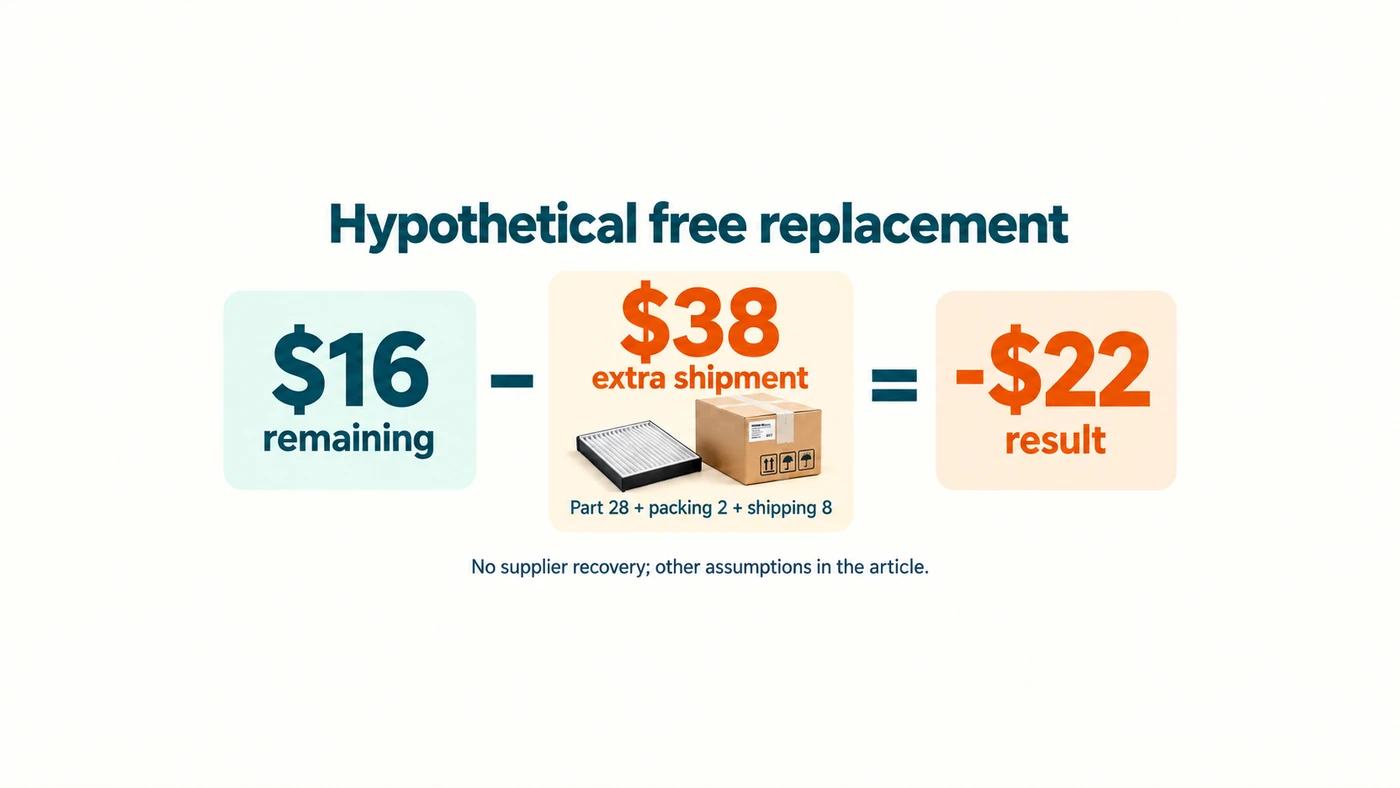
Now suppose the part is wrong and you send a correct replacement free. A second $28 part, $2 packing and $8 shipment cost another $38. With no supplier recovery and no additional payment or advertising cost, the order’s result becomes $16 − $38 = −$22. A large gap between the retail and part prices did not protect it from one extra shipment.
A full refund is a different remedy
Alternatively, suppose you refund the full $67 and all original costs remain spent. With no supplier recovery or added return expense, the result is $16 − $67 = −$51. This is a separate outcome, not a refund added on top of the replacement example. Do not deduct the original $28 part again; it was already included in the $16 calculation. Any new return expense would make this second result worse.
Choose the customer remedy under the actual problem, rights and terms. Budget for it before supplier reimbursement is agreed or paid.
Ten parts need supplier cash before payout
Cash timing matters too. If ten initial orders each require $38 for the part, packing and shipping before your payment provider pays out, you need $380 for those supplier payments. Marketing, payment charges and other bills may also need cash during that gap. A supplier holding inventory does not mean your store can operate without funds. Use the unit economics guide to build the same calculation with your actual quote and payment timing.
06
Get the part shipped and handle a wrong fit
For a normal order, send the supplier the exact brand, manufacturer part number, supplier SKU, supported application and customer order reference. Have it confirm stock and acceptance. Keep unresolved questions on hold, and do not allow an unapproved substitute just because another part looks similar.
Agree how changes and cancellations work. If a customer notices the wrong engine selection before dispatch, ask for a confirmed stop or correction within the supplier’s cutoff. Sending a message does not establish that the parcel was stopped. After packing, retain the order and part references, and distinguish a tracking label from actual carrier acceptance.
When the customer says the part does not fit
If the customer receives the wrong filter, collect the ordered and received brand and part numbers, a clear label or package photo, and the relevant vehicle information. Ask about the application and position without asking the customer to force the part into place. For a safety-related concern, do not encourage continued use or an improvised installation while you investigate.
Find whether the error came from picking or fitment
Compare that information with the listing and supplier order. Was the correct part ordered but a different one picked? Did the listing omit an engine or configuration limit? Did the order lack a required detail? A photograph may identify a picking error, but it cannot settle every fit or safety question.
Offer a clear next step under the applicable customer rights and your actual terms. A replacement must be the established correct part and be available for that application. If a suitable replacement cannot be confirmed, explain the refund and return route rather than sending another guess.
Record the return and supplier claim separately
For a physical return, give an authorized receiving address, packaging instructions and the agreed shipping arrangement. A return merchandise authorization, or RMA, is permission to send the part back. It is not evidence that a refund or supplier credit has been paid. The returns guide explains how to keep the customer’s remedy separate from the supplier recovery.
The buyer remedy can exceed the supplier return rights
That separation matters with special orders. A supplier’s nonreturnable term can leave your store carrying the cost; it does not by itself remove the customer’s rights. Record the customer remedy, the returned part and any supplier claim separately, and change the faulty listing, mapping or order question so the same error is less likely to recur.
07
Questions before your first parts order
Can I sell a part as universal?
Only if that description is true for the actual item. Vehicle-dependent fittings and manufacturer exclusions still matter. A semi-universal mat with floor and installation limits should not become an unrestricted all-car promise in your store.
Does supplier stock mean I need no money?
No. You may avoid holding the part yourself, but you still need funds for supplier payments, shipping, overhead and customer remedies. Establish payment timing and order acceptance before allowing the storefront to take more orders than you can fund.
Does eBay guarantee every part I sell will fit?
No. eBay Guaranteed Fit applies to eligible listings and the program’s matching vehicle conditions, not every automotive sale. The program describes a free wrong-fit return within its stated window—30 days or a longer seller return window where applicable. Check the current listing and program conditions. It is not a guarantee for your independent store.
Before your first sale, finish one exact part record, one matched supplier quote, and one workable customer-remedy process. That gives you something concrete to repeat: the right part, a supportable application, a funded shipment and a clear response if the order goes wrong.
Dropshipping Products: Practical Ideas and How They Compare
Compare concrete dropshipping product ideas, from pouches and phone stands to apparel and wall art, with shipping,

Electronics Dropshipping: Compatibility, Documents and After-Sales Support
Electronics can be dropshipped when the exact model works for the claimed setup and has applicable documents,

Phone Case Dropshipping: Match the Phone Before You Sell the Case
Compare ordinary and printed phone-case suppliers, build an exact model-to-item map, prepare artwork and calculate what a
