
GoDropship may fit a UK-facing store if the exact earphones, postcode charge and return route work for your offer. Its UK warehouse and delivery descriptions are supplier claims. Check the sample, checkout, tracking and return instructions before promising them to a buyer.
This is a UK supplier route. A merchant selling mainly to US buyers should not assume it is an alternative to a US warehouse or China-to-US shipping line. Even within the UK, remote-area costs and different carrier services can change the result.
Explore the broader topic: UK Dropshipping Suppliers: Match Your Store to the Right Supply Route.
01
Follow one order instead of evaluating a catalog headline
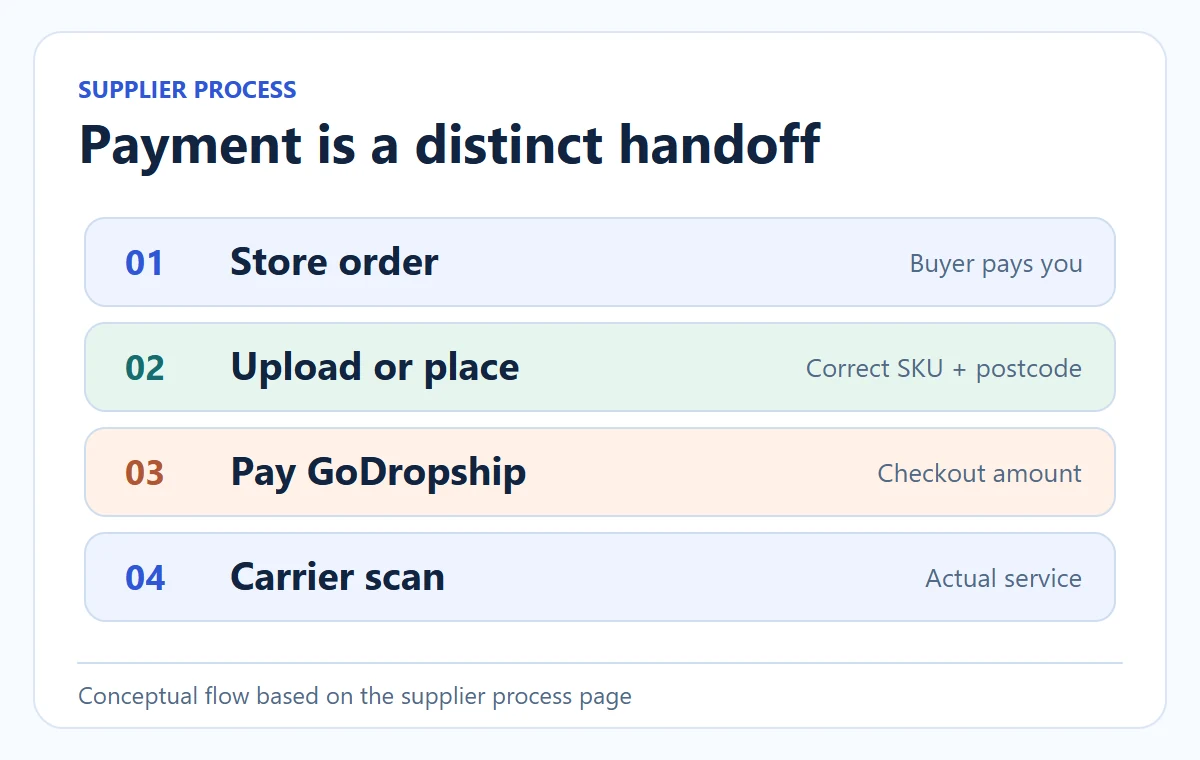
The supplier’s how-it-works page gives a clear sequence: register, download product data, list on your own store, download the customer order, upload or place it on GoDropship, pay, then receive tracking after the supplier ships. This is not the same as connecting a catalog and letting every order move without review.
Map the exact model and contents
Take one earphone model rather than importing a category. Save the supplier item code, color, current stock indication and saleable contents. Copy the data into a draft listing; then compare each claim with a sample and the supplier’s current product page. Are the pictured cable and ear tips included? Is “wireless” actually true for this variant? A buyer sees the product page, not your supplier CSV.
When you place the test order, verify the order number and address at both ends of the handoff. If you upload a batch file, try one order first. A column shift can send the correct product to the wrong house. After payment, compare the supplier status with the carrier event. “Tracking number created” is not proof of handover to a carrier.
Use the documented batch route on one record first
The published process links My Download Product Queue, Upload BatchOrder and BatchPay. It describes downloading product information, listing it in your store, then submitting and paying for the customer order.
Check the imported item
Compare the supplier item code, selected color and saleable contents with your draft earphone listing. Use the current template the supplier provides; do not guess its columns. Save the source file and the version you imported.
Inspect the uploaded purchase
Start with your own permitted order. Reopen the uploaded record and compare item, quantity, full address, postcode and final charges before payment. Confirm supplier acceptance afterward. If a field shifted or the address is incomplete, repair it rather than uploading the same purchase again blindly.
The account’s current controls and checkout govern the actual purchase. A correctly uploaded file has passed a data check, not the earphone, delivery or return test.
| Event | Evidence you should keep | If it does not match |
|---|---|---|
| Listing created | Item code, variant, photos and current price | Correct or hold the listing |
| Supplier order accepted | Supplier order ID, paid amount, address | Stop automatic copying and repair the order |
| Parcel collected | Carrier and first physical scan | Recheck the shipping promise |
| Item received | Actual product, pack and date | Document a defect or listing mismatch |
On a phone, swipe the table sideways to compare every column.
The order-release checklist applies here because a paid customer order should not be sent upstream while its SKU or address is ambiguous.
02
“No membership fee” is not “no order cost”
Save the actual checkout charge
GoDropship’s public process page says there is no membership or warehousing fee for its basic dropshipping service, while mentioning a PayPal checkout fee and delivery exceptions for remote regions. That describes its published offer, not the complete current checkout for your SKU. Confirm the actual charge while logged in and keep the invoice or checkout screenshot.
For a UK order, make one cost row with:
Customer price − GoDropship product price − checkout/payment charge − any remote-postcode or selected service charge − your selling-platform and payment fees − expected refund cost.
Do not fill the unknowns with a “typical UK shipping” number found in another article. Use the buyer’s intended postcode. A £3 change may remove most of the margin on a low-priced earphone. If the site includes a delivery cost in the product price for that postcode, record that as the quote rather than counting free shipping twice.
See what a remote charge does to a small order
Here is an arithmetic example, not GoDropship’s fee schedule. Assume the product price excludes the additional route charge in this case.
Ordinary eligible postcode
A £24 sale minus £9 product, £1 supplier checkout charge, £4 added delivery, £1.50 store/payment fees and £2 expected remedy allowance leaves £6.50 before advertising and overhead.
Same earphones, £3 more postage
The remainder becomes £3.50. A £4 acquisition cost would already exceed it. Decide whether to reprice, restrict that postcode or find another service; do not label the same offer profitable across all addresses.
If your actual product price already includes that delivery, remove the separate delivery line. Replace every sample amount with the saved checkout and your own selling costs.
Held stock needs its own agreement
The supplier also describes an option to hold stock for popular items. That changes the cash and inventory relationship. Check whether there is a commitment, storage term or release rule before treating held stock as ordinary per-order dropshipping. Our supplier-quote comparison helps put the same delivery destination and service into two offers.
03
Read the tracking service, not just the tracking number
Match tracking detail to the promise
GoDropship’s process page says it uses several services and that some large-letter services provide a tracking number without the same detailed movement events as other services. The shipping and tracking page gives the supplier’s current route information. Check the selected service on the actual order. If your store promises detailed delivery updates, a label-only or limited-event service may not support that promise.
A supplier range needs a tested postcode
The site also advertises 3–7-day delivery and a same-day dispatch cutoff on its general page. Those are supplier claims, not a result observed for your buyer’s postcode, SKU and order date. A holiday, missed cutoff, address problem or stock mismatch can change the date. Write a customer-facing estimate that separates processing from transit and has room for the service you chose. See the shipping-times guide for the difference.
Record a real parcel’s timeline
An effective first test sends a parcel to a real UK address, records payment time, first carrier scan and delivery, then repeats for a second postcode if your market includes remote areas. If either postcode produces an unworkable price or service, narrow the shipping zone before making the product public.
04
A defective item has a particular return path
The published Return | Exchange page instructs sellers to contact customer service, provide photos or video of a wrong or defective item, and obtain confirmation before sending it back. It also says the return shipping fee can remain with the sender and that the route and proof matter. Read the actual conditions for the problem you expect to handle; “30 days” alone is not a complete return policy.
Imagine one earphone arrives silent. The buyer contacts your store. Link the order and a clear fault description to the supplier order before asking for the authorized remedy. Do not tell the buyer to mail it to a general footer address.
Build a claim the supplier can identify
The return page asks merchants to contact [email protected] and obtain confirmation before returning goods. A general footer address is not a return authorization.
Keep the two clocks separate
Its published wrong/defective-item window is 30 days after receipt; non-delivery notification is described as 30 days after dispatch. Record both dates and contact the supplier promptly. These merchant claim windows are not a complete statement of the buyer’s rights.
Ask for the exact approved route
Send the supplier order, item code, receipt date and a clear description/video of the silent side. Confirm the remedy, receiver and postage payer. For a return, follow the approved instructions and keep proper delivery proof; the published PO-box route requires Royal Mail, so do not choose an incompatible courier.
Coordinate the buyer’s update through your store while the supplier claim proceeds. Confirmation of receipt, approval and payment/refund are separate entries in the case.
There are at least three different problems to prepare for:
Defect or wrong item
document the item and obtain supplier confirmation.
Undelivered parcel
check the carrier event and the supplier’s notification window before the claim ages out.
Wrong address supplied by the store or buyer
ask which postage or reshipment cost falls on whom.
Translate the supplier’s merchant-facing rules into a clear buyer-facing response. Your customer should not have to negotiate with your wholesaler. Our returns guide covers the policy and order-record side of that handoff.
Do not cap UK consumer rights at the supplier window
For UK consumer sales, GOV.UK’s refund guidance separates faulty or misdescribed goods from eligible distance-sale cancellations. The latter generally allow 14 days to notify cancellation and another 14 days to return, subject to exceptions. Check the item and reason, including any applicable sealed-hygiene exception; do not copy the supplier’s 30-day limit or address deductions as a blanket buyer policy.
05
Keep imported stock and price current
A downloaded catalog file is a snapshot. When the supplier changes a price or runs out of a color, your listing may still display the old one. GoDropship has a stock and price update notice, but the merchant still has to decide how often to compare the feed and what to do with orders arriving between checks.
Hold the unavailable model and review paid orders
For the earphone SKU, record the supplier item code, last stock check, last price check and the maximum price rise your margin can absorb. If a new feed says the item is unavailable, pause the variant and examine paid but unreleased orders. If the supplier price rises after you sold one, calculate whether that order can still be honored and whether future listings need a new price. Do not silently substitute a similar-looking earphone.
Separate committed stock from per-order buying
If you decide to use the site’s held-stock option for a proven item, ask whether the units are allocated only to you, whether you can inspect them and how unsold or damaged units are treated. Held stock may be useful, but it introduces a commitment different from buying one supplier-owned unit after each customer order. Put it on a separate cost sheet.
06
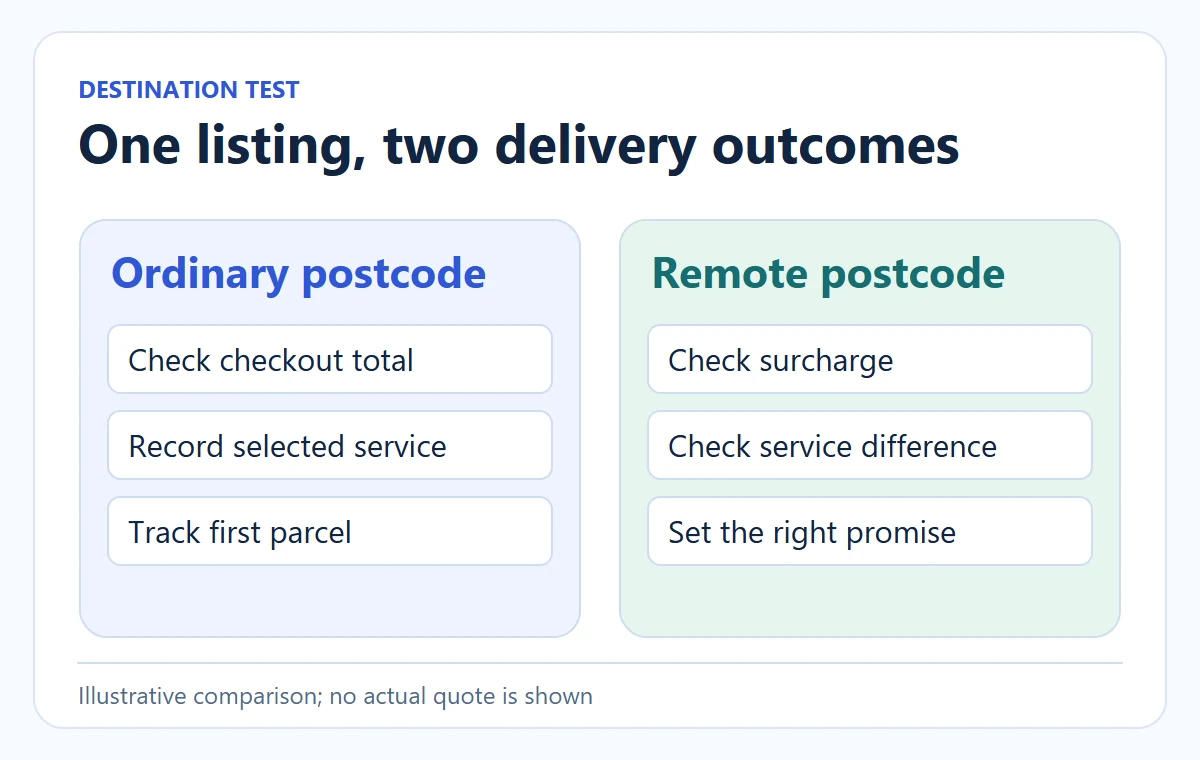
Run two postcode and service checks
Use one ordinary mainland postcode and one address where the service or surcharge may differ. For the same SKU, save what checkout actually shows before buying a small test parcel. A catalog page cannot tell you whether the second destination is served.
| Save from the same SKU test | First postcode | Second postcode |
|---|---|---|
| Checkout total and added fees | Actual amount shown | Actual amount, or “not served” |
| Carrier service and promised range | Service offered | Any service or timing change |
| Tracking | First physical scan on a paid test parcel | Quote-stage tracking level; test a parcel if you plan to serve it |
On a phone, swipe the table sideways to compare every column.
Read the Tuesday-to-Monday timeline
Keep dispatch and delivery separate. Suppose a Tuesday order is marked dispatched Wednesday, first scanned Thursday and delivered Monday. The buyer did not receive two-day delivery. One parcel cannot establish an average, but it can stop an unsupported first-listing promise.
Use that test to set support expectations. If the service shows only sparse tracking, tell the buyer what the first scan means and when your team will investigate a stalled parcel. Record the point when you will contact the carrier or GoDropship rather than copying “in transit” from a panel.
Make a different offer when the route differs
If the second postcode adds a surcharge or weaker service, decide whether to exclude it, price it differently or use a wider delivery range. For non-delivery, keep the last physical scan and the submitted address. The supplier’s return guidance distinguishes courier/supplier fault from address problems; ask for the current decision in writing. Your buyer-facing remedy may be due before that supplier investigation ends.
07
A first-listing decision you can defend
Use four completed answers to release
Release the earphone listing only after a sample or actual test parcel confirms the model and contents, the checkout shows a workable total for the target postcode, tracking supports your delivery wording, and the return route is written down. A fast-looking product feed without those four answers is still research.
GoDropship might suit a UK merchant who wants a local stock route and can manage manual or batch order submission. It is less persuasive when your customers are outside its service area, you need highly detailed tracking on every parcel, or your store’s returns promise conflicts with the supplier’s process. The broader supplier guide helps compare a source on these operational facts.
Compare this SKU’s UK and China routes
If you are weighing a UK warehouse against China-side sourcing or a different fulfillment setup, AIDrop Agent can review the target product, destination, packaging and exception route. Use the inquiry form with the SKU and sample requirements; there is no useful quote without those details.
08
Frequently asked questions
Does GoDropship charge a membership fee?
Its public how-it-works page says no membership fee for the described service, but mentions a PayPal checkout fee and remote-area exceptions. Confirm the amount on your current logged-in order.
Can I promise every UK order in 3–7 days?
That range is a general supplier claim. Check stock, the order cutoff, selected carrier, postcode and a tracked test before making a product-specific promise.
Should the buyer return a defective item directly to the supplier?
The supplier’s published process says to contact customer service and confirm the return before sending it. Your store should coordinate the buyer’s instructions and keep the claim attached to the correct supplier order.
CJdropshipping Review: Costs, Warehouses, Quality and Fulfillment Fit
CJdropshipping is a practical option for sellers who want sourcing, store connections, packaging and fulfillment in one

CJdropshipping vs DSers: Who Sources, Pays and Ships the Order?
CJdropshipping can source and physically fulfill an order; DSers maps a store product to supported external suppliers

AutoDS Review: Evaluate the Automation You Would Actually Use
AutoDS can reduce listing and order work, but its value depends on your sales channel, tier, add-ons
