
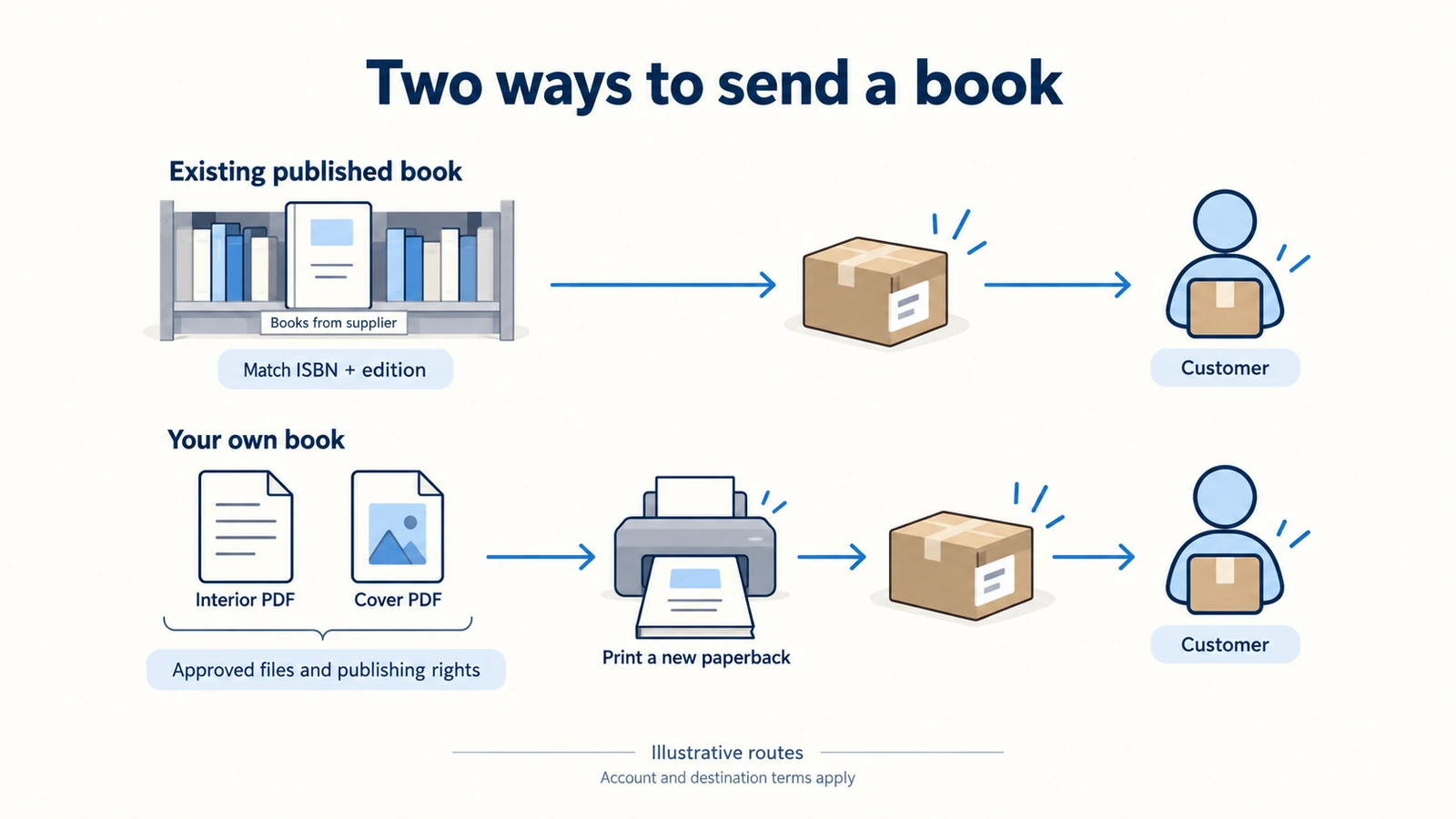
You can dropship physical books in two ways: have a supplier send an existing published title to your customer, or have a printer produce and send a book you own the rights to publish. Choose that route first. It determines whether your next job is finding the exact edition in stock or preparing files for printing.
For existing titles, Ingram’s retailer services and BooksCloud offer relevant routes. For your own work, Lulu Direct and IngramSpark publisher orders are different options. Each has its own account, payment and delivery requirements.
Imagine Eli opening a small store for home cooks. He could sell other publishers’ cookbooks, his own original cookbook, or both. This fictional example follows the actual book and the money through each choice. Ebooks need a digital-delivery arrangement; they are outside this physical-book guide.
01
Choose the book and the reader before the supplier
Eli’s first question is useful and small: which books help someone cook well in a tiny kitchen? A focused range lets him explain why a book suits the reader. Importing a huge catalogue does not show that anybody wants his store’s selection.
| Choice | What the customer buys | What you must arrange |
|---|---|---|
| Existing published title | A specific publisher’s edition in a stated format and condition | Suitable stock, permission to sell through your channel, and a supplier willing to send that exact copy |
| Your own print-on-order book | A newly printed copy made from your approved files | Rights to publish the contents, correct print files, a proof and a paid print-and-ship order |
On a phone, swipe the table sideways to compare every column.
Existing titles let Eli curate other people’s books without designing their pages. He still needs current stock and a workable delivered cost. His own cookbook gives him control over the contents, but writing, editing, cover design and proof copies cost time or money before the first sale. Print-on-demand dropshipping explains the broader production model.
Used books add condition decisions: markings, missing dust jackets or worn corners matter to the customer. BookDrop’s wholesale service describes graded bulk stock, pallets and freight. That is a different purchase from asking a supplier to send one named ISBN to one reader.
Start with a few titles or one original work and a destination you can serve. If you are comparing books with other categories, the product guide helps keep that wider choice separate from this book-order decision.
02
Find a service that handles that kind of order
For existing published titles
These public routes solve different parts of the order:
| Route | What its page describes | Settle before listing |
|---|---|---|
| Ingram Direct-to-Home | Direct customer shipment for eligible retailers; DTH excludes non-US retailers | Account eligibility, title, destination and order method |
| Ingram Consumer Direct Fulfillment | Stock, order-acceptance and shipment messages | Which Ingram service fits your store and how a paid order is accepted |
| BooksCloud | Shopify app with US book sourcing; free to install | Product, shipping, stock and returns billed after sale, separately from Shopify |
On a phone, swipe the table sideways to compare every column.
A free installation does not make delivery free
A public catalogue or free installation is not an approved account or a free delivered book. Ingram’s DTH restriction does not automatically apply to every other Ingram service.
BookSell offers Shopify ISBN imports and distributor shipment. Its page lists monthly Starter, Advanced and Pro prices of $9.99, $69.99 and $199.99, with 50, 500 and unlimited imports respectively. The annual-plan display shows $8, $49 and $159 per month. The same page calls its 10%, 20% and 30% figures both a “commission per sale” and a “profit percentage” based on a book’s suggested retail price. That wording does not tell Eli what he keeps on a particular order. Do not enter one of those percentages as a store fee or net margin. Ask for a settlement example for the exact ISBN showing suggested retail price, Eli’s selling price, book charge, shipment and the amount paid to him.
Confirm the actual destination
BookSell’s country wording conflicts: Advanced, Pro and the FAQ describe international shipping, while other text says US and territories only. Ask for the terms for your plan, title and destination, plus the actual annual amount. The page’s promotion is not a checkout price we tested.
For a book you own
Lulu Direct prints and ships a book whose files you prepared. It offers Shopify, Wix and WooCommerce connections, plus separate Print API and bulk Order Import submission methods. None is a catalogue of other publishers’ titles.
Choose who takes payment and who sends the book
| Owned-book route | Order and payment decision |
|---|---|
| Lulu store connection | Your connected store takes the customer order; confirm the exact Lulu product and delivered print charge. |
| Lulu Direct Buy Button | Lulu checkout connects to Stripe. Compare its payment and payout flow with your own store checkout. |
| IngramSpark publisher-direct | Send an approved title to yourself or your customer. Its August 2026 guide says Global Connect partner printers do not take dropship orders; they fill bookstore and retail orders. |
On a phone, swipe the table sideways to compare every column.
Retail distribution is a different sale: retailers decide whether to list or order your book, and wholesale returns can affect publisher payment. Lulu’s distribution exclusions, including some low-content and public-domain formats, apply to that programme; they are not a ban on all book printing.
For a direct sale, use accurate publisher details, an accepted payment method and one quote for the exact book and destination. We reviewed public documentation; we did not open these accounts or test an order.
03
Make the listing match the exact book
An ISBN identifies a particular book product. Your store’s SKU is your own stock code for that listing. Eli can call a product COOK-PB-02, but the supplier still needs its actual ISBN and the correct version. Neither code tells you that the book is currently available.
Write one order line with these details:
- Supplier-confirmed ISBN and title.
- Edition, publisher, language and paperback or hardcover format.
- New or used condition, including relevant wear or missing pieces.
- Number of copies and any set or bundle contents.
- Supplier item code, current cost and availability for the customer’s destination.
Then make the cover image and description agree with that line. A reader who orders the English second-edition paperback may need the revised recipes or the lighter binding. A first-edition hardcover is not an automatic substitute, even if its title looks similar. Explain the change and let the buyer choose a suitable alternative or refund.
Edition and reprint are different decisions
Bowker’s publication FAQ distinguishes a new edition from an unchanged reprint or minor typo correction. Do not decide that every cover change is a new edition, or that every similar title shares an ISBN; use the publisher’s and supplier’s book details.
For sets, say whether the offer is one volume or the whole collection. A photo of three books must not conceal that the supplier’s price buys only one. Eli should order a sample of his chosen version to inspect its condition and protective packaging before promising the same experience to customers.
04
Prepare your own book for printing
Eli’s original cookbook is a separate product from the published titles he resells. Buying somebody else’s book or obtaining an ISBN does not give him permission to reproduce its text or pictures. The US Copyright Office explains protection for original literary works; permissions and exceptions still depend on the work and applicable law. Our copyright and trademark guide covers the broader sourcing questions.
For his hypothetical 160-page cookbook, Eli chooses a 6 × 9-inch paperback with a black-and-white interior. That is a print specification, not a universal cheap-book format. Paper, binding, colour, page count and destination all affect the quote.
Interior and cover files do different jobs
- Interior PDF: Include the pages readers turn, including title, copyright and intended blanks. A front-cover image is not this file.
- Full cover PDF: Include back, spine and front. IngramSpark’s guide uses a cover template whose spine depends on page count, paper and binding; do not use another printer’s template.
- Provider settings: Lulu’s guide calls for single pages rather than reader spreads, embedded or outlined fonts, suitable resolution such as 300 ppi and the selected format’s bleed. Bleed extends artwork beyond the cut edge to avoid a white trim line.
- Proof and sample: Review the electronic proof, then order a physical copy. Check small recipe text, page order, binding, images and cover alignment. Correct and reapprove the files before more customer orders.
05
Price the book and fund the print order
Use the cost of the complete customer order, including delivery. A $12 book can lose its apparent advantage when a heavy parcel costs more to send than expected. Ask for the selected ISBN or print configuration, quantity, protective packing, destination and shipping method together.
Here is a hypothetical USD comparison with $30 collected for the book and delivery. Customer tax collection is excluded. The assumed costs are not quotes for Eli’s cookbook or any named supplier.
| Per-order line | Existing-title illustration | Own-book Lulu Direct illustration |
|---|---|---|
| Book or print cost | $12.00 | $8.00 |
| Customer shipping | $5.00 | $5.00 |
| Extra protective packing | $0.50 | $0.00 assumed |
| Lulu Direct fulfilment fee | Not applicable to this example | $1.75 |
| Store payment processing | $1.00 assumed | $1.00 assumed |
| Advertising allocation | $3.00 assumed | $3.00 assumed |
| Estimated allowance for remedies | $1.00 | $1.00 |
| Total illustrated costs | $22.50 | $19.75 |
| $30 less those costs | $7.50 | $10.25 |
On a phone, swipe the table sideways to compare every column.
The current Lulu Direct merchant-pricing guide lists the $1.75 fulfilment fee for its Shopify, WooCommerce and Wix integrations. The rest of this table is assumed, including no separately charged packing in the print example. Do not apply that fee automatically to a different API or order route.
These remainders are before tax, subscriptions, editing, design and other overhead. The $1 remedy line is a budgeting estimate, not an actual refund already paid. Tax collected from a customer for remittance is not extra profit. If shipping rises by $3, the illustrated remainder falls by $3 unless you also change what you charge.
Keep print money available before your store pays out
On an integrated Lulu Direct store, the customer pays your store. The order reaches Lulu separately and remains unpaid until you pay Lulu, unless automatic payment is active. Your payment covers printing, shipping, applicable tax and the fulfillment fee. A configured production delay comes before the order is sent into production; customer payment alone does not start an unpaid print order.
In the hypothetical print example, print cost, shipping and the fulfilment fee total $14.75 per order. Ten orders need $14.75 × 10 = $147.50 for those costs before any store payout you are waiting for. Add any applicable fulfilment tax, and keep payment fees, advertising and customer-refund cash separate. This is money to fulfil orders, not a prediction of earnings.

A Buy Button or distribution sale pays differently
Lulu’s Direct Buy Button payout help describes Stripe deductions and a temporary 5% reserve. It states 14-day payment release with 30-day reserve release for standard accounts, and 7-day payment release with 14-day reserve release for established accounts. Those are this checkout route’s stated schedules, not your Shopify bank-payout schedule.
A reserve is not a fee or available payout
The page’s worked examples use inconsistent payment and reserve bases. Ask Lulu which amount the reserve applies to in your account and use your actual Stripe fees before budgeting an exact payout. A temporary reserve is cash you cannot use yet; it is not automatically a permanent expense.
Retail distribution pays on a different schedule
IngramSpark wholesale distribution also pays differently from your own-store order. Its guide describes publisher payment around 90 days after the end of the sales month, subject to payment-method thresholds. Wholesale discounts, printing charges and possible wholesale returns affect that income. Do not plan a direct customer order around a distribution payout you have not received.
06
Send one accurate order from payment to delivery
For an existing title, Eli sends the supplier the exact book, quantity and customer address. The supplier’s acceptance confirms more than an imported store order does: the selected version must be available, the address serviceable and payment or approved credit terms arranged.
For his own cookbook, the order must refer to the approved print project. On a Lulu Direct integration, a correctly connected listing sends the order to Lulu, but a failed supplier payment can stop production. Fix that payment promptly and tell the customer if the promised timing changes; do not mark an unpaid book as shipped.
Use one sample and then one agreed customer-address order to follow the full sequence:
- Confirm the book version or approved print project, copy count and address.
- Obtain supplier acceptance and pay through the agreed method, or confirm approved payment terms.
- Watch stock picking or print production separately from shipping.
- Receive the actual shipment notice and carrier tracking, then send the customer useful delivery information.
- Confirm the received version, quantity and condition, including any second parcel.
Printing time comes before travel time
If a hypothetical order needs three business days to print and four business days in transit, allow seven business days for those two stages, plus any other delay. That is an illustration, not a Lulu or Ingram delivery promise. Use the current order estimate, production calendar, destination and selected carrier service. A priority print service does not automatically buy a priority shipping service.
The cancellation window also belongs to the actual order route. IngramSpark’s guide allows publisher-direct cancellation within 30 minutes through Submitted Orders. Standard Lulu.com order help gives its own one-hour window. Do not apply the standard Lulu.com rule to a Lulu Direct order without the Direct terms.
Set the Lulu Direct delay for the actual workflow
Lulu Direct’s production-delay help, rechecked October 11, allows 60–2,880 minutes after payment before production, with a 60-minute default. Eli could choose 120 minutes for a two-hour wait.
Save 120 minutes
In Stores, choose Manage Store, then Settings. Under Production Delay, choose Update Production Delay, enter 120 and select Save Update. Reopen the setting to check that 120 minutes remains saved for the intended store.
Check the actual order state
Confirm printer payment and the actual order state. Cancellation ends when production starts; changing this setting does not cancel an order already in production.
This setup is proposed, not account-tested. Printing and transit still follow the delay, so the saved setting is not a delivery estimate.
A created label does not prove the carrier has the parcel. If a stocked title becomes unavailable or a print job stalls, contact the customer about a workable delay, buyer-approved alternative or refund rather than silently replacing the book. Keep the store’s available stock and delivery description in step with what the supplier can actually fulfil.
07
Resolve wrong editions, damage and print mistakes
First identify the error:
Wrong edition
Compare the ordered ISBN with the book’s ISBN and publication page.
Crushed corner
Ask for photos of the book, outer packing and shipping label.
Missing or badly printed pages
Compare page photos with the approved interior PDF and order number.
Resolve the customer order separately from the supplier claim. Arrange the appropriate replacement or refund under your terms and applicable customer rights. A supplier credit is a different payment; do not make the customer wait for an upstream claim to be paid. Obtain the actual authorised return address before telling anyone to post the book back.
Lulu’s defect-image guidance explains what photos help assess printing or binding faults. If the printer faithfully produced Eli’s wrong PDF, he must fix the file before sending another order.
Check the return route for the book you sold
The route changes where a return goes and who bears it:
- Publisher-direct: IngramSpark’s guide sends a delivered customer return to the publisher or retailer, not automatically to its print facility. For non-receipt or damage, it describes notice and a Report an Issue button within 90 days of shipment; another defect passage is unclear, so check the actual deadline with support promptly. This is not a universal customer refund window.
- Wholesale distribution: A retailer’s return may charge the publisher the wholesale price and affect compensation. That is separate from refunding Eli’s direct-store customer.
If the book also needs sourcing or protective packing
If Eli needs China-side sourcing or protective packing, send AIDrop the ISBN or owned-book specification, destination, quantity and packing question. Its sourcing service can discuss those practical needs; it does not provide a promised Lulu/Ingram connection, ISBN service or rights clearance.
Questions before your first book order
Is this about selling books or buying a dropshipping guide?
It is about selling physical books. You can curate existing titles through a permitted supplier or sell your own work through a print provider. A book teaching dropshipping is simply one possible title, not a separate fulfillment model.
Does owning a copy or an ISBN let me reprint the book?
No. An ISBN identifies a book product; it does not grant reproduction rights. Selling an authorized existing copy and creating a print file of someone else’s work are different actions. Establish the required rights before sending files to a printer.
Can a non-US retailer use Ingram’s Direct to Home route?
The reviewed retailer DTH information excludes non-US retailers. That specific restriction does not describe every Ingram service. Confirm your eligibility and actual destination for the route you plan to use before relying on its catalogue.
My customer paid. Why is the Lulu order still unpaid?
In an integrated store, the customer pays your business and your business pays Lulu separately. Check automatic payment or submit the actual printer payment, then check acceptance and the production delay. Do not tell the customer printing started solely because your store collected payment.
Can I send another edition if the ordered one is unavailable?
Ask the buyer first. Paperback, hardcover, language and edition can change the product substantially. Offer an accurate wait, an agreed alternative or the applicable refund instead of substituting a different book silently.
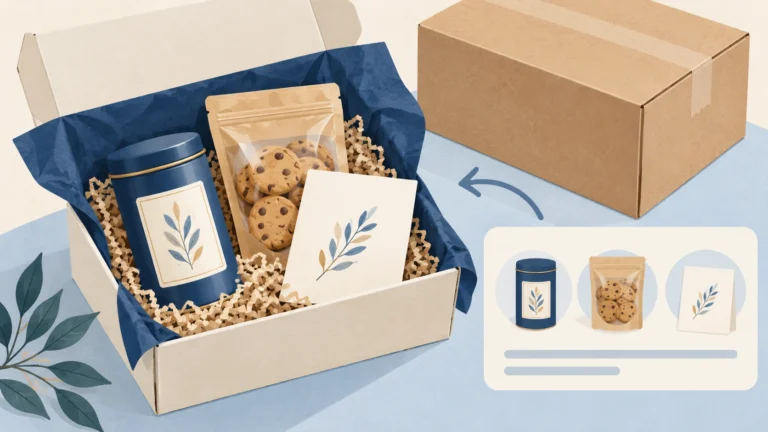
Gift Basket Dropshipping: Choose a Supplier and Keep the Gift Promise
A gift basket can be dropshipped, but the recipient must get the contents, message and delivery experience

Wedding Favor Dropshipping: Get the Count and Event Date Right
Wedding favors can ship directly to a host or venue, but the sold unit, guest count and
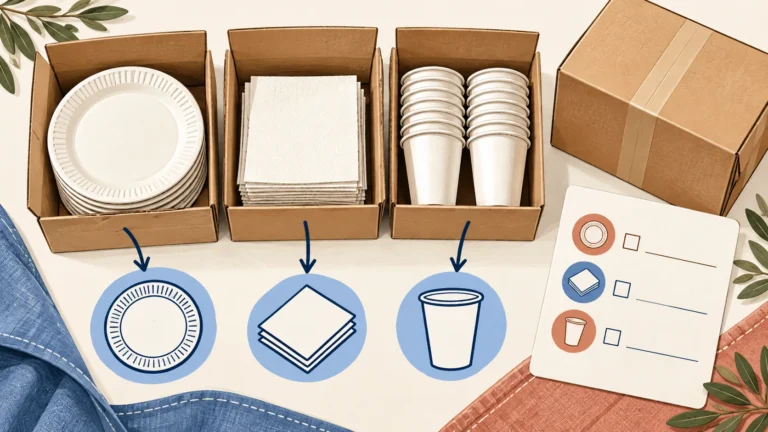
Party Supplies Dropshipping: Build a Kit That Arrives Complete
Some suppliers direct-ship party goods. A useful event kit still needs enough of each piece, a supported
