
For a clothing store, start with Trendsi’s US-stock products. For ready-made goods, look at US Direct or US-based suppliers on DropCommerce. Zendrop and CJ offer US warehouse routes for selected products. For shirts or other goods carrying your own designs, consider Printful or Printify, where the item is made after the order arrives.
Choose the product first, then the supplier. A US supplier badge tells you little about whether the black, medium shirt your customer wants is available, can reach their ZIP code, or can be returned when it does not fit.
These are public supplier routes, not products we bought or delivery speeds we tested. Pick one that suits what you sell, then put one exact item through a sample order before importing a large catalog.
Explore this topic
- Sellvia Dropshipping: What You Pay and What You Control
- GreenDropShip Review: Membership Costs and Your First Grocery Order
01
Compare US dropshipping suppliers by product type
A US company, a US warehouse and a US-made product are three different things. Some services connect you to several brands; others hold selected stock or print your design after the order. Pick by product type first.
| Option | A sensible starting use | What to settle before selling |
|---|---|---|
| Trendsi | Clothing from its US-stock selection | Pick US products rather than overseas products; check size availability, weight-based shipping and excluded returns. |
| US Direct through Inventory Source | Ready-made goods from multiple US suppliers | Its connection requires an Inventory Source Full Automation plan. US Direct membership and order fees are separate considerations; its advertised delivery coverage refers to the Lower 48. |
| DropCommerce | Products from independent US and Canadian brands | Choose a US supplier and the product’s actual destination coverage. Supplier shipping charges vary; automatic fulfillment is a Pro-plan feature. |
| Zendrop US products | Selected ready-made products shipping within the US | Use the US filter; allow processing time. Some items arrive in Amazon-branded packaging, and US products do not offer custom branding. |
| CJ US warehouse products | Selected goods with available US warehouse inventory | Confirm the exact product code and warehouse. Buying private inventory means paying for stock and moving it there; it differs from using available shared inventory. |
| Printful | Original designs on made-to-order goods | Confirm the product and variant’s fulfillment possibilities, making time and shipping cost. A mixed basket may ship from different locations. |
| Printify | Original designs made by a selected print provider | Choose the provider deliberately. Order Routing can switch providers when stock or capacity changes; review the resulting location and cost. |
On a phone, swipe the table sideways to compare every column.
For a ready-made item, compare a specific US listing on Zendrop or CJ. If you designed the artwork, choose the Printful product or Printify provider before quoting delivery; printing takes time even when the blank product is nearby.
Importing is only one step
A catalog connection may update a listing without purchasing a customer’s order. DropCommerce describes paying a supplier from a pending order; automatic fulfillment is a Pro-plan feature. Before paying for any app, separate the features you need: importing products, updating stock, submitting orders, paying the supplier and returning tracking. For Korean beauty products, compare Korean dropshipping suppliers for US customers; that shortlist separates US-stock dropshipping, Korea-side fulfillment and wholesale stock purchases.
02
Check the black medium shirt, not just the supplier name
A SKU is the code a supplier uses for one particular product choice. The black medium shirt and the blue large shirt can have different codes, quantities and warehouse locations. Your customer buys one of those choices, so a product page saying “US stock” is only the start.
Find the exact US-stock variant
In Zendrop, use Find Products and filter ship-from to US. In CJ, choose a US warehouse and inspect stock for the exact product code. Then quote the buyer’s ZIP; a warehouse ZIP and a destination ZIP answer different questions. No public catalog screenshot proves that your chosen size is in stock now.
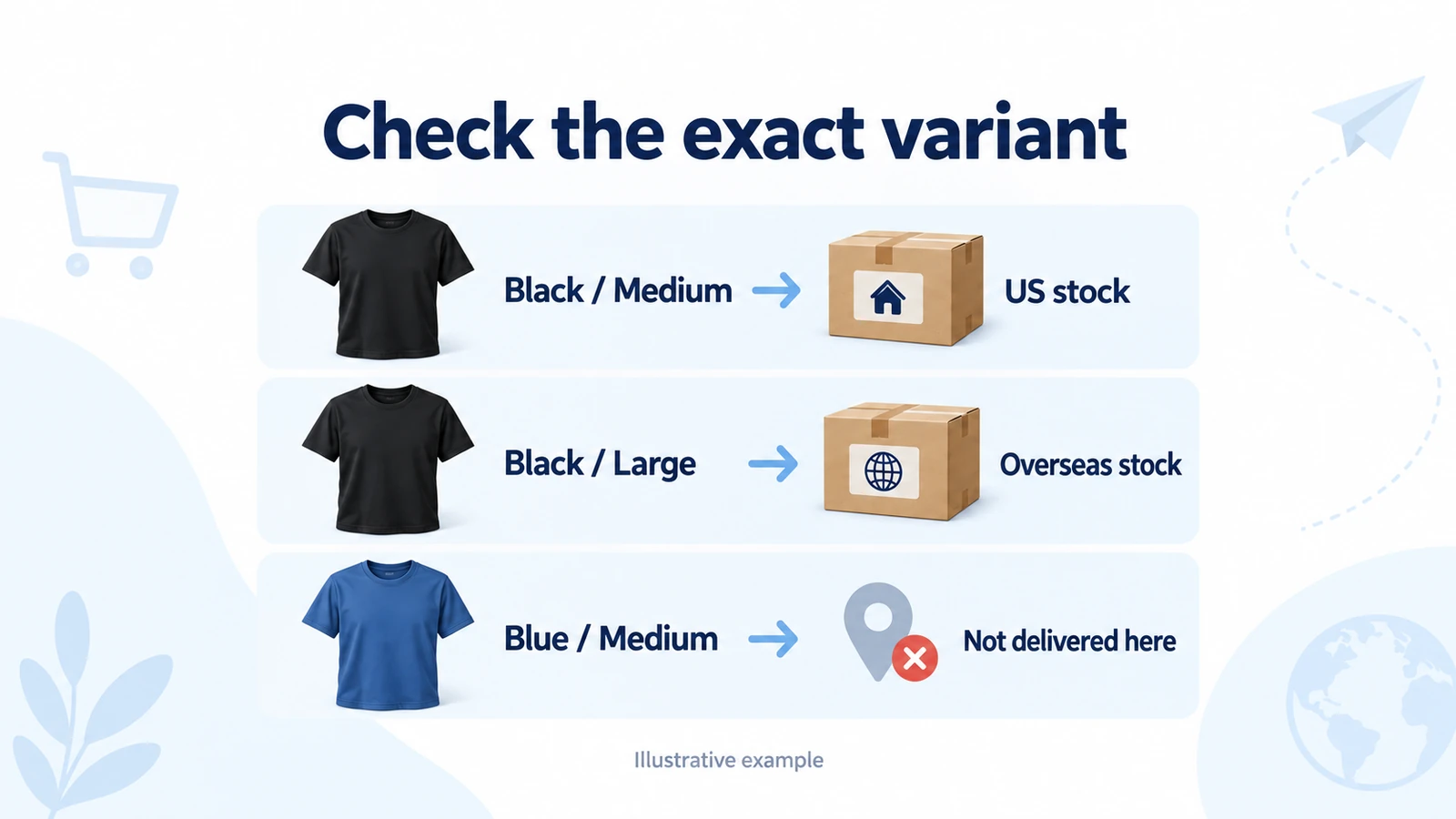
Make a small shortlist rather than importing every color. Here is an illustrative result for three shirt choices, not a statement about any supplier’s actual stock:
- Black, medium: the supplier confirms available US stock and delivery to the intended ZIP. Keep it on the shortlist while you price shipping and check returns.
- Black, large: only overseas stock is available. Leave it out of a listing promising US dispatch, or create a separately explained offer with its real origin and timing.
- Blue, medium: stock is listed, but the chosen warehouse cannot serve that destination. Do not offer that combination until another supported warehouse or supplier can fulfill it.
Keep one record for each sellable variant
Put the product code, warehouse, available quantity, buyer ZIP, dispatch estimate and return contact on the same short list. If the blue medium cannot reach that ZIP, the listing needs another supported option or must stay unavailable.
When that variant sells out
If the next black medium sells out, pause that choice. Offer a buyer-approved equivalent only after the buyer agrees, or explain the refund. Do not quietly replace US dispatch with overseas shipping.
If you are deciding whether to use supplier-held stock, buy your own US inventory or ship from China, the US-versus-China supplier comparison covers that larger choice. Here, the immediate job is smaller: can this supplier send this product choice to this customer?
03
Count packing time before travel time
Processing comes before shipping. Processing is the time spent accepting, preparing and handing over the order; transit is the carrier’s journey to the buyer. Your customer waits for both.
Include the preparation days
Zendrop’s US-supplier guide estimates 1–3 business days of processing and 3–5 business days in transit. Added together, that is roughly 4–8 business days, not 3–5 days from checkout. Peak processing can reach five business days, taking the upper end to ten. These are supplier estimates, not delivery results we measured. Zendrop’s timing guide
Get the order cutoff, preparation days and carrier service for the buyer’s address. Add production time for a printed shirt. The first carrier scan tells you more about dispatch than a label created in advance.
State a supported shipping promise
Give buyers the whole expected wait. Under the FTC’s online-selling rule, a stated shipment time needs a reasonable basis; where no shipment time is stated, the covered default is generally 30 days. If shipment will be late, follow its notice, consent or cancellation and refund steps. A shipment rule does not guarantee the carrier’s arrival date.
Say ships from a US warehouse only when that is the dispatch point. Made in USA is a manufacturing claim with a different FTC standard; a US office or return address does not prove it.
04
Price the whole order and keep money for the supplier
Your cost is the shirt plus supplier delivery, any order or app charge, the checkout payment fee and money for customer problems. Advertising and tax come after those amounts.
Trendsi’s US dropship/sample table, checked October 11, 2026, lists $3.99 up to 0.6 lb, $5.99 up to 1 lb, $9.99 up to 5 lb and $14.99 above 5 lb. Its US standard estimate is 2–5 business days; overseas products have a different estimate. Confirm the basket’s actual charge and destination before quoting a buyer.
Check the packed weight before setting the price
The $5.99 example below assumes the package fits that weight band. Keep the same $40 sale, $18 product, $1.20 checkout fee, $1 order fee and $2 problem allowance. Here is what changes with three invented packed weights:
A 0.5 lb packed order
$3.99 public shipping band: $40 − $18 − $3.99 − $1.20 − $1 − $2 = $13.81 before ads, subscriptions and tax.
A 0.8 lb packed order
$5.99 band: $11.81 remains before those expenses. With the example’s $8 ad cost, that becomes $3.81.
A 1.3 lb packed order
$9.99 band: $7.81 remains before ads. The same $8 ad cost would leave a $0.19 loss before subscriptions and tax.
These are not measured shirts or supplier quotes. Ask for the actual packed weight of the basket, including packaging, then compare the shipping line at the supplier checkout. A heavier order needs its own margin calculation; do not reuse the cheapest single-item freight.
Here is an illustrative $40 shirt order. The product, payment fee, order fee and return allowance are assumptions; the $5.99 shipping line uses that published weight band solely to show how a real quote fits the calculation.
| Item | Illustrative amount |
|---|---|
| Customer payment | $40.00 |
| Product | −$18.00 |
| Supplier shipping | −$5.99 |
| Checkout payment fee | −$1.20 |
| Assumed supplier order fee | −$1.00 |
| Allowance for returns and replacements | −$2.00 |
| Remaining before ads, subscriptions and tax | $11.81 |
On a phone, swipe the table sideways to compare every column.
The calculation is $40 − $18 − $5.99 − $1.20 − $1 − $2 = $11.81. An assumed $8 advertising cost leaves $3.81 before subscriptions and tax. Replace each assumption with your account’s actual charges before choosing a selling price. The $2 allowance is a planning amount, not a promise that every return costs only $2.
Customer payment and supplier payment are separate. A buyer can pay your store while that money is still waiting to reach your bank. The supplier may need payment now to accept and send the order. Ten orders at $18 plus $5.99 shipping need $239.90 for goods and delivery alone, before the assumed order fees or other charges.
Free membership is not a free connection
A free US Direct membership is not a free operating setup: its Inventory Source connection requires Full Automation, and plan-dependent order charges can apply. Price the combination needed for your store and expected order count.
05
Match your return promise to the supplier’s actual terms
A domestic warehouse can send a shirt without accepting it back because the buyer dislikes the fit. Before promising 30-day returns, compare the upstream rules with the promise your store makes to the buyer.
| Supplier route | Upstream return rule that affects your offer |
|---|---|
| Trendsi | Qualifying unworn US apparel with tags and labeled packaging: start the request within seven days, then send the parcel within seven days of submission. For a split order, count from the last package delivered. Swimwear, jewelry and intimates are excluded; there are no exchanges, and shipping/handling is not refunded. |
| US Direct | Request an RMA within 15 days for Honest Green or 30 days for other suppliers. After approval, send the parcel within seven business days to the supplied address with its RMA number. Buyer remorse is excluded. Approved recovery normally starts as account credit; a refund of that credit can be requested within 30 days of issuance. |
| Spocket | Ordinary returns depend on the chosen supplier’s listing. For damage or a wrong item, contact Spocket with supporting photos within 15 days of receipt. |
| Printful / Zendrop | Printful names a Texas receiving address for US/Mexico facilities, but an address does not grant a refund. Zendrop says its warehouse does not accept product returns. Arrange the authorized recipient before listing. |
On a phone, swipe the table sideways to compare every column.
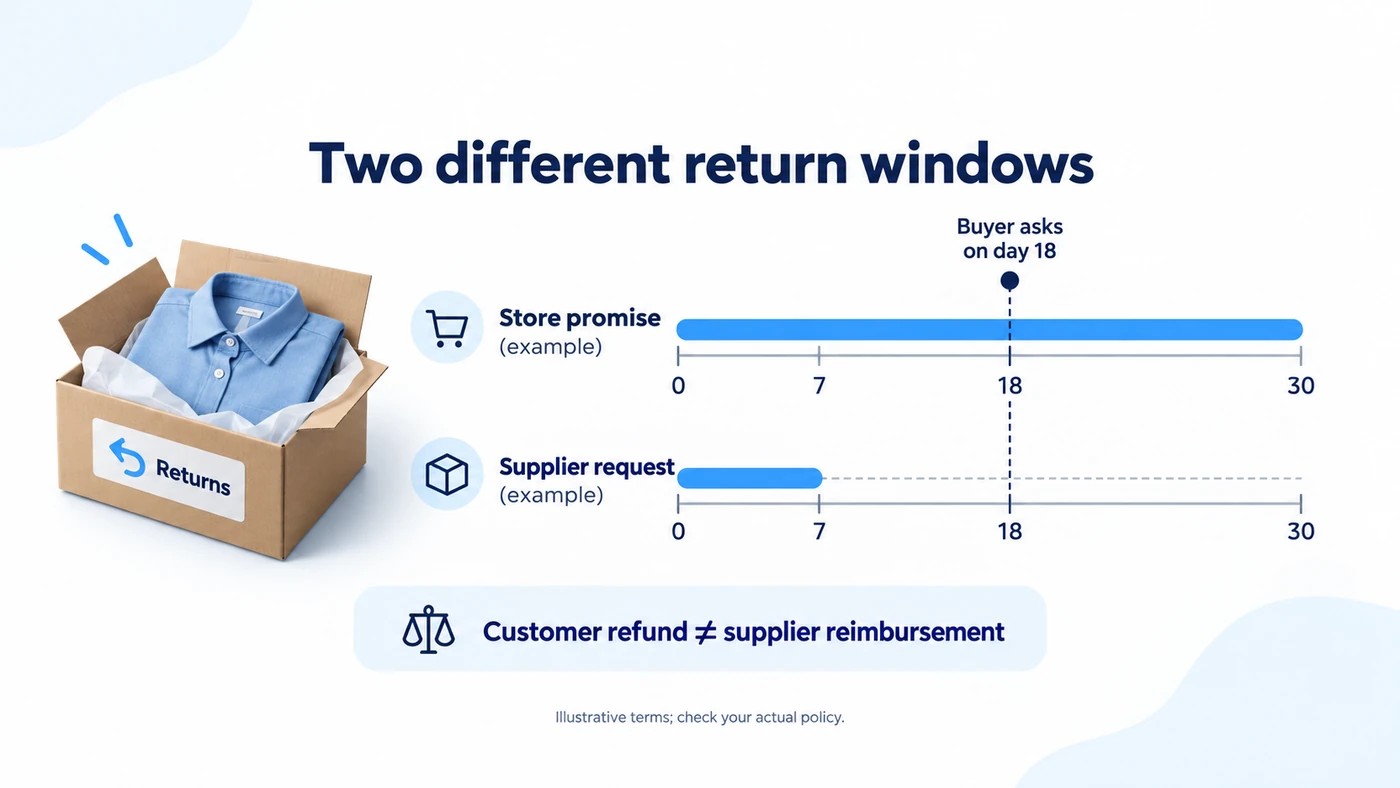
Day 18: your promise can outlast the supplier’s
Now suppose your store promises 30-day returns and the shirt buyer contacts you on day 18 because they changed their mind. That may fall outside a supplier’s seven-day initiation window, or outside a policy that rejects buyer remorse entirely. You still need to follow your customer promise and applicable obligations; the supplier’s business terms do not erase them.
What the unsupported return costs
In the earlier hypothetical order, goods, delivery, payment fee and order fee total $26.19. If all remain unrecovered and you refund the full $40, the sale produces a $26.19 loss, before additional return shipping. The $2 allowance was an average planning estimate, not protection against that individual loss.
Choose a supplier whose remedy fits your offer, or plan where you will receive and handle unsupported returns. Refunding the buyer and claiming money from the supplier are two separate actions, with separate timing and possible outcomes.
06
Order one sample before importing a large catalog
Order the exact size and color you plan to sell to an address in the delivery area you intend to serve. A sample is useful because it turns a catalog promise into a parcel you can inspect, not because one good parcel proves future reliability.
Follow these checkpoints:
- Payment and acceptance: did the supplier actually accept the paid order, or is it waiting for stock, payment or an address correction?
- Carrier handoff: when did tracking first show the carrier had the parcel? Compare that date with the dispatch estimate.
- Delivery: when did it arrive, and did the route match the promised origin and destination?
- The item and package: compare size, color, materials and measurements with the listing. Look for damage, another retailer’s invoice and packaging that would confuse your buyer.
- A possible problem: ask how you would report a wrong item or damage, obtain an authorized return address and request the applicable credit or refund.
Repair the sample’s actual problem
Use the result to fix a wrong size chart, an unexpected packing delay, an unsupported ZIP or an invoice that would confuse the buyer. Keep the first catalog small enough to pause a variant when stock or service changes.
For a wider search across supplier channels, use the dropshipping supplier guide. If a US catalog cannot supply the product and you are considering China, AIDrop’s product sourcing service can discuss specifications, samples, quality checks and packaging with supplier options.
Send us the product link, destination, expected order count and the particular sample or packing problem. That discussion concerns China-side sourcing. US stock and a domestic delivery promise need their own confirmed arrangement.
07
Questions worth settling before you list
Which supplier is best for a small US store?
For clothing, begin with a relevant US-stock catalog such as Trendsi; for original artwork, compare print providers. The best first choice is the one that can supply your exact variant to your destination, within the delivery and return promise you can afford.
Can I sell the same US-stock product on any marketplace?
No supplier badge establishes that. Check the destination marketplace’s sourcing, packaging, tracking and return requirements for your actual arrangement. Retailer-branded boxes or a supplier’s limited return window may make a product unsuitable even when dispatch is domestic.
Does an integration mean orders are fulfilled automatically?
Only if the supported setup covers the necessary steps. Product import, stock updates, order submission, supplier payment and tracking are different jobs. Follow one paid order through all of them, and know where you must act manually before you accept more orders.
Dropshipping Suppliers: Compare Channels, Costs, and Fit
Compare dropshipping supplier channels, including Shopify Collective, directories, marketplaces and print on demand, with costs and practical

How to Find Dropshipping Suppliers You Can Actually Work With
Find dropshipping suppliers through directories, marketplaces and manufacturers, then verify quotes, samples and the delivery process before
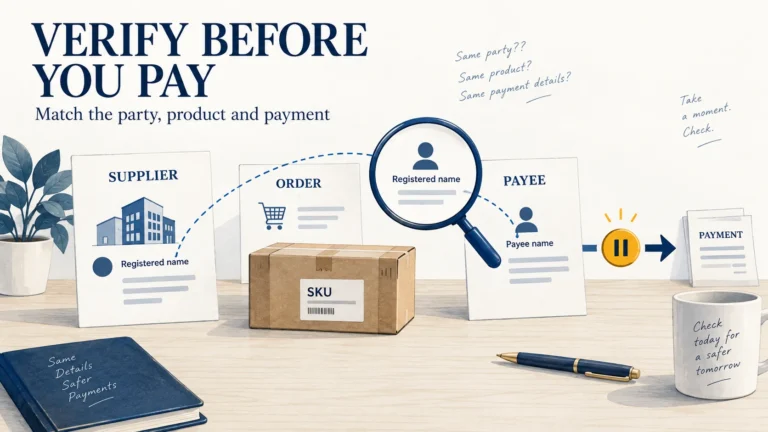
Dropshipping Supplier Red Flags: What to Verify Before You Pay
Pause a supplier payment when the payee, product, stock location or order terms cannot be reconciled with
