
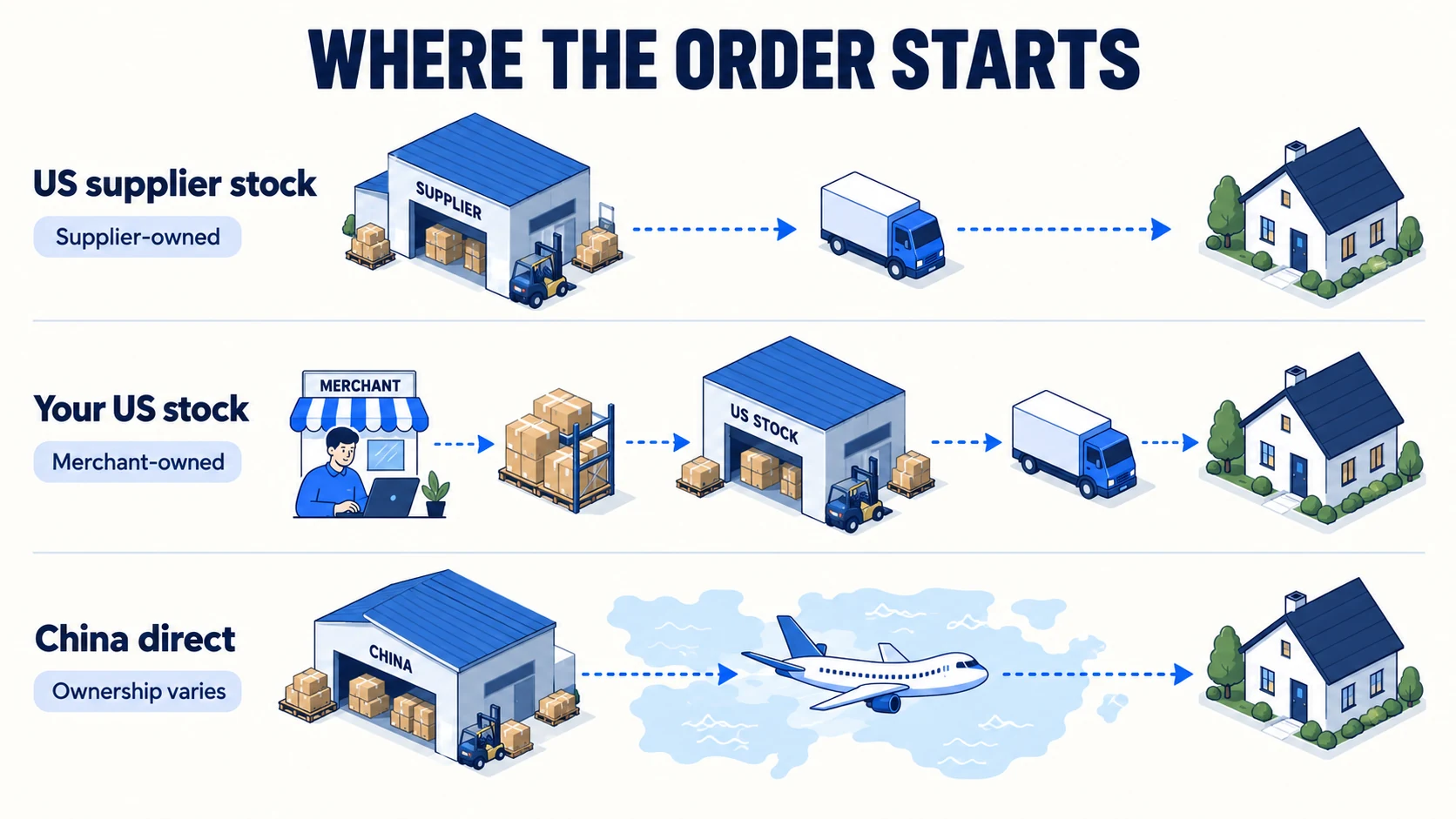
For US customers, inventory already available in a US warehouse usually offers a shorter delivery route than parcels dispatched from China. China-side fulfillment can offer easier access to production, sourcing changes and small-order testing. Compare the actual dispatch location, inventory commitment and delivered cost for your SKU—not just the supplier’s registered country.
A US company can forward orders to China. A China-based supplier can hold stock in the United States. Both descriptions can be accurate, yet they tell you little about the journey your customer’s parcel will take. The useful comparison begins with that journey and the party paying to keep the goods available.
01
Separate three models before comparing countries
“US fulfillment” covers two financially different arrangements. In one, a wholesaler owns available US stock and sells you a unit when your customer orders. In the other, you buy inventory and place it with a US fulfillment warehouse. The second arrangement gives you stock exposure before the retail sale; the first may not require that commitment.
China-direct also has variations. A supplier may dispatch from its own stock, purchase the item after your order, or ship goods you have already bought and reserved. A “no warehouse needed” sales pitch does not answer which arrangement applies.
| Model | Who funds the available inventory? | Main advantage | Main constraint |
|---|---|---|---|
| US supplier with its own domestic stock | Supplier, until you purchase each order under its terms | Domestic dispatch without necessarily buying a batch | You depend on its assortment, variant stock and wholesale price |
| Your inventory in a US warehouse | You, before customer orders arrive | Control over stocked variants and a shorter outbound route | Cash tied up in purchasing, importing and unsold units |
| China-side direct fulfillment | Supplier or you, depending on procurement terms | Close coordination with China sourcing and production | Each customer shipment needs an international route |
These are operating arrangements, not quality grades. The supplier selection guide helps establish whether the business you are considering supplies goods, arranges sourcing, stores inventory or combines those roles.
02
Measure the delivery promise from order to door
Domestic stock removes the international journey from that particular customer order. It does not remove processing time, weekend cutoffs, stock errors or the distance from the warehouse to the buyer. Stock in one US location will not serve every ZIP code at the same speed.
For either route, separate the time between order acceptance and carrier handoff from the carrier’s delivery estimate. China-direct can also involve procurement before packing and border clearance during transit. Establish which stages the supplier’s quoted window includes.
Here is an illustrative comparison: a US-stock offer quotes two business days to process and three in transit. A China-direct offer quotes one day to process and seven in transit. Those assumptions suggest five versus eight business days after acceptance, before exceptions—not three versus seven. Neither is a promise from AIDrop or a carrier benchmark.
Ask for the exact warehouse and availability of the variant you will advertise. “US warehouse available” may apply to only a small subset of a catalog. If the blue version is domestic and the green one is imported after purchase, the product page needs to reflect that difference.
Use recent route evidence and a matched sample order to assess the promise. A single fast parcel is useful but cannot establish a reliable upper delivery limit. Look at slower outcomes as well as averages, and confirm what happens when a parcel misses the estimate. Do not interpret a generated label as proof of dispatch.
03
Put both quotes on the same cost basis
A $5 domestic shipping label is not comparable with a $10 international delivered quote if the domestic calculation leaves out the cost of getting the inventory into the country. Equally, a China quote can omit procurement, packaging, handling or import charges. Compare an order that contains the same item and reaches the same customer under the same assumptions.
The following example compares China-direct with merchant-owned US stock. All figures are hypothetical USD planning inputs, not current rates. The direct route is assumed to cost $17 per completed order. The US route has $14.20 in variable costs plus $400 a month in fixed operating charges.
| Cost per sold unit | China-direct example | Merchant-owned US stock example |
|---|---|---|
| Product | $8.00 | $8.00 |
| International transport, import costs and receiving allocation | Included in the next line | $1.50 |
| Direct parcel delivery and handling | $9.00 | — |
| Domestic pick, pack and delivery | — | $4.20 |
| Expected variable exception allowance | Included in the modeled total | $0.50 |
| Variable total | $17.00 | $14.20 |
| Monthly fixed charge used in this example | $0 | $400 |
At 200 orders a month, the US fixed charge adds $2 per order, producing a $16.20 cost. At 50 orders, it adds $8, producing $22.20. The same service changes from $0.80 cheaper to $5.20 more expensive as those fixed costs are spread over fewer sales.
For these assumptions, the operating-cost crossover is $400 ÷ ($17 − $14.20), or about 143 whole orders a month. That is the result of this example, not a general threshold for moving stock. It also excludes financing cost, inventory write-offs and any difference in conversion or return behavior. Add those before treating the result as a decision.
Do not enter a missing duty estimate as zero to finish a spreadsheet. Mark it unresolved and obtain a shipment-specific calculation. If a quoted total already includes receiving or handling, avoid adding it again. The quote comparison worksheet explains how to align scope and exclusions before comparing the total.
Domestic stock still has an import history
For imported goods, US storage moves the international shipment earlier in the process. It does not make manufacturing origin or import costs disappear. A wholesaler may have already paid and embedded those costs in its unit price. When you own the imported stock, the importing arrangement needs to be established separately.
CBP states that the importer of record remains responsible for entry accuracy and applicable duties, taxes and fees even when using a broker. Its guidance for new importers also explains why product composition, use and origin matter. A domestic warehouse address alone does not answer who performed that role.
For a DDP quote, record the named destination, included charges and responsible parties. Incoterms allocate specified tasks, costs and risks; they do not settle every sale term, payment condition or remedy. Ask how the quoted service implements the arrangement rather than assuming that three letters settle every possible charge.
04
Local stock changes when cash leaves
In the example above, buying 300 units at $8 requires $2,400 for the goods before adding inbound transport, import and setup costs. If only 80 sell, the rest remain inventory. Their purchase cost does not vanish because the per-sold-order fulfillment calculation looks attractive.
This is especially important when demand is spread across variants. Three hundred units of a product are not interchangeable if customers want six sizes and four colors. A best-selling size can run out while the total stock count still looks healthy. Plan replenishment at the variant level.
Replenishment lead time includes production or procurement, inspection, international movement, clearance and warehouse receiving. A warehouse cannot ship stock that is still in transit to it. The shorter customer delivery promise is supported by purchasing and moving goods earlier, so the forecast has to be good enough to fund that work.
China-direct does not always eliminate advance spending. Reserved inventory, custom packaging, supplier deposits and prepaid fulfillment balances can still consume cash. CJ’s service-fee information is one example of why catalog fulfillment and purchased or prestocked inventory need separate cost treatment. Get terms for the service you will actually use.
If you prefer US delivery but cannot fund a batch, first assess a supplier that owns US stock. Its unit price may be higher, but comparing that markup with your own inventory risk can be more useful than assuming a US warehouse always means prebuying.
05
Returns and quality depend on the arrangement
A local return address can reduce the distance a customer must send an item. Find out what the address actually does: receive parcels, inspect them, photograph faults, restock saleable units or dispose of them. Each activity may have a charge, and some providers receive returns without issuing a product refund.
Also distinguish defective goods from customer preference. Trendsi’s return policy, for example, limits its return service to US orders and specifies request windows, item condition and exclusions. That is more informative than treating “US supplier” as a promise of unlimited free returns.
China-direct can be paired with a local returns partner, but that is an additional arrangement to verify and price. It does not follow automatically from international fulfillment. For a low-value item, the cost of return shipping, inspection and restocking may exceed its recoverable value; agree on who can authorize each remedy before complaints arrive.
Product quality is similarly specific. Match materials, construction, labeling, approved samples and inspection requirements. A US distributor and a China-side agent could source the same factory product, yet handle checking and exceptions differently. Conversely, two China suppliers may sell very different products under similar photographs.
Use the sample guide to record the exact item and route tested. Country labels cannot replace that evidence.
06
Use a hybrid only when the listing can support it
A hybrid can keep established variants in US stock while other products ship from China. It works when the store, order routing and customer message agree about which promise applies.
Mixed baskets are the first complication. A customer buying one US-stock item and one China-direct item may receive two parcels at different times. Show the relevant estimates and explain split shipments before purchase. Price the two shipments rather than assuming they will be packed together.
Stockouts are the second. If a US variant runs out, silently switching to China can break the promise that won the order. Decide whether the store should pause that variant, show a revised estimate for new purchases or offer existing customers an acceptable alternative. The fallback route needs its own validated product and shipping terms.
Do not split inventory simply because a hybrid sounds sophisticated. It adds stock reconciliation, more routing rules and possibly more minimum charges. A small catalog with a single reliable source can be easier to operate than two warehouses with unclear ownership of exceptions.
07
Choose with a matched pilot
Compare a representative set of exact SKUs and destinations. Record the agreed specification, availability, processing cutoff, full invoice, carrier acceptance, delivery and any return handling. If the items differ, document the difference instead of attributing its effect to the warehouse country.
For the merchant-owned route, rerun the calculation at lower sales volume and slower sell-through. For a supplier-owned route, check what happens when shared stock disappears. For China-direct, assess the promised international route and the funding needed between paying the supplier and receiving usable sales proceeds.
The practical choice is the arrangement that meets your customer promise at an affordable total cost and commitment. Store-wide order volume is less informative than predictable demand for the individual variants you plan to stock.
08
Questions about US and China suppliers
Does US stock mean the product was made in the USA?
No. Stock location and manufacturing origin are different facts. Use accurate origin information for product claims and required labeling; do not infer it from the dispatch address.
Are China suppliers always cheaper?
No. Product price can be offset by freight, packaging, import costs, replacements or the service needed to meet a delivery deadline. Compare the complete matched order.
Can a small store use domestic suppliers?
Yes. A wholesaler holding its own domestic stock can support per-order purchases without requiring you to buy a warehouse batch. Verify its actual minimums and terms.
Should every successful product move to US stock?
Only when demand, cash availability, replenishment and the improved customer promise justify it. A short-lived spike does not by itself establish enough repeat demand to absorb the inventory.