
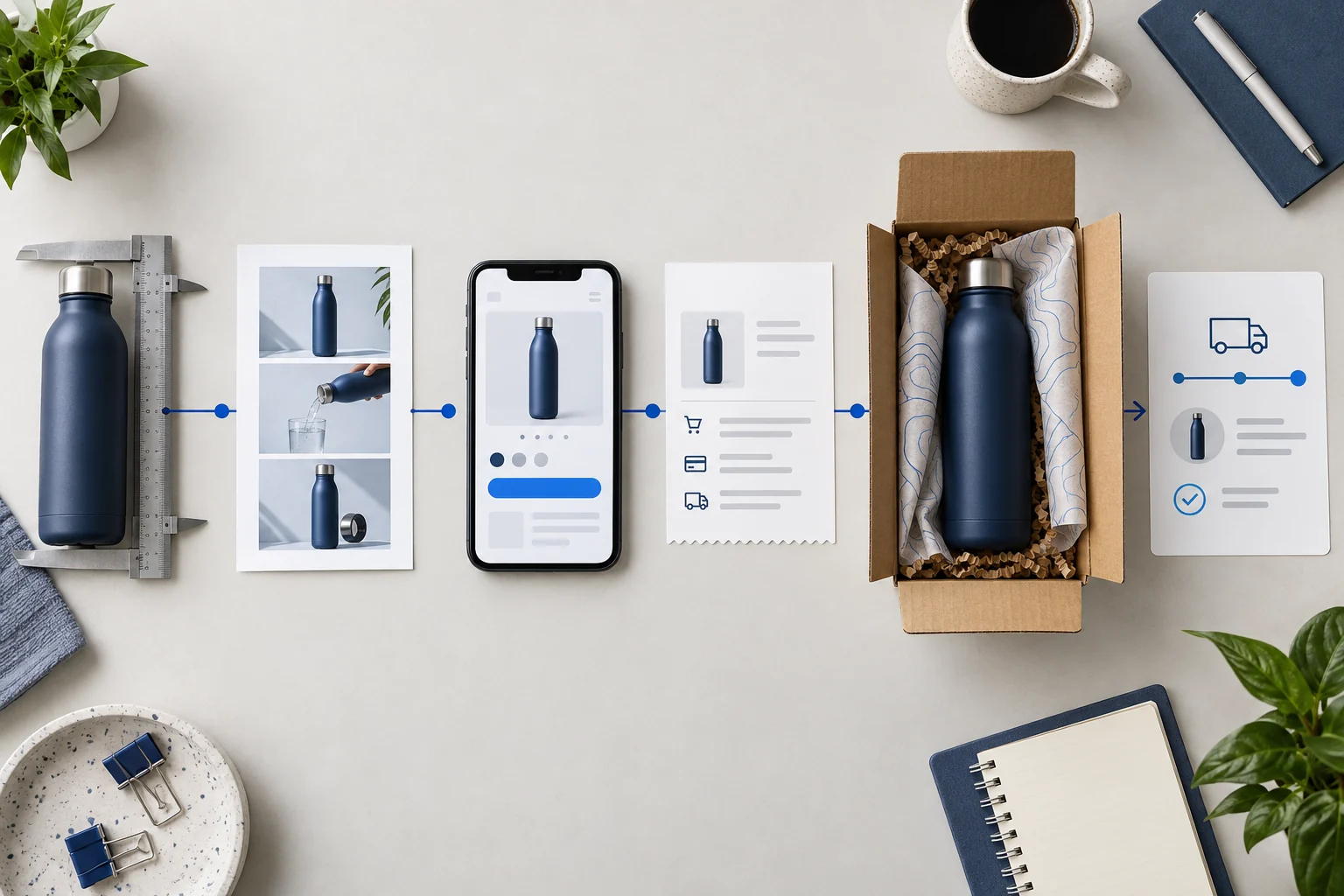
Paid ads can test a dropshipping offer quickly, but they cannot make an unverified product or delivery promise reliable. Before spending, choose one exact variant and destination, confirm what the customer will receive, calculate the most you can pay for an order, and make the ad and product page say the same thing. Start with a pilot small enough to fulfill and review order by order. The economics, risk and growth hub connects advertising to the rest of the business model.
Explore the broader topic: Dropshipping Marketing: A Plan from First Visit to Repeat Order.
Explore this topic
- Facebook Ads for Dropshipping: Test the Creative and the Order
- Snapchat Ads for Dropshipping: Test One Product You Can Deliver
- TikTok Ads for Dropshipping: Setup, Budget and First-Test Results
- YouTube Ads for Dropshipping: Show the Product You Can Actually Deliver
- Dropshipping Break-Even ROAS: Calculate the Floor After Shipping and Returns
01
Make the offer true before buying attention
Write down each claim in the ad and the evidence behind it. The product page must support the same claim, and the delivered item must match it. An attractive video is not evidence for every size, color, destination or customer result.
On a phone, swipe sideways to compare all columns.
| Ad claim | Evidence to check before launch | Wording when the evidence is narrower |
|---|---|---|
| “Fits a 15-inch laptop” | Measure the approved sample’s usable opening and the laptop’s actual dimensions. | Give internal dimensions and show the tested fit. |
| “Ships in six days” | Separate warehouse processing from carrier transit for the chosen destination and route. | State the supported processing and delivery ranges. |
| “Protects fragile items” | Inspect the packed sample and the type of damage its padding can address. | Describe the padding and pack rather than promising no damage. |
These are examples of claim review, not product tests by AIDrop. TikTok’s advertising policy addresses misleading effects and mismatches between ads and landing pages. Google’s misrepresentation policy covers missing or misleading product, business and pricing information. The FTC’s advertising guidance requires evidence for objective claims. Check current rules for the product and market.
Claim gate: Write the sentence the buyer will infer. “Arrives fast” may sound like a delivery guarantee. If the selected route does not support that expectation, show a defensible range or remove the claim.
02
Pick a product the fulfillment path can repeat
An ad can bring orders before you discover that the featured variant is out of stock or the parcel costs more to ship than the sample. Check the exact SKU, supplier, packaging, available stock, replenishment time and eligible route for the market you plan to target. Verify product restrictions where the customer lives. A test order can expose a wrong variant, poor packing or missing tracking; one successful parcel does not establish a reliable delivery rate.
Use three operating states during the pilot:
- Ready: The approved sample, listed variant and pack match; stock and shipping method are confirmed. The campaign may run within the pilot limit.
- Hold: Stock, route, packaging or product evidence changes. Pause the affected ad until the page and cost estimate are checked again.
- Stop: Customers receive a materially different item, repeat damage occurs, or the supplier cannot fulfill the advertised variant. Fix the quality-control process before buying more traffic.
The product-selection guide covers wider screening. Here the test is whether this particular advertised order can be repeated.
03
Calculate what one acquired order can afford
Use net revenue after discounts and excluding sales tax. Subtract product, packaging, handling, shipping, payment fees and an evidence-based allowance for refunds and variable support. Reserve the contribution you need before deciding the acquisition limit.
Maximum acquisition cost = net revenue − non-ad variable costs − target contribution.
Consider an illustrative order with $70 in net product revenue, $24 product cost, $4 handling and packaging, $12 shipping, $3 payment fees, and $5 expected refunds and support. It leaves $22 before advertising. If the store requires $10 contribution, the highest affordable acquisition cost is $12. These are hypothetical inputs, not AIDrop rates or a margin promise. Replace them with a dated quote and completed-order data. The unit-economics guide shows how to include costs beyond gross margin.
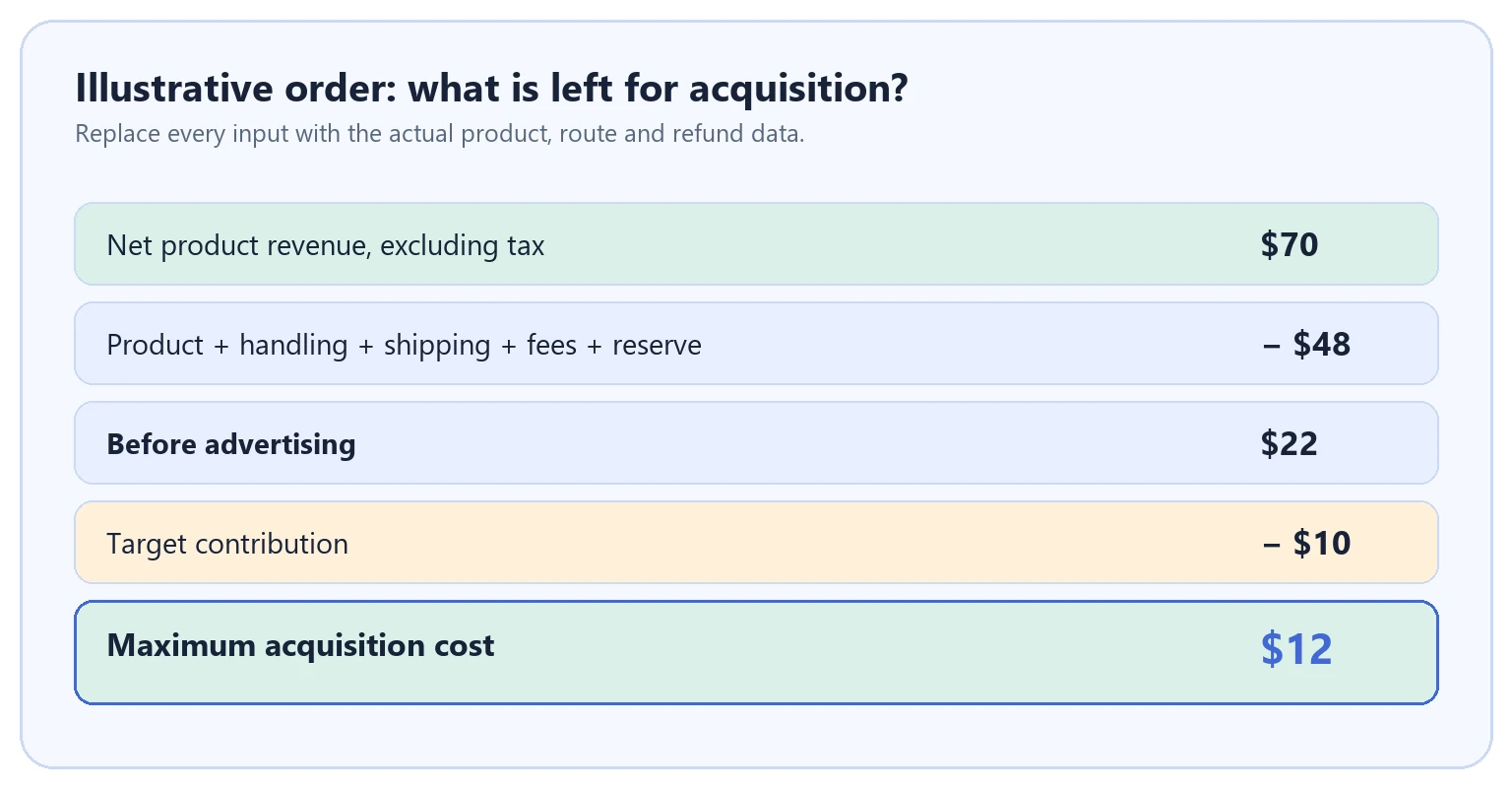
This example explains a common ad-reporting trap. At a $70 sale, a reported 4× return on ad spend implies $17.50 in ad cost, leaving only $4.50—below the $10 target. A 6× return implies about $11.67 in ad cost and roughly $10.33 remaining. Neither ratio sees refunds that have not happened yet. Recalculate by destination and variant when freight or return exposure changes.
04
Choose a channel for the way buyers discover the product
Choose a channel that fits the buyer’s question and the proof you can show. Another store’s reported return on ad spend does not establish your channel fit.
On a phone, swipe sideways to compare all columns.
| Channel | Best starting situation | What the ad and page must show | Poor-fit signal |
|---|---|---|---|
| Search | Buyers can name the product, problem or compatibility requirement. | The exact variant, answer and delivered price for that query. | Broad keywords bring information seekers, not buyers for this item. |
| Short-form video | The product solves a visible problem that can be demonstrated honestly. | The approved item in use; the page confirms dimensions, variants and delivery. | The video needs a different sample or dramatic claim to persuade. |
| Social feed | A defined audience has a recognizable use case, even without active search. | One use case and a page explaining why this item fits it. | People reach the correct page but show little interest in the use case. |
Send a specific search query to the matching product or variant. Let the video demonstrate one observable job, then use the page to explain what it did and did not prove. Channel choice does not repair an unclear offer.
For example, a measured laptop sleeve can answer a search for a particular laptop size if the page shows usable internal dimensions; a short video can instead show the approved sleeve and laptop together. Those are two ways to present the same verified fit, not evidence that either channel will acquire orders below your limit. Start with the channel that can show the buyer’s deciding fact most clearly, then compare completed-order acquisition cost.
05
Build a creative brief from verified inputs
Give the creator one approval sheet with four fields:
- Product: approved variant, sample reference and the buyer problem it solves.
- Proof: each permitted claim beside the sample, specification or other evidence that supports it.
- Offer: current price, shipping wording, return route and product-page URL.
- Exclusions: unverified outcomes, unsupported comparisons and footage from a different item.
For an organizer, film the approved sample holding three measured items, then show its dimensions and available colors. Do not switch to a larger prototype or imply it fits every bag. Check the final video, caption and page against the sheet; a changed sample needs fresh approval. Health, safety, environmental, origin, superiority and price claims need appropriate substantiation. Never present an invented review or simulated warehouse scene as proof.
Three openings for the actual organizer
These are proposed openings, not tested winning ads. Adapt them only after checking the exact organizer, its contents and the items used in the demonstration.
Fit hook: “Will your charger fit in this pocket?”
Show: Put a measured charger into the approved organizer. Show the pocket opening and the actual fit, including any awkward part.
Check: Give the pocket and charger dimensions on the page. If only this charger was checked, do not turn the result into a claim that every charger fits.
Use hook: “Where do these three cables go?”
Show: Show the real organizer holding three cables, then show how someone removes and replaces one. Use only fasteners supplied with this variant.
Check: The page should explain the intended setup and any fit or mounting limits. If the scene needs an extra part, name it rather than implying it arrives in the parcel.
Unboxing hook: “Here’s what arrives when you order this organizer.”
Show: Open a representative parcel and lay out the selected variant, its actual compartment layout and every included part. Keep demonstration accessories separate.
Check: Match the photographed SKU, quantity, color and contents to the order page. Do not show a larger prototype or an optional accessory as part of the purchased kit.
06
Match the landing page to the ad
Open the ad link on a phone without using your store’s admin view. A buyer should find, in this order:
- The advertised product and exact variant.
- Full price, shipping charge or calculation, and what is included.
- Supported delivery expectation, with processing and transit distinguished.
- Business identity, contact route and return terms.
- Checkout with the same product and terms.
TikTok’s landing-page guidance calls for readable mobile pages and company information. Google’s merchant shipping guidance asks for clear handling and transit times that agree with shipping settings. If the ad and page disagree, fix the claim before sending traffic. The shipping-times guide helps build a realistic promise.
07
Verify measurement with a real test order
Complete one test purchase before spending. Record its order ID, currency, paid amount and item ID. Confirm that the store created one paid order and the ad platform received one purchase event with the right value. A checkout-button click is not a purchase; overlapping app and manual tags can record the same order twice.
Google Ads explains primary and secondary conversion actions: a primary action may be used for bidding when its goal is selected. Keep the purchase definition clear rather than optimizing to a convenient but weaker event. TikTok’s web-data setup guidance describes event verification for its pixel or Events API. Follow the current setup instructions for your store, then reconcile campaign-reported purchases with orders and refunds.
A purchase check you can reconcile
For a fictional test order TEST-1042, assume the recorded purchase value is $70 USD with no extra tax or buyer shipping charge. Your expected record is one paid order and one counted purchase for the chosen conversion action. Two $70 purchase signals are not two sales.
For Google Ads, set transaction_id to the real order’s unique confirmation number, alongside the correct value and currency. Google’s instructions identify duplicates by the same conversion action and transaction ID. Every new order needs a new ID; reloading that order keeps its ID. Never install TEST-1042 as a constant.
During an authorized test, reload the confirmation page and check that its order ID stays the same. Compare accepted purchase output with the store’s one paid order. A separate test order needs a different ID. Inspect app and manual tags for different purchase actions: matching IDs do not prove deduplication across those actions. Audit both and the selected campaign goal.
Keep the checks separate: debugger receipt confirms that event data arrived, not that an eligible ad click was attributed. Google’s transaction-ID deduplication also differs from its per-click Count setting. Correct the order/event mismatch before interpreting campaign revenue or acquisition cost.
08
Run a pilot the operation can absorb
Set a spend ceiling from the loss you can afford. Write one question the pilot will answer: “Can this exact offer acquire orders below $12 while the supplier delivers the promised variant?” Test a few meaningfully different creative ideas against one primary purchase outcome.
Put the pilot on one record before launch. For the illustrative sleeve offer, write: SKU/market: approved 15-inch variant and eligible destination; goal: paid purchase; spend cap: the merchant’s chosen loss limit; destination: that variant’s page; creative variants: measured-fit demonstration versus what-arrives demonstration; readout: page visits, paid orders, acquisition cost against the calculated $12 example ceiling, then dispatch exceptions and refunds. The spend cap limits exposure; it does not guarantee enough orders for a reliable conclusion.
- Before spend: confirm stock, route, page terms, purchase tracking and the order’s acquisition limit.
- After ad clicks: check whether the page loads and visits are recorded before judging whether visitors engage with the correct variant, proof and price.
- After paid orders: compare actual acquisition cost with the $12 example limit; use your own calculated limit for a real product.
- After dispatch: check the delivered variant, exceptions, refunds and support work before scaling.
Pause if stock, route or price changes, ad and page conflict, or repeated complaints appear. A wrong item can trigger an immediate stop; a profitability conclusion needs enough completed orders and spend to be meaningful. No universal click count settles every product test.
09
Diagnose the failure before changing the creative
Look at the first stage that failed. Changing bids or making a louder video will not repair a checkout charge or delayed shipment.
On a phone, swipe sideways to compare all columns.
| Signal | First check | Likely next action |
|---|---|---|
| Impressions without relevant clicks | Opening claim, audience and query fit. | Change the promise or targeting, not the product facts. |
| Ad clicks but few recorded page visits | Destination URL, redirects, mobile load and analytics setup. | Repair access or measurement before changing the audience or creative. |
| Page visits without product engagement | Variant match, first-screen price, proof and buyer question. | Repair the offer or send traffic to the better-matched variant. |
| Carts without paid orders | Delivered cost, payment errors, return and delivery terms. | Fix the specific checkout objection. |
| Orders without target contribution | Actual product, freight, fees, refunds and acquisition cost. | Reprice, change the route or pause an unprofitable configuration. |
| Orders followed by support tickets | Stock sync, packing, tracking and customer updates. | Fix customer-service ownership and fulfillment before scaling. |
Keep the campaign tied to the order that arrives at the customer’s door. A strong click rate and a weak delivered result call for an offer repair, not more of the same traffic.
Ad clicks and recorded visits will not always match exactly. Compare the trend, test the destination yourself and separate a loading or measurement fault from a page that loads but fails to answer the buyer’s question.
10
Frequently asked questions
How much should a beginner spend on dropshipping ads?
Choose a pilot loss limit you can afford and calculate the maximum acquisition cost for the exact order. A universal daily budget cannot tell you whether that order will be profitable or fulfilled well.
Can I run ads before receiving a product sample?
You can write a draft, but a supplier listing alone does not substantiate claims about dimensions, finish or packaging. Inspect a representative sample and the intended route before using those claims in a paid campaign.
Which matters more: creative or fulfillment?
Creative brings a relevant buyer and sets an expectation. Fulfillment determines whether the business keeps it. Review both before scaling.
What should I optimize after the first few sales?
Check that purchases are measured once and completed orders meet the contribution target. Then fix the earliest weak stage in the ad-to-delivery path; do not optimize only to attributed return on ad spend.
Google Ads for Dropshipping: Align Search, Feed and Fulfillment
A Google Ads launch guide centered on query fit, Merchant Center feed accuracy, shipping promises and per-order
TikTok Ads for Dropshipping: Setup, Budget and First-Test Results
A practical first paid-ad test: prepare the account and offer, film distinct videos, connect purchase tracking, launch

Facebook Ads for Dropshipping: Test the Creative and the Order
A practical Meta ads test that joins creative proof, purchase measurement and fulfillment economics for one sellable
