
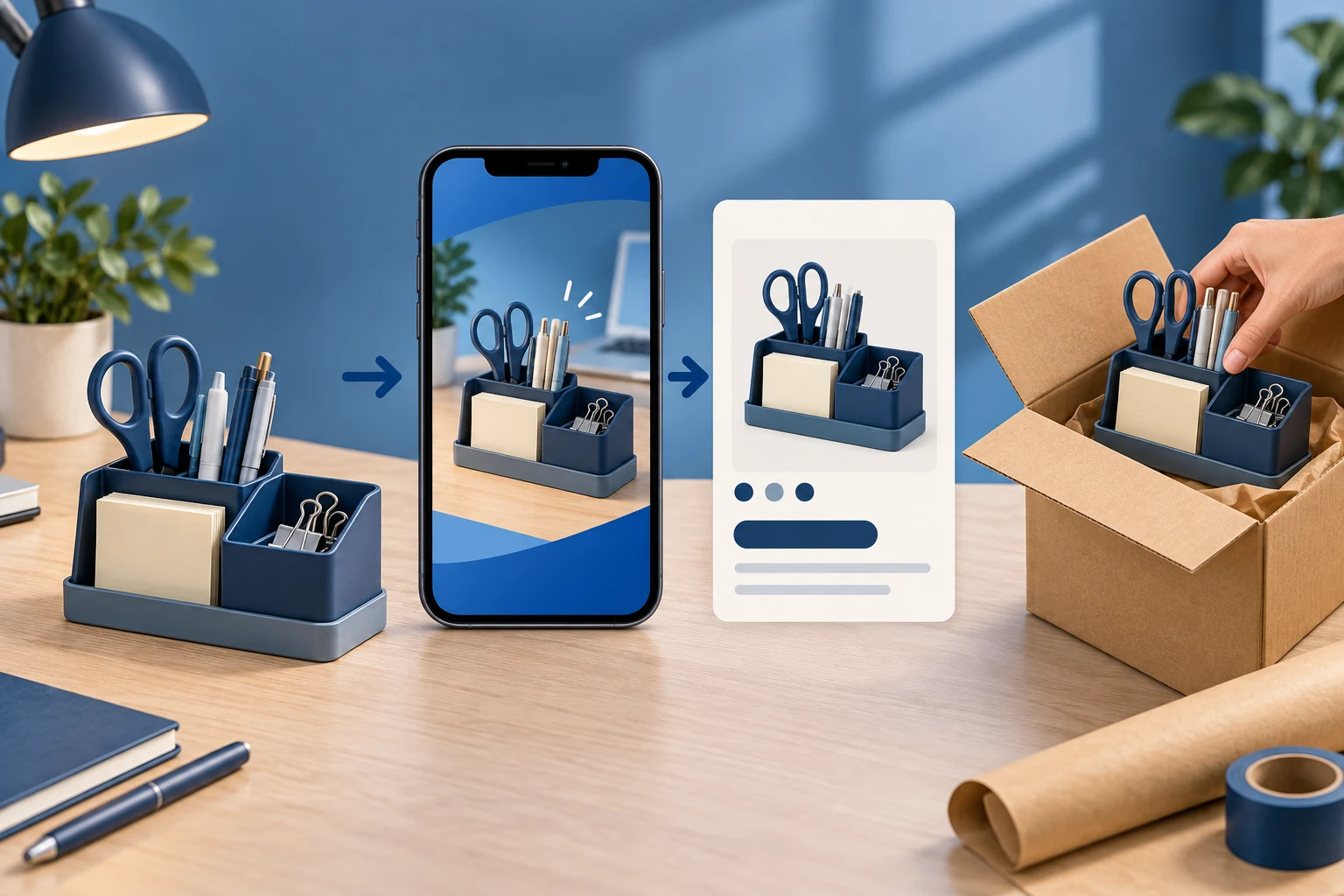
To run Facebook ads for a dropshipping store, start with one product you have inspected and one country you can serve. In Meta Ads Manager, create a sales campaign for website orders, verify the purchase event, set a test budget you can afford to lose, and show the actual sellable product in a few distinct ads. Judge the test by paid and fulfilled orders, not clicks alone.
Facebook and Instagram ads can introduce a product to someone who was not searching for it. The demonstration therefore has to make the product useful in seconds. The dropshipping ads guide compares channels; the steps below are for a first Meta campaign.
01
Launch one Meta sales test, step by step
- Choose the item and destination. Inspect a sample, identify the exact supplier and store variants, confirm stock and a shipping route to one target country. Do not advertise a color or feature the supplier cannot repeatedly release.
- Prepare the product page. Match the creative to the selected variant. Check the price, delivery range, returns and mobile checkout as a new visitor.
- Test the purchase signal. Use your store integration or Meta Pixel setup. Place a paid test order and inspect the purchase in Events Manager. If browser Pixel and Conversions API both send it, check that the integration does not count the same purchase twice.
- Build the campaign in Ads Manager. Choose the sales objective and website purchase outcome where offered by your setup. Set the target location to a country your route serves, choose a budget and schedule within your learning-loss limit, and review placements. Meta’s objective training and budget and placement training explain these controls; labels can vary by account.
- Make the ads. Try a small set of different, supported explanations of the same product: fit, capacity or included parts. Check the crop and copy in the selected placement previews, then send each ad to the matching page.
- Publish and check the first failure. Confirm the final URL and offer once more. After relevant visits arrive, use the diagnosis table below to decide whether the creative, page, checkout or order economics need work. Change one meaningful variable at a time.
Check the current Meta advertising standards for the actual product and market before publishing.
02
Decide whether the product can be shown honestly
A compact desk organizer can be filmed holding the objects it is sized to hold. The operator still has to measure the actual sample and confirm the sellable variant. The product-selection guide covers demand and fit; the approval sheet below determines whether this exact item can be advertised now.
Before scripting the ad, put three checks on one approval sheet:
- The demonstration: approved sample, measured dimensions and footage of that exact version. Hold if the sample differs from the sellable SKU.
- The offer: current variant, stock, price and shipping method for the target destination. Hold if the promoted color or route cannot be fulfilled.
- The promise: supported handling and transit ranges, return terms and a working contact route. Rewrite timing copy if the faster route only covers some destinations.
If any line fails, hold that SKU and fix the source of the mismatch before scripting the ad.
03
Set the maximum cost for a real order
Use the order’s net product revenue after discounts and exclude tax collected for authorities. Subtract the costs that move with the order: product, handling and packaging, freight, payment fees, and a realistic allowance for refunds or variable support. Then reserve the contribution the business needs. The remainder is the maximum acquisition cost, not a recommended bid.
Illustrative example: a $68 net order has a $23 product cost, $4 for handling and packaging, $13 freight, $3 payment fees and $5 expected refund/support cost. That leaves $20 before advertising. If the seller needs $8 contribution, the acquisition ceiling is $12.
A $14 attributed purchase cost would miss that target even though the order may still be above zero contribution.
Every dollar here is hypothetical; replace it with a dated supplier quote and completed-order data. The unit-economics guide explains the full cost boundary.
Set a separate total loss limit for a pilot that gets no orders. A hypothetical $180 test cap is a cash boundary, not a Meta requirement. Record the actual acquisition cost, freight and refunds by completed order; Meta’s attributed return can differ from the money left after fulfillment.
04
What should the purchase event show?
For the paid test order from step three, record the order ID, amount and currency. Check the received Purchase data and the integration’s deduplication diagnostics if browser Pixel and server Conversions API both send it.
Two source receipts can describe one order; check how the integration counts them before treating both as sales. Meta’s Conversions API documentation covers the principle; the integration controls the implementation.
Event receipt also does not prove that Ads Manager attributed the order to an eligible ad interaction.
A useful pause rule: if a checkout click is labeled Purchase, the value/currency is wrong, or the integration actually counts one order twice, repair measurement before buying traffic. Seeing browser and server receipts by itself is not enough to diagnose duplicate counting.
05
Give each creative a job it can prove
Write a small creative sheet before filming. Each angle should answer a different buyer question and point to evidence on the product page.
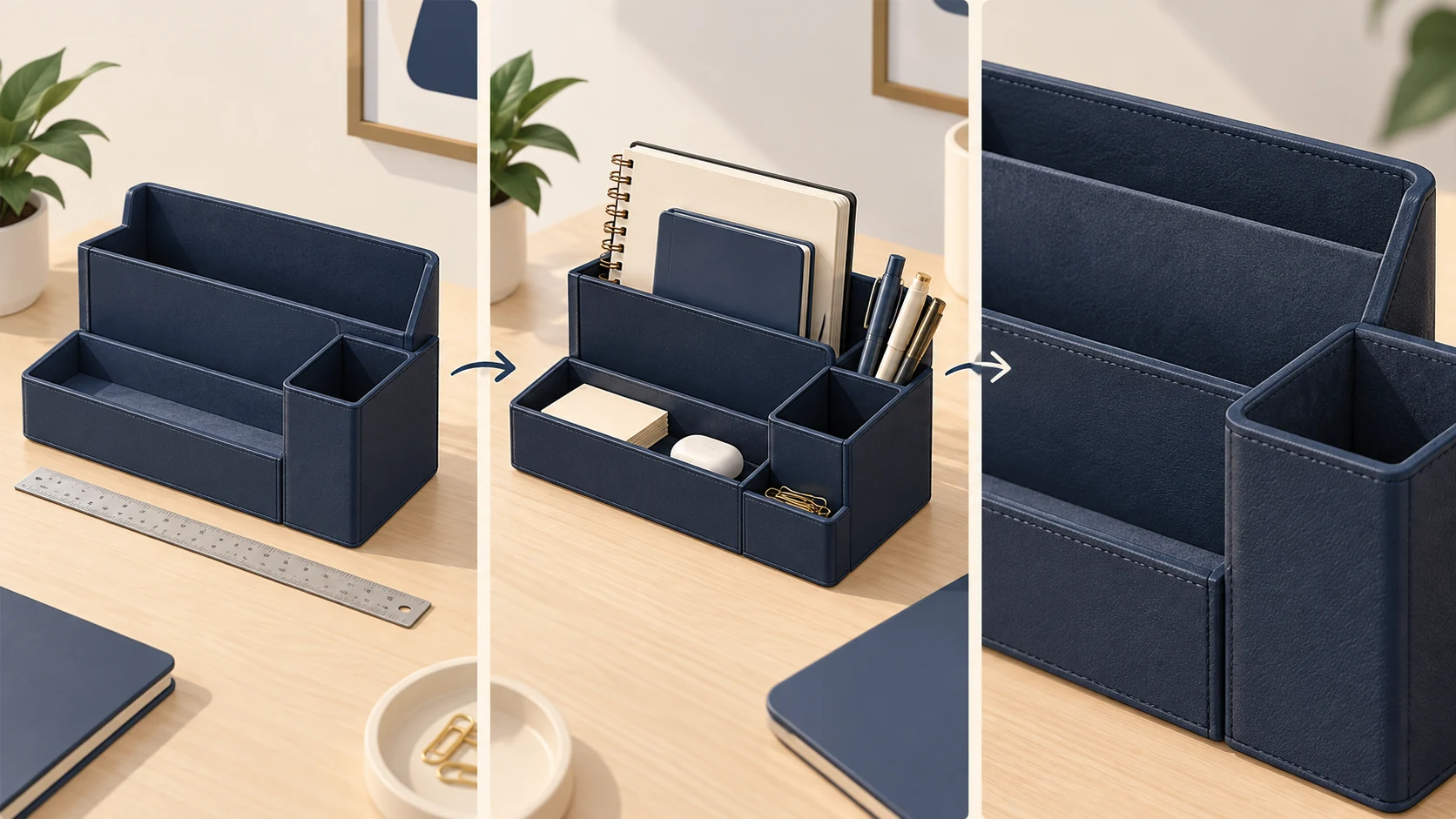
- Will it fit on my desk? Show the approved organizer next to a ruler or known-size object. The page must state its actual width, depth and variant dimensions.
- How much can it hold? Put measured everyday objects in the approved sample. The page should give capacity limits without a universal fit claim.
- What arrives? Show the exact sellable color and included parts. The variant selector, contents and pack photos must agree.
Film the approved sample in each angle rather than creating three near-identical hooks. A testimonial must be genuine and permissioned. For objective US-market claims, use the FTC’s advertising guidance to check substantiation.
Keep one pilot record beside Ads Manager
Use this fictional pilot sheet for the organizer example. It records decisions to verify in your account, not buttons that every Meta setup exposes.
On a phone, swipe sideways to compare all columns.
| Decision | Example setting | Before spending |
|---|---|---|
| Outcome | Sales, website purchase | Chosen purchase signal corresponds to a paid order, not a checkout click |
| Offer | One approved organizer SKU; one serviceable country | Ad URL opens that variant with the full charge and supported delivery |
| Creative | Desk fit, capacity and parcel contents | Three different proof angles; inspect the actual placement crop |
| Money and owner | $12 acquisition ceiling; $180 total learning-loss limit | Assign an operator to review spend and stop the pilot at the recorded loss boundary |
The $180 line is your cash rule, not a guarantee that a daily budget creates an automatic hard cap. Compare the saved campaign, destination and placement previews with this sheet. After launch, reconcile paid orders and actual costs; if orders cost more than the $12 ceiling or the wrong variant ships, use the diagnosis below before expanding.
06
Make the click land on the same offer
Open the ad link on a phone as a new visitor. Can you identify the advertised variant, see the full price and shipping cost before payment, find returns and contact details, and finish checkout? If not, record the exact screen where the promise breaks. “Ships in three days” also needs a defined destination and whether it means dispatch or delivery. The shipping-times guide helps set that promise.
07
Run a bounded pilot, then read the first failure
After the campaign has delivered relevant visits, locate the first stage where buyers stop progressing. Use the table to make one correction and check the next set of visits. A single purchase is an observation, not a stable performance estimate.
On a phone, swipe sideways to compare all columns.
| Observed result | First check | Next decision |
|---|---|---|
| People watch but few click | Is the product and offer clear before the hook ends? | Revise the explanation; do not add an unsupported promise. |
| Clicks arrive but the product page loses them | Is the correct variant, price and shipping information visible on mobile? | Repair the page or destination. |
| Carts form but purchases do not | Are late shipping charges, payment errors or return doubts appearing? | Fix the checkout objection before changing targeting. |
| Orders arrive above the $12 target | Reconcile discounts, freight, fees and event counts. | Reprice, improve the offer, or stop the test. |
| Orders arrive but complaints rise | Check wrong variants, packing, tracking and delivery promises. | Pause scaling and fix the handoff. |
The $12 ceiling in the table belongs to the hypothetical order above; replace it with your own cost calculation.
08
Let delivery feedback change the next ad
For the first fulfilled orders, record the creative angle, SKU sent, destination, complaint or refund reason, and corrective action. If buyers repeatedly receive the wrong variant or delayed tracking, pause that angle and repair the supplier handoff before spending more. The quality-control guide covers approval; the customer-service guide covers exceptions. Expand only when delivery holds and completed orders clear the contribution target.
09
Frequently asked questions
Are Facebook Ads and Instagram Ads separate tests?
They can run through Meta Ads Manager, but placement results can differ. Start by checking where your approved creative actually appears and whether the page works from that placement. Do not assume one crop or message fits every surface.
How much should a new dropshipping store spend?
Set a total learning-loss limit and a maximum acquisition cost from your order economics. There is no dependable universal daily number. If the store cannot afford to learn from a failed pilot, repair the offer or use lower-cost validation first.
Does a good click-through rate mean the ad is working?
It shows that the ad drew clicks. Check qualified product-page behavior, paid orders, actual delivery and contribution before calling the offer successful.
Can I advertise a supplier product without seeing it?
You can draft a concept, but a listing photo does not verify dimensions, finish, included parts or packaging. Inspect a representative sample before making those claims in a paid ad.
Dropshipping Ads: Claims, Creative Inputs and Supply-Chain Readiness
A practical paid-ads framework that connects product proof, creative claims, order economics, tracking and fulfillment readiness.
Dropshipping Marketing: A Plan from First Visit to Repeat Order
Plan dropshipping acquisition, product-page conversion and repeat sales around realistic margins. Compare channels and measure costs and

Dropshipping SEO: Build Search Pages Customers Can Trust
A practical SEO plan for dropshipping stores: map searches to the right pages, verify supplier claims, link
