

Break-even ROAS is sale revenue divided by the order’s contribution before ads. Subtract product, delivery, fees and expected remedy costs first. If 40% remains, the variable-cost floor is 2.5× ROAS; your working target also needs room for overhead and profit.
The number is not a universal “good ROAS.” A $60 accessory with a $10 delivered shipping cost has a different floor from the same accessory with $4 shipping. Make the calculation for the offer and destination you plan to advertise.
01
Build the order cost before choosing a target
ROAS is attributed revenue divided by ad spend. Shopify’s target ROAS explainer presents break-even as one divided by margin and reminds merchants to account for shipping, payment fees and discounts. For a working store decision, use the pre-ad contribution rate: sale revenue left after variable costs other than advertising, divided by that revenue.
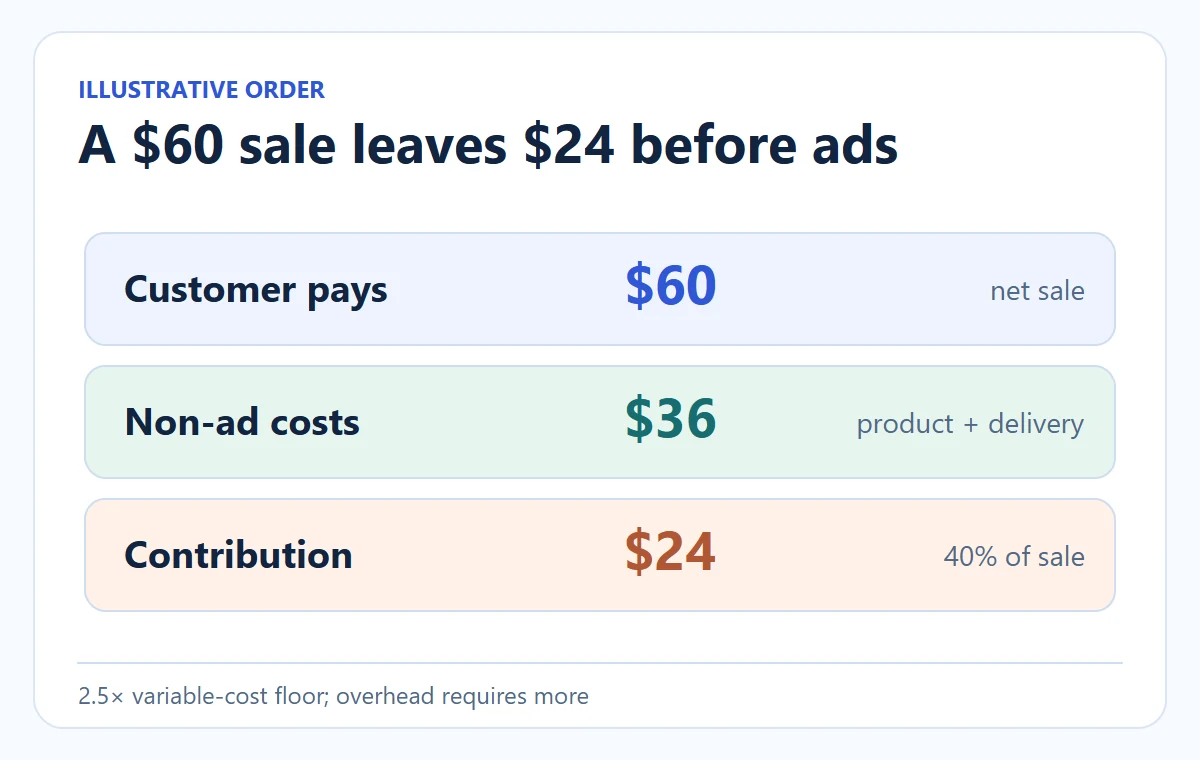
Write every order-level line. For a hypothetical $60 accessory:
| Cost line | Example |
|---|---|
| Customer payment after discount | $60 |
| Supplier product | −$18 |
| Supplier-to-customer delivery | −$10 |
| Payment and selling fee | −$3 |
| Expected refunds, defects and replacements | −$5 |
| Available for ads, overhead and profit | $24 |
On a phone, swipe the table sideways to compare every column.
The example has a $24/$60 = 40% contribution rate. A campaign that spends $24 to cause one $60 sale has $60/$24 = 2.5× ROAS and no contribution left for overhead or profit. If it spends $26, ROAS is roughly 2.31× and the order loses $2 before overhead. All figures are teaching assumptions, not AIDrop rates or observed ad results.
Make the formula usable in a spreadsheet
Enter this article’s teaching values in one column. The order revenue excludes collected sales tax; any customer-paid shipping you include must also remain in the matched revenue report.
Enter the inputs
Use B2 = 60 revenue, B3 = 18 product, B4 = 10 delivery, B5 = 3 fees, B6 = 5 expected remedy, and B7 = 8 desired after-ad amount. Packaging or per-order handling not already included needs its own deduction.
Compute and test
B8: =B2-SUM(B3:B6) gives $24 before ads.
B9: =IF(B8>0,B2/B8,"No positive ad budget") gives 2.5.
B10: =B8-B7 gives the $16 ad ceiling.
B11: =IF(B10>0,B2/B10,"Target not fundable") gives 3.75. Use your spreadsheet’s local separator if required.
Change B2 to 54: B8 must become 18, B9 becomes 3, B10 becomes 10 and B11 becomes 5.4. Restore 60 and temporarily set B4 to 34: B8 becomes 0 and the floor must flag no positive ad budget. A negative contribution cannot be repaired by choosing a finite ROAS target. Restore actual quote inputs before making a decision.
The profit-margin guide explains where gross, contribution and net calculations differ. Do not use the supplier product cost alone as the denominator. International freight and returns can be large enough to reverse the decision.
What to do with shipping zones
Calculate the destination you advertise
If you sell the same item to US West Coast and East Coast buyers, build a row for each zone when rates differ. A campaign reported as 3× may win on one group and lose on another. Segment by destination if your tracking and order volume support it; otherwise use a conservative blended shipping cost and state what you assumed. The shipping-cost guide covers the quote inputs.
Do the same after a promotion. A 10% coupon lowers revenue but may not lower product or freight cost. Recalculate the break-even floor using the actual checkout value rather than the list price.
A coupon moves the working target to 5.4×
In the $60 example, a 10% coupon makes the kept sale $54. If the $36 product, delivery, fee and remedy allowance stays unchanged for this illustration, only $18 remains before ads. The variable-cost floor becomes 3× ROAS ($54 ÷ $18), up from 2.5×. To retain the same $8 after-ad amount, the ad ceiling falls to $10 and the working target rises to 5.4×. Check whether the fee or refund allowance really stays fixed before using those numbers; the calculation shows why a discount changes the bidding decision.
02
Add a buffer for overhead and profit
Variable-cost break-even is only the floor. A store still pays for support labor, apps, creative production, failed tests and perhaps salaries. You may also want cash left to improve packaging or replace a supplier. Decide how much contribution per sale you need after advertising, then solve for allowable ad spend.
Reserve $8 and cap ads at $16
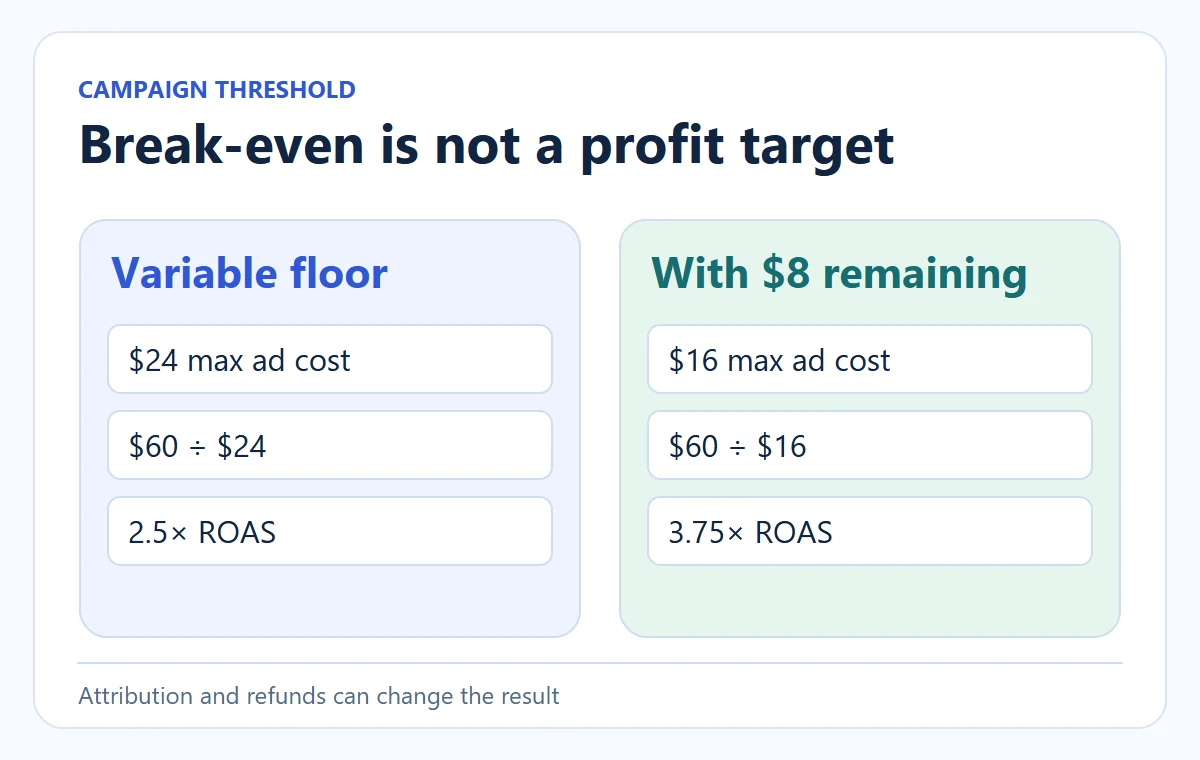
For the $60 accessory, suppose the store requires $8 per order after ads to help cover overhead and profit. The maximum ad spend is $24 − $8 = $16. The corresponding revenue/ad-spend target is $60/$16 = 3.75×. This is a different answer from the 2.5× variable-cost floor.
Use actual costs instead of a round buffer
Do not automatically add a round “20% safety factor.” Start with costs the business actually pays or a written target. If refunds rise, update the expected remedy line. If a supplier lowers freight, recompute. A target that never changes while order costs move is a stale number.
The Shopify break-even ROAS guide discusses the revenue/ad-spend floor, but a store’s chosen definition of margin must match the costs it intends to cover. Put the formula and cost rows next to the ad report so no one mistakes a contribution-only threshold for full profitability.
03
Read the ad dashboard with care
An ad platform reports orders it attributes to the campaign. That is not automatically the number of orders the campaign caused. A buyer may see a paid video and later return through search; another may have purchased without the ad. Different platforms may each claim credit. The Shopify ROAS versus ROI explainer also notes that a strong ROAS can coexist with weak actual profit.
Compare the same orders and report window
Set a consistent attribution window for your test and compare it with store-level orders, new-customer counts and cash contribution. Do not sum Meta ROAS and Google ROAS. They have different denominators, and the same sale can appear in both reports. Our analytics guide covers cross-channel interpretation.
Think of ROAS as a campaign signal and contribution as the order’s economic result. When the two disagree, investigate before increasing budget:
Check returning-buyer attribution
The platform might credit existing customers who were about to buy again.
Requote delivered supplier cost
A supplier may have changed the delivered cost without the ad account knowing.
Reconcile discounts and late refunds
A discount or refund may have happened after the platform counted revenue.
Check the destination mix
A shipping zone may be overrepresented in the new traffic.
Correct the economic row and attribution view rather than celebrating or shutting down a campaign from one number.
04
Recalculate after a refund and a new shipping quote
The $5 expected remedy cost in the example is an allowance, not a bill on every order. To see whether it is reasonable, review delivered orders by cohort. Suppose 100 accessory orders produced eight refunds or replacements costing $600 in total. The observed remedy cost is $6 per order, not $5.
Two extra cost dollars move the floor
If the supplier also raises freight from $10 to $11, pre-ad contribution becomes $22, or 36.7% of a $60 sale. Variable-cost break-even moves from 2.5× to about 2.73×. Keep the same ad target only if you accept less after-ad contribution.
Do not react to a single damaged parcel by pretending the long-term defect rate is known. Track the actual numerator, the count of delivered units and the length of the return window. A new product may need a cautious reserve until the cohort matures. The reserve is a planning estimate; actual refunds still enter the final profit calculation when they occur.
Settle the cohort without charging refunds twice
Keep a forecast and a settled result separate. The $5 line helps plan before complete delivery outcomes; it is not another cash refund on every completed order.
For a forecast
Use the reserve once when estimating pre-ad contribution. State the expected loss and which order count it covers. Update the estimate when a sufficiently observed delivered cohort changes the evidence.
For the settled cohort
Use actual kept revenue after refunds, actual product/freight/fees and unrecovered replacement or reverse-logistics costs. Remove the forecast reserve for that same loss. If refunded revenue is already removed, do not deduct the same refunded amount again as a remedy expense.
This keeps an apparently precise break-even calculation from hiding a duplicated refund or missing return freight. It does not make platform-attributed sales causal sales.
When freight varies by zone, run this test twice. If a campaign attracts more orders from expensive destinations than before, the blended cost can rise without any change in ad performance. Compare the campaign’s order mix with the shipping quote rather than asking the ad platform to explain a fulfillment problem.
Avoid double-counting fees
Match revenue and cost definitions
Decide whether sales tax, customer-paid shipping and discounts are included in the revenue figure you use for ROAS. Your ad platform and store report may define “purchase value” differently. The cost sheet must use a consistent net sales value for the same orders. If the buyer pays $60 for the item plus $5 shipping, and that $5 is also used to offset a carrier cost, do not count it as free margin while also omitting the shipment expense.
Keep advertising outside pre-ad contribution
Likewise, do not subtract ad spend inside contribution and use contribution to derive an ad-spend ceiling; that would count ads twice. Contribution here is before advertising. Overhead and profit targets are considered after the variable-cost floor is found.
05
Compare a campaign with actual order contribution
Imagine a test that spends $240 and receives credit for ten $60 orders. The ad platform reports 2.5× ROAS. At the original $24 pre-ad contribution per order, ten kept orders would contribute $240—just enough to cover the ads, with nothing left for overhead.
| Record | What to check after the first parcels arrive | Decision it changes |
|---|---|---|
| Ad report | Attributed revenue, spend and attribution window | Whether the campaign reached its reported target |
| Store orders | Kept order IDs, discounts, canceled sales and product mix | Whether the reported revenue became real sales |
| Order costs | Actual freight, fees, refunds and replacements | Whether those sales covered the ad bill |
On a phone, swipe the table sideways to compare every column.
A canceled order can turn break-even into a loss
If one order is canceled and contributes nothing, the remaining nine provide $216 before ads under the same assumptions. After $240 of ad spend, the test is $24 short before overhead. A return fee would make it worse. Two existing customers credited to the ad raise a different question: attribution cannot prove those sales would not have happened anyway. Keep that uncertainty visible rather than subtracting them as a fact.
Keep the choice at the campaign’s actual product mix. A bundle ad may lead mostly to lower-priced single-item orders. If the sheet assumes the $60 accessory but buyers keep purchasing a $35 item, recalculate from those kept baskets. A single ROAS target cannot rescue a campaign whose actual SKU mix differs from the cost sheet.
Give a colleague the ceiling and review point
The handoff to a colleague can be one sentence: “This offer has $24 before ads, our planned ad ceiling is $16 per order, and we review after 30 delivered orders or when the test budget is spent.” The customer acquisition cost guide then adds creative and other acquisition spending that ROAS omits.
06
Set a small test and a stop condition
Before launching, record the selling price, product and freight quote, fee allowance, expected remedy cost, contribution rate, break-even floor and desired after-ad amount. Then choose a capped test budget and review time. The purpose is to learn whether the offer can acquire buyers inside that ceiling, not to keep spending until a dashboard turns green.
Recheck after delivery and late refunds
After each review interval, compare actual orders by SKU and destination with ad spend and late refunds. If delivered contribution is below the target, pause or narrow the offer while you identify whether ads, page conversion, supplier cost or returns caused the gap. If the sample is tiny, avoid pretending the ratio is precise; state the range and continue only within a budget you can lose.
The ads guide explains campaign setup. This article supplies the price floor that should be in place before you choose a bid. The related customer acquisition cost guide includes creative and marketing labor that simple ROAS omits.
Replace guessed freight with a real SKU review
AIDrop Agent can review the supplier, packaging, destination and shipping side of your contribution calculation. Send a SKU and target market through the review form if that cost row is still a guess. We do not set a universal profitable ROAS for a store we have not measured.
07
Frequently asked questions
Is 3× ROAS profitable for dropshipping?
It depends on the order’s pre-ad contribution and overhead. In the illustrative $60 accessory example, 3× means $20 ad spend, leaving $4 after ads before overhead. Another SKU could lose money at 3×.
Should I use gross margin or contribution margin?
Use a margin definition that includes all variable costs you expect the ad-driven order to incur, including delivery, selling/payment fees and an evidence-based remedy allowance. Label it clearly.
Can I set one break-even ROAS for my whole catalog?
Only as a rough portfolio signal if product and shipping economics are similar. For decisions on a specific campaign or SKU, calculate the relevant offer and destination mix.
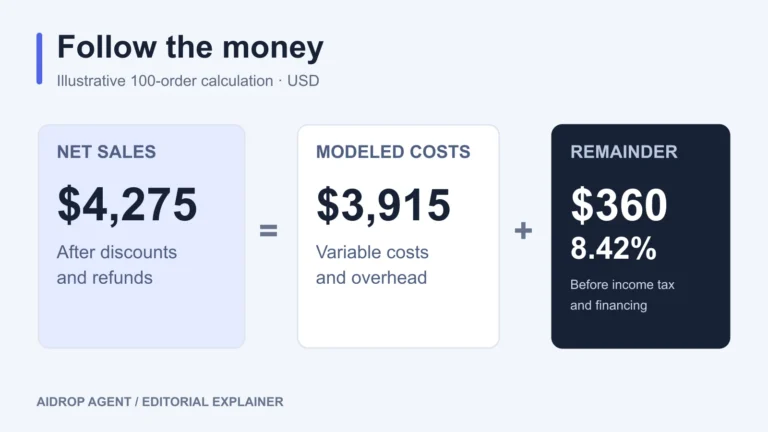
Dropshipping Profit Margin: Calculate What You Keep
Calculate dropshipping gross, contribution, and net margins. See how discounts, refunds, and ad costs change profit in

How to Price Dropshipping Products From Landed Cost and Risk
Calculate a retail price from the delivered cost of one variant, selling fees and required contribution, then
Dropshipping Cash Flow: Supplier Payments, Payouts and Refund Buffers
Plan dropshipping cash flow by date. Separate pending payments from usable cash, fund supplier bills, and test
