
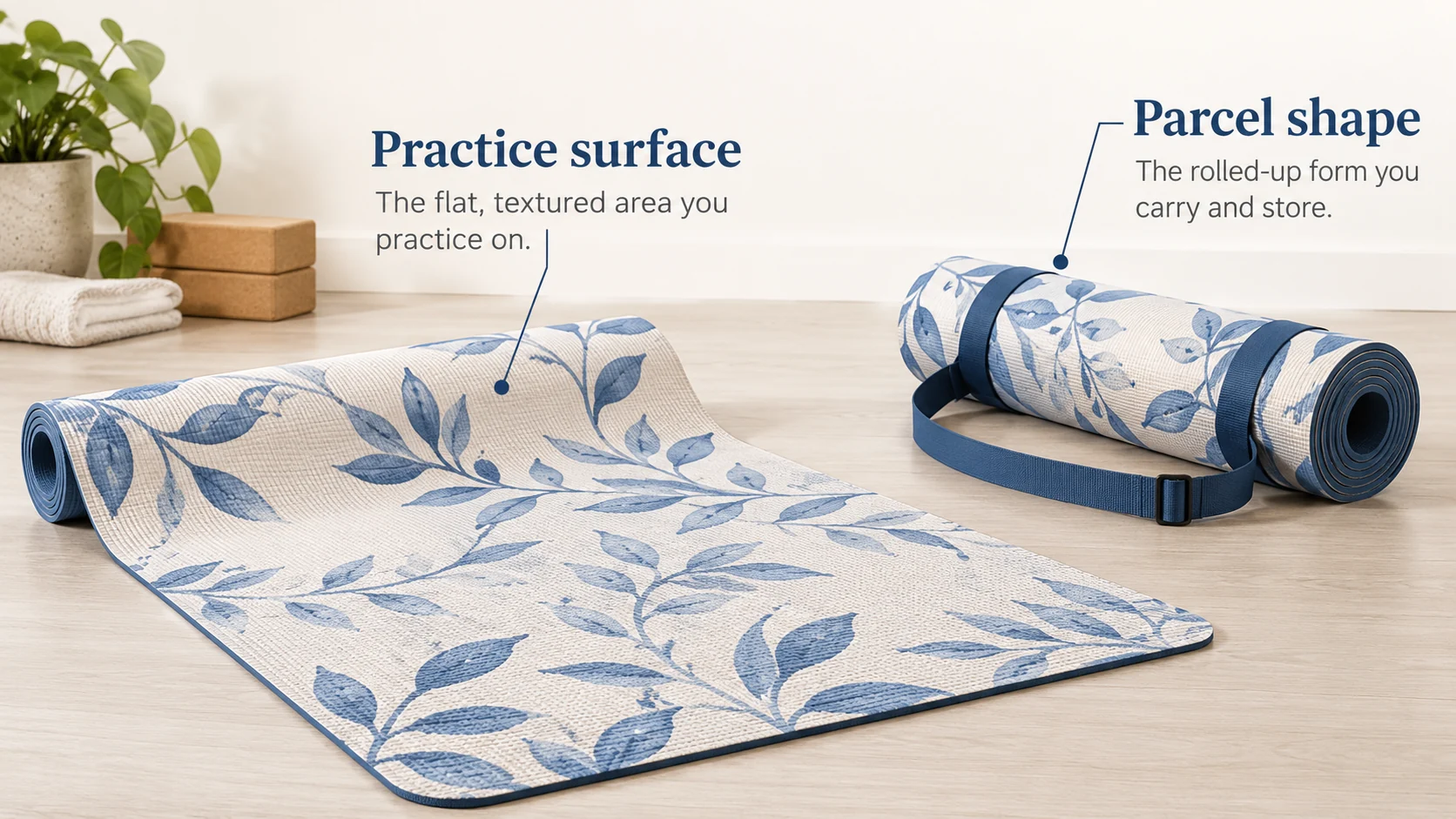
You can dropship a ready-made yoga mat or sell a custom-printed mat through a provider such as Printify. Choose by the surface, backing, thickness and buyer’s practice, then quote the packed roll. A thin travel mat and a cushioned exercise mat are different offers even when they carry the same design.
There are two easy mistakes here: choosing the mat from its picture and estimating freight from its weight alone. The first overlooks how the mat behaves on a floor. The second overlooks the size of the parcel that must carry it.
Provider pages were checked on October 12, 2026. The comparisons use documented product attributes; the sample procedure and freight calculations are examples to apply, not results of a physical test.
Explore the broader topic: Fitness Products Dropshipping: Load, Fit and Support Requirements.
01
Choose a mat for a specific kind of practice
Name the buyer’s main use before choosing thickness. Someone carrying a mat between home and a class cares about portability. Someone using it for floor stretching may prioritize cushioning. A buyer using standing poses also needs to consider how stable the surface feels.
These priorities can compete. More cushioning may suit one activity without being the best choice for another. The mat’s width, length, surface, backing and care requirements also matter.
For a first offer, write a plain brief: “A printed mat for home practice on a hard floor, with the size, thickness and care instructions clearly shown.” That is easier to source and inspect than “the best professional yoga mat.”
Use the buyer’s requirements to compare actual products. Do not promise injury prevention or a medical benefit because the object is used for exercise. A merchant inspection can inform your offer, but does not establish those claims.
02
Find an available supplier route
For original artwork, Printify’s yoga-mat page is a POD starting point. Select the actual product and provider, then confirm current destination availability and the finished order cost.
For an existing branded-product arrangement, ilaSTRATE’s wholesale page advertises a dropship partnership to investigate. Ask about account eligibility, permitted sales channels, exact products and shipping terms. The public offer is not an independent reliability test.
Manufacturing platforms such as Alibaba’s supplier directory provide further leads. Confirm minimum quantities, sample costs and whether individual fulfillment is actually offered. A product manufacturer is not automatically a ready-to-use dropshipping service.
One important exclusion: Prodigi’s yoga-mat page currently marks the product discontinued. Older blogs and documents can still make it look available. Check the current product page before building an offer around a recommendation.
| Your requirement | Route to investigate | First confirmation |
|---|---|---|
| Original printed design without a finished-goods run | Current POD product | Selected provider, template and destination |
| Existing product with permitted resale | Dropship partnership | Account terms and actual SKU availability |
| Particular material, dimensions or branding | Manufacturer or sourcing quote | Development quantity and individual order handling |
The print-on-demand guide explains the broader model. For mats, the specific product and parcel are more useful comparison units than the provider’s name alone.
03
Compare the surface, backing and thickness separately
A mat has two contact surfaces. Your hands and feet contact the top; the floor contacts the bottom. Cushioning is another property. A product can perform differently at each of those jobs.
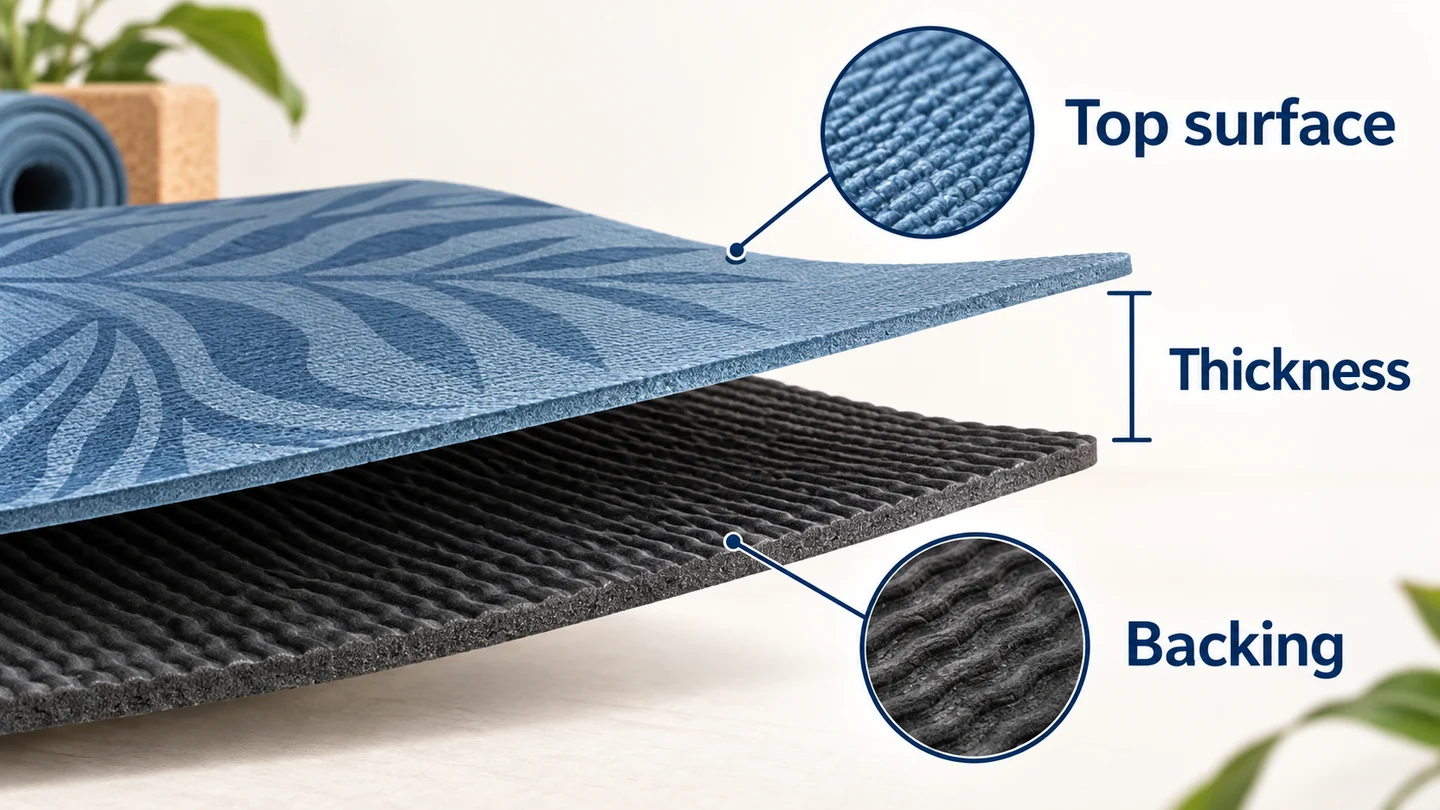
Printify’s current examples include a roughly 61-by-178 cm mat with a microfiber-suede top, rubber base and 3 mm thickness, and a roughly 61-by-183 cm thermoplastic-foam mat listed at 6.5 mm. These are different constructions, not one mat offered in two purely decorative choices.
| Attribute | What it tells you | What it does not prove alone |
|---|---|---|
| Top surface | What the user touches and where the print appears | Grip in every dry or damp condition |
| Backing | What contacts the floor | No movement on every floor finish |
| Thickness | Distance through the material | Better grip or more stable balance |
| Length and width | Available practice area | Suitability for every user’s activity |
| Material and care | How the product is made and maintained | An unsupported environmental or safety claim |
Obtain the exact composition, care instructions and any included strap. Treat “anti-slip” or similar catalog wording as a claim to evaluate for the actual conditions, not a universal guarantee.
For a private product, ask for both sides separately. “Rubber yoga mat” may leave the top layer, texture and printing method unresolved. Those details can change how the item is used and cleaned.
For the home-practice buyer in this guide, shortlist the two constructions for different reasons:
| Candidate | Reason to inspect it |
|---|---|
| 3 mm microfiber/rubber example | Its surface, portability and care may suit the intended practice |
| 6.5 mm foam example | Additional cushioning is an important part of your offer |
Do not choose between them from thickness alone; the surface and backing changed too.
If the buyer values cushioning for floor stretching, inspect how that sample feels in ordinary use and how it rolls for storage. If the buyer carries it to class, inspect its actual packed weight and roll size. Ask for those measurements before writing “lightweight travel mat.” The product’s use and its shipping bill should both survive the choice.
04
Check the sample on the floor where it will be used
Order the selected mat with the artwork and accessories you intend to sell. Photograph it on arrival, including the underside, edges, labels and roll. Allow it to settle as instructed before assessing whether it lies flat.
Use a clean floor representative of the intended use. Observe the top surface and backing separately under ordinary, comfortable movement. If the mat shifts, determine whether your hands are moving on its top or the entire mat is moving across the floor.
Keep a useful record rather than assigning a vague quality score:
| Proposed observation | Record | Decision |
|---|---|---|
| Edges after unrolling | Photographs and time/conditions | Whether the product’s setup instructions need explanation |
| Backing on the intended floor | Floor type and observed movement | Whether the offer fits that use |
| Top contact during ordinary practice | Dry or other permitted conditions | Whether the actual grip supports the description |
| Printing and cleaning | Before-and-after appearance under the care instructions | Whether the artwork and cleaning guidance remain suitable |
Do not invent a wet test if the product instructions do not support that use or cleaning method. Avoid assigning an objective friction value from a casual observation. Stop using a visibly damaged or unsuitable sample and ask the supplier about it.
The quality-control guide explains how to preserve an approval. These checks help decide what to sell; they do not certify injury prevention, chemical safety or grip on every floor.
A slipping hand and a moving mat are different findings
Suppose the mat stays on the floor but the user’s hands slide across its top. That observation concerns contact with the upper surface in those conditions. If the hands stay in place but the whole mat moves, the floor-facing contact is the issue. “It slips” is too vague to choose a different product or ask for help.
Use a short observation record:
- Floor type and permitted use conditions.
- Hands sliding on the surface, or the whole mat moving.
- Setup/cleaning instructions followed and the result afterward.
Repeat only ordinary comfortable movement. If the result remains unsuitable, stop approval and ask about another construction. Do not use a risky pose or an improvised chemical treatment as a merchant inspection.
If only your second sample has an unexpected surface or backing, compare its product/provider and labels with the first. You may have received another construction. Increasing thickness will not necessarily solve a top-surface or backing mismatch.
Use the finished decision in the listing: describe the actual construction and intended use that the evidence supports. Keep any important care or setup requirement close to that description, rather than hiding it in a policy page.
05
Design the print around the finished surface
A yoga mat is a large canvas, but people use and sometimes cover much of it. Small lettering that looks readable on a full-screen mockup can be difficult to see when the product is on the floor.
Build the artwork at the finished scale:
- Open the selected product’s template and check printable area, bleed and edges.
- Keep important details inside the supported area; do not depend on exact edge placement.
- For a botanical design, try restrained motifs near the ends with a quieter middle. For geometry, inspect both the full-length view and a close detail.
- Reject a narrow border if it needs more precision than the supported process can deliver.
If adding alignment-style lines, keep the claim modest. A printed line is a design feature; it does not become professional instruction or guarantee correct posture. Do not add unsupported coaching or therapeutic promises to make the artwork sound more valuable.
After receiving the sample, show the actual top, underside, edges and rolled size. A flat graphic can explain the design, while real photographs show the object the customer will handle.
06
Get the freight quote for the roll, not the mat
A rolled mat may be light enough to carry and still occupy a large parcel. Some routes compare its actual weight with dimensional weight and bill according to their applicable rules.
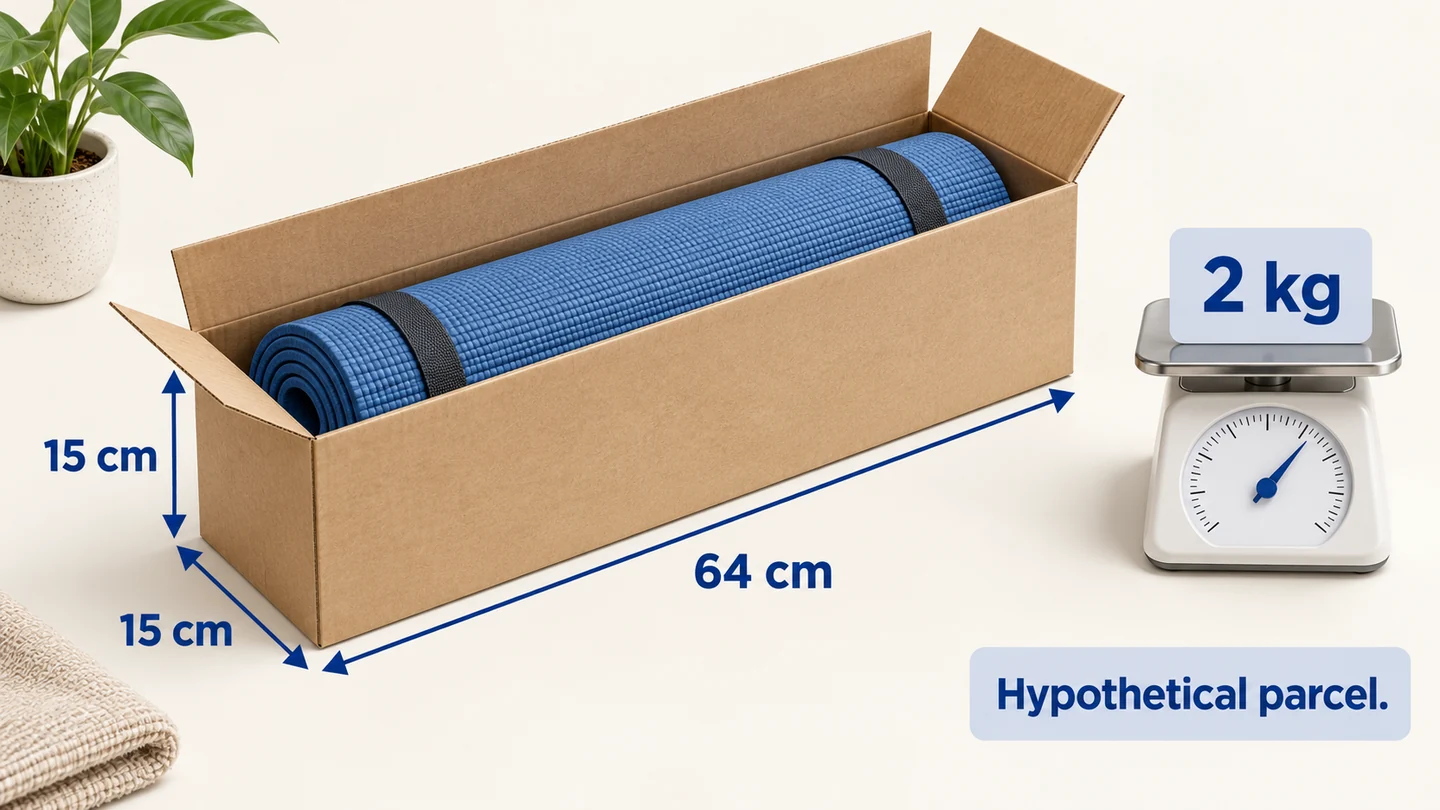
Consider a hypothetical outer box measuring 64 × 15 × 15 cm, with an actual gross weight of 2 kg. Its volume is 14,400 cubic centimeters. The following divisors are illustrations, not official AIDrop rates or a particular carrier’s confirmed tariff:
| Illustrative calculation | Result |
|---|---|
| 14,400 ÷ 6,000 | 2.40 kg dimensional weight |
| 14,400 ÷ 5,000 | 2.88 kg dimensional weight |
| Actual gross weight | 2.00 kg |
The applicable divisor, rounding, weight steps and route rules determine the quoted billable weight. This example shows why “the mat weighs 2 kg” is incomplete information for a freight inquiry.
Ask for the packed outer dimensions and gross weight, destination postcode, service speed and tax/fee scope. Include the strap or any other accessories. The dimensional-weight guide explains the broader calculation.
A few centimeters can change the quote
Keep the hypothetical 64 cm box length, but widen both other dimensions from 15 to 18 cm for a looser protective roll. The volume becomes 20,736 cm³. That produces 3.46 kg with a 6,000 divisor or 4.15 kg with a 5,000 divisor, before route-specific rounding. The gross weight could still be 2 kg.
| Hypothetical parcel | Volume | At divisor 6,000 | At divisor 5,000 |
|---|---|---|---|
| 64 × 15 × 15 cm | 14,400 cm³ | 2.40 kg | 2.88 kg |
| 64 × 18 × 18 cm | 20,736 cm³ | 3.46 kg | 4.15 kg |
That is why the actual outer parcel matters. It does not authorize squeezing a mat into a smaller box if that damages its surface or shape. Have the supplier demonstrate a suitable packing arrangement and quote that arrangement.
A useful request reads: “Please quote one mat with the included strap, packed at [outer dimensions] and [gross weight], to [postcode/country]. State the service, estimated transit, billable weight and rounding, and whether duties or other destination charges are included.” Compare services using the same parcel. A per-kilogram headline rate is insufficient if the services use different billable weights or add different charges.
You can also send those parcel details to AIDrop for a China-sourcing and shipping comparison. The cost calculator’s route inputs are useful once the applicable rate is confirmed; an unconfirmed example rate should not be presented as a quotation.
Then check the full sale
For a fictional $49 receipt, assume $19 for the mat, $12 for shipping, $1.80 in payment fees and a $2.20 remedy allowance. That leaves $14 before advertising, tax and overhead. At $8 advertising cost, $6 remains.
An extra $4 freight charge would leave only $2 on those assumptions. Get the actual route quote before offering free shipping or a discount. These figures are teaching inputs, not supplier prices or a measured refund rate.
If bundling a mat with a bottle from another route, quote the whole basket. The buyer may receive two parcels and the store may pay two shipping charges even though checkout happens once.
07
Sell a useful offer without unsupported promises
The listing should identify the material, dimensions, thickness, printed surface, included accessories and care instructions. Tell the buyer what the mat is intended for in ordinary language, with the limits your actual evidence supports.
Avoid blanket “non-toxic,” “biodegradable,” “latex-free” or “never slips” claims unless you have appropriate product-specific evidence. A catalog adjective or educational illustration cannot provide it.
For damage or a manufacturing issue, collect the order ID, whole-product view, affected-area photographs and packing evidence. Ask the provider for an authorized remedy. Agree on handling for a used mat, an unopened return and a wrong product before publishing your policy.
If a supplier changes the surface or backing, review the product again. Your original sample and descriptions may no longer explain what the customer receives.
08
Yoga mat dropshipping questions
Is the thickest mat always the best?
No. Cushioning, portability and stability can have different priorities. Compare the specific product with the activity and floor the buyer intends to use.
Can I still order Prodigi’s yoga mat?
Its current product page marks it discontinued. Check directly for any later change rather than relying on an older catalog or blog recommendation.
Can I sell one printed mat at a time?
Investigate a current POD product and its chosen provider’s terms. A separate private-manufacturing arrangement may have production quantities even if later fulfillment is one order at a time.
Can AIDrop quote a ready-made mat and its shipping?
You can send AIDrop the material, dimensions, packing and destination for a China-sourcing and fulfillment proposal. Include any design or strap requirement. The final freight needs the packed parcel and selected route; this article’s divisor examples are not a quote.

Pet Supplies Dropshipping: Fit, Materials and Product-Use Boundaries
Start with a narrow non-ingestible pet accessory. Verify intended use, fit, materials, sample version and recovery path

Fitness Products Dropshipping: Load, Fit and Support Requirements
A roller, band and doorway bar need different evidence. Check the exact model, use claim, package and

Outdoor Gear Dropshipping: Product Use, Durability and Shipping Fit
A picnic blanket, dry bag and camp chair call for different use evidence and parcels. Check model,
