

Wholesale2B lets you browse products with a free account, but store integration is a paid service. Its canonical pricing page, rechecked October 11, 2026, lists store integration at $49.99 monthly or $449.91 annually. Goods, destination postage and your own selling costs are separate.
Before choosing a plan, price one product to the buyer’s address, then place a test order. A large catalog and automated sync cannot tell you whether that individual sale leaves enough money or reaches the customer correctly.
This is an integration and order-management service connecting retailers to suppliers. It is not the same decision as buying wholesale inventory. Our dropshipping model guide explains the supplier-to-buyer route that a tool like this supports. The supplier’s product price, shipping charge, your selling channel, advertising and customer support still determine whether the route works for your store.
Explore the broader topic: Dropshipping Suppliers: Compare Channels, Costs, and Fit.
01
Know what “free” buys you
Wholesale2B’s pricing page says a free account can view product and wholesale-price information without a card. Its own terms say the free account is for browsing and a plan is needed to start selling through the service.
Choose the plan for your actual channel
At the review date, the main store-integration plan was displayed at $49.99 per month; Amazon was marked separately at $99.99 per month, and a data-download/API plan at $99.99 per month. Check today’s checkout and the exact channel before treating any of those as your actual bill.
The plans do different jobs. A store integration can import products and exchange inventory, order and tracking data with a supported storefront. A product-data download serves a custom system that must use the feed correctly.
A catalog does not prove this variant can ship
Having access to a million listings is not the same as confirming that a particular supplier will dispatch a particular variant for a particular destination. Wholesale2B advertises supplier order and return handling, but your business still sells to and answers the buyer.
| Choice | What you are paying for | First question before activation |
|---|---|---|
| Free account | Catalog and price review | Do the specific items and suppliers fit your market? |
| Store integration | Connected listing, inventory, order and tracking workflow for a supported channel | Does this plan cover your storefront, and does an actual order flow through? |
| Data/API route | A feed for a custom site or workflow | Who maintains the import, stock mapping, order placement and error queue? |
On a phone, swipe the table sideways to compare every column.
The Wholesale2B terms also matter before activation. They discuss account verification when using Wholesale2B’s order service and limits on how exported product content may be used. Read those conditions for your chosen plan, especially if you intend to republish data to more than one site. An integration license is not a blanket license to put supplier photos and descriptions anywhere.
02
Test what the paid integration controls
Before paying, decide who controls each field on one test listing:
Supplier feed
supplier SKU, available quantity and quoted product cost.
Your store
retail price, buyer-facing promise and approved product claims.
Human review
dimensions, included parts, images and any imported description that could mislead a buyer.
With the supplier’s permission, use a controlled product update or observe a real approved feed change. Compare the same SKU before and after sync: does the update overwrite your edited title or image? Record the result for your plan and channel; the plan name does not establish those controls.
Configure one listing as a controlled experiment
Pick a supplier item with a clear variant code and a served address. Record supplier SKU → store variant SKU, supplier cost, postage and intended retail price. Then test which fields the integration can update.
Your policy might allow quantity and cost to refresh while a person approves claims, images and retail price. That is a proposed store rule, not a promise that every Wholesale2B plan has those switches. Demonstrate it in your channel before importing a catalog.
Run one controlled sync test:
Before sync
Capture the store page and supplier record before sync.
Observe one permitted update
Make or observe one permitted supplier quantity or cost change.
After sync
Compare the page and order line after sync.
A $3 cost increase needs a decision
If the example supplier cost rises from $14 to $17 while your $38 price holds, contribution falls by $3. Pause, reprice or deliberately accept the smaller remainder. If your channel needs price approval, make that a human step; a feed rule will not necessarily protect margin.
03
Work out the fee per order, then add the actual parcel
A monthly fee feels small or large depending on how many real orders it supports. Divide it by fulfilled orders for the period, not by the number of listings you imported.
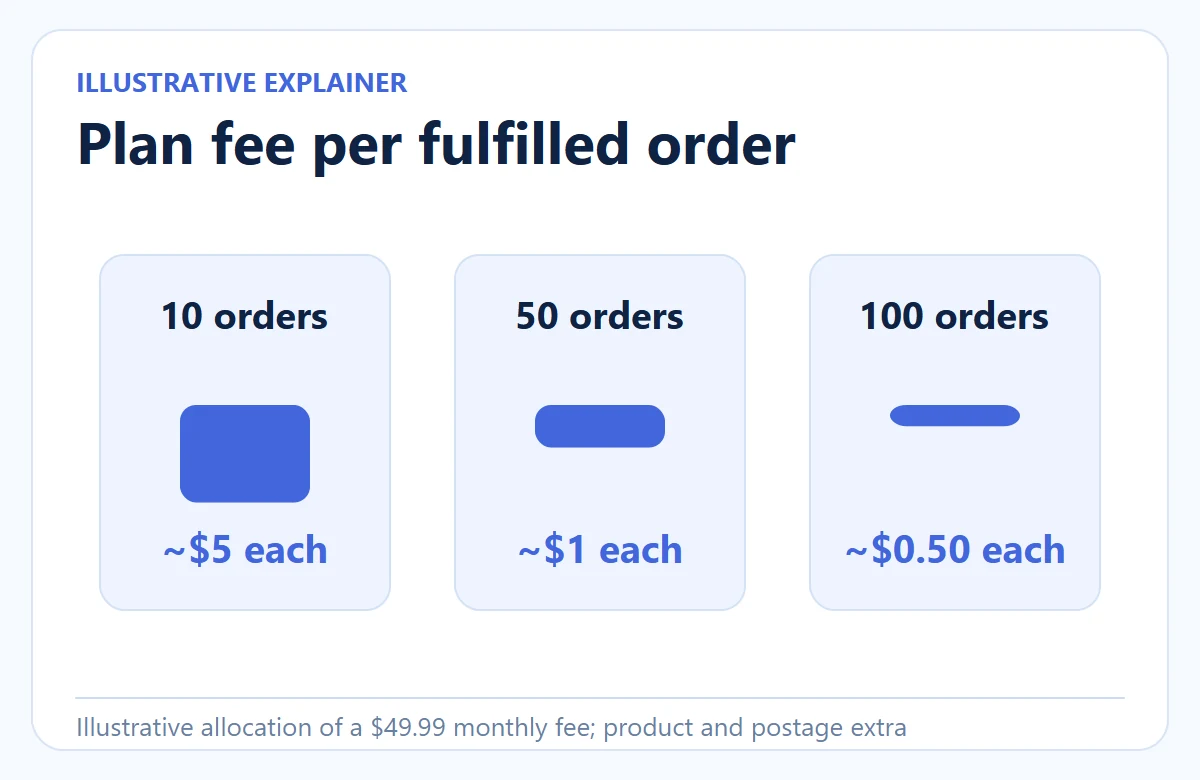
Allocate the fee across actual fulfilled orders
Using the displayed $49.99 monthly integration fee only as an arithmetic example, 10 fulfilled orders allocate about $5 each; 50 allocate about $1 each; 100 allocate about $0.50 each. That is an allocation method, not a promised outcome. If zero orders ship, you still owe the plan fee under the applicable billing terms.
Take a hypothetical $38 home organizer. The item costs $14, destination shipping $7, customer acquisition $9 and payment fees $2. At 10 fulfilled orders, about $5 of monthly plan fee falls on each order.
One-dollar contribution leaves little room for a claim
That leaves about $1 per order before refunds, tax and overhead: $38 − $14 − $7 − $9 − $2 − $5. At 50 similar orders, plan allocation falls to about $1 and the remainder becomes about $5. These product, postage and ad figures are teaching inputs, not Wholesale2B quotes or AIDrop rates.
| Input for the first real SKU | What to verify |
|---|---|
| Supplier item cost | Exact variant and current supplier price |
| Shipping | Buyer destination, package size, handling and delivery service |
| Store/channel charges | Marketplace commission, processor fee or app fees outside the Wholesale2B plan |
| Acquisition | Actual cost of getting an order, not an assumed “free traffic” number |
| Monthly integration | Current plan and reasonable fulfilled-order volume |
| Exception reserve | Damaged, canceled or returned order movement and support |
On a phone, swipe the table sideways to compare every column.
The hard part is often shipping and exceptions, not arithmetic. Wholesale2B’s terms say supplier-provided product data may contain price or description errors. When a feed changes, a buyer may still be looking at your older price. Build a rule for reviewing price changes and pausing a listing that cannot be sold at the promised amount. The supplier-quote comparison shows how to compare delivered product costs across sourcing routes.
An $11 return can consume eleven orders’ remainder
The example’s $1 remainder at 10 orders is a warning, not a success. One return costing $7 postage and $4 handling would consume the pre-overhead remainder from eleven otherwise identical $1 orders. These numbers are illustrative; they show how little error a narrow contribution can absorb.
Get the real damaged-item and change-of-mind terms. Run a low-volume month as well as an optimistic one. If the route works only at 100 orders you have never reached, the subscription and product choice are not proven.
04
Follow one order rather than trusting a feature list
Choose one representative product, not the cheapest item in the catalog. Confirm its variant, product dimensions, seller-allowed content, supplier cost, destination shipping and return path. Put it in a test listing with the correct stock mapping. Place a controlled paid order and follow the full trail: store order, Wholesale2B order, supplier acceptance, parcel tracking and final buyer delivery. Save the timestamps and any error you had to repair.
If the supplier changes the item’s price or rejects the destination, find out when your store learns about it.
A tracking number still needs a real carrier event
If tracking appears, check for a real carrier movement rather than assuming a number means the parcel was handed over. If an item arrives wrong, note who opens the supplier claim, who gives the buyer a remedy and who pays the return or replacement shipment. Wholesale2B may coordinate the supplier side, but the buyer will usually contact the store that charged them. Our order-fulfillment guide follows that customer-facing chain.
Check the received item, not just the data trail
The test should also challenge the catalog content. Does the delivered organizer match its image, size and included parts? Are those images permitted for your storefront and sales channel? The terms’ product-data disclaimer is a reason to inspect one sample, not an accusation that the catalog is inaccurate. Do not turn a supplier-supplied description into your own quality promise until you have checked what reaches the buyer.
During the first ten orders, log five handoffs: store order, Wholesale2B receipt, supplier acceptance, carrier event and delivered item. A blank stage is a finding.
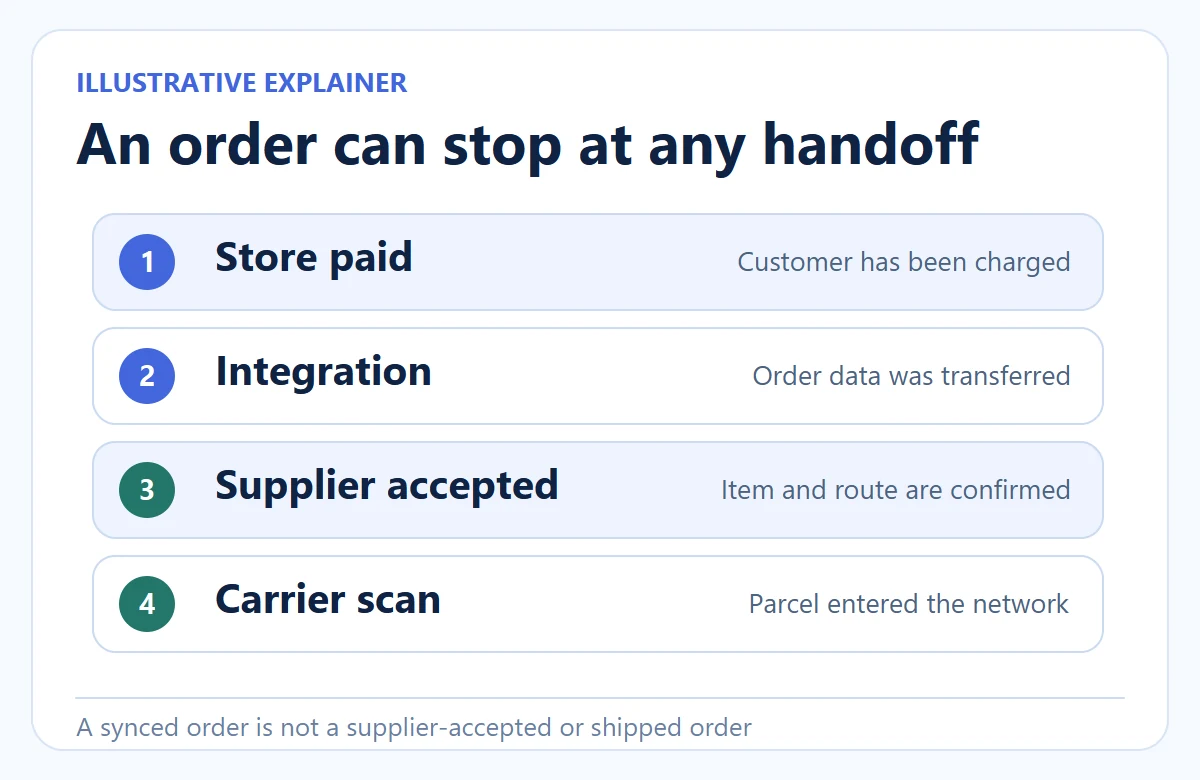
Find the missing handoff before buying again
If order #10 appears only in your store, investigate the connection or mapping before blaming the supplier. If Wholesale2B has it but the supplier has not accepted it, the next check is different. Integration can expose handoffs; it cannot make those states interchangeable.
Decide what counts as a passed integration test
Write a short receipt for the test order:
- Paid store order ID and matching Wholesale2B reference.
- Supplier-accepted variant and actual product plus shipping charge.
- First carrier acceptance event, delivered item and buyer email.
Name the owner of any missing check. No Wholesale2B reference points to connection or mapping; no supplier acceptance points to supplier or payment; a label without movement points to handoff. “Order sync works” hides those differences.
Rehearse the rejected variant or destination
Test one failure before taking a real buyer’s payment: an unavailable variant or an unserved destination. Does the listing stop, does the order hold, or do staff discover the problem only after checkout? Record the actual result. Do not assume cancellation or refund happens automatically.
Make the release decision specific to this SKU
Turn the result into a release rule another person can check: “Do not advertise this SKU until the live variant, destination charge and supplier acceptance are visible in the trial.”
05
Check the cancellation and return path before scaling
Order cancellation needs supplier confirmation
Wholesale2B’s terms say a processed order cancellation might incur a charge and is not guaranteed once it reaches the supplier. That is a practical warning for a store with fast-changing customer edits: the buyer can message “wrong address” after your system has already transmitted the order. Know the last point at which an edit can be made, who can stop a parcel and what your support team will say when it cannot.
The service says it handles returns with suppliers, but the case starts with your buyer:
- The buyer reports a damaged organizer; your store collects photos and the order reference.
- Wholesale2B or the supplier decides the business-to-business claim.
- Your store tells the buyer the remedy under its policy and applicable obligations.
Give the buyer a usable return route
A plan feature cannot write that customer policy. Check the supplier’s terms for this item and destination, including return postage, replacement and credit.
Count the support work the plan leaves behind
If those answers require too many manual messages, that is evidence about the operating cost. Time spent on support belongs in the comparison even if there is no explicit per-ticket fee. The supplier red-flags article helps assess missing documents, unclear responsibility and impossible promises.
06
Decide after a small, complete trial
The useful decision is not “Is Wholesale2B good?” but “Does this plan, channel and supplier route solve my store’s next ten real orders?” Check the current plan at checkout, compare at least one delivered SKU against an alternative, place a test order and document the return path. Keep or expand the integration when the order flow and margin both work. Pause if you cannot identify the dispatched variant, shipping charge or buyer remedy.
For sellers who need someone to source, inspect, package or coordinate China-side dispatch of a defined product, AIDrop Agent’s sourcing service is a different route to evaluate. Send the product specification, destinations, expected volume and the point where the catalog integration fails through the inquiry page. A tailored quote is needed; this article does not claim AIDrop can duplicate Wholesale2B’s catalog, software or plan price.
07
Frequently asked questions
Can I sell through Wholesale2B with only the free account?
Its free account is for reviewing the catalog and prices. Selling through a connected store or another channel needs the relevant paid plan under the current terms. Confirm the channel and checkout price before importing products; the monthly plan is separate from supplier product and shipping charges.
What if supplier cost rises while my store price stays the same?
Compare the updated supplier amount and destination postage with the retail price and your required remainder. Hold or reprice that SKU if the order no longer works. Test which fields your chosen integration updates automatically and which need human approval; a fresh feed does not necessarily protect your margin.
Can I cancel a customer order after Wholesale2B sends it to the supplier?
Do not promise an automatic cancellation. Its terms say a processed order may not be cancellable and a charge may apply. Check the order’s stage, request a stop through the documented route, and tell the buyer what you can verify. Build an address-correction cutoff into your support playbook.
Does canceling the plan stop an already submitted order?
Are subscription cancellation and supplier cancellation the same?
No. Canceling renewal changes the service subscription, not a supplier’s accepted or processed parcel. Ask separately for order cancellation and retain the actual answer. Wholesale2B’s terms also limit continued use of its product descriptions/photos to an active plan; review the licensed content on your site when ending the service.
Should I wait for supplier recovery before handling the buyer?
Decide the buyer’s remedy under your actual sale terms and obligations, while pursuing supplier cancellation or reimbursement separately. Do not treat an unresolved private supplier claim as proof that the buyer has already received a refund or must keep waiting indefinitely.
CJdropshipping Review: Costs, Warehouses, Quality and Fulfillment Fit
CJdropshipping is a practical option for sellers who want sourcing, store connections, packaging and fulfillment in one

CJdropshipping vs DSers: Who Sources, Pays and Ships the Order?
CJdropshipping can source and physically fulfill an order; DSers maps a store product to supported external suppliers

AutoDS Review: Evaluate the Automation You Would Actually Use
AutoDS can reduce listing and order work, but its value depends on your sales channel, tier, add-ons
