
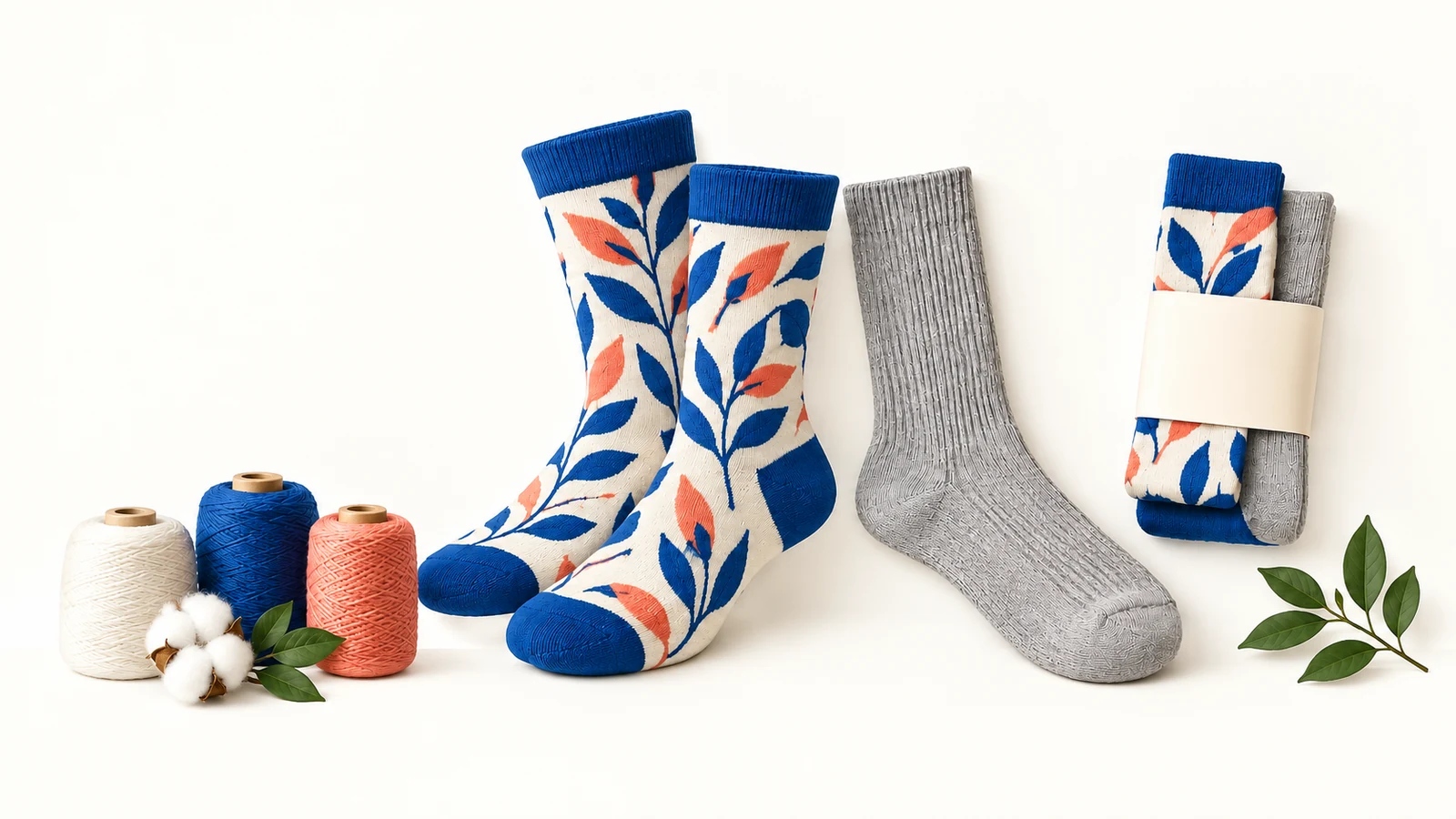
You can dropship ready-made socks or sell custom printed socks through providers such as Printify, Prodigi and Contrado. Choose the fabric and fit before the artwork. A printed polyester sock is a different product from a cotton-rich sock knitted to your own specification.
That difference matters to the buyer. Someone looking for a fun birthday gift may value the pattern. Someone buying everyday socks may care more about softness, thickness and how the cuff feels after several hours.
This guide compares supplier routes and practical checks using documentation reviewed on October 10, 2026. Examples are illustrative, and we have not worn or washed the providers’ samples. Our print-on-demand guide covers the wider order model.
01
Choose the sock before choosing the artwork
Decide which of these products you want to sell:

| Product route | What you control | What to investigate |
|---|---|---|
| Ready-made socks | Product selection and presentation | Composition, size range, stock and branding permission |
| Printed socks on an existing blank | The artwork on the offered sock | Print method, fabric, stretch and placement |
| A custom-knitted sock | A quoted construction and yarn specification | Development, minimum quantities, sampling and fulfillment |
For example, Prodigi’s tube-sock offer specifies polyester and dye-sublimation printing. That does not make it a cotton-rich everyday sock, even if the uploaded design imitates a knitted pattern.
Write a small product brief before looking at prices: ankle or tube height, composition, intended size range, thickness, decoration and whether the sale unit is one pair or a multipack.
If you need a particular terry sole, rib construction or yarn blend, ask about that construction explicitly. Uploading artwork to an existing blank will not change how the sock is knitted.
02
Compare actual sock products and a stocked alternative
For original artwork, shortlist the printed blank. For an everyday cotton-rich range without your own print, look at stocked merchandise. These choices change what the buyer receives.
Printify: three materially different printed socks
Printify’s custom-sock page listed these non-Premium starting prices in USD when checked. Shipping, tax and a destination-specific quote are separate.
| Printify product | Published composition | Size options | Base price from |
|---|---|---|---|
| Sublimation Socks | 95% polyester, 5% spandex | S, M, L | $7.25 |
| EU Sublimation Crew Socks | 70% polyester, 25% cotton, 5% spandex | S, M, L | $11.96 |
| DTG Padded Crew Socks | 86% polyester, 10% nylon, 4% spandex | One size | $10.48 |
The first offers the lowest listed base in this comparison. The EU crew contains some cotton but remains polyester-rich. The padded crew has different construction and one-size availability. None is a 100%-cotton custom-knit sock.
For a pattern-led gift with size choices, investigate the sublimation product. If cushioning is central to your offer, investigate the padded crew’s exact specification and size range before accepting its higher price. The word “padded” alone does not prove sports performance.
Record the selected Print Provider and destination. Printify is a platform; switching its provider can change the sock or delivery route while leaving your artwork unchanged. The EU product’s base price is not evidence of US production.
Prodigi and Contrado: other printed routes
Prodigi’s tube socks specify 100% polyester, dye-sublimation and UK dispatch. Its ankle socks are a separate product. Use the relevant template and destination quote, not one shared sizing promise.
Contrado’s custom-sock offer is another printed route. Compare its selected material, size and complete delivery bill with the same buyer brief.
A stocked cotton-rich candidate through Doba
Doba lists Daily Finds’ Flower Pattern Cotton Mid Calf Hi Socks, item D01027XF80J. The listing specifies 67% cotton, 29% nylon and 4% spandex, US shoe sizes 4–10, and US origin/destination. Price and detailed inventory require login.
That is a concrete route to investigate for existing patterns and a cotton-rich fabric. It does not give you control over a new knitted design. Confirm the purchase unit, pack count and supplier terms before comparing its account price with one printed pair. We do not infer reliability from the page’s promotional fulfillment statistics.
03
One size needs a usable size range
“One size” does not tell a buyer whether the sock fits their foot or calf. Stretch can accommodate a range, but it can also change the pattern and cuff pressure.
During this review, Prodigi’s tube-sock page showed different size wording in its narrative and variant details: one referred to up to UK 11, while the variant row showed UK 6–10. Confirm the current SKU with the provider before publishing a range.
Do not combine the two statements into a new, larger size range. Keep a written confirmation beside the product record.
Ask for:
- The supported foot-size range for the exact variant.
- Useful unstretched measurements and the intended calf fit.
- Whether the listed dimensions describe the flat sock or a print template.
- The applicable size conversion when selling across countries.
For a hypothetical listing, use “fits the confirmed UK size range shown in our chart” and provide that chart. Avoid saying “fits everyone” because the fabric stretches.
A sample worn by one person establishes only that person’s experience. It should not become a claim covering the entire advertised range.
04
Design for the fabric after it stretches
A sock is not a flat poster. The pattern changes when the fabric wraps around a foot and calf.

Small words can become distorted, and a logo positioned precisely at the ankle may not sit there on every wearer. A repeating pattern often tolerates movement better.
Prodigi recommends full-area patterns rather than designs that depend on exact placement. Its product page provides file guidance, including a 300 dpi requirement. Use the selected provider’s template; that does not establish one universal pixel size for all socks.
Try this hypothetical artwork revision:
| First version | Revised version | What the sample should answer |
|---|---|---|
| A tiny name beside the ankle | A larger name within the supported area | Is it readable when worn? |
| One detailed face | A simple repeated motif | Does stretching change the expression or shape? |
| A border that must align around the whole leg | A pattern that tolerates joins | Are the joins acceptable in normal use? |
Inspect the print on the front, back and sides. Check the heel and toe areas as well as the part visible in a product mockup.
Keep essential artwork away from any area the template identifies as uncertain. Approve the physical result before calling the placement exact.
05
Calculate the price of one pair and a bundle
Low-priced merchandise can lose much of its margin to a single parcel. A bundle may help, but only if the shipping quote and buyer demand support it.
Use a real product base as the starting point, then add the costs you still have to quote. This example uses Printify’s published $7.25 non-Premium starting base for Sublimation Socks; shipping, retail prices, fees and remedy allowances below are hypothetical. It assumes the selected provider sells and prices the quoted unit as one pair.
| Order | One pair | Two-pair bundle |
|---|---|---|
| Customer pays | $18.00 | $32.00 |
| Product base used in the example | $7.25 | $14.50 |
| Shipping | $4.00 | $5.00 |
| Payment fee | $0.90 | $1.30 |
| Remedy allowance | $1.10 | $1.70 |
| Left before advertising and other overhead | $4.75 | $9.50 |
The bundle works better here because the assumed second pair adds only $1 to freight. Ask for the actual combined quote before using that result. If the two pairs ship separately at $4 each, the bundle leaves $6.50 instead of $9.50 under the other assumptions. That still exceeds one pair’s contribution, but the buyer must also want the bundle.
Also check the unit you are buying. If a supplier’s listing says “three pairs,” compare its price with a three-pair retail offer. Confusing one sock, one pair and one pack creates expensive listing errors.
A useful bundle pairs designs the customer would actually want together. Two unrelated prints offered solely to raise the order value may make the choice harder.
06
Wash and wear the sample before launch
Inspect the exact product and artwork version. Follow the care instructions rather than improvising a harsher wash and treating it as normal use.
This is a proposed merchant sample check:
| Check | Before use | After normal wear and the instructed wash |
|---|---|---|
| Fit | Record the wearer’s foot size and cuff feel | Note slipping, pressure or a change in fit |
| Fabric | Look at thickness, seams and opacity | Inspect visible wear and any change in feel |
| Photograph the flat sock and worn pattern | Compare color and distortion under similar lighting | |
| Pairing | Confirm two matching socks and the sale unit | Check the product record still matches the listing |
Keep the observations honest and limited. One wash does not establish long-term durability, and a comfortable casual sock has not automatically become a performance or medical product.
If the cuff is uncomfortable for your intended customer, changing the picture will not fix it. Revise the size claim or choose another sock.
After approving the item, run one paid store order and verify the pair count, variant, supplier bill and buyer tracking. The sample approval guide explains how to preserve the final product and artwork reference.
07
Sock dropshipping questions
Can I dropship custom cotton socks one pair at a time?
Look for an offer that explicitly supports the composition and order model. A polyester printed blank is not interchangeable with a custom-knitted cotton sock. Custom knitting may involve development and minimum quantities.
Are printed socks always suitable for sport?
No. Sport-specific cushioning, support, moisture handling or other performance claims need evidence for that product. A decorative pattern does not establish those properties.
Can I call the product plastic-free?
Check the fabric separately from the packaging. Polyester is not a plastic-free textile. A packaging claim should describe the packaging and be supported by its actual materials.
Is a bundle better than selling individual pairs?
Compare real combined shipping and likely demand. The example above shows a possible benefit, but a bundle also asks the buyer to spend more and choose more designs.
What if I need my own yarn blend or knitted logo?
Prepare a construction brief and compare a sourced production run with the on-demand offer. AIDrop Agent can review a China-side sample, supplier and packing scope. Send the sock specification and expected volume so the comparison covers the actual product rather than just artwork.

Clothing Dropshipping: Sizes, Variants, Samples and Returns
Verify apparel sizes, variants, samples, labels and returns before launch. Build a clothing dropshipping offer around accurate
Clothing Dropshipping Suppliers: 5 Options for Different Stores
Compare Trendsi, Printful, Printify, Apliiq and BrandsGateway by clothing model, fit information, stock, shipping and return costs.
Shoe Dropshipping: Sizing Evidence, Variants and Return Exposure
A shoe listing needs model-specific fit evidence, exact size-color stock and a workable exchange route. Compare one
