
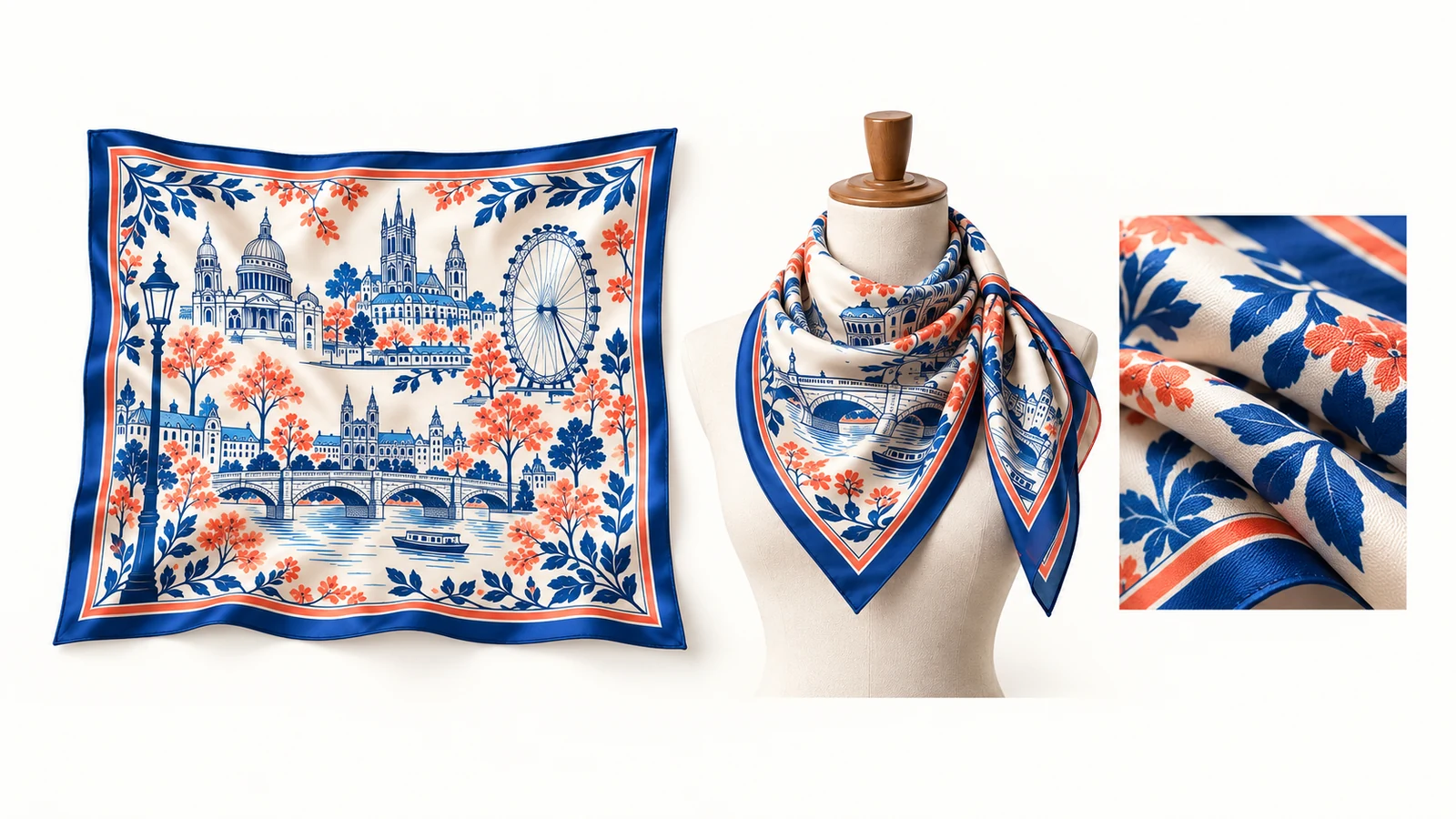
For your own printed scarves, compare Art of Where, Contrado, Qikink and Schalfabrik by fabric, size and branding. For ready-made winter styles, investigate a stocked supplier listing such as Ellison+Young through Doba. A pure-silk square, a silk-modal blend and a knitted winter scarf are different products, even when all are sold as scarves.
A square scarf can look wonderful laid flat and hide most of its design when folded around a neck. A shiny fabric can look like silk in a photograph without being made from silk. Those two details can make the product page attractive but inaccurate.
This guide uses official product information checked on October 10, 2026. It includes proposed design and sample checks; we have not tested the providers’ scarves.
01
Decide how the customer will wear it
Pick one primary use before choosing a catalog item.
| Intended use | What matters first | What to show |
|---|---|---|
| Neck square | Dimensions, foldability and skin feel | Open and folded views |
| Hair wrap | Size, grip and coverage for the intended style | A realistic tied view |
| Bag accessory | Narrow visible area and an appropriate length | The design on the tied portion |
| Long fashion scarf | Drape, width and hanging length | A worn view showing both ends |
An ornamental satin square is not automatically a warm winter scarf. Do not infer warmth from shine, or suitability for every hairstyle from one styling photograph.
For a hypothetical city-map design, choose whether the scarf is mainly wall-like artwork when opened or an accessory worn folded. That decision changes where the important part of the map belongs.
The wider print-on-demand guide explains the order model. Here, the product and its visible design are the main decisions.
02
Choose a scarf route by fabric and branding
Start with the product you want to sell, then compare offers for the same wearing use and destination.
| Route | Published product or capability | A useful starting use |
|---|---|---|
| Art of Where | 100%-silk habotai or a separate 15%-silk/85%-modal blend | Original illustrated squares where the specified fabric is part of the offer |
| Contrado | Different custom-scarf fabrics, with brand-label and packaging options | A branded accessory whose chosen material and finish support its price |
| Qikink | All-over-print poly-woven satin | An original pattern where polyester satin meets the buyer’s brief |
| Schalfabrik | Individually fulfilled custom-scarf service | A custom-scarf project requiring an agreed fabric and destination quote |
| Ellison+Young through Doba | A stocked knitted scarf with an existing design | A ready-made winter range, subject to channel and destination restrictions |
Art of Where’s pure-silk habotai and its silk-modal blend give you a real material choice. The habotai’s “8 mm” designation refers to silk fabric weight, not an eight-millimeter-thick scarf. Use the stated composition when writing the listing.
Contrado documents custom-label and packaging options. If your brand label is essential, obtain that selected fabric’s configured quote; printing artwork alone does not include every branding service. Its material choices should not all be called silk.
Qikink’s poly-woven satin is a different textile from pure silk. Compare it for a pattern-led product where that composition is acceptable. Schalfabrik describes individual fulfillment, but worldwide service is not a single worldwide price.
A stocked winter scarf comes with different limits
Doba’s Checked On Happiness Cozy Scarf, item D0102HG3NCA, is an Ellison+Young design. The listing specifies approximately 13 × 80 inches, 42% acrylic/28% nylon/30% polyester and dry cleaning. It is made in China but offered from US stock for the US and Puerto Rico.
Its listing prohibits sale on Amazon, SHEIN, Temu, AliExpress, eBay, Wish and Walmart. Price and detailed stock require login. That can rule it out before you spend time building a listing for one of those marketplaces. It also demonstrates why a stocked US parcel and the product’s manufacturing country are separate facts.
For original silk artwork, compare Art of Where’s two fabrics first. For a label-led accessory, price Contrado’s actual label option. For a winter assortment without original artwork, investigate the stocked knit—if its composition, care requirements and permitted channel fit. These are selection reasons, not a tested quality ranking.
03
Read the fiber composition behind the word silk
Silk names a fiber. Satin describes a fabric construction. A satin surface can be made with different fibers, so shine alone cannot tell you the composition.

Art of Where’s selected scarf specifies 15% silk and 85% beechwood modal. Qikink describes its product as poly-woven satin. Neither should become “100% silk” in your store description.
A clear listing says what the chosen product actually contains. “Silk-modal blend” is more accurate for that blend than an unqualified silk claim. Use the exact label and current supplier specification for percentages and care information.
If a supplier says only “silky,” ask for the composition. That adjective can describe feel without specifying a material.
Also separate the fabric from other claims. Packaging materials, manufacturing location and a fiber’s origin answer different questions. Do not combine them into a broad sustainability promise without supporting information.
04
Design the scarf after folding it
The buyer often sees a narrow section of the print. A large central logo may disappear inside a fold.
Here is a hypothetical layout exercise:
- Draw a 90 cm square layout, using the template for the product you actually select.
- Mark the design that matters most: a name, border or motif.
- Simulate the intended fold, leaving an approximately 8 cm visible strip in this example.
- Check which artwork remains visible and how it looks when tied.
The 90 cm and 8 cm figures illustrate the exercise; they are not specifications for every supplier’s scarf.
For the city-map example, a border of small landmarks can remain visible around the neck while the full map appears when the scarf is opened. Important text placed only at the center may be hidden.

Art of Where describes moderate print-through on the reverse. That does not mean both sides have identical color intensity. Inspect the reverse on the sample before advertising a matching two-sided result.
Try a paper layout first to catch obvious placement problems, then inspect the fabric sample. Paper will not establish drape, translucency or the way a real knot sits.
05
Check the hem and drape on a sample
Order the exact size, fabric and artwork version you want to sell. A sample of another fabric cannot establish this scarf’s feel or finish.
Use the following as a proposed inspection:
| Part of the scarf | What to inspect | Why the buyer notices |
|---|---|---|
| Hem and corners | Curling, uneven stitching or loose threads | The edge is often visible when tied |
| Open surface | Print clarity, joins and visible marks | Large artwork needs a clean overall result |
| Reverse | Color difference and transparency | The back can show around a knot |
| Worn fabric | Drape, feel and behavior when tied | A flat mockup cannot show the wearing experience |
Follow the care label for any wash check. Photograph the sample before and after under similar lighting, and record actual observations rather than saying it passed an unspecified durability test.
If the hem curls enough to hide the border, inspect the finish and design together. Moving the border inward may help the artwork, but it does not fix a faulty hem.
Keep an approved reference photo and file version. Our sample approval guide explains how to document that decision.
06
Compare the dropship price for the size you sell
Art of Where’s pure-silk habotai page provides a public USD baseline. Use the dropship column for an individual-order comparison. Wholesale pricing has different conditions, including at least six of the same design and size.
| Selected habotai size | Published dropship price |
|---|---|
| 16 × 16 inches | $16.80 |
| 26 × 26 inches | $26.25 |
| 36 × 36 inches | $39.90 |
Those are product prices, not delivered quotes. The page’s size summary and table also differ, so confirm the selected variant’s availability before publishing it. We are not combining both into a supposedly complete size list.
For a $35 selling price, the small square gives this mixed-source planning example:
| Component | USD amount |
|---|---|
| Customer pays | $35.00 |
| Published 16 × 16 product base | −$16.80 |
| Hypothetical shipping | −$6.00 |
| Hypothetical payment fee | −$1.50 |
| Hypothetical remedy allowance | −$2.50 |
| Left before advertising and overhead | $8.20 |
Only the $16.80 product base is the public provider price here. Replace the other inputs with your destination and business costs. A $1 sleeve plus $2 more freight would leave $5.20 under these assumptions, if the selected provider offers that packing.
The 36 × 36-inch product base is already above a $35 retail price before delivery. You would need a different selling price or a different product. This is why copying a price from a small polyester scarf can produce a loss on a large silk one.
Qikink’s page showed conflicting price references during review, so do not use its headline as a confirmed payable quote. For a gift offer, include the actual packing and delivery arrangement; an attractive fabric does not establish recipient-facing paperwork or arrival before an occasion.
07
Show the buyer the scarf they will receive
Use a short opening that names the material, size and intended use. Put the detail buyers need beside the pictures instead of burying it beneath a long fashion story.
After approving the sample, build a small photo set:
- The scarf opened, showing the overall pattern.
- The intended fold or tie, showing visible artwork.
- The reverse, when its appearance differs.
- A close view of the hem and corners.
An educational illustration can explain folding or composition. It should not be presented as an actual photograph of a supplier’s product.
Give buyers the composition, confirmed dimensions, care instructions, dispatch origin and applicable delivery and remedy information. If the scarf is made after purchase, say so clearly.
Then run one paid store order to check artwork version, variant, supplier bill and buyer tracking. A correct mockup does not establish that the correct production file was used.
08
Scarf questions
Can I dropship a scarf without a large stock purchase?
Individual on-demand or dropshipping offers can support that route for eligible products. Confirm the exact product and destination. A custom manufacturing quote can have different minimum quantities.
Is satin always silk?
No. Satin describes construction, while silk describes fiber. Read the exact composition instead of judging from shine or the word “silky.”
Will the print look the same on the reverse?
Only if the selected product’s process supports that result. Print-through can give a lighter reverse. Check the specification and sample before promising identical sides.
Can I add a label and gift packaging?
Ask about those services individually, including cost and how they appear on a sample. Printed artwork does not automatically include your label or branded parcel.
What if I need a different fabric or a stocked branded range?
Prepare the composition, dimensions, finish and packing brief, then compare a sourced run with on-demand production. AIDrop Agent can review that China-side supplier and sample scope. Send your specification and expected order volume for a practical comparison.

Clothing Dropshipping: Sizes, Variants, Samples and Returns
Verify apparel sizes, variants, samples, labels and returns before launch. Build a clothing dropshipping offer around accurate
Clothing Dropshipping Suppliers: 5 Options for Different Stores
Compare Trendsi, Printful, Printify, Apliiq and BrandsGateway by clothing model, fit information, stock, shipping and return costs.
Shoe Dropshipping: Sizing Evidence, Variants and Return Exposure
A shoe listing needs model-specific fit evidence, exact size-color stock and a workable exchange route. Compare one
