
Start with a free resource such as Shopify’s Dropshipping University for individual topics or Davie Fogarty’s long-form tutorial for a start-to-finish walkthrough, then complete one small product-and-order exercise. Buy another course only for a skill you still cannot perform and feedback you can inspect. A finished playlist does not prove you can fulfill or refund an order.
If you are new, your first goal is not to find a “secret winning product.” It is to understand the path from a product promise to a supplier purchase, parcel, customer message and cost record. A useful course helps you produce those outputs. A poor one leaves you with a beautiful store and no answer when a buyer asks where the parcel is.
Explore the broader topic: Dropshipping for Beginners: Learn the Model and Test Your First Order.
01
Decide what you need to learn before choosing a teacher
The Shopify guide to dropshipping courses, checked October 7, 2026 lists free and paid resources, but its most useful distinction is audience. A beginner course should cover the model, product choice, suppliers, store setup, pricing, fulfillment and marketing. A seller with real orders may need a narrower lesson on ads, inventory sync or customer service.
Choose the specific lesson you need
Write one sentence about your current bottleneck. “I do not understand dropshipping” is too broad. “I can find a product but cannot calculate delivered cost to a US buyer” gives you a course test. The right next lesson is the one that lets you produce a cost sheet, not the one with the most dramatic testimonial.
Your current stage: No product selected
Useful learning output: One customer problem and two candidate products with source evidence
Course promise to question: “Every trending item will sell”
Your current stage: Product selected
Useful learning output: Approved sample, supplier quote and return condition
Course promise to question: “No supplier checks needed”
Your current stage: Store ready
Useful learning output: A paid test order, tracking and refund route
Course promise to question: “Launch in an hour and automate the rest”
Your current stage: Traffic running
Useful learning output: A cost per new customer and first-order contribution
Course promise to question: “A fixed ROAS proves profit”
These are not hoops for a certificate. Each output catches a failure that a video cannot catch on your behalf.
02
Use free material to build a first working order
The Shopify course guide, updated September 28, 2026, describes two useful free formats:
- Shopify’s Dropshipping University: a collection of shorter videos. Start here if you need to learn one topic, then return to your store and apply it.
- Davie Fogarty’s 11-hour tutorial: a long-form walkthrough covering product research, store setup, marketing and profit tracking. It suits someone who prefers seeing the whole sequence, but pause to do the work rather than watching it as a marathon.
Those are published course descriptions, not evidence that we completed them or that either guarantees sales. The current Shopify dropshipping help also describes the order and fulfillment mechanics. These are useful references because the steps can be checked against the platform you will actually use. Free does not guarantee complete or neutral advice, but it gives you a baseline before you spend on coaching.
Try a five-part practice sequence. It need not take five calendar weeks, and you should stop at a failed gate rather than rush to the next module:
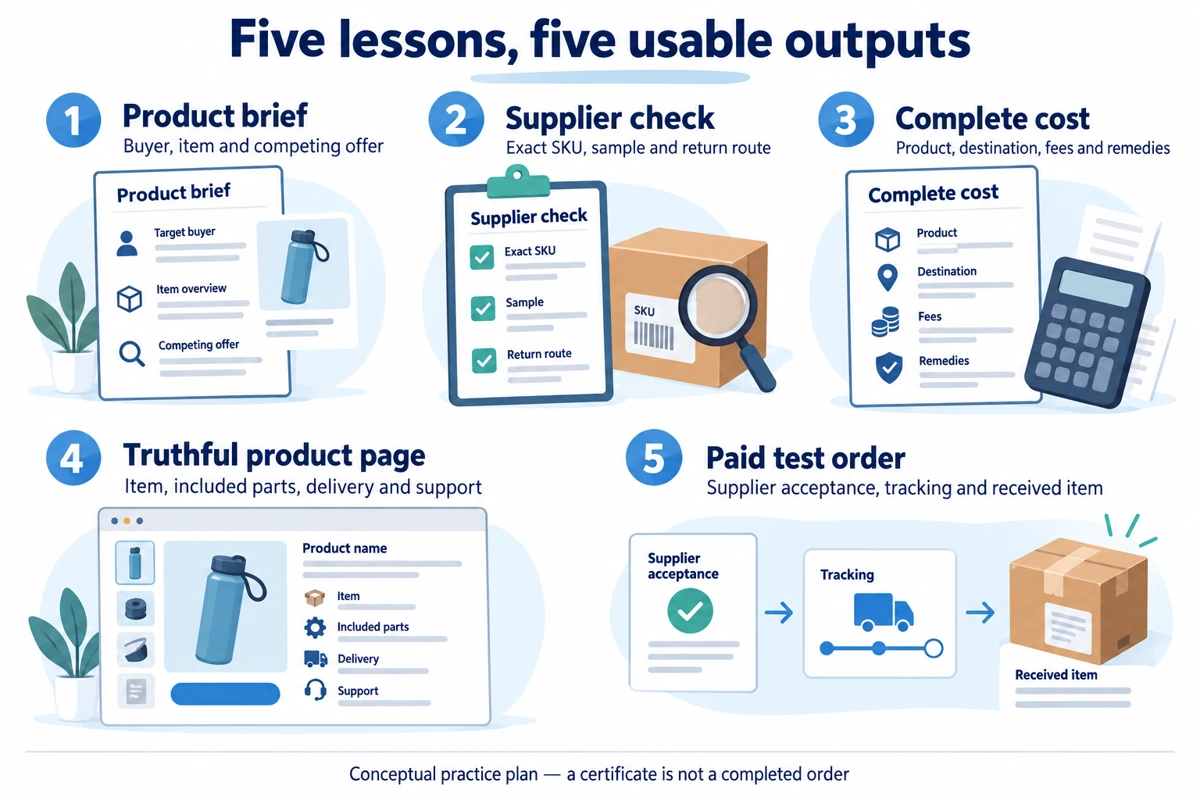
Define the buyer and item.
Write who needs the product, what they compare and why your offer might be better. Use the product-validation guide to test demand without pretending a trend score is a purchase.
Verify a supplier.
Ask for the exact SKU, sample, production or stock location, destinations, fulfillment time and return process. The supplier guide shows why a marketplace listing is only a starting point.
Build the cost row.
Add product, shipping, payment, selling-channel charges and an allowance for returns before an ad budget. Compare this with a price a customer might actually accept.
Build a truthful page.
Show the exact item, included parts, delivery range and buyer support route. Do not borrow product images without permission or show an untested feature.
Place a paid test order.
Confirm supplier acceptance, tracking movement, delivered item and who handles a wrong or damaged product. Save the order record and revise the listing.
By the end, you have a small operation to improve. If you only have notes from 40 hours of video, the course has not yet changed your ability to serve a buyer.
Check whether the lesson changes a real decision
Imagine a lamp priced at $35 with a $12 supplier cost. Calling the $23 difference “profit” leaves out the costs a beginner needs to understand.
- With $9 shipping, $2 fees and a $2 expected remedy allowance, $10 remains before acquiring a customer and paying overhead.
- A 10% discount reduces collected revenue to $31.50. With the exercise’s costs unchanged, $6.50 remains.
- Spending $7 to acquire that discounted order would already exceed its contribution. The useful lesson is to change the price, costs or campaign before scaling it.
All amounts are hypothetical. Actual fees can change with revenue, and the $2 allowance does not mean a replacement costs only $2. A worthwhile assignment saves the inputs and explains the decision they produce. The startup-cost guide covers other cash needs.
03
When is a paid course worth buying?
A paid course can save time if it shows a specific skill at a level free material does not. It may provide reviewed assignments, access to the instructor or a well-maintained implementation library. None of those is valuable just because the sales page says “mentorship.” Ask what feedback you receive, who gives it, how quickly and on which real artifact.

Compare free orientation with the paid syllabus
For a concrete comparison, Shopify’s free Dropshipping University covers broad setup and operating topics. A paid option such as Tim Sharp’s Udemy course offers a structured video syllabus and lists mentoring and income-oriented outcomes on its sales page. Those are course claims, not an earnings forecast for you.
Look for a decision, not only installation
Preview a lesson and inspect the assignment: does it make you calculate delivered product cost and handle a failed order, or does it mostly show app installation and revenue screenshots? Check the current price at checkout because discounts change.
You might choose the free broad course for orientation and a paid specialist session for a bottleneck, such as reviewing your actual ads or product page. You might decide the free course plus a sample order is enough. The choice follows your missing output, not a league table of instructors.
Before paying, inspect the dated syllabus, a sample lesson and the promised feedback. Look for current platform screens and a complete cost sheet, then ask how the lesson handles a stockout, lost parcel or refund.
An instructor’s successful store is not your expected result. Treat income promises or “secret hacks” as claims to investigate, and compare the actual assignment and written purchase terms.
Use a small purchase test:
Name the blocked task
Name the missing output, such as a workable product-page brief or campaign cost sheet.
Inspect the lesson and assignment
Find the exact lesson and assignment that will produce it.
Compare the full learning cost
Compare the fee with the likely cost of learning that skill through a limited experiment, a free current guide or a specialist.
Read the purchase and renewal terms
Read refund and renewal conditions before entering payment details.
Pay for the review that unblocks the task
For a seller struggling with customer returns, a broad beginner course may repeat information they know. One focused workshop with a real refund-policy review might be more useful. For a complete novice, a high-priced ad course may arrive before they can identify a reliable supplier.
04
Check what has aged out
Platform interfaces and policies move. Old screenshots can still teach a principle, but a lesson should tell you which current help page controls the actual step. If a course instructs you to enable an integration that no longer exists or to use a marketplace sourcing method a platform prohibits, do not follow it because the instructor once earned sales.
Save the setting and the observed result
Keep the principle, its current platform control and your observed result together. For stock, the principle is simple: do not sell a unit you cannot supply. Check the actual inventory settings and supplier availability, then use a permitted stock-change exercise to see whether the offer stops accepting unavailable units.
Save the account setting and the observed checkout result. If the lesson uses an old screen, follow the current official help page for that step. A good explanation can survive a menu change; an old screenshot alone cannot verify your store.
Ask what the earnings figure excludes
Be equally cautious with earnings evidence. A screenshot of $100,000 in sales does not show ad spend, product cost, returns or the person-hours behind the result. If a course claims a student outcome, ask how the outcome was measured and whether it is typical; if not available, treat it as a story, not an expected return on tuition.
05
Give a course a real assignment before buying more lessons
Take one claim from a course and ask what would prove you can use it. If the lesson is “find a winning product,” the assignment is not a spreadsheet of ten trending items. It is a one-page product brief: buyer problem, competing offer, supplier SKU, sample result, delivered cost and the reason a buyer might choose your version. If you cannot produce it after the lesson, identify which input the instructor skipped.
For a pricing lesson, use the $35 lamp example above and try three destinations. Request an actual freight quote for each. Add a discount and a damaged-unit replacement to one scenario. Can the course explain why the product is viable in one location and not another? If it only shows a markup multiplier, it has not taught the pricing decision.
Keep the incomplete address test held
For an order-automation lesson, prepare your own held test record with an incomplete apartment number. Keep the supplier purchase paused. Inspect where the address becomes incomplete, correct it, then compare the saved store and supplier records before approving payment or dispatch.
If the supplier already accepted the order, check that purchase before creating another. Some integrations may not hold an incomplete address automatically. A safe assignment must reveal that behavior without deliberately shipping a parcel to a known-bad address.
Save these small artifacts in one folder. They become a record of what you learned and a baseline for improving the store. A completion badge is pleasant; a documented test order is operational evidence.
What a useful assignment record looks like
For the address exercise, a short proposed record can be more useful than another hour of video.
Input and failure
Record the exact SKU, own test-order ID and the missing apartment field. Save the relevant lesson/help-page date and the screen showing where the value was lost. Do not use a real buyer’s incomplete order as a practice shipment.
Correction and acceptance
Save the corrected address at both ends, one supplier order and the confirmed payment state. Pass the data step only when those match. The physical-order assignment still needs the carrier event and delivered-item check; a saved correction does not prove delivery.
Keep failure and correction evidence so you can repeat the exercise after an app change. No test order was placed for this article.
Compare feedback, not only video hours
Inspect the feedback you actually receive
Two courses can both contain ten hours of video. One might give you a dated sample cost sheet, a critique of your product page and a chance to ask about a supplier exception. The other may show an edited success story.
Ask who reviews the assignment and when
Check what “community” or “mentorship” actually includes: number of reviews, scope of questions, response time and whether the feedback comes from a person who can inspect your work. If feedback is unlimited in the sales copy, read the written terms.
Finish one exercise before buying another
Do not buy several overlapping beginner courses. Finish one small product/order exercise, then pay only for a missing skill that blocks the next step. If the missing skill is product safety or tax treatment, a general marketing mentor may be the wrong expert regardless of popularity.
06
Keep the learning budget separate from the order budget
Your first few hundred dollars might go to a course, samples, domain and store fees, shipping tests, or a limited customer-acquisition experiment. They do not all buy the same kind of knowledge. A sample can tell you whether the item matches the listing. A paid order can reveal the supplier handoff. A course can teach you how to interpret those observations but cannot produce them without your store.
Separate lessons from product testing
Set a ceiling for instruction and a separate ceiling for product tests. Before each purchase, ask: “Which unanswered decision will this expense resolve?” If you cannot name it, wait. If a paid course really saves five weeks of avoidable errors, the value should appear in the quality of your output, not in a claim that every student earns money.
Check the recommended app yourself
Remember that free lessons can also have affiliate links. A recommended app may be useful, but compare its fees, permissions and alternatives yourself. The instructor’s commission is not evidence that the app is the right fulfillment route for your product.
07
Turn learning into one safe launch decision
Show the offer and test record to another reader
Before launching a store, show a friend or colleague one product page and a test-order record. Can they tell what arrives, when it should ship, what the full cost is and who helps if it is wrong? If not, identify the unanswered question and learn that specific skill next.
You do not need to master every channel before one controlled sale. You do need enough to avoid sending a buyer into an untested supplier workflow. Use the order-release checklist when your first paid order appears.
Get the sourcing assumption checked
AIDrop Agent can help examine the China-side sourcing, quality, packaging and fulfillment part of a planned product. If you have a SKU, destination and the course’s proposed supplier route, share those through the review form. We can discuss an operating path; we cannot make a course’s income claim true.
08
Frequently asked questions
What is the best dropshipping course for a beginner?
There is no universal winner. Begin with current free material, then judge it by whether you can produce a product brief, full cost row and paid test-order record. Buy a course for a specific missing skill and useful feedback.
Do I need a course to start dropshipping?
No paid course is required to understand the model or test one order. You still need to learn supplier, store, cost, delivery and customer-service tasks from reliable current sources and actual tests.
How do I know a course is outdated?
Check its last substantive update, sample platform screens and policy links. An old principle may remain valid, but current account settings, fees and marketplace permissions need fresh verification.
What Is Dropshipping? How to Build and Run the Business
Learn how dropshipping works, earns money and handles risk, from product research and supplier checks to shipping,
How to Start a Dropshipping Business: From Offer to First Delivery
Start a dropshipping business with a clear offer, verified supplier, workable pricing, tested checkout, and a plan
Dropshipping for Beginners: Learn the Model and Test Your First Order
Learn dropshipping basics, choose a focused offer, budget for supplier payments and rehearse checkout, shipping and support
