
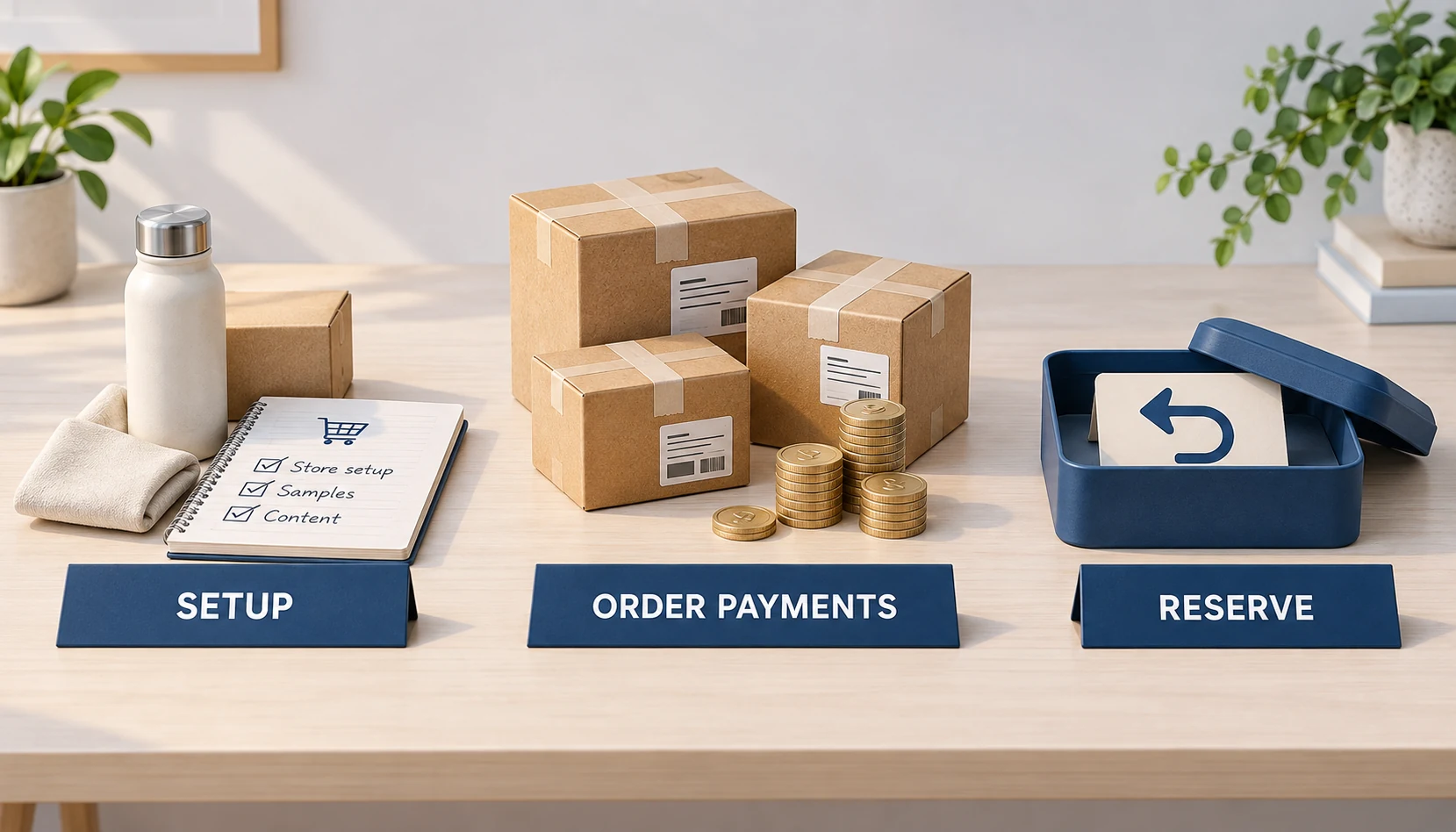
You can test a small, self-built dropshipping store with several hundred dollars. A launch that buys traffic, commissions content and funds more customer orders can need several thousand. The difference is what that money must pay for: setting up the store, testing the offer and keeping orders moving before customer payments reach your bank.
The examples below require $650 for a lean first-month test and $2,300 for a larger paid test, before location-specific registration, compliance and insurance costs. These are deliberately specified budgets, not market averages, supplier quotations or promises that either amount will produce a profitable business. Replace the assumptions with your own quotes before spending.
01
Decide what your launch budget must cover
A domain and a subscription can get a storefront online. They cannot pay for an order, replace a damaged parcel or tell you whether a product earns enough to support advertising. Work out the cash required through your first review date, rather than asking only what the website costs today.
Separate the budget into three parts:
- Money you expect to spend: samples, setup, subscriptions, content and an agreed test budget.
- Money temporarily tied up: supplier payments made before customer proceeds become available. This is working capital, often called fulfillment float.
- Money held for trouble: refunds, a second shipment, a delayed payout or an invoice larger than expected.
The second and third parts belong in your starting cash requirement even though they are not automatically expenses. An unused $200 reserve still belongs to the business. Treating it as a cost when calculating profit would understate profit; spending it on ads because it is “unused” could leave the next order unfunded.
Choose the scope before assigning amounts. One lightweight product, one destination and content you make yourself create a different launch from apparel in six sizes, several countries and commissioned videos. Narrowing the offer reduces the number of samples, delivery quotes, product pages and return arrangements you need to get right.
02
Build a lean budget and a paid-test budget
Here are two illustrative 30-day plans in USD. Both assume an existing computer and phone, a self-built store, no bulk inventory purchase and no salary paid to the owner. The platform allowance uses $39 monthly; the other amounts are planning choices. Neither assumes promotional discounts or sales proceeds will arrive in time to fund launch spending.
| First-month allocation | Lean, owner-made content | Paid test with commissioned content |
|---|---|---|
| Store subscription | $39 | $39 |
| Domain, paid for the year | $20 | $20 |
| Samples including delivery | $90 | $180 |
| Optional apps | $0 | $30 |
| Content production cash | $25 | $250 |
| Advertising test ceiling | $0 | $750 |
| Other setup allowance | $26 | $31 |
| Planned spending subtotal | $200 | $1,300 |
| Supplier-payment float | $300 | $700 |
| Additional contingency cash | $150 | $300 |
| Starting cash for this plan | $650 | $2,300 |
The lean plan spends $200 before counting the cost of fulfilling customer orders. It keeps $450 available to pay suppliers and absorb problems. Its marketing work falls mainly on the owner: product demonstrations, useful posts, outreach and page improvements. Zero ad spend does not imply zero effort or a predictable date for the first sale.
The paid plan can buy a limited amount of creative and traffic. It cannot promise a conclusive test across ten products. A $750 ad ceiling allows, for example, up to $50 a day for 15 days, but that is a spending limit, not an instruction to keep a poor campaign running for two weeks.
Local registration, professional advice, product testing, permits and insurance are additional amounts to establish, not assumed to be free. Add them above the starting-cash total when they apply. Also add personal living expenses separately if the business must support you during the test.
If you already own the domain, remove that payment. If your supplier requires a $1,000 prepaid balance, substitute it for the float where it serves the same purpose; do not add both without checking what each pays for. A refundable deposit affects cash even when it is not an immediate operating expense.
03
Price the store and software after promotions end
The Shopify US pricing page, checked September 19, 2026, lists Basic at $39 when paid monthly or $29 per month when paid yearly. The yearly equivalent is $348 for twelve months before relevant taxes and extras. A displayed monthly equivalent should not be entered as a one-month cash payment when the plan bills annually.
Promotions can lower early spending. Keep the normal renewal amount in the budget as well: otherwise the store can appear affordable for its trial period and become cash-tight just as you begin learning from customers. Hosting is included in a standard Shopify plan, so do not add a separate web-hosting subscription for that setup.
For a self-hosted store, build the corresponding total from hosting, domain, backups, security, paid extensions and any maintenance help. Free store software does not make those services free. For a marketplace-only launch, website expenses may shrink while selling fees, category rules and account-specific obligations become more important.
Create a short subscription list with the monthly price, renewal date and reason for each tool. “Imports orders reliably” is a useful reason. “Might improve conversion” is not enough to buy three overlapping apps before the store receives traffic.
A practical starting stack needs to accept payment, communicate accurate orders to the supplier, show delivery information and let you understand basic traffic and sales. Add specialist research, attribution or retention software when the task and expected use justify the bill. Check usage charges as well as the advertised base plan.
04
Buy enough product evidence before buying traffic
Samples help answer whether you can honestly make the offer on the page. Include delivery, import costs where applicable and any second sample needed to verify a change. A free sample with expensive express delivery still consumes cash.
For one product, an initial sample can support a physical inspection and original photos. A second shipment through the proposed customer route can reveal packaging, tracking and delivery issues that an express sample bypassed. Neither sample proves that every future unit will pass or that the same delivery time will repeat.
Spend according to the uncertainty. If fit is the likely source of apparel returns, inspecting a single size may not resolve it. If the product requires safety documentation, a good-looking sample does not replace that evidence. Products with expensive testing or specialist compliance needs can exceed a small launch budget before the first ad runs.
Ask for the correct variation, contents and packing arrangement. Photograph what arrives and record defects against what you intend to promise. If the supplier proposes a different material or accessory, decide whether the revised product still suits the customer before accepting a cheaper quote.
Those samples can also reduce content spending. A clear demonstration made with a phone may answer a buyer’s question better than a polished generic video. Commission work when you need a skill, location or demonstrator you cannot supply, and agree usage rights and deliverables before paying.
05
Calculate the cost of fulfilling one order
Get the supplier’s total for the packed product going to the actual destination. The quote should distinguish the item, pick-and-pack work, packaging, delivery and any import or handling charges. Confirm whether a line is already included before adding it again.
For a dropshipped item held in the supplier’s normal stock, a separate storage invoice may not exist. If you pre-buy products or packaging, receiving, storage, minimum monthly charges and disposal can become relevant. Use the proposed arrangement, not a warehouse fee copied from another business model.
Consider this hypothetical $40 order, excluding any tax collected for a tax authority:
| Order input | Assumption |
|---|---|
| Customer revenue after discount | $40.00 |
| Product | $11.00 |
| Packing and handling | $1.00 |
| Delivery | $6.00 |
| Payment processing | $1.50 |
| Expected refund/replacement impact | $2.00 |
| Amount available before marketing and fixed overhead | $18.50 |
The $1.50 processing charge and $2 loss allowance are example inputs, not published platform rates. Your processor may charge different rates by card, payment method, country and currency. Your loss allowance needs to reflect the net effect of refunds, returned goods and supplier recoveries, not simply the full retail value of every return plus the same product cost again.
At a $12 acquisition cost, this order leaves $6.50 toward subscriptions, owner pay and profit before tax. A $4 increase in delivery cost reduces that amount to $2.50. That is why a supplier’s low item price is only one part of the decision. Our supplier quote comparison guide explains how to compare the same item, package and destination across quotations.
06
Keep supplier money available while payouts are pending
Your customer can pay today while the supplier also requires payment today. The customer’s payment confirmation does not mean the money is already available in your bank.
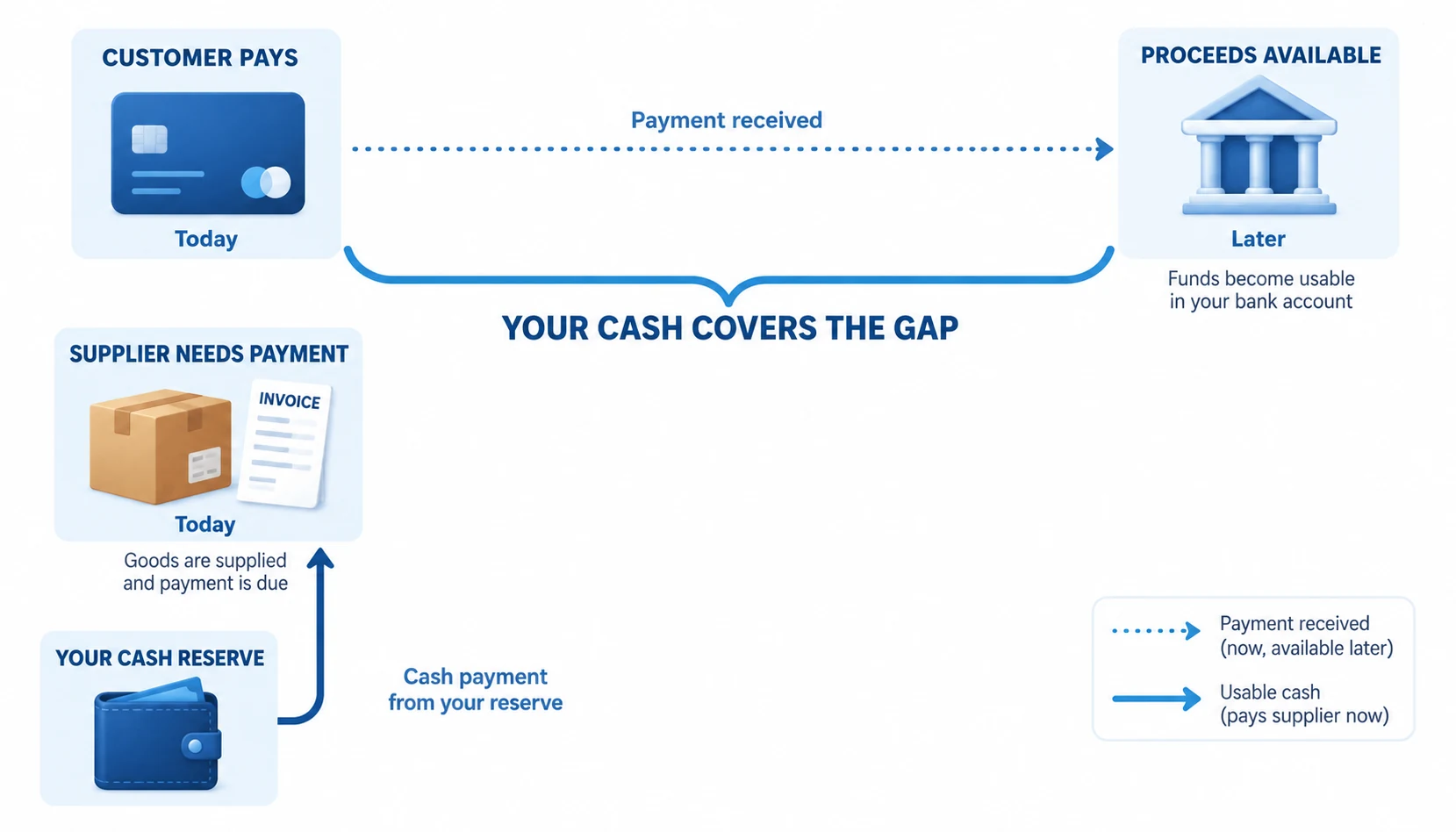
Shopify’s payout guidance distinguishes settlement, payout schedules and bank processing. Timing varies by country, risk and payment type; reviews or reserves can delay access further. Use your own account’s schedule and a slower case in the budget.
A starting estimate for supplier float is:
Orders per day × cash paid to the supplier per order × days before usable proceeds arrive.
Suppose you receive three orders a day, pay $18 per order for product, packing and delivery, and plan for seven calendar days before usable proceeds arrive. That requires 3 × $18 × 7 = $378 in supplier payments. If the gap stretches to fourteen days, it becomes $756. These are hypothetical gaps, not Shopify payout promises.
The $300 float in the lean plan would therefore be insufficient for that three-order daily pace over seven days. At two orders daily, the same assumptions require $252, leaving only $48 within that float. You would need to limit the pace or add funds rather than assume that more sales solve the shortage.
This simple calculation excludes ads, subscriptions, tax remittances and refunds during the gap. Add their due dates to a daily cash forecast. With a changing sales pace, list each day’s actual supplier payments and expected bank receipts; the lowest running balance tells you more than a monthly profit total. See dropshipping cash flow for the fuller operating model.
07
Put a ceiling on the first marketing test
Set the amount you can afford to lose after protecting order and refund funds. Then decide what the test is intended to answer: whether a particular customer wants the offer, whether the page communicates it well, or whether paid acquisition can fit within the margin.
Using the $40 example, $18.50 is the maximum acquisition cost before the order contributes nothing to fixed overhead or profit. If you want $8 left after advertising, the acquisition target becomes $10.50. Revenue divided by that target is about 3.81, but this simple ROAS comparison only works when the revenue and cost assumptions describe the same orders.
A campaign can miss that target for different reasons. Relevant clicks with few carts suggest investigating the offer and product page. Carts without completed purchases call for a checkout, shipping-charge and delivery-promise review. Purchases followed by cancellations or returns require product and fulfillment work, even if the ad dashboard looks good.
Avoid inventing a universal number of clicks or dollars that proves a product works. A small sample can be inconclusive. Decide beforehand what evidence would justify the next spend, and distinguish “the offer failed” from “the test was too small to tell.” The dropshipping marketing guide connects channel choice with the complete order result.
08
Budget for refunds, disputes and replacements
A refunded sale can leave advertising, outward shipping, handling and payment charges behind. For example, Shopify Payments says the original credit-card transaction fee is not returned when the customer is refunded. Check your actual provider rather than applying that rule to every payment service.
Map the outcomes before accepting orders. A damaged unit might lead to a replacement funded by the supplier, a replacement partly funded by you, or a refund with no recoverable product. A change-of-mind return might produce resellable stock but require a return label and inspection. Each outcome has a different cost and cash date.
Keep the customer remedy separate from recovering money from a supplier or carrier. A supplier’s slow credit approval does not pause the obligations you have to your customer. Also avoid refunding a disputed transaction a second time without checking its current status in the payment system.
There is no useful universal reserve percentage for every new product. Start with explicit adverse cases: one full refund, one replacement and a longer payout gap. Ask whether the business can meet those payments while fulfilling orders already accepted. Update the allowance as actual data arrives.
09
Add the costs that depend on your business and market
Registration, licenses, insurance and tax administration depend on where you operate, what you sell and where customers receive goods. Obtain actual local amounts; a zero in a generic spreadsheet is not evidence that a requirement does not apply.
Budget for product-specific documentation and testing before committing to a category. For cross-border orders, establish who handles import declarations and who pays duties, taxes and brokerage. A shipping quote described as DDP still needs a clear scope for the product and route; do not assume it resolves every seller obligation.
Treat sales tax or VAT collected for remittance as money owed onward, not available profit. Distinguish recoverable tax from a cost you must absorb, and include the date a payment is due in cash planning. Income tax, owner drawings and loan repayments also affect what you can take out of the business, even though they do not all belong in the same operating-cost line.
Record time as well as cash. If a month requires forty hours of filming, messages, order checks and bookkeeping, the store is using forty hours of labor even if you pay yourself nothing. This matters when comparing a “cheap” manual process with a tool or hired help later.
10
Spend in stages and know when to stop
First pay for the information needed to decide whether the product can be sold honestly and fulfilled reliably: samples, necessary documentation and a usable delivered quote. If that fails, you have avoided paying to send customers to an offer you cannot support.
Next finish the basic store, order handoff and customer policies. Test the payment and order flow through legitimate platform test tools where available. Only then release the planned content or advertising. Buying traffic before fixing a broken checkout consumes the test budget without answering the product question.
At the review date, compare actual cash spent, contribution from completed orders and remaining obligations. Include open returns and orders still in transit. Do not call the test profitable merely because the ad account reports more revenue than spend.
Pause expansion when the contribution remains negative at a credible selling price, the supplier cannot meet the delivery promise, or available funds cannot cover accepted orders and likely remedies. A lower subscription bill will not repair a product that loses money on every sale. Narrow the offer, renegotiate a real cost, change the fulfillment arrangement or stop that product.
For the broader relationship between order cost, pricing and risk, continue with the economics and risk resources. The useful startup budget is the one that lets you deliver the first orders and make a reasoned next decision.
11
Frequently asked questions
Can I start dropshipping with $100?
You may be able to research, build a basic trial store and buy a low-cost sample for $100. That amount may leave very little for supplier payments, refunds or a second attempt. Treat it as a tightly limited learning budget unless your complete cash calculation shows you can fulfill the orders you intend to accept.
Is $1,000 enough to start?
It can fund some narrow launches, particularly when you create content and build the store yourself. It does not fund every product or acquisition strategy. Subtract necessary setup and local obligations, calculate supplier float, keep contingency cash, and see what remains for marketing before deciding.
Do I have to buy inventory first?
Many supplier-direct arrangements let you pay per customer order instead of buying a bulk lot. You still need money to pay those orders. Custom packaging, reserved stock, marketplace-specific arrangements or a move to stocked fulfillment can introduce advance commitments.
Which costs can usually wait?
Premium themes, overlapping research tools, large packaging orders and expensive automation can often wait until a real requirement justifies them. Product evidence, accurate shipping costs, mandatory compliance and the ability to fund customer remedies should be resolved before selling.
How much should I keep after launching?
Keep enough to cover the peak expected payment gap, committed operating bills and plausible refunds or replacements. Recalculate as daily orders change. A reserve sized for two orders a day may become inadequate at ten, even when the store shows a positive margin.