
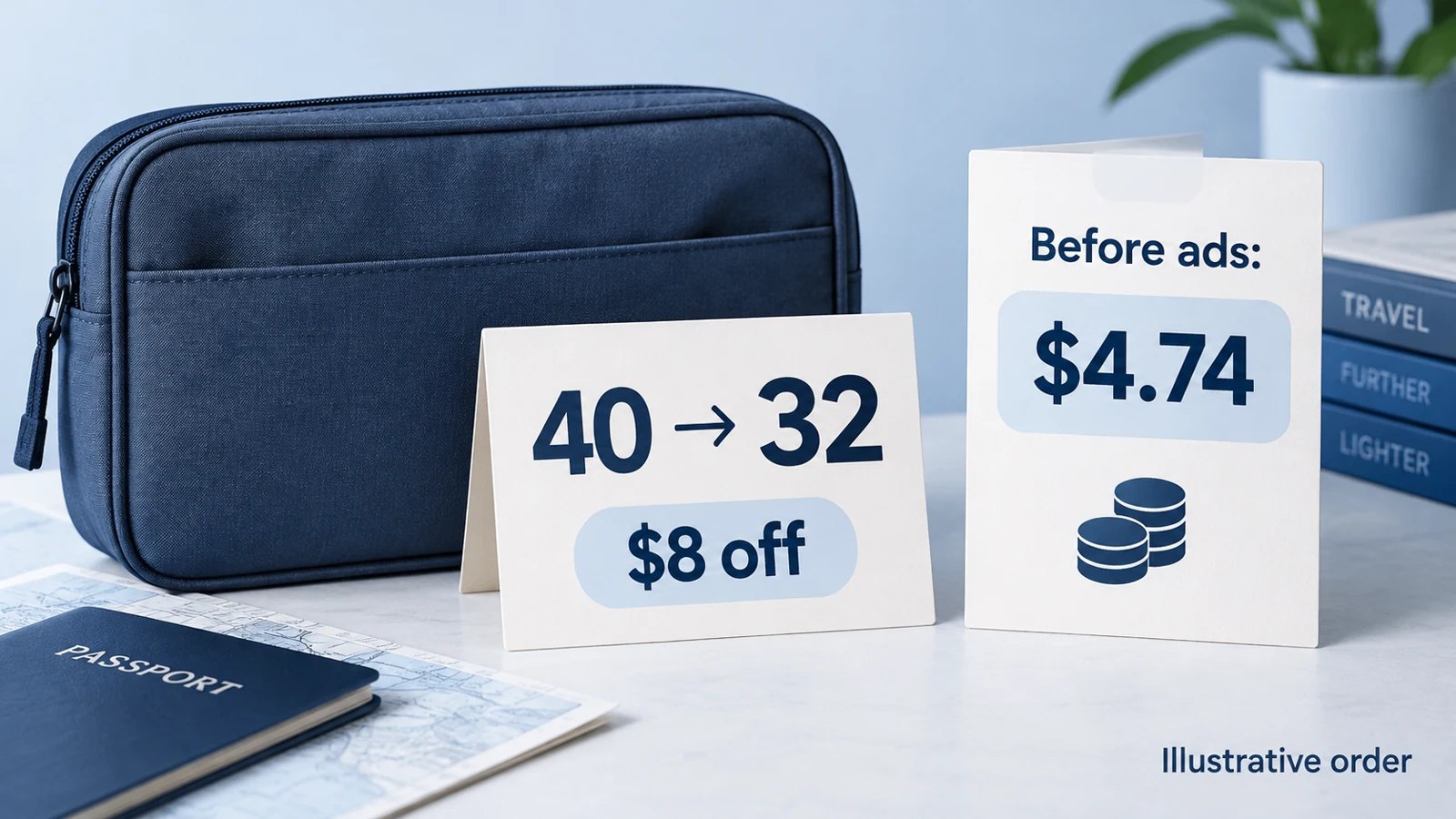
A workable Black Friday dropshipping sale starts with a useful product, a discount you can afford and enough capacity to send the orders. For 2026, Black Friday is November 27 and Cyber Monday is November 30.
Begin with one offer you can explain and test. Work through its price, shipping, supplier allocation and checkout before paying to bring shoppers to it. A larger discount does not repair an unsuitable product or an unworkable parcel.
This guide follows a travel-organizer promotion, including the effect of charging shipping separately. The wider marketing guide covers building demand beyond the holiday.
01
Start with a sale people can explain in one sentence
“20% off selected travel organizers with BLACK20” gives a shopper a product and a saving. The offer still needs eligible variants, an end time and delivery terms.
Use an item whose description, sample and supplier arrangement are settled. A last-minute replacement with another fabric or pack size can leave your advertisement selling something the supplier will not send.
Write the offer before designing the banner:
- Selected product and variants, with any exclusions.
- Code or automatic saving and any qualification.
- Start/end time in the store’s time zone.
- Destinations and shipping charge or free-delivery condition.
- Supported stock and dispatch information.
Keep the customer benefit visible too. For the organizer, show what it holds, how it closes and what comes in the pack. “Our biggest sale” provides less useful information than a product demonstration and a clear price.
If you prefer a bundle
A pouch-and-organizer set may be more attractive than a deep discount. First establish whether both pieces travel together. Two parcels can cost more and arrive on different days. The bundle guide explains that physical arrangement.
02
Check the money left after the discount
Use the amount the customer actually pays and the costs you actually incur. In particular, shipping charged to the buyer is revenue; shipping paid to the carrier is a cost. Leaving one out can change the decision.
For this worked example, assume an $18 product cost, $6 outbound shipping, a payment fee of 3% plus $0.30 and a $2 allowance for order problems. These are teaching figures, not provider rates or a recommended reserve.
| Pricing policy | Customer pays | Left before ads and overhead |
|---|---|---|
| Full price, delivery included | $40 | $12.50 |
| 20% off, delivery included | $32 | $4.74 |
| 20% off, plus $6 delivery | $38 | $10.56 |
The payment fees are $1.50, $1.26 and $1.44 respectively. With delivery included, the $8 discount removes $7.76 of the contribution. Charging $6 delivery preserves more of it, but the buyer then saves only $2 against the original delivered $40, despite the 20% product-price reduction.
Choose the shipping policy deliberately. The first discounted option gives the buyer the full delivered saving but leaves little advertising room. The second protects more contribution, while making the product saving and delivery charge especially important to communicate clearly.
The amount left is not a recommended advertising budget. Overhead and profit still need room. The profit-margin guide separates order contribution from final business profit.
03
Find out how many orders can actually leave
Ask about the exact variants available to your store and how the allocation is held. Then ask about picking, checking, printing or personalization, packing and carrier collection.
Those are different constraints. Forty allocated units do not establish forty next-day dispatches. If the agreed operation can dispatch fifteen parcels a day, the remaining orders form a queue even while goods remain on the shelf.
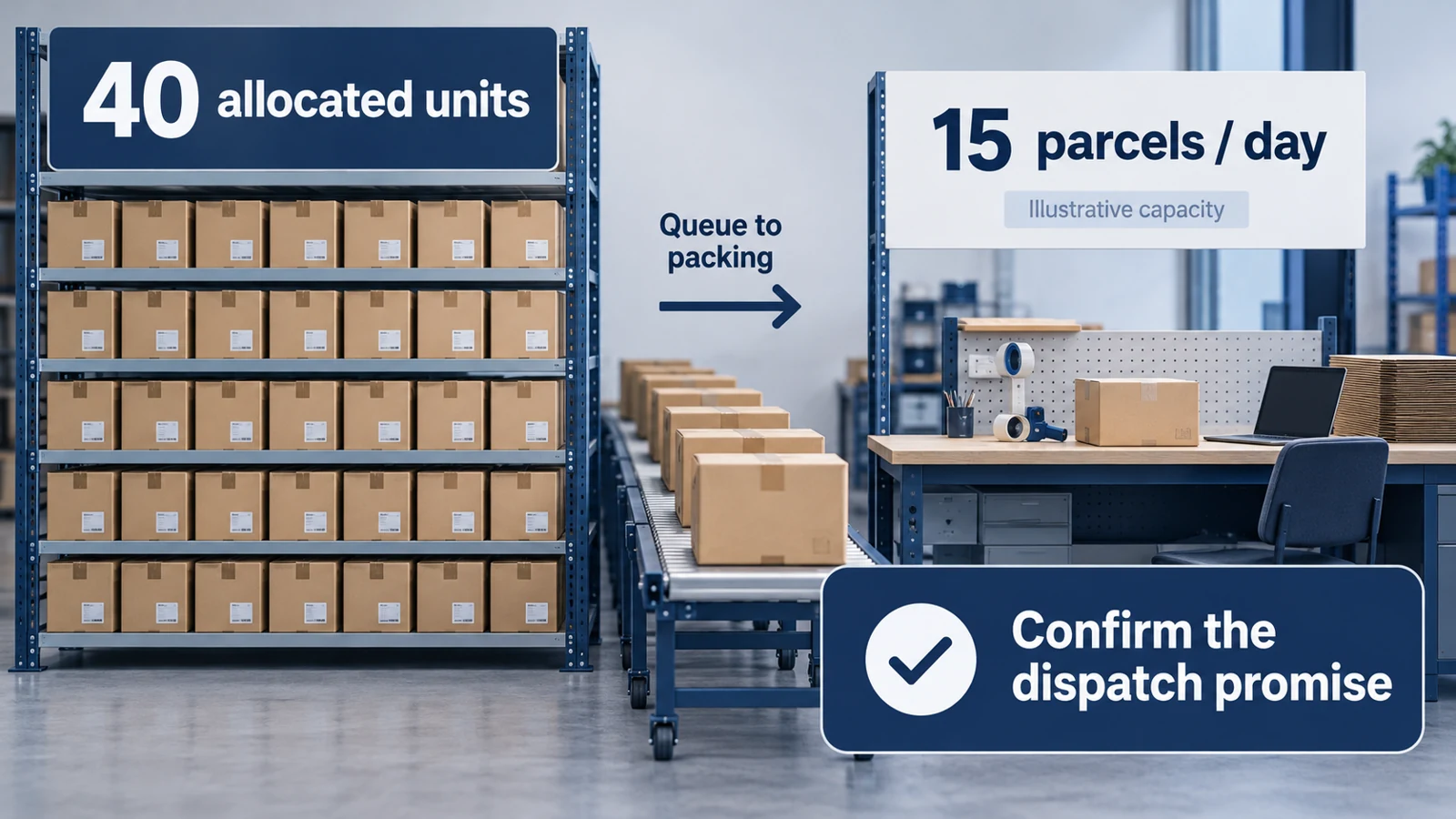
Obtain the cutoff, working days and response to a rejected order. For a custom product, include the artwork deadline and production stage. Keep the provider reply with the offer so a change in the product or route triggers a real decision.
If the supported volume is smaller than the audience you intend to reach, narrow the promotion or arrange more capacity before selling the larger promise. A stock counter alone will not manage a dispatch backlog.
04
Build BLACK20 and run the checkout cases
Shopify’s amount-off product instructions describe Discounts → Create discount → Amount off products. Select code or automatic method, set the reduction and choose eligible products. Review minimums, customer eligibility, limits and dates before saving.
For this proposed configuration, use BLACK20 on the selected $40 organizer and exclude a $10 add-on. Do not combine the code with other product or order discounts. Shopify’s combination guidance explains the relevant classes and settings.
Reopen the saved offer and compare it with your plan. Check the time zone; a midnight promotion in one country can begin at another local time for the buyer.
Test the chosen shipping policy, not the old assumption
Suppose you choose a shipping rate that is free from $35 of discounted merchandise and otherwise costs $6. This is the charged-shipping option in the earlier calculation. Tax, if applicable, is additional and excluded below.
| Proposed test | Merchandise | Delivery |
|---|---|---|
| Organizer + BLACK20 | $32 | $6 |
| Excluded add-on only | $10, no code saving | $6 |
| Organizer + add-on + BLACK20 | $32 + $10 = $42 | $0, if the actual rate uses that threshold |
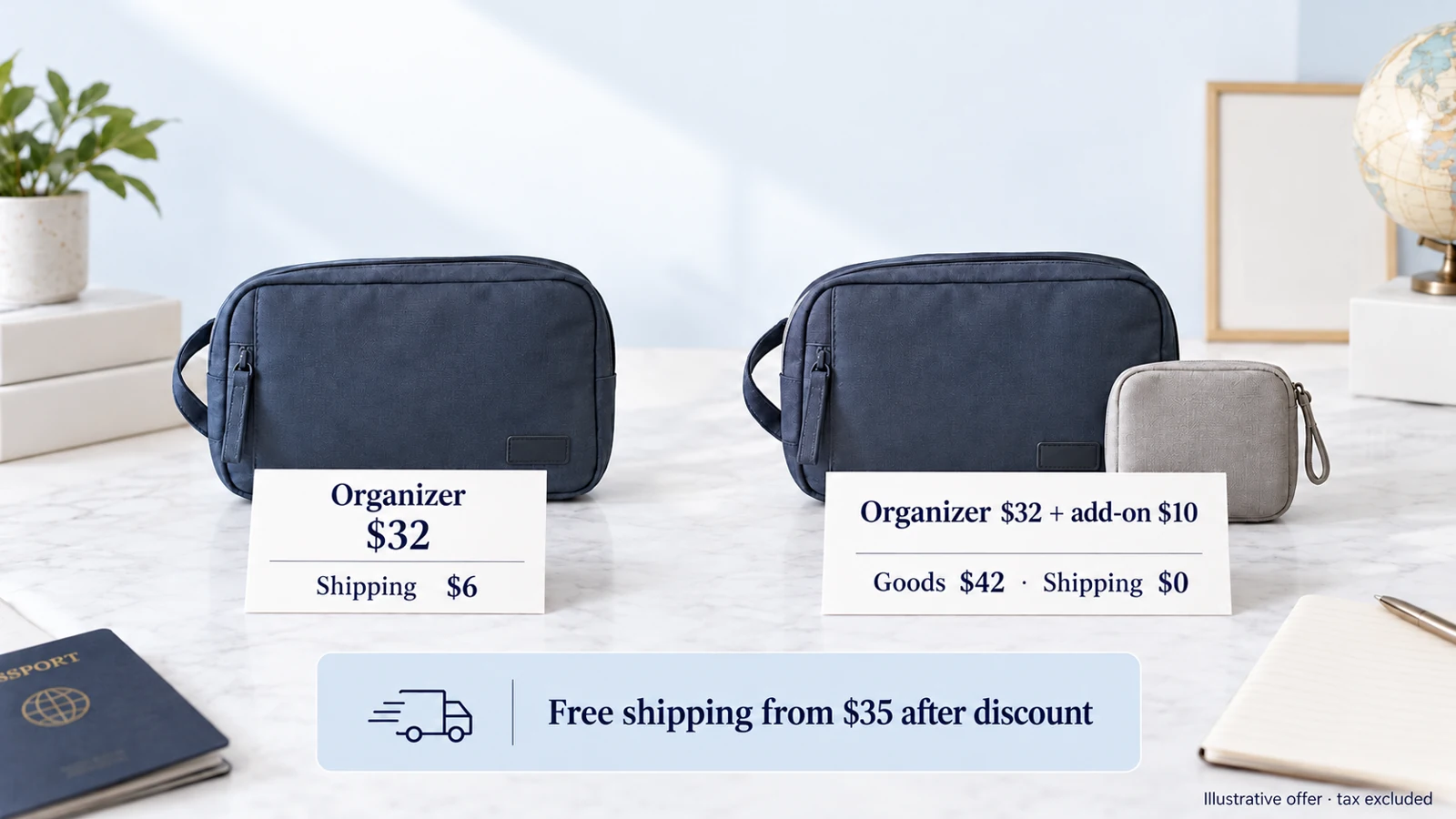
For the mixed basket, the expected pre-tax payment is $42. If the add-on also receives 20% off, the eligibility is wrong. If the single organizer gets free shipping, the actual rate does not match the assumed $35 discounted threshold.
Add a second product/order code and check that the offers do not stack. Do not assume the code typed last wins. Also inspect any restricted customer, destination and last available variant.
These are expected results to test in your own store. Compare the actual checkout with them before payment; use a separate controlled order when you need to test the supplier handoff. Repair an unexpected discount or rate before sending more visitors into it.
05
Turn the tested offer into a useful campaign
Start with the people most likely to understand the product: an existing permission-based email list or an audience you already know. Shopify’s BFCM checklist provides wider campaign preparation; the supplier and checkout answers belong beside the creative work.
For the same organizer offer, an announcement could say:
Subject: 20% off selected travel organizers with BLACK20
Keep cables and small essentials together. Use BLACK20 on the selected $40 organizer to pay $32 before delivery and any tax. The $10 add-on is excluded. Free shipping starts at $35 of discounted merchandise for eligible destinations; otherwise the quoted delivery charge applies. See the product page for dispatch information and the confirmed offer end time.
Replace the destination and end-time wording with the actual saved settings before sending. Show the organizer being used rather than a clip of a different supplier version. A useful short video demonstrates capacity, closure and contents, then states the saving.
Plan three moments: the opening announcement, a reminder tied to the real deadline, and the end of the offer. When the sale ends, remove or update the banners, codes and scheduled messages. A deadline that keeps restarting undermines the offer.
If you have no useful audience yet, a larger percentage discount does not create product demand by itself. Test whether the product and message attract the right buyers before expanding the spend.
06
Watch orders and delivery while the promotion runs
Read the sales numbers alongside the fulfillment queue. A low advertising cost is less useful if paid orders are waiting for an unresolved purchase or packing slot.
Track the same operating facts through the sale:
- Paid customer orders versus accepted supplier purchases.
- Remaining allocated variants and any rejected lines.
- Orders waiting for preparation or collection.
- Acquisition cost against the contribution under the shipping policy actually used.
If the queue grows beyond the supported promise, reduce or pause the affected offer and resolve accepted orders. Give buyers an item-specific update: what is ready, what is waiting and when they will hear next. A created label is not a carrier collection event.
For US online merchandise orders within its scope, the FTC’s shipping-promise guidance explains reasonable representations and delay/refund duties. Changing a banner does not resolve an earlier order accepted under an inaccurate promise.
If you need a second China-side fulfillment proposal, send AIDrop Agent the eligible products, expected order pattern and destinations. Ask for supported preparation, packing and route costs before offering a dispatch commitment.
07
Black Friday dropshipping questions
Is it too late to add a new product just before the sale?
Use the actual preparation needed. If the sample, cost or route is unresolved, promote a product already ready rather than letting the date decide quality.
Should the code apply to the whole store?
Only if the cost, supply and settings support that range. Selected products make it easier to control the offer and explain exclusions.
Does free shipping always improve the sale?
It changes both the buying offer and the order economics. Compare the customer’s total and your contribution. In the worked example, collecting $6 delivery changes the remainder from $4.74 to $10.56 and also reduces the buyer’s delivered saving.
What should happen when a promoted variant sells out?
Stop the unsupported sale or use an agreed alternative with accurate customer information. Do not silently replace the variant or keep the old delivery claim while waiting for new supply.
No campaign or supplier capacity was tested for this article. The figures and checkout cases are worked examples to apply to an actual offer.
Dropshipping Marketing: A Plan from First Visit to Repeat Order
Plan dropshipping acquisition, product-page conversion and repeat sales around realistic margins. Compare channels and measure costs and

Dropshipping SEO: Build Search Pages Customers Can Trust
A practical SEO plan for dropshipping stores: map searches to the right pages, verify supplier claims, link

Dropshipping Customer Retention: Earn the Next Order After the First Delivery
A practical retention plan for dropshipping stores: meet the first-order promise, choose a relevant follow-up, and measure
